Fort Worth Basketball Training – Trainers, Camps & Teams
Fort Worth’s basketball landscape spans 350+ square miles from Alliance to Southside. This page helps families understand Fort Worth’s unique geography, season timing, and decision frameworks — not prescribe solutions.
Fort Worth Population
Square Miles
Major Districts
NCAA D1 Program
Why BasketballTrainer.com Created This Fort Worth Resource
 Fort Worth is Texas’s 11th-largest city and just surpassed 1 million residents in 2024. That growth means hundreds of basketball training options — from North Fort Worth’s Alliance area to TCU’s campus to Historic Southside. I have had the good fortune to stay in Fort Worth before and teach a camp there. Beautiful neighborhoods, old mansions and some friendly people. Fort Worth offers lot of basketball trainers, camps and teams as choices, and we aim to help you find some great info for your choices.
This page exists to provide context, not direction. We help families understand Fort Worth’s geography, seasonal patterns, and what questions to ask trainers — rather than telling you who to hire. The best trainer for a Texas Basketball family in Alliance might not work for someone in Tanglewood, and vice versa. Geography, commute, and family logistics matter as much as coaching credentials.
Our Approach: Context, Not Direction
We don’t rank trainers or camps as “best” — we help you understand what makes different programs right for different needs. The best trainer for one family might not fit another’s goals, budget, commute tolerance, or learning style. This page provides frameworks for decision-making, not prescriptive recommendations.
Learn more about how BasketballTrainer.com works and read our editorial standards.
Understanding Fort Worth’s Basketball Geography
Fort Worth’s 350+ square miles create distinct basketball ecosystems. Where you live significantly impacts which training options make sense for your family. A 15-minute drive from Alliance feels different than a 35-minute cross-town commute during rush hour.
North Fort Worth / Alliance
What to Know: Highest concentration of training facilities, newer development, strong youth sports infrastructure.
- Commute Reality: I-35W southbound 5-7pm = 25-30 minutes to Southside
- School Districts: Northwest ISD, Eagle Mountain-Saginaw ISD, portions of FWISD
- Basketball Culture: Suburban intensity, travel team heavy
Tanglewood / TCU Area
What to Know: Affluent neighborhoods, top-rated schools (Tanglewood Elementary #1 in FWISD), central location.
- Commute Reality: 15-20 minutes to most Fort Worth areas
- School Pipeline: Tanglewood Elementary → McLean Middle → Paschal High School
- Basketball Culture: Competitive academics + competitive athletics
West 7th / Cultural District
What to Know: Urban, trendy, walkable, higher price points for training options.
- Commute Reality: 10 minutes to downtown, easy access to major routes
- Demographics: Young professionals, smaller families, boutique programs
- Basketball Culture: Skills-focused private training
Historic Southside / Near Southside
What to Know: Revitalizing neighborhoods, diverse, strong community basketball tradition.
- Commute Reality: Close to Medical District, 10-15 min to downtown
- Basketball Legacy: Home to Dunbar High School (Robert Hughes, winningest HS coach in US history)
- Basketball Culture: Grassroots programs, community courts, authentic game
The Commute Reality Check
If a trainer or gym is 30 minutes from your home, that’s 2 hours of driving per practice. Over a 6-month season, that’s 80+ hours in the car. Geography isn’t a trivial factor — it’s often the deciding factor between sustainable commitment and burnout. Many families choose a “good enough” trainer 10 minutes away over an “excellent” trainer 35 minutes away, and that’s often the right choice.
Fort Worth Basketball Season: What to Expect
Understanding when different basketball programs run in Fort Worth helps families plan without panic. This calendar shows typical timing — not deadlines you must meet.
High School Season (UIL)
Typical Timeline: First practices mid-October, games begin early November, playoffs through February, state tournament late February/early March.
What This Means: Your child’s school season is their primary commitment October through March (if they make playoffs). Everything else competes for time and energy during these months.
AAU / Select Basketball Season
Here’s What Surprises Families: AAU tryouts often happen in February and early March — while high school season is still happening. Teams form quickly because they want rosters set before spring tournaments begin.
Typical Timeline:
- February-March: Tryouts (yes, during school season)
- March-April: Early tournaments begin (immediately after school season ends)
- April-June: Spring tournament season
- June-August: Peak summer tournament season (teams often travel to Dallas, Houston, regional showcases)
- September: Fall ball wraps up, many teams done until next year’s tryouts
Basketball Camps
Typical Timeline:
- May-June: Early summer camps start
- June-July: Peak camp season across Fort Worth
- July-August: Final summer opportunities before fall training
Fort Worth Camp Landscape: TCU hosts camps on campus, various private trainers run summer programs, community centers offer affordable options. Camp costs range from $150-$400/week depending on facility and coaching credentials.
Year-Round Private Training
September-October: Fall training season — private trainers are typically busiest preparing players for school tryouts. This is when “I need to make the team” urgency peaks.
March-August: The overlap season — AAU practices, tournaments, and camps all happening simultaneously. This is when families feel most stretched.
Anytime: Private training is available year-round, especially in North Fort Worth, Tanglewood, and West 7th areas.
Planning Timeline, Not Pressure Timeline
This calendar shows when programs typically run in Fort Worth — not deadlines you must meet. Some families train year-round. Others focus only on school season. Some skip AAU entirely. The goal is understanding what exists and when, so you can make choices that fit your family’s goals, budget, and capacity. There’s no single “right” path through youth basketball.
The Fort Worth Reality: With UIL school season, AAU tournaments, and summer camps all available, basketball can fill the calendar year-round. Many families find their rhythm by choosing priorities — some focus on school team plus private training, others on school team plus AAU, while some families engage with all three at varying levels of intensity throughout the year.
Fort Worth’s Basketball Culture & Heritage
Fort Worth’s basketball identity blends Western heritage with urban intensity, TCU’s D1 presence with legendary high school programs. Understanding this context helps families navigate training options.
The Dunbar Legacy
Any discussion of Fort Worth basketball starts with Dunbar High School and Coach Robert Hughes — the winningest high school basketball coach in U.S. history with 1,333 career victories. Hughes coached at Dunbar from 1973 to 2005, building a program that won three state championships (1993, 2003, 2006) and produced countless college players.
Dunbar’s girls program also won two state titles (2005, 2007). This tradition means Fort Worth has deep basketball roots in its Historic Southside community — real grassroots basketball culture, not just suburban development programs.
The Paschal-Arlington Heights Rivalry
Paschal High School and Arlington Heights High School maintain one of Texas’s oldest and most intense high school rivalries, dating back decades. Both schools consistently field competitive basketball programs. Paschal feeds from Tanglewood Elementary (the #1-ranked elementary in FWISD) and McLean Middle School — creating a strong academic-athletic pipeline.
TCU’s Presence
Texas Christian University brings NCAA Division I basketball to Fort Worth. The Horned Frogs compete in the Big 12 Conference at Ed & Rae Schollmaier Arena. TCU’s presence means:
- High-level basketball visible to Fort Worth youth
- College camps and clinics on TCU’s campus
- Former TCU players sometimes coach local programs
- A tangible local example of college basketball
TCU basketball’s 2017 NIT Championship and recent NCAA tournament appearances keep college basketball culturally relevant in Fort Worth.
The Fort Worth Approach
Fort Worth basketball culture differs slightly from Dallas’s intensity. Fort Worth maintains more small-town accessibility within a big city — trainers are often more personally connected to families, programs feel less corporate, community courts still matter. This isn’t better or worse than Dallas’s approach, just different. Families moving from Dallas sometimes find Fort Worth refreshingly grounded. Families moving from smaller Texas towns sometimes find Fort Worth surprisingly intense.
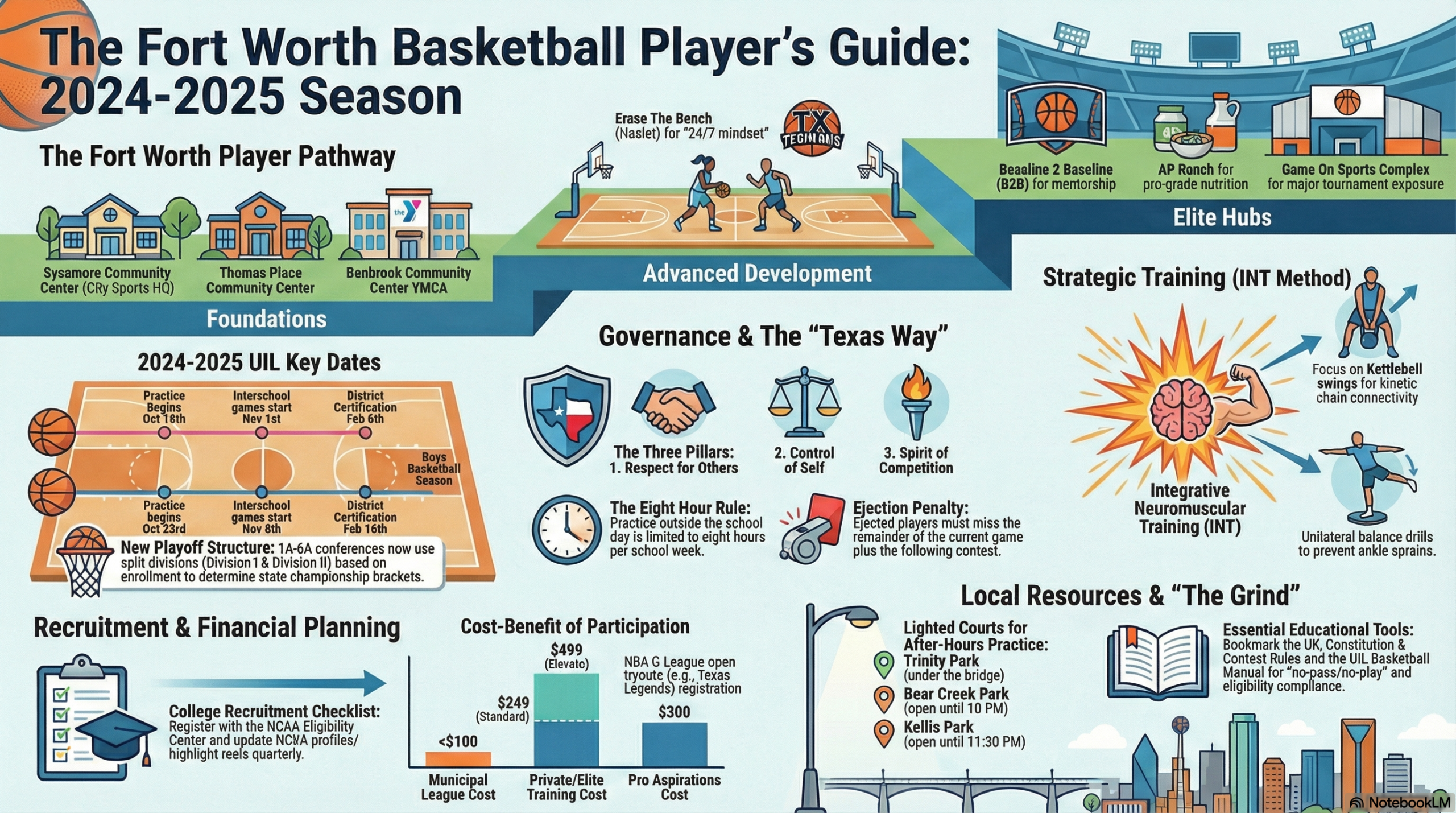
Evaluating Basketball Training Options in Fort Worth
We provide evaluation frameworks, not recommendations. These questions help you assess trainers, camps, and teams based on what matters for YOUR family.

Questions to Ask Private Trainers
How many players do you work with at my child’s age and skill level?
Why this matters: A trainer working mostly with high school varsity might not be ideal for your 4th grader, even if they’re excellent at what they do.
What does measurable progress look like in 3 months?
Why this matters: Vague promises of “improvement” mean nothing. “30% better free throw percentage” or “can complete this specific drill” = clarity.
How do you handle scheduling conflicts with school teams?
Why this matters: November through March, school season is your priority. Trainers who understand this make family life sustainable.
What’s your approach: skill development or showcase prep?
Why this matters: Some trainers focus on fundamentals, others on highlight-reel moves. Neither is wrong, but they’re different goals.
What is your maximum group size?
Why this matters: “Small group training” with 12 kids is not small. 4-6 players = real individual attention.
Questions to Ask About Camps
What’s the coach-to-player ratio?
Why this matters: 1 coach per 20 kids = babysitting. 1 coach per 8 kids = actual instruction.
Is this skills development or competition-focused?
Why this matters: Camps emphasizing games teach different lessons than camps emphasizing drills. Both have value, but know what you’re buying.
What age range will be in my child’s group?
Why this matters: Mixing 3rd-8th graders creates limited value for both ends of that spectrum.
What’s included in the cost?
Why this matters: Some camps include lunch and a t-shirt, others are just instruction. Total cost varies.
Questions to Ask About AAU/Select Teams
How many tournaments per month during peak season?
Why this matters: Some teams play 2-3 tournaments monthly April-July. That’s 6-9 weekends. Plan accordingly.
What’s the total annual cost including travel?
Why this matters: Team fees ($1,500-$4,000) plus hotels, gas, food for tournaments = real cost often doubles.
How do you handle playing time decisions?
Why this matters: “Everyone plays equal” and “best players play more” are both valid philosophies, but very different experiences for your child.
What’s your practice schedule during school season?
Why this matters: AAU practice Tuesday/Thursday while school team practices Monday/Wednesday/Friday = exhausted kid by Saturday.
Fort Worth Pricing Reality
Private Training: $80-$125 per hour for individual sessions, $150-$300/month for small group training (2-4 sessions/week)
Summer Camps: $150-$400 per week, half-day vs full-day significant cost difference
AAU Teams: $1,500-$4,000 annual team fees, plus expect $2,000-$5,000 in travel costs for competitive teams
Investment vs. Outcome Reality
More money doesn’t guarantee better results. The $300/month trainer might be perfect for your 6th grader. The $80/month community program might provide everything your 4th grader needs. What matters is fit — trainer’s style matching your child’s learning needs, schedule working with your family’s life, cost being sustainable for however long you’ll need it. Basketball development happens over years, not weeks. Affordability and sustainability matter more than premium pricing.
Free Fort Worth Basketball Training Evaluation Guide
Download our comprehensive guide with Fort Worth-specific considerations, red flags to watch for, and questions to ask before committing to any program.
Fort Worth Basketball Trainers
These Fort Worth trainers work with players across skill levels. Each has their own approach and specialty — use the evaluation questions from earlier on this page when reaching out.
TX Gym Rats Basketball Training
Based in North Fort Worth, TX Gym Rats specializes in transitioning recreational players to competitive AAU-level basketball. Small group training (max 6 players) focuses on basketball IQ and reading defenses, not just ball-handling moves. Works primarily with 5th-9th graders.
Fort Worth Elite Basketball
Fort Worth Elite runs both individual training sessions and structured group classes for K-9th grade players. Known for fundamental skill development and creating clear pathways from camps to team programs. Multiple locations across Fort Worth including Southside facility.
Courtside 360 Training
Courtside 360 focuses on game-situation training rather than isolated drills. Works with 3rd-12th graders emphasizing decision-making under pressure. Training sessions incorporate video review and game film study. West 7th area location.
Championship Basketball Academy
Championship Basketball Academy offers position-specific training with former college players as coaches. Individual and small group sessions available. Strong track record with Fort Worth ISD high school players, particularly Paschal and Arlington Heights pipelines. Alliance area facility.
Elite Guard Training
Specializes exclusively in guard development — ball-handling, shooting mechanics, and pick-and-roll reads. Works primarily with middle school and high school guards preparing for varsity tryouts and college recruitment. Tanglewood area, by appointment only.
Fort Worth Basketball Camps
Fort Worth basketball camps run primarily during summer months (June-August) with some spring break options. Most camps are week-long programs.
Fort Worth Elite Summer Basketball Camp
Week-long day camps for K-9th grade players running throughout June and July. Focus on fundamentals with age-appropriate instruction groups. Half-day and full-day options available. Many Fort Worth Elite campers transition into their year-round training programs. Multiple Fort Worth locations.
TCU Horned Frogs Basketball Camps
Hosted on the TCU campus, these camps provide instruction from TCU coaching staff and current players. Available for various age groups and skill levels, including team camps and position-specific sessions. Takes place at Ed & Rae Schollmaier Arena. Typically runs multiple sessions June through early August.
Championship Skills Basketball Camp
Intensive skills development camp for serious players grades 3-12. Smaller camp size (max 60 players) ensures individual attention. Includes shooting mechanics analysis, ball-handling progressions, and competitive play situations. Alliance area, typically runs 2-3 one-week sessions in July.
Fort Worth Select Basketball Teams
Fort Worth AAU and select basketball teams compete in regional and national tournaments primarily March through August. Tryouts typically occur in February-March.
Boys Teams
Texas Mayhem Basketball
Established AAU program with teams from 8U through 17U. Competes in regional and national tournaments including Nike EYBL circuit at higher age groups. Based in North Fort Worth with multiple practice locations. Known for strong coaching staff and college placement track record.
Fort Worth Flight Elite
Competitive select basketball program focusing on player development alongside tournament play. Teams from 10U through 17U. Emphasizes fundamentals and team basketball. Practices in Alliance area. Competes primarily in Texas regional circuit with select national tournaments.
DFW Hoops Academy
Year-round basketball organization offering both developmental and competitive team options. Teams available for ages 9-17. Known for transparent cost structure and parent communication. Practices across multiple Fort Worth locations. Competes in AAU and Adidas circuits.
Girls Teams
Texas Fury Girls Basketball
Premier girls AAU program with teams 10U through 17U. Strong emphasis on college recruitment exposure at 15U and up. Competes in Nike and Under Armour circuits. Multiple Fort Worth ISD and suburban school district players. Practices in Southside Fort Worth facility.
Fort Worth Lady Flight
Sister program to Fort Worth Flight Elite boys, offering competitive girls basketball from 10U through 17U. Balance between skill development and tournament success. Competes in regional Texas tournaments and select national events. Alliance area practices.
Cowtown Elite Girls Basketball
Fort Worth-based girls program emphasizing fundamentals and team concepts. Teams for ages 11-17. Lower tournament frequency than some programs, focusing on quality competition over quantity. Good option for families wanting AAU experience without overwhelming travel schedule. West Fort Worth practices.
How to Use These Listings
These are Fort Worth trainers, camps, and teams that families in the area work with. We don’t rank them as “best” or endorse specific programs. Use the evaluation questions earlier on this page when contacting any of these options. The right fit depends on your child’s age, skill level, goals, your family’s schedule, and your budget. Contact 2-3 options before committing.
Fort Worth High School Basketball
Fort Worth Independent School District (FWISD) and surrounding suburban districts offer competitive high school basketball programs:
- R.L. Paschal High School (oldest FWISD school, feeds from Tanglewood Elementary)
- Arlington Heights High School (historic Paschal rival)
- Dunbar High School (legendary program under Coach Robert Hughes)
- Trimble Tech, North Side, Polytechnic, and other FWISD programs
- Suburban schools in Northwest ISD, Eagle Mountain-Saginaw ISD, and surrounding districts
School team tryouts typically occur in October. Most Fort Worth high schools field both varsity and JV teams for boys and girls basketball.
Getting Started with Basketball Training in Fort Worth
If you’re new to Fort Worth basketball or just starting your child’s training journey, here’s a practical path forward:
Step 1: Define Your Goals
Are you trying to help your child make their school team? Prepare for AAU competition? Just develop fundamental skills? Learn the game? Your goal determines which training option makes sense. There’s no single “right” goal — clarity helps you evaluate options.
Step 2: Map Your Geography
Which Fort Worth areas work for your commute? A trainer 15 minutes away who you’ll visit consistently beats a trainer 40 minutes away who you’ll eventually quit due to logistics. Be honest about what’s sustainable for your family.
Step 3: Contact 2-3 Options
Use the evaluation questions from this page. Review the trainer, camp, and team profiles above. Reach out to 2-3 that match your geography and goals. Ask about their approach, experience with your child’s age group, schedules, and costs. Most offer trial sessions.
Step 4: Trust Your Gut
After conversations and trial sessions, trust your instincts. Does your child seem excited or dreading practice? Does the trainer communicate clearly with you? Do logistics actually work? Sometimes the “less credentialed” option is the right fit because your child connects with that coach.
Free Basketball Training Evaluation Guide
Download our comprehensive guide with specific questions to ask trainers, camps, and teams before committing.