Chicago Basketball Training – Trainers, Camps & Teams
Chicago basketball training spans 234 square miles across three distinct Sides. This page helps families understand the 773’s unique geography, deep basketball heritage, and decision frameworks — not prescribe solutions.
Basketball Trainers
Basketball Camps
Select Teams
Parks & Fieldhouses
⚡ Looking for Basketball Training in Chicago?
Skip the background — jump straight to what you need:
Why This Chicago Basketball Resource Exists
Chicago’s 2.7 million residents spread across three distinct Sides create hundreds of basketball training options from Rogers Park to Morgan Park. This page helps families understand Chicago’s unique geography, neighborhood basketball culture, and decision frameworks — not prescribe solutions. The right trainer on the South Side might not work for a North Side family, and the AAU team that’s perfect for a Hyde Park player might be the wrong fit for a kid in Logan Square.
Our Approach: Context, Not Direction
We don’t rank trainers or camps as “best” — we help you understand what makes different programs right for different needs. The best fit depends on your child’s age, skill level, goals, your family’s schedule, budget, and where you live across Chicago’s three Sides. This page provides evaluation frameworks and local context, not prescriptive recommendations. Learn how BasketballTrainer.com works • Read our editorial standards
Understanding Chicago’s Basketball Geography
Chicago has no East Side — Lake Michigan fills that role. The city divides into three Sides (North, South, West) surrounding the Loop downtown, and every Chicagoan carries a deep sense of Side identity. This isn’t just cultural — it’s logistical. A training program on the opposite Side often means 45-60 minutes of city traffic. The CTA helps, but not every family travels by train. Geography matters here as much as it does anywhere.
North Side
Key Areas: Lincoln Park, Lakeview, Rogers Park, Logan Square, Wicker Park, Uptown, Bucktown
- Commute to South Side: 45-60 minutes during rush hour on Dan Ryan/Red Line
- College Access: DePaul University, Northwestern (Evanston) camps nearby
- Basketball Culture: Growing private training scene; neighborhood park courts active year-round
- Transit: Red, Brown, Purple L lines; strong CTA access
South Side
Key Areas: Hyde Park, Bronzeville, Chatham, South Shore, Kenwood, Englewood, Beverly, Morgan Park
- Basketball Legacy: Deepest basketball heritage in the city — Simeon, Marshall, Kenwood, Morgan Park
- NBA Pipeline: Home of Derrick Rose (Englewood/Simeon), Anthony Davis (Perspectives), Dwyane Wade’s roots
- Transit: Red, Green, Orange L lines; Dan Ryan (I-90/94) for driving
- Park Access: Chicago Park District South Region — 200 ball diamonds, strong fieldhouse network
West Side
Key Areas: Austin, Humboldt Park, Garfield Park, Little Village, Pilsen, Near West Side, United Center area
- Historic Basketball: Marshall High School (11 city boys titles, 23 girls titles under Coach Gaters)
- NBA Connection: Westinghouse produced Mark Aguirre, Eddie Johnson; Crane HS produced Tony Allen
- United Center: Chicago Bulls play here — world-class facility nearby
- Transit: Blue, Green, Pink L lines; I-290 (Eisenhower) for cross-town access
Northwest & Southwest Sides
Key Areas: Jefferson Park, Portage Park, Irving Park (NW); Back of the Yards, Bridgeport, Clearing (SW)
- Character: Working-class residential neighborhoods, strong community parks, bungalow belt
- Suburban Access: Close to Oak Park, Berwyn, suburbs where many programs train
- Transit: Blue Line (NW), Orange/Pink Lines (SW); Midway Airport nearby (SW)
- Programs: Sharks Basketball Academy (Melrose Park/Elmwood Park) serves this area well
The “Same Side” Rule for Chicago Families
In a city where Rogers Park (Far North) to Morgan Park (Far South) can be 60+ minutes by car during rush hour, “Same Side” isn’t just a preference — it’s often the difference between a sustainable commitment and a burnout. The CTA Red Line runs the full North-South spine and genuinely helps, but you’re still talking 45-minute train rides at both ends of the city.
Many Chicago families who have lived through this: a program 20 minutes away that you’ll attend consistently almost always beats a program 50 minutes away that you’ll start skipping by November. That’s not a knock on the far program — it’s math. Three sessions per week times 50 minutes each way times the school year equals an enormous time burden. Be honest with yourself about what’s actually sustainable given your Side of the city.
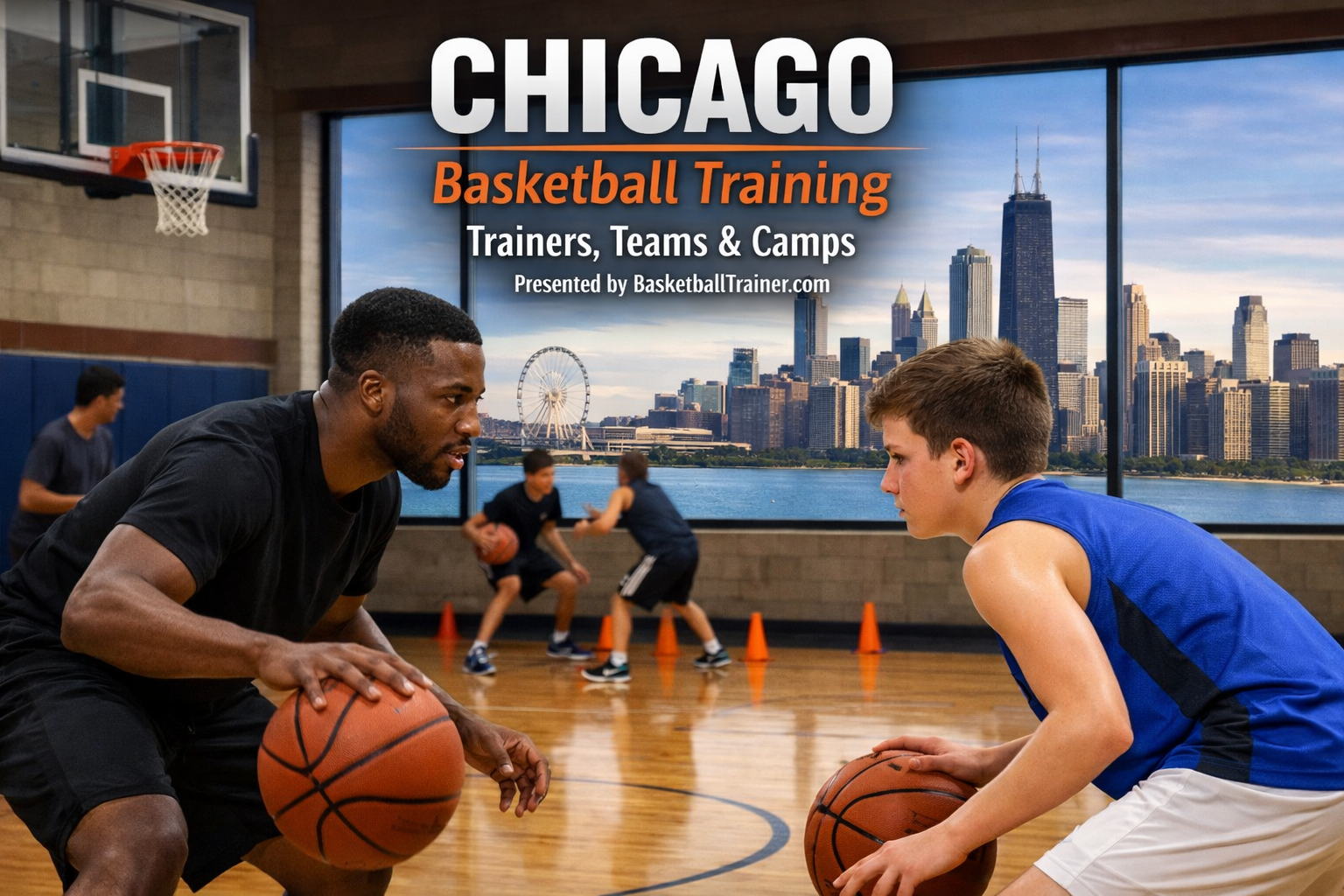
Chicago Basketball Trainers
These Chicago basketball trainers work with players across skill levels and neighborhoods. Each brings a distinct philosophy and approach. Use the evaluation questions later on this page when reaching out to any program.
M14Hoops Chicagoland
M14Hoops has been operating in the Chicagoland area for 14+ years and has grown into one of the largest youth basketball development organizations in Illinois, serving over 5,000 players annually with a staff of 40+. The organization offers private instruction, group training, summer camps, and operates AAU teams on the NY2LA Circuit (boys) and Adidas 3SSB Circuit (girls) — two nationally recognized competitive platforms. Their claim that approximately 97% of players who train with them make their high school team reflects a development-first approach rather than a showcase-heavy one. Private instruction pricing varies by coach and session format; group training runs $150-300/month. M14 serves players in grades 3-12 at multiple Chicagoland locations, making this a meaningful option for families across the North Side and suburbs who want systematic, year-round development under an established organization with verifiable infrastructure.
Pro Skills Basketball (PSB) Chicago
PSB Chicago’s director Shane Kenney brings serious coaching credentials: he’s currently the head sophomore coach and varsity assistant at Saint Ignatius College Prep, and his middle school head coaching record of 56-14 over four seasons included a Chicago Catholic Youth League championship. This is someone who actually coaches in Chicago’s competitive landscape, not just someone who trains kids for the summer. PSB is also a JRNBA Flagship Organization, offering both competitive club teams and a Player Development Academy (PDA) for players who don’t make a team — the “no one gets left behind” philosophy stands out. Seasonal team fees run approximately $800-1,500; individual training clinics range from $50-80/session. Best for players grades 3-12 wanting a clear pathway from development to competitive play under coaches connected to Chicago’s high school scene.
Athletes on the Rise (AOTR)
Athletes on the Rise positions itself at the serious competitive end of the Chicago basketball training spectrum. The program is designed for players ages 10 and up who want to compete at the highest levels — from youth through elite — and every athlete goes through a customized, progressive assessment before training begins. Each one-hour session is built around a specific aspect of the athlete’s personalized development plan rather than generic group drills. Life skills are explicitly integrated alongside basketball, and players are expected to put in work between sessions. Training rates fall in the $75-125/session range typical for elite Chicago basketball coaching. This program works best for players who already have solid fundamentals and want to push toward varsity, college prep, or beyond — not the right entry point for a beginner, but potentially the right tool for a motivated 8th-grader preparing for a high school tryout.
Fit City Kids Basketball
Fit City Kids Basketball has built one of the more family-friendly models in the Chicago market: month-to-month classes with no season-long commitment required, the ability to join at any time, and programs that start genuinely at the beginner level. The “Lil Dribblers” track teaches basic dribbling, passing, shooting, and game rules to young players who are truly starting from scratch, while the advanced track moves into position-specific techniques and help-side defense. Additionally, Fit City runs its own recreational basketball league, holiday break camps (Thanksgiving, winter break), and offers one-on-one private sessions by request. Monthly class pricing runs approximately $50-100 depending on program level, making this one of the more affordable private instruction options in Chicago. For families with younger children (roughly ages 5-10) looking for a low-pressure introduction to basketball without annual commitments, Fit City Kids stands out as a genuinely different model.
Athletes Untapped Chicago
Athletes Untapped operates as a vetted coaching marketplace rather than a single organization, connecting Chicago families with independent private coaches who specialize in basketball instruction. With 8+ verified coaches currently active in the Chicago area, the platform offers sessions from $30-75 per lesson depending on coach, making this one of the most flexible and affordable private training entry points in the market. Coaches specialize in areas including shooting mechanics, ball handling, defense, and overall game IQ development for both youth and adult players. Flexible scheduling allows sessions to be set around school, work, and other commitments — a meaningful advantage in a city where most people live busy lives. For families who want to test private instruction before committing to a larger program, Athletes Untapped allows single-session bookings with a free lesson added after the first paid session. Website: athletesuntapped.com/browse/basketball/illinois/chicago-il/
Chicago Basketball Camps
Chicago basketball camps range from D1 university experiences at DePaul and Northwestern to affordable Chicago Park District programs available at neighborhood parks across all three Sides. Most camps run June through August, with some holiday options in fall and winter.
DePaul University Blue Demons Basketball Camps
DePaul’s basketball camps give players access to McGrath-Phillips Arena — a genuine Division I facility in the heart of the city near the Loop. Instruction comes from DePaul Men’s Basketball players and coaching staff, which means players learn from people who compete at the Big East level, not just experienced coaches. Full Day camps (grades 3-10) run approximately $395/week; Half Day camps (ages 5-rising 6th grade) run approximately $250/week. The DePaul camp is genuinely a high-quality experience, not just a marketing opportunity, and the facility itself is a draw — there’s something different about working on your shot in an arena you’ve watched on television. For North Side and downtown Chicago families looking for a structured summer camp option with real D1 flavor, this belongs on the shortlist. Visit depaulathleticscamps.com for current session information.
Northwestern Chris Collins Basketball Camp
Northwestern University’s camp in Evanston (15 minutes from the Far North Side) offers a Big Ten camp experience within striking distance for Chicago families who don’t want to travel to downstate programs. Coach Collins and the Northwestern coaching staff emphasize both fundamental basketball skills and life lessons around sportsmanship and team play. Daily structure alternates between station-based skill work (ball handling, passing, shooting, defense) and game application. Campers are grouped by age and ability for fair competition throughout. This camp works best for players whose families are interested in a Big Ten school connection or who live on the North Side and can make the Evanston run without cross-town driving. Pricing is comparable to other D1 university camps — typically $350-450/week depending on session. Visit chriscollinsbasketballcamp.com for current offerings.
Chicago Park District Basketball Camps
The Chicago Park District runs youth basketball programs and summer day camps at parks across all three Sides of the city — and the pricing is consistently the most accessible option in the market at $60-120 per week for summer programs. This is the entry point for thousands of Chicago kids every year, and there’s nothing wrong with that — the Park District has professional staff, well-run programs, and the single biggest advantage in Chicago youth sports: you can almost certainly find a location within 15 minutes of where you live. The CPD also runs Windy City Hoops, a free year-round teen basketball league at 10+ parks citywide, with games twice per week culminating in playoffs and a city championship. For a family testing whether a child is interested in basketball, or for a beginner who doesn’t need elite instruction yet, the Park District is the most logical starting point anywhere in the city. Registration at chicagoparkdistrict.com.
M14Hoops Skillz Camps
M14Hoops offers dedicated summer Skillz Camps for boys and girls in grades 3-8, separate from their year-round academy programming. M14 describes these as “the best Skillz Camps in Illinois” — and given their 14-year track record and volume, there’s credibility behind that claim. Week-long sessions focus on basketball fundamentals in a structured camp format, and the camps benefit from M14’s established coaching staff who also run their academy programs year-round. Pricing typically runs $200-350/week depending on session and location. For families already enrolled in M14’s regular programs, the summer camps offer continuity; for families new to M14, the camps serve as a lower-commitment entry point to evaluate the organization before committing to a full academy or team season. Visit chicagoland.m14hoops.com for current registration.
Breakthrough Basketball Chicago
Breakthrough Basketball operates a national network of 400+ camps annually, with multiple Chicago-area sessions available each summer. Their model emphasizes tight age and skill groupings (to avoid mixing first graders with fifth graders), structured fundamentals curriculum, and coach accountability standards — they track camper satisfaction ratings and remove lead instructors who fall below standards. Sessions for youth (ages 6-11) and older players (ages 8-18) run $200-300/week. The national infrastructure means consistency: a Breakthrough camp in Chicago will follow the same quality standards and curriculum as their camps in other cities. For Chicago families who have experienced Breakthrough elsewhere, the brand carries meaningful continuity. For new families, it’s a reliable known quantity with a verifiable quality process. Visit breakthroughbasketball.com for Chicago-area dates.
Chicago Select & AAU Basketball Teams
Chicago and the broader Chicagoland area support a highly competitive select basketball ecosystem. AAU and travel teams compete in circuits ranging from local Chicago-area tournaments to regional Midwest competition and national showcases. Travel typically includes tournaments in Indianapolis, Kansas City, Milwaukee, and nationally for top programs. Tryouts generally run February through April.
LVL Basketball (Lakers / Lady Lakers)
LVL Basketball has maintained a claim as a top Chicago travel program for over 10 years, serving players in grades 3-8 (youth) and 14U-17U (high school AAU). The structure makes LVL unusually accessible: each grade level fields multiple teams at different competitive tiers, meaning a player who doesn’t make the top team still has a meaningful home rather than getting cut entirely. LVL also runs the LBL Grammar School League — a competitive in-city league for public and private middle schools, giving players organized game experience between seasons. Year-round training and development programming supplements team competition. Annual fees typically run $1,500-2,500 depending on age group and team tier, with tournament travel (primarily Midwest) adding costs families should budget for separately. Visit lvlelitetravel.com for current tryout information.
ALL IN Athletics
ALL IN Athletics has placed 360+ athletes in college basketball since 2014 — that’s a trackable outcome, not a marketing promise. The program trains over 2,000 athletes annually and offers a genuine pathway from early development to college recruitment. For grades 2-5 specifically, the ALL IN Raiders program provides a lower-intensity entry point: local-only tournaments (within one hour), professional coaching, and top-tier gear without the heavy financial and time demands of the full competitive program. High school teams compete in both Local Seasons (fall, winter, spring, summer) and National/Regional circuits. Practice locations include Chicago, Deerfield, Mount Prospect, and Libertyville — primarily serving North Side city families and north suburban families. Annual fees range $1,500-3,000 depending on team tier, with national travel potentially adding significant additional costs for top teams. Visit aiathletics.com for current tryout schedules.
Chicago Cannons (Play Hard Hoops)
The Chicago Cannons operate as Play Hard Hoops’ high school travel program (15U, 16U, 17U), offering both AAU/Exposure teams and Local Travel teams. The exposure track competes in Prep Hoops events and the AND 1 Connect League Circuit as a premier program — meaningful for juniors and seniors chasing college looks. The local track runs an 8-week season with a more manageable commitment and lower cost. Practice locations rotate through Chicago facilities including Mount Carmel, Nettelhorst, OSM, Sport House, and Wolcott — giving families multiple options rather than forcing everyone to one facility. AAU/Exposure fees typically run $1,500-2,500 for a 10-week spring season; local teams are lower ($800-1,200 estimated). The program’s philosophy is transparent about playing time: it’s earned, not equal — but all players who attend will play in every game. That’s a reasonable middle ground for competitive-level travel basketball. Visit playhardhoops.com for tryout details.
Illinois Lady Lightning (Girls)
Founded in 2001, Illinois Lady Lightning is one of the premier girls-only basketball programs in the state. Youth teams (grades 3-8) compete in suburban Chicago leagues and local/regional tournaments. The high school program operates at a nationally elite level: Lady Lightning is one of only two Illinois programs invited into the Power 24 division of the Select 40 Circuit — the premier national girls AAU circuit featuring the top 40 clubs in the country. If your daughter is a serious high school player seeking college recruitment exposure at the highest level, Lady Lightning represents a legitimate pathway. Annual fees range $1,500-3,000 depending on age and team tier; national travel costs for high school teams can add significantly beyond base fees. For younger players (3rd-8th grade), the program offers competitive suburban league play without the national travel burden. Visit illinoisladylightning.com for tryout information.
Sharks Basketball Academy
Located in Melrose Park and Elmwood Park (just west of the Chicago city limits), Sharks Basketball Academy serves both city families on the West/Northwest Sides and western suburban players as a full-service basketball organization. Programs include house leagues, private/small group sessions, seasonal competitive travel teams, and developmental camps — making it a single destination for families who want multiple layers of involvement. Travel teams compete throughout the Midwest on a seasonal schedule. Annual fees for travel teams typically run $800-2,000. The organization serves players from kindergarten through 12th grade, and their multi-layered structure means players can grow within the organization rather than graduating out at a certain age. For West Side and Northwest Side Chicago families who want to avoid cross-city travel to North or South Side programs, Sharks provides meaningful geographic proximity. Visit sharksbasketballacademy.com for current programs.
Chicago High School Basketball
The Chicago Public League (CPL) runs one of the most storied high school basketball structures in the country. Over 70 CPS schools compete in an internal championship structure before advancing to the IHSA state tournament in Champaign. The Chicago Public League Championship Week at Credit Union 1 Arena draws thousands of fans annually — the 2000 championship at the United Center drew 20,002 attendees, a new state attendance record at the time. This is not a background detail. It shapes youth basketball culture across the entire city.
Legendary Programs (South Side)
- Simeon Career Academy — Chicago’s most celebrated recent program; 8 state championships; produced Derrick Rose, Jabari Parker, Anthony Davis, Kendrick Nunn; 4 consecutive state titles 2010-2013 under legendary coach Robert Smith
- Whitney Young Magnet High School — Multiple state titles; girls program won 4+ state championships; perennial city and state championship contender; annual Chicago Elite Classic showcase co-host
- Kenwood Academy — South Side powerhouse, regular CPL finals participant
- Morgan Park High School — 2017 Class 3A state championship
Historic Programs (West Side & City-Wide)
- Marshall High School — West Side; 11 boys city championships; 23 girls city championships under the legendary Coach Dorothy Gaters (830+ career wins, most in Illinois state history)
- Westinghouse High School — Produced Mark Aguirre (#1 pick 1981) and Eddie Johnson; dominant late 1970s program
- Curie High School — Regular CPL Finals participant; competitive South Side program
- Lane Tech — Larger North Side school with historically competitive program
Catholic & Private School Programs
- St. Ignatius College Prep — Competitive Catholic school program; PSB Chicago director Shane Kenney coaches here
- Mount Carmel High School — South Side Catholic school; historically strong program
- DePaul College Prep — North Side Catholic program; connected to DePaul University athletic culture
- Proviso East (Maywood suburb) — Most NBA players of any Illinois high school; produced Doc Rivers, Michael Finley, Shannon Brown and 10+ NBA players across six decades
CPS school team tryouts typically occur in October. Most schools field both varsity and JV teams, with larger schools adding sophomore and freshman teams. IHSA state tournament is held in Champaign, IL each March.
How to Use These Listings
These are Chicago-area trainers, camps, and teams that families in the 773 work with. We don’t rank them as “best” or endorse specific programs. Use the evaluation questions in the next section when contacting any of these options. The right fit depends on your child’s age, skill level, goals, your family’s schedule, your budget, and your Side of the city. Contact 2-3 options before committing to see which actually feels right — and always ask about pricing upfront. Most organizations are glad to be direct about costs.
Chicago Park District: The Foundation of Chicago Basketball
Before looking at private trainers, understand what Chicago’s Park District offers. With 580+ parks, hundreds of fieldhouses with gymnasiums, and programs across every neighborhood on every Side, the Chicago Park District represents the most accessible basketball infrastructure in any American city. This isn’t a fallback option — it’s where generations of Chicago basketball players have started, and many have gone all the way to the NBA after coming up through neighborhood parks.
Windy City Hoops: The Free Year-Round Teen League
FREE. Year-Round. Zero Cost to Play.
Windy City Hoops is the Chicago Park District’s signature teen basketball program — and it is completely free. Games run twice per week at participating parks citywide, with each season culminating in playoffs and a city championship. Registration is ongoing; sign up in-person at any participating park or complete the form online at chicagoparkdistrict.com/programs-memberships/windy-city-hoops/.
Participating Parks (representative list): Carver Park (Altgeld) — South Side, and 10+ locations across the city. Check the CPD website for the current full list of active sites near you.
Chicago Park District Fieldhouses: Hundreds of Gyms Citywide
What the Fieldhouse System Offers
The Chicago Park District’s fieldhouse system is unlike anything in most American cities. Hundreds of gymnasiums scattered across 77 community areas mean virtually every Chicago neighborhood has accessible court space within walking distance. Amenities vary by facility — some offer only a basic gym with hoops, while larger fieldhouses include fitness centers, multipurpose rooms, and auditoriums.
ComEd Recreation Center (Addams Park) — One of the most modern CPD facilities; offers Open Basketball programming (drop-in), fitness center, indoor track. Multiple sports and open play times available weekly. Note: follows a separate program schedule from standard CPD parks.
South Region Parks (South Side) — The South Region includes nearly 200 ball diamonds, 22 indoor pools, and major cultural centers including Marquette Park, South Shore Cultural Center, and Washington Park. Strong fieldhouse basketball infrastructure throughout Hyde Park, Kenwood, South Shore, and surrounding communities.
Neighborhood Fieldhouses (All Sides) — Every major Chicago neighborhood has a CPD fieldhouse. Lincoln Park, Humboldt Park, Jackson Park, Garfield Park, Logan Square, Portage Park, Beverly — the list runs to hundreds of locations. To find the nearest gym to your home, use the facility finder at chicagoparkdistrict.com/facilities/gymnasiums.
Youth Basketball Classes & Leagues
What a Typical CPD Basketball Program Costs
Youth Basketball Classes: $60-120 per season (8-12 week programs)
Summer Day Camps: $60-120/week; multiple sessions June-August at parks citywide
Windy City Hoops (Teen League): FREE — register at any participating park or online
Open Basketball (at select facilities like ComEd Rec Center): Drop-in or pre-registration through CPD website
Financial Assistance: CPD offers scholarship assistance for qualifying families, with priority for low-income households. Ask at your local park about available assistance before assuming a program is unaffordable.
How to Register for Chicago Park District Programs
Registration opens online at chicagoparkdistrict.com — typically in April for summer programs, with seasonal openings for fall, winter, and spring programs.
Online Registration Tips:
- Create a CPD account in advance at chicagoparkdistrict.com
- West of California Ave: registration opens one day before East of California Ave — check dates annually
- Popular programs fill quickly online; in-person registration available only if spots remain
- Update emergency contacts and child information before your registration time
The Park District is the most underused resource in Chicago youth basketball. Families who figure out the registration system early have consistent, affordable access to programs their neighbors are sleeping on.
CTA Access to Park District Facilities
One unique advantage of Chicago’s Park District vs every other city in this directory: CTA transit actually gets families to basketball programs. The L train system (Red, Blue, Green, Brown, Orange, Pink, Purple lines) combined with extensive bus routes means many Chicago families can send kids to Park District programs without a car.
North-South Corridor: Red Line runs from Howard (Far North) through the Loop to 95th/Dan Ryan (Far South) — directly serving dozens of parks and programs along the spine of the city.
West Side Access: Blue Line (O’Hare-Forest Park) and Green Line serve West Side neighborhoods including Humboldt Park, Garfield Park, and Austin. Pink Line covers significant portions of the Southwest Side. For families without a car, proximity to an L stop should factor into program selection as much as proximity to home.
Evaluating Basketball Training Options in Chicago
We provide evaluation frameworks, not recommendations. These questions help you assess trainers, camps, and teams based on what matters for YOUR family in Chicago.
Questions to Ask Private Trainers
Why this matters in Chicago: A trainer based on the South Side who trains at South Side facilities doesn’t easily serve a North Side family. This isn’t about quality — it’s about a 50-minute round trip every session becoming unsustainable by December.
Why this matters: Vague “you’ll improve” promises mean nothing. Specific benchmarks — free throw percentage, specific drill times, identified game-situation reads — signal real coaching, not casual ball-handling.
Why this matters in Chicago: In a city with this much basketball history, trainers who actually develop players have a track record worth asking about. Not names — general outcomes. “Three of my players made varsity this fall” is meaningful. Vague reputation isn’t.
Why this matters: Life happens. Understanding policies before paying protects your investment and tells you a lot about how the trainer runs their business.
Why this matters: A trainer who works mostly with high school varsity might not be the right fit for your 4th grader, regardless of credentials.
Questions to Ask About Select Teams
Why this matters in Chicago: Midwest regional tournaments in Indianapolis or Milwaukee are manageable. Programs that also travel to national events in Las Vegas, Orlando, or Virginia quickly add $1,500-3,000 per trip to the base team fee.
Why this matters: Programs advertising $1,500/season often become $3,500-5,000 when all-in costs are tallied. Reputable organizations will give you a clear total picture; the ones who won’t give you a straight answer are telling you something.
Why this matters: “Equal time” and “earned time” are both legitimate philosophies, but they create very different experiences. Know what you’re signing up for before your child has played three games and is frustrated.
Why this matters: CPS school coaches sometimes have strong opinions about AAU participation during school season. A select team that creates open conflict with your child’s school coach creates a harder problem than it solves.
Chicago Pricing Reality
Chicago Park District (leagues, classes): Free (Windy City Hoops) to $60-120/season or week — most accessible entry point in the city
Private Training: $30-125/session; group classes $50-100/month
Summer Camps: $60-120/week (CPD) to $250-450/week (D1 university programs)
AAU/Select Teams: $800-3,000/season in team fees, plus $1,500-5,000+ in travel for competitive programs with national schedules
Chicago’s Unique Advantage: Options at Every Level
Unlike smaller cities where families face a choice between “almost nothing” and “expensive AAU,” Chicago has legitimate pathways at every investment level. The Park District gives you a free competitive league. Programs like Fit City Kids give you accessible developmental classes month-to-month. Organizations like LVL and ALL IN give you serious travel team competition. And if your kid is truly elite, programs like Illinois Lady Lightning and Chicago Cannons offer national-level exposure. The question isn’t whether Chicago has the right option for your family — it does. The question is knowing what you actually need at this moment of your child’s development, and being honest about what your family can sustain financially and logistically.
Free Chicago Basketball Training Evaluation Guide
Download our comprehensive guide with Chicago-specific questions, red flags to watch for, and a framework for making the right call for your family.
Chicago Basketball Season: What to Expect
This calendar is meant to help Chicago families plan thoughtfully — not create urgency. Understanding when different programs run lets you make reasoned decisions rather than reactive ones.
CPS / High School Season (IHSA)
Typical Timeline: First practices in October, games begin early November, CPL Championship Week in late January/February at Credit Union 1 Arena, IHSA state tournament in Champaign in March.
What This Means: Your child’s school season is their primary basketball commitment October through March. Everything else competes for time and energy during these months — and Chicago school coaches often have opinions about outside basketball involvement.
AAU / Select Basketball Season
- February-April: Tryouts across most Chicago select programs; spring season teams finalize rosters
- March-May: Spring tournament season begins; Midwest regional competition (Indianapolis, Milwaukee, Kansas City)
- June-August: Peak summer AAU season; national showcases for elite programs
- September-November: Some programs offer fall seasons; others take a break before spring cycle restarts
Basketball Camps
- Spring Break: Some programs (LVL, Chicago Park District) run camps in March during CPS break
- June-July: Main camp season; DePaul, Northwestern, M14, Breakthrough, CPD summer camps all running
- August: Final summer camp sessions; some specialty programs offer late-summer skill focus
- Holiday Breaks: Thanksgiving camps (Fit City Kids and others), winter break programs
Year-Round Park District Programs
The Chicago Park District operates programs across all four seasons. Windy City Hoops runs year-round. Youth basketball classes run in fall, winter, and spring seasons. Summer camps run June-August. This means a family using the CPD as their primary basketball option can maintain consistent engagement every month of the year at very low cost.
Chicago’s Basketball Culture & Heritage
There’s a saying in basketball circles: the sport was born in Springfield, Massachusetts, but it was raised in Chicago. That’s not boosterism — it’s a reasonable claim with historical weight behind it. Chicago formed its first basketball league in 1893, barely a year after the game was invented. The city has been producing basketball at an elite level for 130 years.
The Neighborhood Identity
In Chicago, basketball identity is inseparable from neighborhood identity. You don’t just play basketball — you play for your Side, your school, your park. When Derrick Rose won MVP in 2011, it wasn’t just a moment for the Bulls or for the NBA. It was Englewood. It was Simeon. It was the South Side. The deep connection between geography and basketball culture is part of what makes Chicago’s basketball scene different from every other American city.
That culture has a tangible daily expression: Chicago’s neighborhood parks run some of the most competitive summer pickup basketball in the country. Before Derrick Rose was an NBA player, he was playing pickup at neighborhood parks and school courts in Englewood. That culture hasn’t changed. The parks are still competitive. The quality of play is still high. And for families entering the Chicago youth basketball world, understanding that your neighborhood’s park courts aren’t just casual recreation — they’re actual development environments — matters.
The Simeon Legacy
Simeon Career Academy’s run from 2010-2013 — four consecutive IHSA state championships — under coach Robert Smith stands as one of the most remarkable runs in Illinois high school basketball history. During that stretch, Simeon produced players who became lottery picks and rotation players in the NBA. The program became a national story, with national cable crews following players through their daily lives. Smith recently retired after a storied career, and his final season ended with a city championship — a perfect ending to a legendary coaching tenure.
What the Simeon story means for youth basketball families: it’s an example of what a program-first, development-first culture can produce. Simeon didn’t develop Derrick Rose and Jabari Parker with elite facilities — they developed them with elite coaching and demanding culture. The lesson transfers: programs with clear development philosophies and high standards can produce remarkable outcomes regardless of facility quality.
The Dorothy Gaters Standard
Marshall High School’s Coach Dorothy Gaters holds more wins than any other coach in Illinois basketball history — boys or girls — with over 830 career victories and 23 city championships for the girls program. In a city that produces NBA players, this is the standard by which Chicago basketball cultures measure longevity. Gaters built something at Marshall that was as much about discipline and character as it was about basketball results, and the girls program she built remains one of the most respected in the state.
The Chicago Public League Championship as Cultural Event
The CPL Championship Week is not just an athletic event — it’s a civic moment. When the championship was held at the United Center in 2000, over 20,000 people attended. Schools bring student sections. Families travel from across the city. Chicago basketball families who haven’t been to Championship Week are missing one of the genuinely unique youth sports experiences in American sports culture. It’s worth going once just to understand what’s at stake in the basketball development ecosystem your child is entering.
Frequently Asked Questions About Chicago Basketball Training
These are the questions Chicago families ask most often when navigating youth basketball programs, costs, and timing in the 773.
How much does basketball training cost in Chicago?
Chicago basketball training costs span an unusually wide range because the city has options at every level. Windy City Hoops (Chicago Park District teen league) is completely free. CPD youth basketball classes run $60-120 per season, making them among the most affordable in the country. Private individual sessions typically run $35-125/session depending on the coach’s experience and demand, with group classes at $50-100/month. Summer camps range from $60-120/week at Park District sites to $250-450/week at D1 university programs like DePaul or Northwestern. AAU/select teams cost $800-3,000 in annual team fees, plus travel costs that can add $1,500-5,000 for programs competing nationally. The Park District’s financial assistance programs also make paid programming accessible for qualifying families who ask.
When do AAU basketball tryouts happen in Chicago?
Most Chicago select and AAU teams hold spring season tryouts in February through April, with the timing often overlapping the end of the CPS high school season. This creates a genuine logistical challenge for high school players whose school season runs into March. Some programs (like ALL IN Athletics) hold tryouts across multiple locations to reduce travel burden. Programs with fall seasons may hold separate tryouts in August or September. Contact specific organizations in January to get accurate tryout windows for the upcoming season — timelines vary more in Chicago’s competitive market than in smaller cities.
Do Chicago school coaches allow AAU basketball?
It depends entirely on the school coach — and in Chicago, that conversation matters more than in most cities because CPS coaches often have strong relationships with select programs and equally strong opinions about competing commitments. Some coaches actively support certain AAU programs; others strongly discourage AAU involvement during school season. The overlap period (February-March) is the most sensitive — school playoff basketball and AAU tryouts happening simultaneously creates real tension. Before committing to an AAU program, talk to your child’s school coach about expectations. A difficult conversation now is far better than your child being caught between two conflicting commitments during the most important part of the school season.
What’s the best age to start basketball training in Chicago?
There’s no universally correct starting age — but there are honest realities by stage. Ages 4-7: CPD youth classes, Fit City Kids “Lil Dribblers,” and N Zone-style recreational programs are genuinely appropriate — this is about basic motor skills and making basketball fun, not competitive development. Ages 8-11: Private instruction starts to add real value when a child can focus on specific mechanics and follow direction. Group training programs like M14 or Pro Skills become meaningful at this stage. Ages 12+: Competitive development training, pre-tryout intensive work, and select team competition all become age-appropriate if your child is motivated. The most important factor at any age is your child’s genuine enthusiasm — forced basketball at any level produces burnout faster than talent. Chicago’s Park District means there’s always a low-stakes entry point when interest emerges naturally.
How do I navigate Chicago’s basketball options given the city’s size?
Start with geography before you evaluate quality. Figure out which Side you’re on and identify 3-5 options within 20-25 minutes of home. Chicago is large enough that you’ll have legitimate choices within that radius, and small enough geographically that same-Side programs are meaningfully accessible. The players and families who burn out in Chicago’s youth basketball scene almost always made the mistake of falling in love with a program across the city and underestimating what 45-minute cross-town drives twice per week actually cost over a full season. From your geographic shortlist, then evaluate quality, coaching philosophy, cost, and fit for your child’s current development level. Don’t start from the rankings — start from the map.
Is the Chicago Park District really good enough for serious basketball development?
Yes — but it depends on what you mean by “serious.” The Park District’s Windy City Hoops program and neighborhood fieldhouse basketball produced generations of Chicago players who went on to compete in high school, college, and professionally. The Park District is not a path to national AAU exposure or D1 college recruitment — it’s not designed for that. But for fundamental skill development, consistent competitive experience, and a low-cost introduction to organized basketball, the CPD does exactly what it needs to do. Many families do exactly what works best: Park District for baseline development and competitive experience, supplemented by private training targeted at specific skills. That combination serves most players better than expensive AAU commitments at young ages.
Chicago Basketball Training Options at a Glance
| Training Option | Cost Range | Best For | Time Commitment |
|---|---|---|---|
| CPD Windy City Hoops | FREE | Teens wanting organized competition at no cost | 2 games/week, year-round |
| CPD Youth Classes / Camps | $60-120/season or week | Beginners, budget-conscious families, neighborhood access | Seasonal 8-12 week programs; summer daily camps |
| Private Training (Individual) | $35-125/session | Skill development, pre-tryout prep, targeted weaknesses | Flexible, typically 1-2 sessions/week |
| Group Training Programs | $50-100/month; $150-300/month academies | Year-round development; cost-effective alternative to 1-on-1 | 2-4 sessions/week |
| Summer Basketball Camps | $60-450/week | Summer skill building; D1 experience at DePaul/Northwestern | 1-2 week sessions, June-August |
| Select / AAU Teams | $800-3,000+ (plus travel) | Competitive players, college exposure, tournament experience | 6-8 months, 2-3 practices/week, weekend tournaments |
Note: Costs represent typical Chicago-area ranges as of 2026. Many organizations offer financial assistance, sliding-scale pricing, or scholarship opportunities. Always ask — most organizations are glad to discuss what options are available.
Getting Started with Basketball Training in Chicago
Chicago’s basketball landscape is enormous — and that can feel paralyzing. Here’s a practical path forward that keeps the decision manageable.
Step 1: Define Your Goal
Fun and fitness? Learning fundamentals? Making the school team? College exposure? Chicago has options at every level — but the goal determines everything else. A 7-year-old having fun needs something completely different than a 15-year-old trying to earn varsity minutes. Be honest about where your child is, not where you hope they’ll be in three years.
Step 2: Apply the Same Side Rule
Before researching programs, decide: North Side, South Side, West Side, or NW/SW suburbs? A trainer 45 minutes away across town is a trainer you’ll eventually stop using. Chicago traffic is real. The Same Side Rule isn’t a limitation — it’s what makes a 6-month commitment actually happen. Start local, expand if needed.
Step 3: Start with the Park District
Before spending a dollar on private training, explore what’s free or near-free. Windy City Hoops (free for teens), CPD fieldhouse drop-in basketball, and $60-120 seasonal classes are available at parks in nearly every neighborhood. These programs help you gauge your child’s actual interest and commitment level before investing in private instruction or AAU fees.
Step 4: Contact 2-3 Options and Ask Hard Questions
Use the evaluation questions from this page. Ask about coach-to-player ratios, price ranges, geographic location, playing time philosophy, and what progress looks like in 3 months. Most Chicago trainers and programs respond well to direct questions — if they’re vague or evasive, that tells you something. Trust your gut after those conversations more than any website claim.
Free Basketball Training Evaluation Guide
Download our comprehensive guide with Chicago-specific considerations, red flags to watch for, and the exact questions to ask before committing to any program.
Chicago Quick Links
Basketball Resources
About BasketballTrainer.com
© 2026 BasketballTrainer.com. All rights reserved. Chicago, Illinois basketball training resource. Context, not direction.