Phoenix, Arizona Basketball Training – Trainers, Camps & Teams
Phoenix basketball training spans 517 square miles of Valley heat with one hard reality: summer outdoor courts are closed from June through September. This page helps families navigate indoor training options, understand Phoenix’s sprawling geography, and find programs that work for your neighborhood and budget.
Basketball Trainers
Basketball Camps
Select Teams
City Rec Centers
⚡ Looking for Basketball Training Options?
Skip the background info — jump straight to what you need:
Why This Phoenix Basketball Resource Exists
Phoenix’s 1.7 million residents spread across 517 square miles — the 5th-largest city by land area in the United States — creating hundreds of basketball training options from Deer Valley to Ahwatukee. Add the summer heat that shuts down outdoor courts for four months, and geography becomes everything. A program 30 minutes away during rush hour may be unsustainable for a busy Phoenix family. This page provides context and decision frameworks, not prescriptive answers.
Our Approach: Context, Not Direction
We don’t rank trainers or camps as “best” — we help you understand what makes different programs right for different needs. The best fit depends on your child’s age, skill level, goals, your family’s schedule, budget, and where you live in Phoenix’s sprawling Valley grid. This page provides evaluation frameworks and local context, not prescriptive recommendations. Learn how BasketballTrainer.com works • Read our editorial standards
Understanding Phoenix’s Basketball Geography
Phoenix runs on a grid system — Central Avenue is the north-south zero point, Washington Street is the east-west zero point, and major roads fall roughly every mile. That predictable layout sounds navigable until you’re trying to get from Ahwatukee to Deer Valley during the 4:00 PM freeway backup. Where you live in Phoenix isn’t just a neighborhood preference; it’s a 45-minute-commute-versus-15-minute decision that determines whether youth basketball stays sustainable for your family.
North Phoenix / Deer Valley
What to Know: Fastest-growing corridor, newer development, suburban family culture. I-17 is the spine. Strong school programs through Deer Valley USD and Paradise Valley USD.
- Commute Reality: 35-50 minutes to South Phoenix during 4-6 PM on I-17
- School Districts: Deer Valley USD, Paradise Valley USD
- Basketball Hub: Deer Valley Community Center, multiple private academies along I-17
North Central / Sunnyslope / Biltmore
What to Know: Established mid-city neighborhoods along the SR-51 corridor. Mix of longtime Phoenix families and recent arrivals. Sunnyslope has deep community basketball roots; Biltmore/Arcadia skews affluent.
- Commute Reality: 20-25 minutes to downtown, SR-51 makes north-south movement efficient
- School Districts: Phoenix Union, Scottsdale USD for Arcadia families
- Basketball Hub: Sunnyslope Community Center, Washington Activity Center
West Phoenix / Maryvale / Laveen
What to Know: Working-class neighborhoods with deep community basketball culture, particularly Maryvale. Laveen is rapidly developing along the new Loop 202 South Mountain Freeway corridor. Programs here tend to be community-centered and budget-conscious.
- Commute Reality: I-10 west can be brutal; Loop 202 now provides east-west relief for Laveen
- School Districts: Phoenix Union, Laveen Elementary/Tolleson Union for high school
- Basketball Hub: Desert West Community Center, Cesar Chavez Community Center (Laveen)
South Phoenix / Ahwatukee Foothills
What to Know: South Mountain divides these two very different communities. South Phoenix has a long basketball legacy through Phoenix Union schools; Ahwatukee is suburban, family-oriented, with median home values around $342K. Loop 202 has made east-west travel far more practical for both areas.
- Commute Reality: Ahwatukee to North Phoenix: 45+ minutes on I-10 during rush hour
- School Districts: Phoenix Union (South), Tempe Union High (Ahwatukee)
- Basketball Hub: South Mountain Community Center, Pecos Community Center (48th St)
The Phoenix Sprawl Reality Check
Phoenix is enormous. Cross-town trips that look manageable on a map routinely take 45-60 minutes during peak hours on I-10 or I-17. If a basketball program is in another part of the Valley — and much of what people search for is technically in Scottsdale, Mesa, Tempe, or Chandler — budget the commute before you budget the fees. Three practices per week plus weekend tournaments means 6-8 hours of driving weekly for some Phoenix families.
The Loop 202 Advantage: The recently completed South Mountain Freeway section finally gave south and west Valley families a real east-west connector that doesn’t funnel through downtown I-10. If you’re in Laveen or Ahwatukee, the 202 changes what’s “nearby” compared to five years ago.
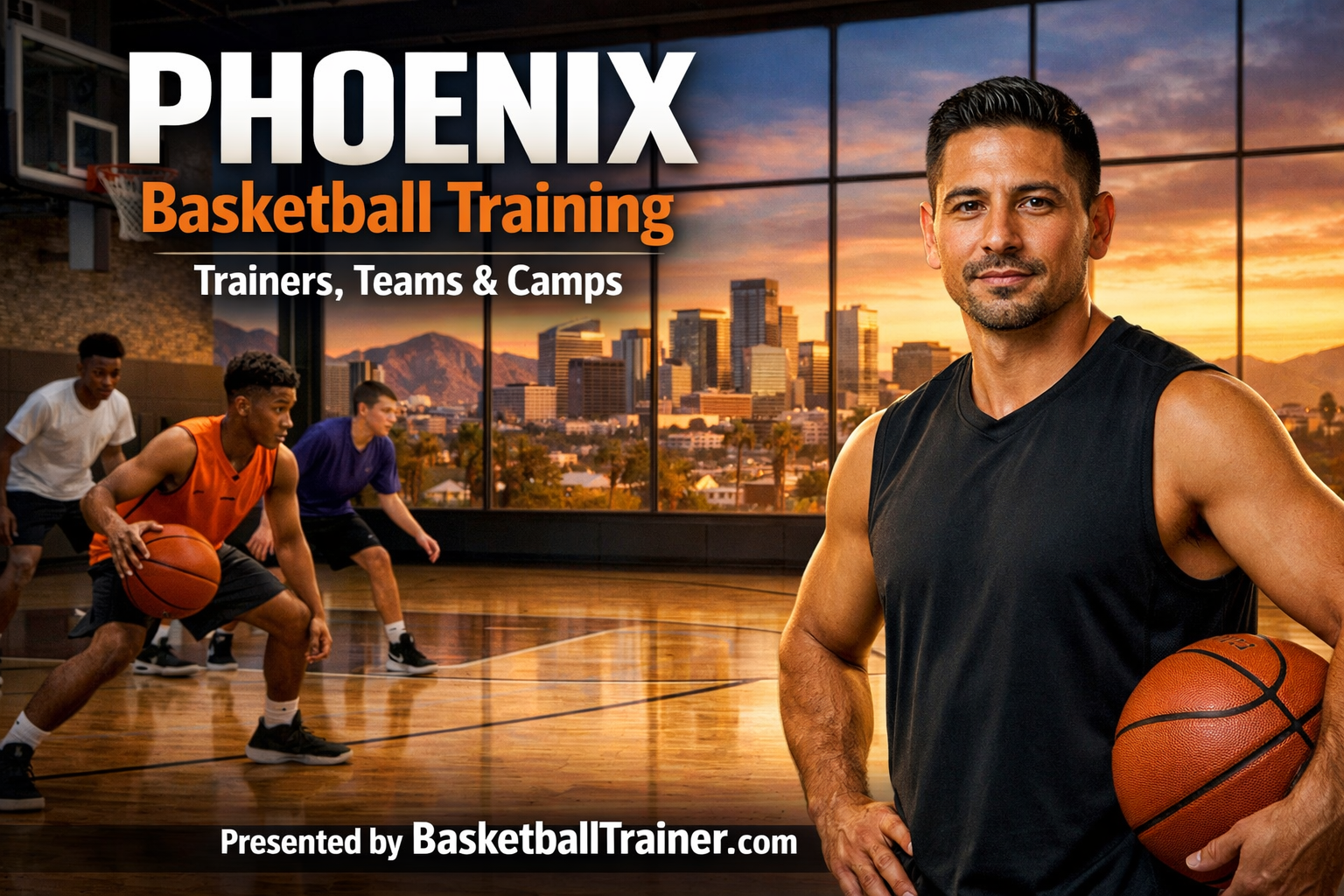
Phoenix Basketball Trainers
These Phoenix-area basketball trainers work with players across skill levels and ages. Phoenix’s year-round indoor training culture means many operate 12 months of programming, though summers skew heavily toward enclosed facilities. Use the evaluation questions later on this page when reaching out to any program.
Pro Skills Basketball
Pro Skills Basketball is designated as a Jr. NBA Flagship Organization in the Phoenix market, which carries meaningful weight for families looking at structured pathways. Coaches include Mark Schumaker, the head coach at Paradise Valley High School who has compiled over 100 wins at the varsity level, and Zach Washut from Cactus Shadows with a 120-57 career record. The program runs AAU club teams for grades 4-11, emphasizing skill-first development. The coaching staff’s active high school credentials mean they understand what varsity coaches look for — which is genuinely useful context for players targeting school team spots. Programs operate across the Valley with multiple practice locations.
Dream Team Academy
Dream Team Academy operates out of a dedicated training facility at 4633 E Shea Blvd on Phoenix’s northeast side. Individual and group basketball instruction covers ages from elementary through high school, with session structures that accommodate both recreational players building fundamentals and competitive players preparing for travel or school teams. The Shea Blvd location is accessible from North Scottsdale, Paradise Valley, and northeast Phoenix neighborhoods without requiring cross-town I-10 travel, which matters practically for families in those corridors.
Arizona Athletics (Coach Elijah Knox)
Coach Elijah Knox brings an elite-level credential that’s uncommon in the youth training market: WNBA coaching experience. His Arizona Athletics program works primarily with high school, college, and professional-caliber players seeking advanced skill refinement. For younger players with serious competitive aspirations, the ceiling of coaching expertise here is higher than most Valley programs. Families with players who’ve already moved through recreational and mid-tier competitive programs often find this level of instruction is the logical next step. Individual sessions focus on biomechanical precision, game-speed skill application, and the mental preparation that separates competitive players from recreational ones.
Steven Hunter Life Skills & Basketball Academy
Steven Hunter played in the NBA as a center and spent time with the Phoenix Suns, giving this academy a local professional basketball connection that resonates with Phoenix families. The program serves players ages 5-16 and intentionally pairs basketball skill development with character and life skills instruction — a model that works particularly well for younger age groups where learning to compete, handle loss, and work with teammates matters as much as crossover dribbles. This isn’t a pure “elite training pipeline” program; it’s closer to the community-building model that often creates longer-term player development than pure skills-only approaches.
DeRosier Basketball Academy
DeRosier Basketball Academy has operated in the Valley for six-plus years, offering individual and group training that spans a wide range of player development stages. Longevity in the Phoenix market matters — the Valley sees training programs open and close regularly, and a six-year track record indicates a program that has maintained family trust through multiple seasons. Group sessions provide a more affordable entry point than individual training while still offering structured coaching feedback that recreational leagues don’t provide. Contact the program to confirm current location and scheduling since group offerings can shift seasonally.
Athletes Untapped
Athletes Untapped connects families with vetted private trainers — including active Arizona State players — for one-on-one basketball instruction. The platform model lets families compare trainer profiles, see player backgrounds and specialties, and often trial a session before committing to ongoing training. For families new to private training who aren’t sure which coach fits their child, this discovery approach can be less intimidating than cold-calling individual trainers. Pricing and trainer availability shift based on who’s active in the platform, so check current listings when evaluating.
Phoenix Basketball Camps
Phoenix basketball camps run year-round thanks to the climate forcing everything indoors, but summer is when volume peaks. The heat is a practical factor: choose camps with confirmed air conditioning — not just “indoor courts” — because some older Valley facilities have poor cooling. Week-long day camp sessions typically run June through August with some spring break and holiday options.
Phoenix Suns Youth Basketball Camps
The Suns organization runs summer basketball camps that leverage the NBA brand and, in some sessions, involvement from Suns players and coaching staff. For elementary and middle school players, the experience of training in a professional basketball environment carries real motivational value — which is a legitimate factor when choosing camps, not just marketing hype. Sessions typically run at Valley-area facilities with programming designed for ages 7-15. Camp costs run mid-range for the Phoenix market. Confirm current session locations, dates, and pricing through the Suns organization directly since programming details change annually.
The Phhacility / PGC Basketball Programs
The Phhacility is a 31,000-square-foot private training facility that hosts PGC Basketball programs when PGC operates in Phoenix. PGC focuses on IQ-driven basketball — court vision, decision-making, and reading defenses — rather than pure athleticism or highlight-reel skills. For players who already have solid fundamentals but struggle to translate them into actual game performance, this is often the missing piece. PGC camps are multi-day, intensive, and priced at the higher end of the camp market, but families who’ve attended consistently report they’re the most meaningful camp investment their players made. Confirm current Phoenix session availability since PGC rotates locations nationally.
Hoop Code Basketball Academy Camps
Hoop Code operates primarily in the Scottsdale area but draws Valley-wide participation for their camp programming. Clinics and camps cover fundamentals through advanced skill work, with age-appropriate groupings that ensure younger players aren’t overwhelmed by older competition. Their club team programs and camps are connected, which gives families a pipeline from camp learning to competitive team experience without rebuilding relationships with new coaches. Session availability varies by season; their Scottsdale location is most practical for families in northeast Phoenix, Scottsdale, and Paradise Valley corridors.
Breakthrough Basketball Camps
Breakthrough Basketball operates nationally and brings structured camp programming to Phoenix-area locations during summer months. Their curriculum is skills-focused and consistent regardless of location — which is a plus for families who’ve attended Breakthrough camps elsewhere and know what to expect. Particularly strong for players ages 8-14 working on fundamental skill gaps. Week-long sessions typically run $180-250 depending on location and session format. Confirm current Phoenix-area session locations since they use various host facilities across the Valley rather than a dedicated space.
Phoenix Select Basketball Teams
Phoenix AAU and select basketball operates within a large, competitive Valley ecosystem. Travel typically includes regional tournaments in Tucson, Las Vegas, and California, with national circuit events for higher-level teams. Tryouts generally happen January through March. Total annual cost including travel commonly runs $3,000-6,000 when hotel, food, and gas are factored in beyond the team fee.
Pro Skills Basketball Club Teams
Pro Skills Basketball’s AAU club teams operate through grades 4-11 and compete on regional and national circuits. As a Jr. NBA Flagship Organization, the program carries credibility in the national AAU ecosystem. Coaching from active high school head coaches gives players exposure to coaches who understand what varsity programs actually require. Teams compete in tournaments across the Southwest and occasionally on national circuits for older age groups. Annual team fees and travel costs vary by age group and level of competition; request a full cost breakdown when inquiring, including expected tournament travel commitments.
Arizona Elite Basketball
Arizona Elite is among the Phoenix area’s longer-established select programs, fielding teams across multiple age groups for both boys and girls. The program emphasizes transparent cost communication — a real differentiator in select basketball where hidden tournament fees and uniform costs frequently surprise families. Practices occur at Valley facilities with rosters drawn from across Phoenix, Scottsdale, and adjacent cities. Teams compete in regional Arizona circuits and travel selectively to regional showcase events. The program’s history in the Valley market means coaches have developed relationships with local high school coaching staffs, which can be useful context for older players navigating recruitment conversations.
Rise Athletics / Jr. Suns Programs
The Suns organization’s Jr. Suns and Jr. Mercury youth basketball programs operate through Rise Athletics and community partners including YMCA and Boys & Girls Clubs across Phoenix. These programs serve a developmental role — leagues and skill work for younger players who aren’t ready for or interested in competitive select basketball — rather than functioning as a traditional AAU travel team pathway. For families with players in the 6-12 age range exploring organized basketball without committing to tournament travel costs, Jr. Suns programming provides an entry point with genuine NBA brand connection.
Hoop Code Club Teams
Hoop Code’s club teams connect with their academy training, creating continuity between individual skill development and competitive team play. Players who train with Hoop Code coaches are working with the same staff they’ll compete alongside in tournaments — that consistency is worth more than it sounds when you’re trying to translate practice skills into game performance. The program is primarily Scottsdale-based, which positions it best for families in the northeast Valley. Annual costs are mid-range for the Phoenix select market; confirm current team fee structures and tournament schedules when inquiring.
Valley Kings Basketball
Valley Kings competes in regional AAU circuits with teams across multiple age groups. The program operates from west and central Phoenix, making it more accessible geographically for families in Maryvale, Laveen, and west Valley neighborhoods than programs anchored on the Scottsdale side. Travel is primarily within Arizona and to Nevada, keeping costs somewhat lower than programs pursuing national circuit events. The organization has scholarship options for families demonstrating financial need — worth asking about directly when inquiring about the program.
Phoenix High School Basketball
Phoenix high school basketball is governed by the Arizona Interscholastic Association (AIA) with state tournaments held at Veterans Memorial Coliseum (1826 W McDowell Rd). The Valley’s competitive landscape is legitimately elite — Arizona produces consistent Division I talent, and state championship games regularly feature nationally-ranked programs.
Phoenix Union High School District
Phoenix Union has the most state championship appearances of any school district in AIA history. Schools include South Mountain, Camelback, North, West, Central, Carl Hayden, Trevor Browne, Maryvale, Metro Tech, North Canyon, and Shadow Mountain — all serving the urban core of Phoenix.
Programs Worth Knowing
- Perry High School (Gilbert): Four consecutive AIA titles including Open Division championships 2023-2025. Annually one of Arizona’s top programs.
- Mountain Pointe High School (Ahwatukee): Four championships including recent 5A title. Strong south Phoenix presence.
- Brophy College Prep (Phoenix): Consistent Open Division contender with strong college placement history.
- Chaparral High School (Scottsdale): Four state titles, perennial contender.
- Highland High School (Gilbert): 6A championship winners, strong talent pipeline.
Other Major Phoenix-Area Districts
- Deer Valley USD: Barry Goldwater, Deer Valley, Horizon, Mountain Ridge, Sandra Day O’Connor
- Paradise Valley USD: Chaparral, Desert Shadows, Horizon, North Canyon, Paradise Valley, Pinnacle, Saguaro, Shadow Mountain
- Tempe Union High School District: Serves Ahwatukee with Mountain Pointe and Desert Vista
School team tryouts typically occur in early November for winter programs. AIA state tournament tickets are available through GoFan, with adult tickets around $20 and student tickets $7.50.
How to Use These Listings
These are Phoenix-area trainers, camps, and teams that families in the area work with. We don’t rank them as “best” or endorse specific programs. Use the evaluation questions in the next section when contacting any of these options. The right fit depends on your child’s age, skill level, goals, your family’s schedule, and your budget. Contact 2-3 options before committing to see which feels right for your family.
Phoenix Recreation Centers: The Basketball Insider’s Guide
Before paying for private training, understand what Phoenix’s 33 municipal community centers offer. At $20 per year for an adult parks pass and $5 for youth, Phoenix operates one of the most affordable publicly-funded recreation systems in the American West. Open gym basketball, youth leagues, and drop-in play are available across the Valley at prices that make the municipal system a legitimate primary option for many families — not just a fallback.
The Phoenix Parks Pass: What You Need to Know
Annual Pass Pricing:
- Adults (18+): $20/year — access to all 33 community centers
- Youth (17 and under): $5/year
- Day pass: $2 adults, $1 youth (for occasional visits)
One annual pass covers every Phoenix community center.
Purchase at any Phoenix community center front desk. Bring photo ID and payment.
North & Central Phoenix: Established Gyms
Sunnyslope Community Center
Address: 802 E Vogel Ave, Phoenix 85020 | Near: Central Ave and Dunlap area
One of north-central Phoenix’s primary basketball hubs. The community has a gritty, authentic basketball culture — pickup games here have genuine competition. Regulation gym with consistent open gym scheduling.
Hours: Mon-Thu 9:00 AM – 9:00 PM | Fri 9:00 AM – 6:00 PM | Sat 10:00 AM – 6:00 PM
Commute Note: SR-51 and Cave Creek Road make this accessible from North Phoenix without touching I-10.
Washington Activity Center
Address: 2240 W Citrus Way, Phoenix | Established: 1969
A Phoenix institution with a full-size basketball gym that’s been central to the city’s rec basketball community for over 50 years. Youth and adult leagues run seasonally. The longevity of programming here means established league structures and experienced recreational staff.
Hours: Mon-Thu 9:00 AM – 9:00 PM | Fri 9:00 AM – 6:00 PM | Sat 10:00 AM – 6:00 PM
Deer Valley Community Center
Address: 2001 W Wahalla Ln, Phoenix
North Phoenix’s primary municipal gym. Most accessible for families in the Deer Valley, Happy Valley, and Anthem corridors. Active youth programming from Deer Valley USD feeder communities.
Hours: Mon-Thu 9:00 AM – 9:00 PM | Fri 9:00 AM – 6:00 PM
Paradise Valley Community Center
Address: 17402 N 40th St, Phoenix 85032
Northeast Phoenix location serving the 40th Street and Bell Road corridor. Accessible from Scottsdale and Paradise Valley adjacent neighborhoods. Good option for families who want City of Phoenix pricing without crossing into the city’s western grid.
Hours: Mon-Thu 9:00 AM – 9:00 PM | Fri 9:00 AM – 6:00 PM | Sat 10:00 AM – 6:00 PM
Longview Neighborhood Recreation Center
Address: 4040 N 14th St, Phoenix
Central Phoenix option with consistent open gym access. Mon-Thu 9am-9pm, Fri 9am-6pm, Sat 10am-6pm. Convenient for families in Central City, Camelback East, and Midtown neighborhoods.
West Phoenix & Laveen: Community Hoops Hubs
Desert West Community Center
Address: 6501 W Virginia Ave, Phoenix 85035 | Area: Maryvale / West Phoenix
The western Valley’s primary municipal basketball hub. Full-size gym with youth leagues and open gym. Strong community programming in a neighborhood with deep Phoenix basketball roots. This is where west-side basketball culture lives at the rec level.
Hours: Mon-Thu 9:00 AM – 9:00 PM | Fri 9:00 AM – 6:00 PM | Sat 10:00 AM – 6:00 PM
Cesar Chavez Community Center (Laveen)
Address: 7858 S 35th Ave, Phoenix (Laveen area) | Opened: 2023
Phoenix’s newest major community center, and it shows. At 34,000 square feet with a full basketball court and indoor track, this is modern facility infrastructure serving a rapidly growing southwest community. Opened 2023, meaning equipment, courts, and HVAC systems are fresh — the air conditioning actually works, which matters in Phoenix summer.
Hours: Mon-Thu 9:00 AM – 9:00 PM | Fri-Sat 9:00 AM – 5:00 PM
South Phoenix & Ahwatukee: South Valley Options
Pecos Community Center
Address: 17010 S 48th St, Phoenix 85048 | Area: Ahwatukee Foothills
At 38,000 square feet, Pecos is one of Phoenix’s larger community centers and the primary option for Ahwatukee families. Full basketball gym with youth leagues and open gym access. The 48th Street location is Loop 202 accessible, making cross-town travel less painful than it was before the South Mountain Freeway opened.
Hours: Mon-Thu 9:00 AM – 9:00 PM | Fri 9:00 AM – 5:00 PM | Sat 8:00 AM – 6:00 PM
South Mountain Community Center
Address: 212 E Alta Vista Rd, Phoenix | Established: 1976
South Phoenix’s institutional rec basketball hub, operating since 1976. Full-size gym with youth and adult leagues. The surrounding community has produced several notable Valley basketball players over the decades. Established programming structure with experienced staff who know the community’s basketball culture.
Hours: Mon-Thu 9:00 AM – 9:00 PM | Fri 9:00 AM – 6:00 PM | Sat 10:00 AM – 6:00 PM
The Heat Factor: Why Phoenix Rec Center Hours Matter More Than Elsewhere
In Phoenix, outdoor courts become unusable from roughly June through mid-September — temperatures regularly exceed 110°F and don’t drop below 90°F until late evening. This creates real seasonal pressure on indoor facilities. During summer months, expect Phoenix rec center gyms to be at higher capacity with longer waits for open gym. Plan arrival early (before 10 AM or after 7 PM when heat-driven demand is lower) or join a structured league that guarantees court time.
Practical tip: Call your target facility in late May to ask about summer open gym scheduling changes. Hours sometimes shift seasonally and not all updates make it to the city website promptly.
Evaluating Basketball Training Options in Phoenix
We provide evaluation frameworks, not recommendations. These questions help you assess trainers, camps, and teams based on what matters for your Phoenix family — including the heat, the sprawl, and the Valley-specific competitive landscape.
Questions to Ask Private Trainers
Why this matters in Phoenix: Some Valley facilities have inadequate cooling. In summer, a 95°F gym is a health risk, not just discomfort. Confirm HVAC quality before committing to summer training programs.
Why this matters: A trainer on the Scottsdale side and a family in Laveen may face a 45-minute drive each way. Map the actual commute during your typical training time before committing.
Why this matters: Vague promises don’t help you evaluate whether training is working. Ask for specific benchmarks — shooting percentages, drill speeds, defensive positioning — that can actually be tracked.
Why this matters: A trainer whose client base skews much older or more advanced than your child may not be the right fit, regardless of credentials. Ask about their actual current caseload.
Why this matters in Phoenix: Many Valley trainers take August off or reduce volume during peak heat. If summer is when your player has the most availability, understand the trainer’s seasonal schedule before signing up.
Questions to Ask About Camps
Why this matters: Legitimate question in Phoenix. Ask specifically — “indoor” doesn’t always mean adequately cooled.
Why this matters: 1:20 is supervision. 1:8 is instruction. Anything beyond 1:12 for skill work rarely produces meaningful individual feedback.
Why this matters: Both have value but serve different purposes. A player working on shooting mechanics needs drill repetition; a player preparing for team play needs game-situation competition. Know which you’re paying for.
Why this matters: Many Phoenix programs offer need-based scholarships that aren’t prominently advertised. Asking directly can open access to programs that otherwise appear out of budget.
Questions to Ask About AAU/Select Teams
Why this matters: Team fees of $1,500 become $4,000-6,000 when you add Las Vegas, California, and national circuit hotel/gas/food. Get the real number before committing.
Why this matters in Phoenix: Many Valley programs chase California and Nevada tournaments, adding long drives or flights. Other programs stay primarily in Arizona and New Mexico. Know what you’re committing to.
Why this matters: Equal playing time and merit-based playing time are both legitimate philosophies, but they create very different experiences. Understand the program’s approach before your child is benched at tournament time.
Why this matters: Some Phoenix programs actively work to build diverse, socioeconomically inclusive rosters. Asking doesn’t hurt your application — programs that care about diversity welcome the question.
Phoenix Pricing Reality
City Recreation (Parks Pass + leagues): $5-20/year pass, plus $40-80 per seasonal league registration
Private Training (Individual): $60-150 per session, depending on trainer credentials and session length
Small Group Training: $200-400/month for 2-4 sessions per week
Summer Camps: $150-350 per week depending on program level and facility
AAU/Select Teams: $1,500-3,000 annual team fees, plus $2,500-5,000 in tournament travel costs for active rosters
Investment vs. Outcome Reality
The Phoenix market has everything from $5/year public access to $6,000/year national circuit programs. More expensive rarely means more development, particularly for younger players. The $20 annual parks pass plus a few hundred in league fees may be all a 9-year-old needs to develop a genuine love of basketball. Save the premium investment for when your player’s commitment is clear and their development specifically requires what private training provides.
Free Phoenix Basketball Training Evaluation Guide
Download our comprehensive guide with specific questions to ask trainers, camps, and teams before committing — plus red flags that indicate programs worth avoiding.
Phoenix Basketball Season: What to Expect
Phoenix basketball has an unusual seasonal dynamic compared to most U.S. cities: the outdoor courts go dark in summer, not winter. This reverses some conventional youth sports calendar logic. Understanding when different programs run helps families plan around Phoenix’s climate reality.
High School Season (AIA)
Typical Timeline: First practices early November, games begin mid-November, regular season through late January, AIA state tournament through late February at Veterans Memorial Coliseum.
What This Means: November through February is school season. Private training and AAU activity generally takes a backseat during this stretch, particularly for players who make varsity.
AAU / Select Basketball Season
- January-March: Tryouts (often overlapping with school season end)
- March-May: Spring tournament season begins, regional Arizona and Nevada events
- June-August: Peak summer tournaments, national circuits; ALL competition moves indoors
- September-October: Fall ball winds down, school season preparations begin
Phoenix Travel Reality: Common regional tournament destinations include Tucson (2 hours south), Las Vegas (4-5 hours), and Southern California (5-6 hours or a short flight). National circuit events pull players to Texas, Georgia, and the Mid-Atlantic. The farther circuits require serious travel budget planning.
Summer Training Season (Phoenix’s Hidden Advantage)
While much of the country plays outdoor ball in summer, Phoenix families train indoors year-round — which creates more structured training volume than cities where players drift to outdoor pickup games. The Phoenix player who uses summer properly can log more quality indoor training than counterparts in more temperate climates.
Best summer training windows: Early morning (6-9 AM before heat builds) or evening (7-10 PM once temps drop below 100°F). Phoenix rec centers and private facilities with solid AC are in high demand during these hours.
Basketball Camps
- Spring Break: March camps serve players between school season and AAU startup
- June-July: Peak camp season, widest selection
- August: Late summer camps; confirm facility cooling before registration
Phoenix Basketball Culture & Heritage
Phoenix basketball exists in a unique American sports context: a major metropolitan area with a 1968 NBA franchise, enormous high school talent depth, and a Valley-wide competitive ecosystem that draws players from across the southwest. The Suns aren’t just local entertainment — they’re an organizational presence that shapes youth basketball culture through camps, Jr. Suns programming, and the gravitational pull of professional basketball on the city’s youth sports identity.
The Suns Tradition
The Phoenix Suns (founded 1968) are one of the NBA’s original Western expansion teams and have the fifth-best all-time winning percentage in league history. Their three Finals appearances — 1976 against the Celtics, 1993 with Charles Barkley’s MVP season, and 2021 with the Devin Booker/Chris Paul tandem — have each represented different eras of Phoenix basketball culture.
Steve Nash’s back-to-back MVP seasons (2005, 2006) with the “Seven Seconds or Less” offense influenced a generation of Phoenix players who grew up watching pace-and-space basketball become the league’s dominant style. Deandre Ayton, the 2018 number-one overall pick who spent time at University of Arizona before going pro, represents the type of elite talent the southwest college basketball ecosystem regularly produces.
The 2021 Finals run — Phoenix’s first in 28 years — noticeably reinvigorated youth basketball interest across the Valley. Youth program enrollments and training inquiries increased measurably in the following seasons, a pattern that’s common when NBA teams have sustained success.
High School Basketball: The AIA Open Division
Arizona’s addition of an “Open Division” to state tournament play changed the competitive landscape. Rather than limiting top programs to single-division brackets, the Open Division brings together the state’s elite programs regardless of enrollment size — creating a true best-of-Arizona tournament bracket. Perry High School’s four consecutive championships from 2022-2025 (including three Open Division titles) represent a level of sustained dominance that doesn’t happen without exceptional player development pipelines.
The Nike Tournament of Champions, hosted annually in December in the Phoenix area, brings 124 girls’ programs from across the country and is widely considered the de facto national girls’ high school basketball championship. The tournament’s 28-year Phoenix presence says something about the Valley’s facilities, weather, and organizational capacity for elite-level competition.
The Valley-Wide Basketball Ecosystem
Phoenix basketball doesn’t operate in a vacuum from Scottsdale, Mesa, Tempe, and Chandler. Families routinely cross municipal lines for training, and select teams draw rosters from across the Valley regardless of city borders. This creates a larger talent pool and more competitive landscape than Phoenix’s city boundaries alone would suggest. The practical implication: don’t limit your search to Phoenix city programs if programs in adjacent cities are reasonably accessible from your home. Valley-wide is the relevant geographic frame for evaluating options.
Frequently Asked Questions About Phoenix Basketball Training
These are the questions Phoenix families ask most often about youth basketball programs, costs, and timing in the Valley.
How much does basketball training cost in Phoenix?
Phoenix basketball training costs range more widely than most cities. At the affordable end, a Phoenix Parks Pass costs $20/year for adults or $5 for youth and unlocks open gym basketball at 33 community centers citywide — one of the best rec center values in the American West. Private individual training typically runs $60-150 per session depending on trainer credentials. Group training programs generally cost $200-400 per month for multiple weekly sessions. Summer camps range from $150-350 per week. AAU select teams charge $1,500-3,000 in annual team fees, with tournament travel adding another $2,500-5,000 for families who compete on regional and national circuits. Many programs offer need-based financial assistance; always ask directly when inquiring about any program.
When do AAU basketball tryouts happen in Phoenix?
Most Phoenix-area AAU and select teams hold primary tryouts January through March, with some programs running second-round tryouts in April and May. This timing partially overlaps with the AIA high school season, which ends in late February — creating a compressed window where players and families are juggling school team playoffs and AAU program decisions simultaneously. Contact programs of interest in November or December to understand their specific tryout schedules and what they’re looking for at each age group. Some programs have rolling admissions or informal evaluations throughout the year for players who miss formal tryout periods.
Can kids play basketball outdoors year-round in Phoenix?
No — this is Phoenix’s most significant basketball training reality. Outdoor courts are effectively unusable from approximately early June through mid-September when temperatures regularly reach 110°F and heat index climbs higher. Even early morning and evening outdoor play becomes a health risk during peak summer. This means Phoenix’s serious basketball training is almost entirely indoor, year-round. The practical consequence: quality indoor facilities — both municipal rec centers and private academies — see higher summer demand and can get crowded. Plan training around indoor availability, not outdoor preference.
How competitive is high school basketball in Phoenix?
Genuinely competitive at the top level — Arizona consistently produces Division I talent and Phoenix-area high schools regularly appear in national rankings. Programs like Perry, Mountain Pointe, and Brophy recruit aggressively and compete in Open Division brackets that include the state’s best regardless of enrollment size. That said, the Valley has 280+ AIA-member schools across all enrollment sizes, so there’s competitive basketball at every level. A player who wouldn’t make a Tier 1 varsity roster might start on a smaller school’s program and have an excellent experience. Understanding the competitive tiers — Open Division, 6A, 5A, 4A, smaller — helps families set realistic expectations for which high school environment fits their player’s development stage.
Which part of Phoenix has the best basketball training options?
Training options are distributed across the Valley rather than concentrated in one corridor. North Phoenix and Scottsdale have a higher density of private academies. West and South Phoenix have strong municipal rec center programming with deep community basketball culture. Central Phoenix has the most established rec centers with the longest operating histories. The more important question is: which options are realistically accessible from your home given Phoenix traffic patterns? A program that requires crossing downtown on I-10 during 4-6 PM rush hour is effectively a 45-minute commute each way for many Valley families. The best training option for your family is often the best program within a sustainable commute distance from home.
What age should kids start basketball training in Phoenix?
There is no universal right age — this depends on your child’s interest and your family’s capacity. Jr. Suns programs and YMCA leagues serve players as young as 5-6 with age-appropriate, fun-focused programming. Phoenix’s rec centers offer youth leagues for elementary-age players in an affordable, lower-pressure environment. Private training becomes most effective around ages 8-10 when players can focus on specific skill instruction rather than just learning basic rules. Select team commitments (with travel) are generally best deferred until players have demonstrated genuine interest and commitment through recreational or school team participation. Many families who pushed competitive AAU early (7-8 years old) report it created burnout by middle school; many who waited until 10-11 report players were more motivated and developed faster.
Phoenix Basketball Training Options at a Glance
This table helps Phoenix families understand cost, time commitment, and best use cases for the Valley’s basketball training landscape.
| Training Option | Cost Range | Best For | Time Commitment |
|---|---|---|---|
| City Rec Centers (Parks Pass) | $5-20/year + $40-80/league season | Beginners, recreational players, budget-conscious families | Open gym anytime; seasonal leagues 1-2x/week |
| Private Training (Individual) | $60-150/session | Targeted skill gaps, pre-tryout prep, advanced players | Flexible, typically 1-2 sessions/week |
| Group Training Programs | $200-400/month | Consistent development, cost-effective alternative to individual | 2-3 sessions/week, year-round or seasonal |
| Summer Basketball Camps | $150-350/week | Summer skill building, trying basketball, childcare alternative | 1-week blocks, June-August primarily |
| AAU/Select Teams | $1,500-3,000+ team fees (plus travel) | Competitive players, exposure, tournament experience | 6-8 months, 2-3 practices/week, weekend tournaments |
Note: Costs represent typical Phoenix Valley ranges as of 2026. Many programs offer financial assistance, sibling discounts, or scholarship options. Always ask directly.
Getting Started with Basketball Training in Phoenix
New to Phoenix basketball or starting your child’s training journey? Here’s a practical, pressure-free path forward for Valley families.
Step 1: Define Your Goal
Are you looking for fun and exercise? School team preparation? Competitive AAU experience? College recruiting exposure? Your answer changes which program type makes sense. Most Phoenix families start with affordable rec center access or a single season of league play before deciding whether more structured training is worth the investment.
Step 2: Map Your Commute
Phoenix traffic is real. Before falling in love with a program’s credentials, run the commute on Google Maps during your likely training departure time. A program 20 miles away that routes through downtown during 4-5 PM may be 50 minutes in practice. Sustainable commitment requires a commute you can actually maintain for 6-8 months.
Step 3: Contact 2-3 Options
Use the evaluation questions from this page. Look at 2-3 programs that match your geography and budget. Reach out with specific questions about their approach, experience with your child’s age group, summer scheduling (heat matters!), and costs. Most offer trial sessions or initial consultations.
Step 4: Trust What You Observe
After a trial session, does your child come home talking about it or dreading the next one? Does the coach communicate clearly about what they’re working on? Do the logistics actually work for your family? The “less prestigious” program your kid loves often develops them more than the elite program they dread attending.
Free Basketball Training Evaluation Guide
Download our comprehensive guide with specific questions to ask trainers, camps, and teams before committing.
Phoenix Quick Links
Basketball Resources
Nearby Arizona Cities
About BasketballTrainer.com
© 2026 BasketballTrainer.com. All rights reserved. Phoenix, Arizona basketball training resource. Context, not direction.