Charleston SC Basketball Training – Trainers, Camps & Teams
Charleston basketball training spans a metro area of 800,000+ residents across the Lowcountry — from Mount Pleasant to West Ashley, Daniel Island to James Island. This page helps families understand the Holy City’s unique geography, water-divided neighborhoods, and decision frameworks — not prescribe solutions.
Basketball Trainers
Basketball Camps
Select Teams
Municipal Rec Centers
⚡ Looking for Basketball Training Options?
Skip the background info — jump straight to what you need:
Why This Charleston Basketball Resource Exists
Charleston’s 800,000+ metro residents are spread across water-divided neighborhoods — Mount Pleasant east of the Cooper River, West Ashley across the Ashley, James Island south of downtown, and North Charleston stretching inland. That geography creates hundreds of basketball training options, but a trainer on Daniel Island might be 40 minutes from a family in West Ashley even though they’re technically in the same metro. This page helps families understand Charleston’s unique layout, seasonal patterns, and decision frameworks — not prescribe solutions.
Our Approach: Context, Not Direction
We don’t rank trainers or camps as “best” — we help you understand what makes different programs right for different needs. The best fit depends on your child’s age, skill level, goals, your family’s schedule, budget, and which side of the water you live on. This page provides evaluation frameworks and local context, not prescriptive recommendations. Learn how BasketballTrainer.com works • Read our editorial standards
Understanding Charleston’s Basketball Geography
Charleston’s defining geographic reality is water. The Ashley River, the Cooper River, and the harbor divide the metro into distinct neighborhoods connected by bridges — some of which become genuine bottlenecks during rush hour. Where you live determines not just which trainers are convenient, but whether a 15-minute drive can suddenly become 40 minutes depending on bridge traffic and the time of day.
Mount Pleasant / Daniel Island
What to Know: The fastest-growing part of the metro. Predominantly family-oriented suburbs with newer facilities. Daniel Island is planned and walkable; outer Mount Pleasant has large subdivisions with amenities. Home to Wando High School, one of the state’s most competitive programs.
- Commute Reality: 20-35 min to downtown/West Ashley via Ravenel Bridge; bridge backups common at 5-7pm
- School Districts: Charleston County School District (Wando, Oceanside Collegiate, Philip Simmons)
- Basketball Culture: Growing, affluent youth sports scene; strong travel team presence
Downtown Peninsula / North Charleston
What to Know: The historic core and the city’s largest employment hub. Home to TD Arena (College of Charleston), Burke High School, and The Block — Wesley Horne’s 20,000 sq ft training facility on Meeting Street Road in North Charleston. Most accessible area for families across the metro.
- Commute Reality: Central to everything; 15-25 min to most neighborhoods without bridge delays
- School Districts: Charleston County (Burke, Academic Magnet, Military Magnet, Stall)
- Basketball Culture: Deepest basketball history; Burke HS tradition; College of Charleston D1 presence
West Ashley / James Island
What to Know: West Ashley is the most affordable area close to downtown, home to roughly half the city’s population. James Island lies south across the Wappoo Creek drawbridge — that bridge is a real commute factor. Bees Landing Recreation Center serves West Ashley; the James Island Recreation Complex serves James Island families.
- Commute Reality: 5-25 min to downtown depending on bridge/traffic; James Island drawbridge adds unpredictability
- School Districts: Charleston County (West Ashley HS, James Island Charter, St. Johns)
- Basketball Culture: Community-oriented; Wings Basketball Academy serves James Island families out of Harbor View Presbyterian
Summerville / Goose Creek / Tri-County
What to Know: The fastest-growing outer suburbs spanning Dorchester and Berkeley counties. Many families here find that travel team tournaments and top trainers require a 30-45 minute drive into Charleston proper. The Tri-County area is covered by a different set of local teams and parks systems, though many families access Charleston-based trainers and select teams.
- Commute Reality: 30-50 min to downtown Charleston; I-26 corridor; Dorchester Rd a common alternative route
- School Districts: Dorchester District 2, Berkeley County School District, Colleton County
- Basketball Culture: Rapidly growing youth sports programs; Goose Creek HS a consistent playoff presence
The Bridge Reality Check
Charleston’s bridges are gorgeous and maddening in equal measure. The Arthur Ravenel Jr. Bridge connecting downtown to Mount Pleasant is a genuine rush-hour bottleneck. The Wappoo Creek drawbridge to James Island opens for boat traffic on a schedule — and if you hit it wrong, you’re waiting 15 minutes. Many Charleston families have learned the hard way that “only 20 minutes away” on a map can become 45 minutes on a Tuesday at 5:30pm. When evaluating trainers, account for which side of the water they operate on and what your bridge situation looks like during your typical practice time. Geography isn’t a minor footnote in Charleston — it’s the main event.
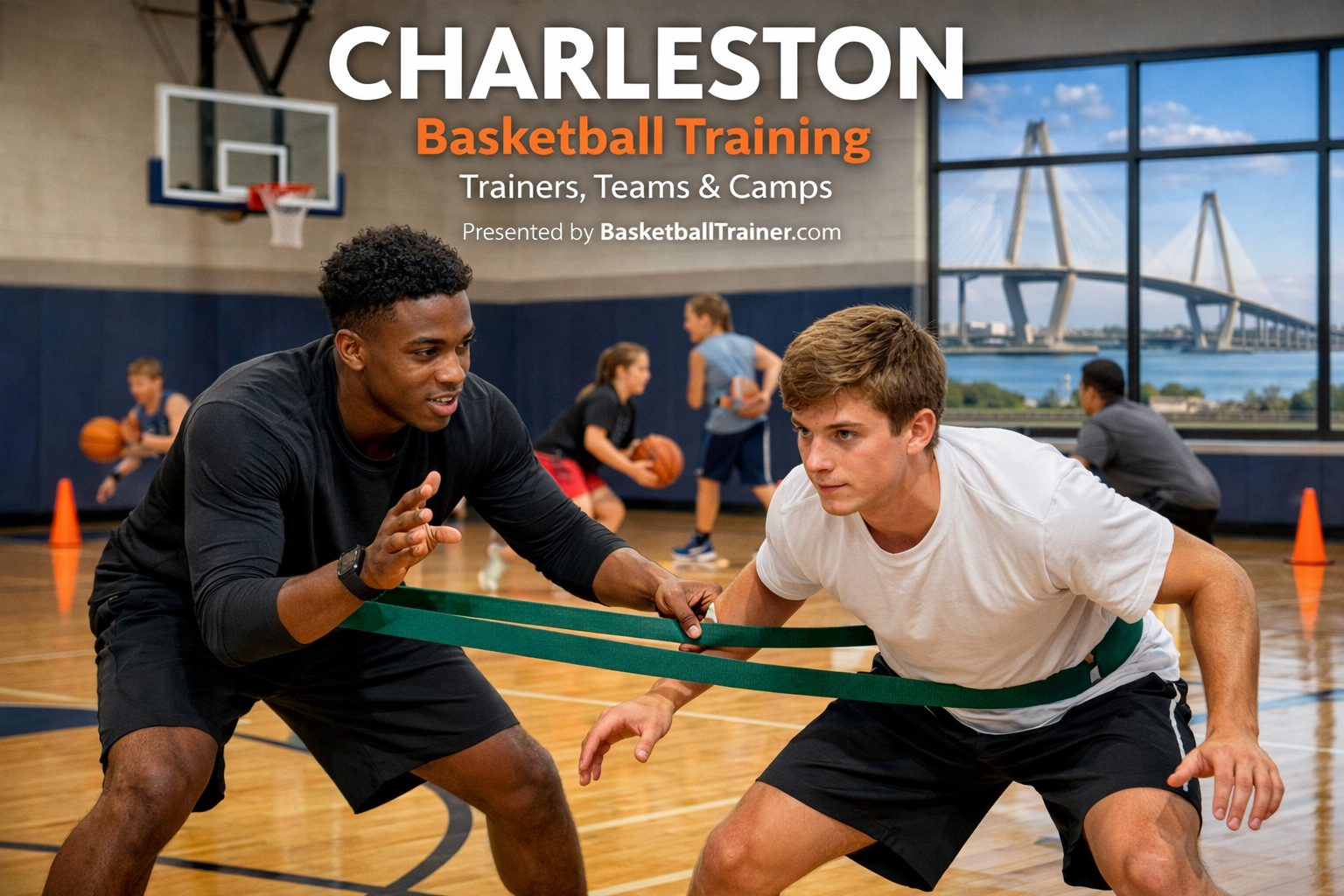
Charleston SC Basketball Trainers
Charleston’s private basketball training scene has grown significantly over the past decade. The trainers below work with players across skill levels and age groups. Each brings a distinct approach — use the evaluation questions later on this page when you reach out to any of them.
Dynamic Sports Team (Coach Wesley Horne)
Wesley Horne’s credentials are hard to match in the Lowcountry. After stints as a statistical analyst with the Philadelphia 76ers and player development work with the LA Lakers and Clippers’ G-League affiliate — working alongside Kobe Bryant, Danny Green, and Jeremy Lin — Horne returned to build what is now Charleston’s most prominent basketball training organization. Dynamic Sports Team has grown from one client in a middle school gym to more than 1,500 clients and a staff of six coaches. The organization now operates out of The Block, a $6.4 million, 20,000-square-foot facility at 2045 Meeting Street Road in North Charleston, featuring two full basketball courts, strength and conditioning space, a scouting deck, and physical therapy services. DST offers private one-on-one sessions, the Dynamic Academy (a 7-week structured curriculum program for grades 5-6, 7-8, and 9-11, capped at 30 players per age group), and Team Dynamic for travel competition. Individual sessions typically run $75-150 depending on the coach; Academy enrollment pricing reflects the facility and staffing investment — contact DST directly for current rates. Best for: serious players grades 5-12 who want professional-grade development in a purpose-built facility.
Wings Basketball Academy (Coach John Harris)
John Harris founded Wings Basketball Academy in 2023 after more than eight years running John Harris Basketball in the Lowcountry. Harris is a player-turned-coach who has helped high school players earn college offers at schools including Illinois State, Mercer, and Alabama A&M, and is deeply embedded in the Charleston community through mentorship work with the Restoration Project. Wings operates out of multiple sites — Palmetto Christian Academy in Mount Pleasant and Harbor View Presbyterian Church on James Island (900 Harbor View Rd, Charleston) — making the academy more geographically accessible than many single-facility programs. The faith-based program serves grades 2-12 with beginner, intermediate, and advanced tracks. Individual skill sessions run approximately $80-800 depending on package; the first evaluation session is free. Wings also runs seasonal leagues and spring academies. Best for: players across all skill levels who want a coach invested in their character development alongside their basketball growth, and families on the James Island or Mount Pleasant sides of the water who want a local option.
Athletes Untapped — Charleston County Network
Athletes Untapped connects families with vetted private basketball coaches across Charleston County. Rather than a single trainer with a fixed location, this is a platform with multiple coaches who specialize in different areas — shooting mechanics, footwork, defensive technique, and overall skill development. Coaches come to the family’s preferred location (local court, driveway, or gym), which eliminates the bridge-and-commute problem entirely for many Lowcountry families. Individual coaches on the platform typically charge $40-90 per session. The model works especially well for families who want consistent weekly training without committing to a specific facility location. Best for: families who want flexibility on location and scheduling, younger players building fundamentals, and families priced out of premium facility-based training.
Lowcountry FCA Basketball (Fellowship of Christian Athletes)
The Lowcountry chapter of the Fellowship of Christian Athletes runs a basketball camp program for ages 8-17 out of Charleston Baptist Church — and is notable for welcoming all skill levels without tryouts or competitive pressure. For families looking for affordable, values-based basketball instruction rather than elite player development, the FCA program fills a gap. Camp programming emphasizes character alongside fundamentals, with registration fees kept accessible to the broader community. Contact the Lowcountry FCA directly for current programming and pricing. Best for: beginners and recreational players ages 8-17, families who prioritize character development alongside skill building, and those looking for the most affordable structured basketball programming available.
City of Charleston Recreation Basketball — Youth Leagues
The City of Charleston’s Recreation Department runs youth basketball leagues at multiple facilities including Bees Landing Recreation Center (West Ashley), Daniel Island Recreation Center, and James Island Recreation Complex. These are recreational leagues — organized game play with referees for ages 7 and up — not individual skill instruction. Seasonal league registration runs approximately $50-100. This is the most affordable entry point into organized basketball for families in Charleston proper, and a reasonable starting point before investing in private training. The city’s spring break camps also include basketball programming through Wings Basketball Academy instructors. Best for: beginners ages 5-12, families who want low-pressure recreational participation, and players trying out organized basketball for the first time. Not a substitute for skill development training.
Charleston Basketball Camps
Charleston basketball camps run primarily June through August, with some spring and holiday options available. The Holy City’s tourism infrastructure — hotels, restaurants, beaches — makes it an attractive destination for out-of-area camp programs as well, so families have options beyond just local providers.
Dynamic Sports Team Camps & Clinics
Coach Wesley Horne and the DST staff run seasonal camp programming at The Block facility in North Charleston (2045 Meeting Street Road). The two-court facility with strength and conditioning space allows for a quality instruction environment rather than the crowded gym experience common at some camp programs. DST camps emphasize skill development and competitive discipline rather than pure game-play, with small-group instruction that benefits from the organization’s professional coaching staff. Camp fees typically run $150-300 per week depending on program intensity and age group. The facility’s central North Charleston location makes it accessible from most parts of the metro without major bridge issues. Best for: grades 4-12 players seeking genuine skill development in a professional facility environment during summer months.
John Harris Basketball Camp
Coach John Harris runs summer basketball camps for grades 3-8 at Palmetto Christian Academy in Mount Pleasant (313 Egypt Rd, Mount Pleasant, SC 29466). Separate sessions for boys and girls run in morning and afternoon blocks. Camp registration runs $135 per week — among the more affordable structured camp options with a named, credentialed coach in the area. Harris also partners with the City of Charleston’s spring break camp programming through Wings Basketball Academy. The Mount Pleasant location works well for families east of the Cooper River but adds bridge time for West Ashley or James Island families. Best for: grades 3-8 players on the Mount Pleasant side of the metro, families wanting faith-based instruction from a coach with an established local reputation, and players building fundamentals over a structured week.
College of Charleston Basketball Camps
The College of Charleston Cougars — under head coach Chris Mack, who came to Charleston after head coaching stints at Xavier and Louisville — periodically run youth camp programming at TD Arena and on-campus facilities. D1 college camps give players an authentic college basketball experience in the facilities where Cougar games are played. Contact the College of Charleston athletic department for current summer camp scheduling and pricing, as offerings vary by season and coaching staff. Pricing is typically in the $200-350/week range for D1 college programs nationally. Best for: competitive players ages 10-17 who want D1 facility access and instruction from college coaches and staff, particularly those considering competitive high school basketball or eventual college recruitment.
Wings Basketball Spring Academy
Wings Basketball Academy runs an 8-week spring development program that combines skill instruction with structured 5v5 gameplay — giving players the rare benefit of learning concepts and immediately applying them in competitive situations during the same sessions. Every participant receives a Wings Personal Development Journal and training shirt. The spring academy operates at both Mount Pleasant and James Island locations, and is structured as a seasonal program rather than a drop-in camp. This format suits players who want consistent development across multiple weeks rather than a single intensive week of camp. Contact Wings for current enrollment pricing. Best for: grades 2-12 players who finished their winter season and want structured skill work before the summer AAU season begins.
Lowcountry Basketball Camp
Lowcountry Basketball Camp offers fundamental-focused instruction across skill development areas — ball handling, shooting, passing, defending, and rebounding — with an emphasis on making the game fun for players at all levels. Participants are encouraged to bring their own ball. The program is designed to welcome all skill levels and avoids the intimidating atmosphere some elite camps create for younger or less experienced players. Contact the program for current pricing and location. Best for: younger players (roughly ages 7-14) and beginners who want a welcoming introduction to structured basketball instruction without elite camp pressure.
Charleston Select & AAU Basketball Teams
Charleston is a genuine tournament destination — US Travel Basketball runs multiple national-level events in the Holy City, which means local select teams often compete against high-quality out-of-state competition. That cuts both ways: the local travel basketball scene is competitive, but it also means tournaments can happen close to home, reducing travel costs. Most team tryouts occur in February and March. Tournament travel typically covers the Carolinas, Georgia, and Florida, with national events occasionally bringing teams to Charleston itself.
Team Dynamic (Dynamic Sports Team)
Team Dynamic is the travel competition arm of Wesley Horne’s Dynamic Sports Team organization, operating out of The Block facility in North Charleston. The program differentiates itself by integrating player development — access to DST’s professional skill training, 3v3 tournaments, and coaching infrastructure — directly into the travel team experience rather than treating tournaments as the sole purpose. Coaches have backgrounds ranging from grassroots to the NBA G-League. Annual team fees are competitive with other select programs in the Charleston market; contact DST directly for current pricing as it varies by age group and tournament schedule. Travel primarily covers the Carolinas and Southeast. Best for: competitive players grades 5-11 who want travel team competition backed by professional player development infrastructure, not just games.
SC Lowcountry Storm
The Lowcountry Storm is a community-rooted travel basketball organization based in Charleston that emphasizes player development, team values, and the importance of community alongside competitive play. Coaches include former College of Charleston players — including a coach who was part of the Cougars’ 2017 NIT and 2018 CAA championship run — which gives the program a genuine connection to high-level basketball. The Storm offers teams across multiple age groups. Annual fees vary by age group and tournament load; families should expect team fees in the $1,200-2,000 range plus regional travel costs of $1,500-3,000 annually depending on tournament schedule. Best for: players who want competitive travel basketball with coaching tied to local college basketball pedigree, and families who value community connection in their team environment.
BTB Charleston (formerly Carolina Cavaliers)
BTB Charleston has more than a decade of organizational history in the Charleston youth basketball market — founded as the Carolina Cavaliers before rebranding in 2021. The program centers on a mission “bigger than basketball,” emphasizing values, community, and character development alongside competitive play. BTB hosts the Chad Cooke Classic tournament each spring, drawing more than 60 teams — a meaningful indicator of their organizational capacity and community standing. Annual team fees and age group offerings are best confirmed directly with the organization, as programs evolve season to season. Best for: families who want a program with proven organizational longevity, community-focused values, and a history in the Charleston travel basketball ecosystem.
Coastal Select Basketball
Coastal Select focuses on girls basketball and is affiliated with TMP Basketball’s network in Charleston. The program has earned parent reviews specifically noting that players don’t feel “excluded, singled out, or underplayed” — which reflects an emphasis on equitable playing time and inclusive team culture rather than a win-at-all-costs approach. Teams serve grades 7-11. Contact Chris Pouyat for tryout information and current fee structure. Best for: girls players grades 7-11 who want competitive travel basketball in an environment that prioritizes player experience and equal opportunity over pure winning metrics.
US Travel Basketball — Charleston Events
US Travel Basketball runs more national-level tournament events in Charleston than perhaps any other single-sport organization in South Carolina. Events like the Holy City Basketball Showcase, Bash at the Beach, Port City Memorial Shootout, Championship of the Carolinas, and even the US Travel Basketball National Championship have been held in Charleston. For Charleston-based teams, this creates an unusual opportunity: national-quality competition within driving distance, reducing hotel and travel costs that crush family budgets in other markets. Teams from across the Eastern Seaboard compete at these events. If your child plays on a Charleston select team, ask your coach which US Travel events they participate in — the answer tells you a lot about the program’s competitive level and travel commitment.
Charleston Area High School Basketball
Charleston County School District oversees the largest cluster of high school basketball programs in the metro, with additional programs in Dorchester and Berkeley counties for Summerville-area families. The SCHSL governs all public school basketball; independent and private schools compete under SCISA. School team tryouts typically occur in October.
Charleston County School District — Notable Programs
- Burke High School (downtown Charleston) — The city’s most historically significant basketball program; hosts the annual Modie Risher Showcase invitational tournament. Deep community roots and longtime tradition.
- Wando High School (Mount Pleasant) — One of the largest schools in the state; consistently competitive in AAAAA; strong program on the east side of the Cooper River.
- Stall High School (North Charleston) — Notable as the alma mater of Anthony Johnson, the College of Charleston’s first NBA Draft pick who played 13 seasons in the league.
- Academic Magnet High School (North Charleston) — Selective enrollment, strong academic-athletic culture.
- James Island Charter High School (James Island)
- West Ashley High School (West Ashley)
- Philip Simmons High School (Daniel Island area)
- Oceanside Collegiate Academy (Mount Pleasant) — Charter school with a competitive athletic program
- Military Magnet Academy and Baptist Hill High School also field programs within the district
Tri-County Area (Dorchester / Berkeley)
- Goose Creek High School (Berkeley County) — Consistent AAAAA playoff program
- Cane Bay High School (Berkeley County) — One of the state’s newest and largest schools, growing athletic program
- Hanahan High School (Berkeley County)
- Ashley Ridge High School (Dorchester District 2, Summerville area)
- Summerville High School (Dorchester District 2)
- Fort Dorchester High School (Dorchester District 2)
Private & Independent Schools
- Porter-Gaud School (Charleston) — Notable as the alma mater of NBA players Khris Middleton (Bucks) and Aaron Nesmith (Pacers)
- Bishop England High School (Daniel Island) — Catholic school; consistent playoff contender
- Palmetto Christian Academy (Mount Pleasant)
The South Carolina High School League (SCHSL) governs public school competition. The Carolina Lowcountry Invitational, held annually between Christmas and New Year’s, draws teams from more than a dozen states to Charleston — one of the premier holiday basketball events in the Southeast.
How to Use These Listings
These are Charleston trainers, camps, and teams that families in the area work with. We don’t rank them as “best” or endorse specific programs. Use the evaluation questions in the next section when contacting any of these options. The right fit depends on your child’s age, skill level, goals, your family’s schedule, your budget, and frankly — which side of the water you live on. Contact 2-3 options before committing to see which feels right for your family.
Charleston Recreation Centers: The Community Basketball Guide
Before committing to private training, understand what’s already available through the City of Charleston’s recreation system and the broader Charleston County Parks network. These facilities offer the most affordable basketball access in the metro — and for families new to the area, they’re often the best way to find out which side of the city has programming that actually fits your schedule.
City of Charleston Facilities
Bees Landing Recreation Center — West Ashley
West Ashley’s primary rec facility. Features a full basketball court alongside a football field, dog park, and outdoor fitness amenities. The city’s basketball league programming runs seasonally through this facility. Monthly open gym calendars are published on the city website. Drop-in and league programming serve youth ages 5 and up. For West Ashley families, this is the most convenient municipal option without dealing with bridge crossings. Check the City of Charleston Parks & Recreation site for current hours and registration details.
Commute Note: 5-15 minutes for most West Ashley families; avoids the Ashley River bridge entirely.
James Island Recreation Complex
The primary recreation hub for James Island families. Features a basketball court, youth programs, fitness classes, and senior activities. James Island’s drawbridge reality means this facility is genuinely useful only for families already on the island — don’t plan to come from West Ashley or downtown for casual drop-in basketball unless you’ve confirmed the Wappoo Creek bridge isn’t backed up. Youth basketball leagues run seasonally through the city registration system.
Commute Note: James Island families: 5-15 minutes. Everyone else: factor in the drawbridge.
Daniel Island Recreation Center
An air-conditioned multi-purpose facility on Daniel Island that hosts youth sports, fitness classes, and community programs. Features a basketball court with monthly open gym scheduling. Daniel Island’s planned neighborhood layout makes this one of the more pleasant recreation experiences in the city — easy parking, walkable from much of the island. The city publishes a monthly facility open gym calendar. Best for families living on Daniel Island or inner Mount Pleasant who want city-managed programming without the longer bridge commute.
Additional City Facilities
Arthur W. Christopher Community Center — Downtown peninsula
Community center on the peninsula. Youth fitness, arts and educational programs. Check city site for current basketball availability.
St. Julian Devine Community Center — Downtown Charleston
Centrally located community center serving the downtown and Upper Peninsula area.
Shaw Community Center — Charleston peninsula
Neighborhood community center. Check City of Charleston recreation programming for basketball availability.
North Charleston Athletic Center — The Standout Option
North Charleston Athletic Center
Address: 5794 Casper Padgett Way, North Charleston, SC 29406 | Phone: (843) 744-1203
The standout public athletic facility in the metro. Features 3 full-size basketball courts — the highest court count of any public facility in the area — along with 3 volleyball courts and 4 pickleball courts. The multi-court setup reduces wait times dramatically compared to single-court facilities. The center hosts high school and college sporting events on weekends, adult basketball leagues, and community programming throughout the week.
Hours: Monday–Thursday: 9:00 AM – 8:00 PM (verify current hours directly)
Why It Matters: The central North Charleston location — near I-26 and Dorchester Road — is genuinely accessible from most parts of the metro without bridge delays. For families across West Ashley, downtown, and the suburbs, this is often the easiest public option to reach consistently.
Charleston County Parks — Community Centers
Charleston County Parks and Recreation (ccprc.com) operates community centers that serve outlying areas of the county, particularly useful for Tri-County families in the Summerville and Goose Creek areas:
Schroder Community Center — Serves North Charleston/county area
Haut Gap Recreation Complex — Johns Island area
Thompson Hill Recreation Complex — Outlying county area
North Charleston — Whipper Barony Community Center (3855 Chestnut St) — Basketball court and playground
📍 Practical Note: Unlike El Paso’s centralized City Rec ID card system, Charleston’s public facilities are managed across multiple systems — City of Charleston, North Charleston, and Charleston County Parks each have separate registration processes. Budget $50-100/season for youth league registration, and check the specific facility’s website before showing up for drop-in play, as open gym hours vary significantly by facility and season.
Evaluating Basketball Training Options in Charleston
These questions help you assess trainers, camps, and teams based on what matters for YOUR family in the Lowcountry — not generic criteria that might apply anywhere.
Questions to Ask Private Trainers
Why it matters in Charleston: A trainer based in Mount Pleasant isn’t automatically accessible to a West Ashley family. Bridge timing and rush-hour patterns can make a 20-minute drive unsustainable twice per week over a six-month season.
Why it matters: Vague promises of “improvement” mean nothing. Specific benchmarks — “your child should be able to shoot 60% from the free throw line” or “handle this drill at game speed” — indicate a trainer who actually tracks development.
Why it matters: A trainer who works primarily with varsity high school players may not be the right fit for your 6th grader trying to make the middle school team — even if their credentials are excellent.
Why it matters: Charleston weather — hurricanes, flooding, heat — creates genuine disruptions to outdoor and even indoor schedules. Understanding makeup policies before paying protects your investment.
Why it matters: Any trainer worth hiring should have no problem letting a parent observe a session. Reluctance to allow observation is a red flag.
Questions to Ask About AAU/Select Teams
Why it matters in Charleston: Team fees ($1,200-2,800) are just the starting line. Hotel, gas, and food for weekend tournaments in Charlotte, Atlanta, or Orlando adds $2,000-4,000 annually for competitive teams. Get this number before you commit, not after.
Why it matters: Charleston hosts national-level US Travel events. A local team that participates in these can provide high-level competition at zero travel cost — a meaningful budget difference over a full season.
Why it matters: “Everyone plays equal” and “best players play more” are both valid philosophies. Neither is wrong — but knowing which you’re signing up for before the season starts prevents mid-season conflict.
Why it matters in Charleston: Charleston’s military population (JB Charleston, former Weyland-Yutani installations) and its relocation-heavy real estate market mean families sometimes need to leave mid-commitment. Understanding refund policies matters.
Charleston Pricing Reality
Municipal Recreation Leagues: $50-100 per season — the most affordable baseline
Private Training (Individual): $40-150 per session depending on coach credentials
Summer Camps: $100-350 per week depending on facility and instruction level
AAU/Select Teams: $1,200-2,800 annual team fees, plus $1,500-4,000 in travel depending on tournament load
Free Basketball Training Evaluation Guide
Download our comprehensive guide with specific questions to ask trainers, camps, and teams before committing to any program.
Charleston Basketball Season: What to Expect
This calendar is meant to help families plan — not create urgency. Charleston’s year-round mild climate means outdoor basketball is genuinely available most of the year, but formal program seasons follow a predictable rhythm.
High School Season (SCHSL)
Typical Timeline: First practices in October, games begin early November, playoffs run through February, state tournament late February/early March at Colonial Life Arena in Columbia.
What This Means: The school season is the primary basketball commitment October through March. The Carolina Lowcountry Invitational brings outside teams to Charleston during the holiday window — a meaningful opportunity for local players to compete against high-quality out-of-state programs.
AAU / Select Basketball Season
- February-March: Tryouts (often overlapping with school playoffs)
- March-April: Early spring tournaments begin; US Travel events in Charleston kick off
- April-June: Peak spring tournament season; regional travel to Charlotte, Atlanta, and beyond
- June-August: Summer tournament peak, including national-level US Travel events hosted in Charleston itself
- September: Fall ball wraps up; preparation for next school season begins
Basketball Camps
- March-April: Spring academy programming (Wings, DST)
- June-August: Peak summer camps at all price points
- Holiday breaks: Spring break camp programming through city recreation facilities
Charleston’s Unique Scheduling Wrinkle: Summer heat and humidity in the Lowcountry are genuine factors for outdoor training — Charleston summers routinely hit 95°F with oppressive humidity by late June. Programs operating in air-conditioned facilities (The Block, TD Arena camps, rec centers) offer relief that outdoor training cannot. Factor this in when comparing summer camp options.
Charleston’s Basketball Culture & Heritage
The Holy City isn’t a basketball town the way Indiana or North Carolina are basketball towns. Charleston’s identity is built around its history, its harbor, and its food. But that doesn’t mean basketball is an afterthought — it means the basketball culture here is built on authenticity rather than hype, and the College of Charleston’s program is the connective tissue that ties it all together.
The John Kresse Era and the College of Charleston
From 1979 to 2002, John Kresse built one of the most quietly remarkable coaching records in college basketball history. His career record of 560-143 gave him the 11th-highest winning percentage across all divisions in college basketball history. His Division I record of 258-64 ranked 5th highest at retirement. The Cougars under Kresse won four TAAC championships and made multiple NCAA Tournament appearances — the most famous being the 1997 upset of Maryland as a #15 seed, which remains one of the most memorable March Madness moments of that decade.
The local pipeline Kresse built still matters to youth basketball today. Anthony Johnson — a Charleston native from Stall High School — became the program’s first NBA Draft pick in 1997 and played 13 seasons in the league. Later, Andrew Goudelock earned the nickname “Mini Mamba” from Kobe Bryant himself during a stint with the LA Lakers. Grant Riller became the school’s all-time leading scorer before being drafted by Charlotte in 2020. Former Cougar players coaching youth programs in Charleston is common — the connection from College of Charleston basketball to local youth development is real and ongoing.
Porter-Gaud: The NBA Pipeline School
North Charleston’s Porter-Gaud School has produced two NBA players in a nine-year span — Khris Middleton (2009 graduate, now one of the NBA’s premier wings with the Milwaukee Bucks) and Aaron Nesmith (2018 graduate, Indiana Pacers). That’s an unusual concentration from a single private school that tells you something about the program’s coaching quality and the caliber of players the Charleston area can develop at the high school level when conditions are right.
Burke High School and the Modie Risher Classic
Burke High School’s boys basketball program has deep roots in Charleston’s African-American community and runs the annual Modie Risher Showcase — a December tournament that draws teams from across the state and Southeast. The tournament is a significant piece of the city’s basketball cultural calendar. Burke’s alumni include Anthony Johnson from nearby Stall High, and the school’s program represents the kind of community-first basketball culture that defines the peninsula’s approach to the sport.
A Tournament Destination
One underappreciated aspect of Charleston basketball culture: the city has become a genuine national tournament destination. US Travel Basketball runs more events here than almost any other single city in the Southeast, and the Carolina Lowcountry Invitational has drawn teams from more than a dozen states and countries including Australia. For local players, that means elite competition shows up in your backyard regularly — a genuine advantage over smaller markets where families have to travel to find high-level games.
Frequently Asked Questions About Charleston Basketball Training
How much does basketball training cost in Charleston?
Charleston training costs range widely. Municipal recreation leagues run $50-100 per season — the most accessible entry point. Private coaching through platforms like Athletes Untapped typically runs $40-90 per session. Established programs like Dynamic Sports Team charge $75-150+ per individual session with Wesley Horne-level credentials; academy formats run higher. Summer camps range from $100-350 per week depending on facility and instruction level. AAU select teams cost $1,200-2,800 in annual team fees, with regional travel adding $1,500-4,000 annually depending on tournament schedule. Some programs offer financial assistance; always ask.
When do AAU tryouts happen in Charleston?
Most Charleston-area select teams hold tryouts in February and March — which overlaps with high school playoff season. This timing is deliberate: programs want rosters set before spring tournament season begins. Some programs hold second tryouts in May for remaining roster spots. If your child plays high school basketball into February playoffs, the timing can create tension — communicate with both coaches about scheduling conflicts before committing to tryouts. A few programs run year-round with rolling admissions rather than formal tryout windows; asking about this upfront saves confusion.
How does Charleston’s geography affect which trainer or program I should choose?
More than most people expect going in. The bridges matter. A trainer in Mount Pleasant might be a 35-minute commute from James Island during rush hour — which means 70 minutes round-trip, twice a week, adds up to 100+ hours of driving over a season. Most Charleston families eventually settle on programs within 15-20 minutes of home, not because local options are inferior, but because the math of commuting across the water becomes unsustainable. Dynamic Sports Team’s location in North Charleston (accessible off I-26, no bridge required for most of the metro) and Wings Basketball Academy’s dual Mount Pleasant/James Island sites are both geography-conscious choices worth noting when evaluating.
What age should my child start basketball training in Charleston?
There’s no single right answer. Many families begin with city recreation leagues at ages 5-7 — these are no-pressure, fundamentals-and-fun programs that let kids find out if they enjoy the sport before committing to anything more intensive. Private training tends to become more productive around ages 8-10 when kids can focus and retain skill instruction between sessions. AAU/select teams are available as early as 8U, but most families in Charleston wait until 10U or 11U before travel team commitments make sense. The most important factor at every age: is your child intrinsically interested, or are you pushing them toward something they’ll resent?
Does Charleston have a strong girls basketball program ecosystem?
Yes, though it’s less visible than the boys side. Coastal Select Basketball specifically focuses on girls travel basketball, and Wings Basketball Academy serves girls alongside boys at all levels. John Harris Basketball has run girls-only summer camp sessions in Mount Pleasant. The City of Charleston’s recreation leagues include girls programming at community centers. At the high school level, Wando, James Island Charter, and several other programs field competitive girls teams. The FCA Lowcountry camp explicitly welcomes all skill levels for both boys and girls. The gap is more at the elite private training level — the most credentialed coaches in Charleston have primarily built their reputations on the boys side, though that is gradually changing.
Is the College of Charleston a realistic aspiration for local players?
That depends entirely on the player — and honestly, the question is worth reframing. College of Charleston competes at the Division I level in the Coastal Athletic Association, and head coach Chris Mack (previously head coach at Xavier and Louisville) has significantly elevated recruiting standards. The program is not a soft landing spot for good local players — it recruits nationally. The more useful context is that local youth exposure to D1 basketball through CofC’s TD Arena, the College of Charleston’s camp programming, and the pipeline of former Cougar players coaching in the area creates a genuine basketball development environment. Whether CofC specifically is the destination matters less than whether the environment develops players to their full potential.
Are there good options for families who can’t afford private training?
Absolutely. The City of Charleston’s recreation leagues ($50-100/season) are the foundation. The Lowcountry FCA Basketball Camp is specifically designed to be accessible to all families regardless of budget. Wings Basketball Academy offers a first evaluation session at no cost and prices sessions across a range to accommodate different family situations. The North Charleston Athletic Center’s three courts offer public basketball access without the per-session fee structure of private training. If private training is a genuine financial stretch, starting with city leagues and one of these more accessible programs is a reasonable path that doesn’t shortchange your child’s development.
How competitive is Charleston compared to other South Carolina markets?
Charleston is the third-largest metro in South Carolina and growing fast. The youth basketball scene is meaningfully more developed than comparable-sized markets nationally, partly because the city’s tournament hosting role brings national competition here regularly. Upstate South Carolina (Greenville/Spartanburg) historically had the strongest youth basketball ecosystem in the state, and Columbia is competitive. But Charleston’s tournament infrastructure and the presence of programs like Dynamic Sports Team — with genuine NBA-level coaching backgrounds — make it a legitimate player development market. Families coming from major basketball markets like Charlotte or Atlanta may find fewer options; families relocating from smaller markets will likely find more than they expected.
Charleston Basketball Training Options at a Glance
| Training Option | Cost Range | Best For | Time Commitment |
|---|---|---|---|
| Municipal Rec Leagues | $50-100/season | Beginners ages 5-12, recreational play, first-time families | Seasonal, 1-2x/week |
| Private Training (Individual) | $40-150/session | Skill development, pre-tryout prep, specific weaknesses | Flexible, 1-2x/week |
| Academy Programs (DST, Wings) | $300-800+/session block | Grades 5-11, structured curriculum, competitive development | 7-8 weeks, 3x/week |
| Summer Basketball Camps | $100-350/week | Summer skill building, introductory experiences, ages 6-17 | 1-2 week sessions, June-August |
| AAU/Select Teams | $1,200-2,800+ (plus travel) | Competitive players, college recruitment exposure, tournament experience | 6-8 months, 2-3 practices/week + weekend tournaments |
Note: Costs represent typical Charleston ranges as of 2026. Many programs offer financial assistance or sliding-scale pricing. Always ask about scholarship and assistance opportunities.
Getting Started with Basketball Training in Charleston
If you’re new to Charleston basketball or just starting your child’s training journey, here’s a practical path forward:
Step 1: Define Your Goals
Are you trying to help your child make their school team? Develop fundamental skills? Play competitively without burning out? Your goal determines which option makes sense. Many Charleston families start with city recreation leagues before exploring private training. There’s no wrong place to start — clarity helps you evaluate.
Step 2: Map Your Bridge Reality
Which side of the water do you live on? Which bridges are on your likely commute route, and at what time of day would you be crossing them? A program 15 minutes away that you can commit to beats an excellent program 45 minutes away that will slowly destroy your family’s patience. Charleston’s geography is not a minor consideration — make it your first filter.
Step 3: Contact 2-3 Options
Use the evaluation questions from this page. Review the trainer, camp, and team profiles above. Reach out to 2-3 that match your geography and goals. Ask about their approach, experience with your child’s age group, scheduling, and total costs. Most offer initial consultations or first-session trials.
Step 4: Watch Your Child’s Response
After a trial session or first few weeks, pay attention to how your child talks about practice. Are they excited or dreading it? Engaged or going through motions? The trainer’s credentials matter, but the trainer-to-player chemistry matters more. Sometimes the right fit is the coach your kid actually connects with, not the one with the longest resume.
Free Basketball Training Evaluation Guide
Download our comprehensive guide with specific questions to ask trainers, camps, and teams before committing to any program in the Lowcountry.
Charleston Quick Links
Basketball Resources
Nearby SC Cities
About BasketballTrainer.com
© 2026 BasketballTrainer.com. All rights reserved. Charleston, South Carolina basketball training resource. Context, not direction.