Detroit Basketball Training – Trainers, Camps & Teams
Detroit basketball training runs deep across 138 square miles of the Motor City. This page helps families understand Detroit’s neighborhoods, its unmatched basketball heritage, and how to find programs that actually fit your child — not just the ones with the biggest marketing budget.
Basketball Trainers
Basketball Camps
Select & AAU Teams
Rec Centers
⚡ Looking for Basketball Training Options?
Skip the background info — jump straight to what you need:
Why This Detroit Basketball Resource Exists
Detroit’s 645,000 residents spread across 138 square miles, from Corktown to East English Village and the Northwest Side to Delray — which means basketball training options look very different depending on where you live in the Motor City. This page helps families understand Detroit’s neighborhoods, program types, seasonal rhythms, and decision frameworks. The right trainer near the West Side might not work for a family in the Northeast, and what’s affordable for one family might not be sustainable for another.
Our Approach: Context, Not Direction
We don’t rank trainers or camps as “best” — we help you understand what makes different programs right for different needs. The right fit depends on your child’s age, skill level, goals, your family’s schedule, budget, and where you live in Detroit’s diverse geography. This page provides evaluation frameworks and local context, not prescriptive recommendations. Learn how BasketballTrainer.com works • Read our editorial standards
Understanding Detroit’s Basketball Geography
Detroit is a city of distinct neighborhoods with their own basketball ecosystems. At 138 square miles, it’s geographically large for its population — which means cross-town travel matters. A program on the West Side feels very different from one near the Gratiot corridor on the East Side, both in commute time and in culture. Here’s what families actually need to know before choosing a program.
West Side / Northwest
What to Know: Established neighborhoods (Rosedale Park, Grandmont, Brightmoor, Bagley), home to legendary St. Cecilia’s gym on Livernois. Stronger concentration of private trainers using suburban facilities (Westland, Livonia, Redford). Adams Butzel Complex (10500 Lyndon) is the primary rec center hub.
- Commute Reality: 25-35 minutes to Far East Side; 15-20 min to downtown
- Basketball Legacy: Pershing HS, Cooley HS, Southwestern HS all located here
- Trainer Access: Close proximity to Westland/Livonia training facilities via I-96
East Side / Far East
What to Know: East English Village, Morningside, Jefferson Chalmers, East Rivertown. Butzel Family Center (7737 Kercheval) and Heilmann Recreation Center (19601 Crusade) are main basketball hubs. Proximity to Harper Woods where MWA Elite is based.
- Commute Reality: 25-35 minutes to West Side; 15-20 min to downtown via I-94
- AAU Access: Close to MWA Elite’s Harper Woods facility (D-Leagues)
- High Schools: East English Village Prep, Southeastern HS
Downtown / Midtown / New Center
What to Know: Rapidly growing core. Little Caesars Arena (Pistons home), Wayne State University, University of Detroit Mercy. Coleman A. Young Recreation Center (2751 Robert Bradby Dr) on Southeast side recently reopened after $11M renovation. Coleman A. Young RC has swimming and racquetball but limited court space.
- Commute Reality: Central hub — 15-25 minutes to most Detroit neighborhoods
- College Presence: UDM Calihan Hall, Wayne State — D1/D2 camp options
- Culture: Cass Tech HS, Renaissance HS draw from across the city
Northeast / Lasky / Banglatown
What to Know: One of Detroit’s most culturally diverse areas — Yemeni, Polish, Bosnian, Bangladeshi communities alongside long-time Black Detroit families. Lasky Recreation Center (13200 Fenelon) is the neighborhood anchor. Farwell Recreation Center (2711 E. Outer Dr.) has tennis courts and gym access.
- Commute Reality: Gratiot Ave connects to East Side; I-75 runs through to downtown
- Community character: Rec center programs are the cultural anchor here
- High Schools: Osborn HS, Martin Luther King Jr. HS serve this corridor
The 8 Mile Reality Check
Detroit’s most famous boundary is 8 Mile Road — the border between Detroit proper and the northern suburbs (Warren, Hazel Park, Ferndale, Oak Park, Southfield, Livonia to the west). Many of Metro Detroit’s best-equipped private training facilities sit just north of 8 Mile, in suburbs like Westland, Southfield, and Harper Woods, where real estate costs support larger dedicated training centers. For Detroit families, a trainer 5 miles north of 8 Mile might be 15-20 minutes away — often more accessible than crossing the city.
Cross-city drives inside Detroit are manageable — 25-35 minutes from West Side to East Side during off-peak hours. But add rush hour on I-94 or I-96 between 4:30-6:30 PM and that becomes 45-55 minutes. The sustainable choice is usually the program within 20 minutes of home, not the “elite” program requiring a 45-minute haul three times a week.
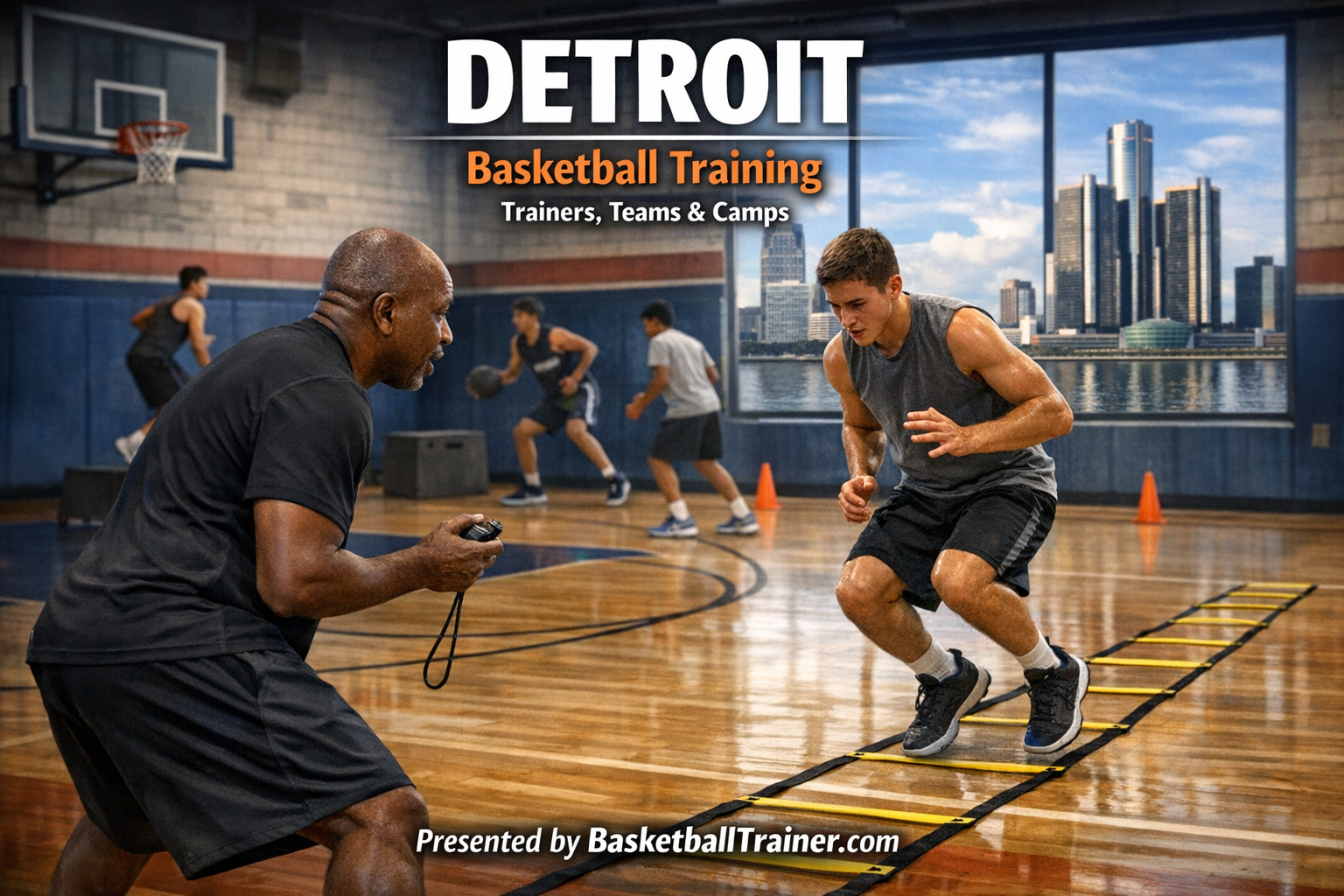
Detroit Basketball Trainers
Detroit’s basketball training landscape reflects the city’s deep basketball culture — programs here tend to be community-rooted, development-first, and honest about what they offer. Use the evaluation questions later on this page when reaching out to any trainer or program.
The Factory Basketball Training
One of Metro Detroit’s most credentialed training programs, The Factory operates out of Westland — serving West Detroit, Livonia, Farmington Hills, Southfield, Canton, and Plymouth families who want serious development without the drive into the city. The staff roster stands out: Coach Shae Oleta Smith (Pistons Jr. NBA Coach of the Year recipient), Coach Kate Sherwood (Wayne State D2, two-time ALL-GLIAC honoree), Coach Jalen Sykes, and Coach Andrew Leamy (Henry Ford CC national tournament, University of Michigan-Dearborn). More than 50 athletes have gone on to play college basketball at levels from D1 through JUCO since the program launched. Services include private lessons, small group training, 75-minute Skills and Shooting Classes, an Elite Training Service combining film review with on-court work, and a Saturday Youth Instructional Program for grades 1-6. A free 30-minute skills assessment is available for new families. Individual sessions typically run $50-80; group skills classes average $25-40 per session. Best for West Side Detroit families and suburban players seeking college-track development under coaches with genuine credentials.
Pro Skills Basketball Detroit
Pro Skills Basketball Detroit is the official Jr. NBA Flagship Organization for the Detroit market — a designation from the NBA’s youth development arm that requires demonstrated coaching quality and program structure. Director Blair Ramsey has served as Freshman Head Coach and Varsity Assistant at University of Detroit Jesuit High School since 2018, and played D3 basketball at East Stroudsburg University where he earned the Basketball Leadership Award. The program runs club teams for boys grades 3-10 alongside Shooting Academies, Player Development Academies, and clinics. PSB Detroit’s structure is a good fit for families who want both skill instruction and organized competitive team experience under the same program umbrella. Season fees typically run $800-1,500 depending on age group and competitive level. Best for boys grades 3-10 whose families want a development-first philosophy with the infrastructure of a nationally affiliated program.
Purpose Basketball Training (Coach Jon Hovermale)
Coach Jon Hovermale brings a college coaching background to individual and group skill work — he served as Graduate Assistant at Siena Heights University (2020-2022) and as Assistant Director at Hamm Hoops (2018-2020) before launching Purpose Basketball Training. He played college ball at Siena Heights (NAIA). Purpose offers 1-on-1 sessions (one hour), group training for 2-5 players, and team training for 6+ players that incorporates pick-and-roll concepts and defensive schemes. Hovermale also runs the Michigan Cobras, a girls AAU program with teams across multiple age groups — one of the more affordable competitive options in the market at $500 for a full season. Private sessions run approximately $50-70 per hour. Best for players wanting fundamentals-focused individual work and for families with daughters looking for an accessible girls AAU entry point.
Blade Basketball Training
Blade Basketball Training offers both skill development services and a competitive travel team (BBT Elite) affiliated with the Puma-sponsored NXT Pro Circuit — one of the nation’s top AAU circuits with exposure to college coaches at NCAA-certified events. For families who want their child training and competing under the same coaching staff and system, this is a compelling one-stop option. Services include group lessons, private lessons, camps, and spring break camps. Individual sessions typically run $40-70. The travel team side carries additional season costs comparable to other elite AAU programs. Best for players who want training and competitive team experience integrated rather than kept separate, and who have the time and budget for a circuit team commitment.
Independent Detroit Coaches (Athletes Untapped / CoachUp)
Detroit’s deep basketball pipeline means independent trainers are plentiful — former college and pro players offering private lessons on their own schedule at local gyms, parks, and recreation centers. Platforms like Athletes Untapped and CoachUp list verified Detroit-area coaches with ratings and backgrounds. One notable example on the platform: a former D1 player at the University of Detroit Mercy with five years of professional experience overseas. Rates on these platforms in the Detroit market typically run $30-100 per session depending on credentials and session length. This is the most flexible option for families who need variable scheduling or want to try training before committing to a structured program. Best for budget-conscious families, families with unpredictable schedules, or players who want to sample different training styles before committing.
Detroit Basketball Camps
Detroit basketball camps run primarily June through August with some spring break options available. Programs range from affordable city recreation offerings to D1 facility experiences. The range in price reflects genuine differences in instruction quality, facility access, and coach credentials — not just branding.
University of Detroit Mercy Basketball Camps
University of Detroit Mercy offers youth camps run by D1 coaching staff at historic Calihan Hall — the same floor where the Titans compete in the Horizon League. Coach Mark Montgomery (hired 2024) and his staff bring NCAA-level instruction to players who want a genuine college basketball environment. For Detroit families, the UDM camp provides access to D1 facilities and coaching without traveling to Ann Arbor or East Lansing. Week-long sessions typically run $150-300 per week depending on age group and camp type. Best for older players (middle school through high school) who are serious about basketball development and motivated by the college environment as a goal-setting experience.
Detroit Pistons Academy
Backed by the Pistons franchise, the Detroit Pistons Academy runs Saturday league programs at Royal Oak High School with NBA-level branding, game tickets for participants, award ceremonies, and the kind of production value that makes young players feel like they’re part of something bigger than a local rec league. Sessions include music, player introductions, and structured competition. Pricing runs approximately $80-150 per league season — making this one of the more accessible branded programs in the market. Best for younger players (elementary through middle school) who respond to the motivational environment of professional sports branding and structured Saturday programming that fits busy family weekend schedules.
MWA Elite D-Leagues (Metro Detroit’s Longest-Running League)
MWA Elite has been running the D-Leagues program for 20+ years — the longest-running basketball league in Southeast Michigan. Based at DCP-Harper Woods (19360 Harper Ave, Harper Woods), it serves boys and girls from ages 3-18 across five seasons per year. Local teams practice twice weekly at Basketball City and play a 10-game regular season schedule. For East Side Detroit families and those near the I-94 corridor, Harper Woods is highly accessible. The D-Leagues format is structured like a real league — rosters, schedules, referees, standings — which gives kids genuine competitive game experience without the travel costs of AAU. Pricing typically runs $200-400 per season for local league participation. Best for families wanting organized game experience in a neighborhood-accessible setting without tournament travel commitments.
YMCA of Metro Detroit Basketball Camps
YMCA of Metro Detroit branches offer traditional week-long summer basketball camps with non-competitive instruction for ages 5-14. Camp fees run $75-130 per week depending on YMCA membership status, with financial assistance available through their scholarship program. The Y’s approach emphasizes fun, teamwork, and character development — a good entry point for kids new to basketball who might be overwhelmed by the intensity of more competitive programs. Extended-hour options (7am-6pm) make pickup and drop-off manageable for working parents. The Y’s “no child turned away” financial assistance policy is real — ask about it when registering. Best for younger beginners and families needing summer childcare alongside structured basketball activity.
City of Detroit Parks & Recreation Basketball Programs
Detroit’s Parks & Recreation department runs summer basketball programming across its network of 15+ recreation centers. For Detroit residents ages 13-24, summer free passes provide access to recreational facilities. City-run programs are the most affordable entry point in the Detroit market — often $0-30 for residents with qualifying passes, and $60-100 for structured camp programs. Registration happens through the RecTrac portal (dprd.detroitmi.gov). Priority and pricing advantages go to Detroit residents, which matters in a city where many families are navigating tight budgets. Best for Detroit-resident families seeking affordable recreational basketball access, especially as a starting point before evaluating private training investments.
Detroit AAU & Select Basketball Teams
Detroit’s select basketball scene is competitive by any national standard — the city that produced Isiah Thomas, Chris Webber, Spencer Haywood, and Chauncey Billups takes youth basketball seriously. Most select teams compete in regional tournaments March through August with tryouts in February-March. Tournament travel typically includes Lansing, Grand Rapids, Cleveland, Indianapolis, and Chicago — factor that into your budget conversation before committing.
Michigan Playmakers
Founded by former Bishop Borgess High School players, Michigan Playmakers has built one of the most impressive track records in the state: 95%+ of their first three graduating classes went on to play college basketball at some level, with 100+ total kids receiving scholarships since the program launched. That’s not marketing — it’s a genuine outcome record that separates Playmakers from programs that talk development but measure success in tournament wins. Teams available for both boys and girls starting as young as ages 4-10. Annual fees typically run $800-1,800 depending on age group and competitive level. The culture is described as family-oriented — coaches who know your child’s name and are invested in outcomes beyond their own coaching record. Best for families who want a proven long-term development pathway and care more about college outcomes than bracket results.
MWA Elite Basketball Club
MWA Elite’s club division is separate from the D-Leagues local program — this is the competitive travel arm. Based at DCP-Harper Woods (19360 Harper Ave), State Level teams play 45-50 games per season on a regional travel circuit. Club Director Keith Paris brings extensive high school and college coaching experience to the program. Local competitive teams run approximately $400-800 per season; State Level teams are $1,500-2,500. Families should note the program’s non-refundable policy after seven days — this is worth understanding before signing commitment paperwork. Best for East Side and Harper Woods-area families with competitive players in 2nd through 6th grade who can handle a high-volume game schedule and regional travel.
Factory Basketball Travel Teams
The Factory’s travel team program serves boys and girls across Wayne, Oakland, and Washtenaw counties — a geographic footprint that reflects West Detroit, suburb, and Ann Arbor-corridor families. For the 2025-26 winter season, team fees are $1,450, which covers practices, skills sessions, insurance, coaches’ stipends, and game fees. That transparency in cost structure is worth noting — many programs advertise a team fee and then layer on additional charges throughout the season. Factory Travel is better suited for families who want the training program and competitive team experience under the same coaching staff that’s already teaching skills during the week. National-level teams exist for the most committed players; local options serve developmental players. Best for West Detroit and suburban families whose player is already working with Factory coaches and wants to compete as well.
Pro Skills Basketball Detroit Club Teams
PSB Detroit’s club team program flows directly from the development academies — players build skills in their shooting and player development programs, then step into structured club team competition. Director Blair Ramsey’s connection to University of Detroit Jesuit High School means older players get exposure to a college-prep basketball environment. Teams serve boys grades 3-10 with a Jr. NBA philosophy emphasizing development over wins. Season costs run $800-1,500 depending on level. The advantage here is continuity — same coaching staff for skills training and game coaching, which means what’s taught in practice actually shows up on game day. Best for boys grades 3-10 whose families want development-first culture with organized competitive experience in the same program.
Michigan Cobras (Girls AAU)
The Michigan Cobras, run by Coach Jon Hovermale of Purpose Basketball Training, is one of the most accessible girls AAU programs in the Detroit market. At $500 for a full season — covering multiple age groups — this represents genuine value compared to most select programs that start at $800-1,000 before travel. Hovermale’s college coaching background at Siena Heights and Hamm Hoops informs a development-focused approach rather than a win-at-all-costs AAU culture. For families with daughters who want their first experience on a structured travel team without a $1,500+ initial commitment, the Cobras deserve a serious look. Best for girls seeking an affordable first AAU season or for families evaluating whether competitive basketball is the right fit before committing to a higher-cost program.
Michigan Crossover (Girls Elite)
Michigan Crossover is the top end of girls AAU basketball in Michigan — a Nike Girls EYBL affiliated program founded in 1997 with teams from ages 10-18. The Nike EYBL circuit is the most visible girls platform for college recruitment, featuring live periods attended by coaches from D1 programs nationwide. This is not a developmental or introductory program — it’s for players who are already serious competitors and whose families understand the time and financial commitment of a national circuit. Annual costs reflect the EYBL level of competition. Best for highly skilled girls ages 10-18 who are targeting D1 college basketball and need elite-circuit exposure to be evaluated by college programs at the highest level.
Detroit High School Basketball
Detroit’s Public School League (PSL) is one of the most storied high school basketball conferences in the United States. Twenty high schools governed by MHSAA compete for the PSL City Championship — a title that carries real weight in a city where basketball is taken seriously at every level. School team tryouts typically occur in October-November.
Detroit Public Schools Community District (DPSCD) — Public School League
Historic Powerhouse Programs:
- Pershing High School — The all-time dominant program in Detroit basketball. Five Class A state titles, four Mr. Basketball winners, eight PSL City Championships. Alumni include Spencer Haywood (NBA star, Olympic gold medalist) and Steve Smith (NBA All-Star). The gold standard for Detroit high school basketball history.
- Southwestern High School — Under Coach Perry Watson in the 1980s and ’90s, Southwestern won three Class A state championships and became one of the most feared programs in Michigan. Watson later went on to coach at the University of Detroit Mercy.
- Cooley High School — Won three consecutive Class A state titles (1987, 1988, 1989) — a three-peat that remains one of the most impressive runs in Michigan high school basketball history.
- Renaissance High School — Two Class B state titles (2004, 2006). Cass Technical High School draws high-achieving students from across the city and has produced notable athletic and academic alumni.
- Cass Technical High School — Detroit’s premier academic-athletic institution, ranked #1 IB World School in Detroit. Strong athletics alongside rigorous academics.
Additional PSL Programs:
- Osborn High School, Martin Luther King Jr. High School, Southeastern High School
- East English Village Preparatory Academy, Mumford High School, Denby High School
- All PSL schools field boys and girls varsity and JV programs governed by MHSAA
Private & Charter Schools
- University of Detroit Jesuit High School & Academy — Strong academic-athletic tradition, competes in the Detroit Catholic League. Draws students from across the metro area; connection to UDM basketball pipeline.
- Detroit Country Day School — Private school in Beverly Hills (suburb), historically competitive basketball program drawing from Detroit families seeking the private school environment.
The PSL City Championship game is a genuine community event in Detroit — not just a high school sports final but a celebration of neighborhood identity. Families new to Detroit basketball should understand that school affiliation carries cultural weight in the city that goes beyond win-loss records.
How to Use These Listings
These are Detroit trainers, camps, and teams that families in the area work with. We don’t rank them as “best” or endorse specific programs. Use the evaluation questions in the next section when contacting any of these options. The right fit depends on your child’s age, skill level, and goals, your family’s schedule and budget, and where you live in Detroit’s sprawling geography. Contact 2-3 options before committing to see which feels right for your family.
Detroit Recreation Centers: Basketball on a Budget
Before spending hundreds on private training, understand Detroit’s network of 15+ municipal recreation centers. The City of Detroit has invested $45 million (including $30M in ARPA funds) to renovate facilities across the city — several are genuinely excellent basketball venues. Drop-in access for Detroit residents ages 13-24 is free during summer months. Here’s what families actually need to know.
West Side / Northwest: The Community Anchors
Adams Butzel Complex
Address: 10500 Lyndon, Detroit (Northwest Side)
One of the largest recreation complexes on the West Side, Adams Butzel serves a high-traffic Northwest Detroit corridor. Basketball courts available for open play and organized leagues. The surrounding neighborhood includes deep basketball history — Pershing HS is not far, and the pickup culture runs strong here.
Best For: Northwest Detroit families wanting accessible drop-in basketball without cross-city commutes. Livernois Ave and McNichols Rd provide straightforward access from most West Side neighborhoods.
West Side Alternatives
Kemeny Recreation Center — Southwest Detroit / Delray neighborhood
Renovated in 2019 as part of the city’s rec center investment push. Serves the Southwest Detroit community including a large Latinx population. Basketball courts alongside other programming.
Patton Recreation Center — Southwest Detroit
Community anchor for Southwest Detroit. Lower traffic than Northwest flagships — useful for players wanting less competition for court time during weekday afternoons.
East Side: The Neighborhood Hubs
Butzel Family Center
Address: 7737 Kercheval Ave, Detroit (East Side)
The East Side’s most-used basketball facility, Butzel Family Center sits in East English Village — one of the more stable East Side neighborhoods with deep community investment. The “Family Center” designation reflects programming aimed at multiple age groups simultaneously, which creates a welcoming environment for youth players.
Commute Tip: East Jefferson Ave and Kercheval Ave provide direct access from most East Side neighborhoods. I-94 exit at Conner Ave gets you here in under 10 minutes from the Near East Side.
Far East Options
Heilmann Recreation Center — 19601 Crusade St (Far East)
Deep Far East Detroit facility serving families in the Morningside and East English Village corridors who are too far from Butzel for a quick trip. Basketball courts and programming. The Far East is close to Harper Woods — MWA Elite is accessible from here.
Clemente Recreation Center, Brennan Recreation Center, Tindal Recreation Center
East Side community centers with basketball facilities. Lower drop-in traffic than flagship centers — good for uninterrupted practice time on weekday afternoons before the after-school rush begins.
Northeast / Banglatown: The Diversity Corridor
Lasky Recreation Center
Address: 13200 Fenelon St, Detroit (Northeast / Banglatown area)
Lasky serves one of Detroit’s most culturally diverse corridors — Yemeni, Bangladeshi, Polish, Bosnian, and Black Detroit families all use this facility. The rec center functions as a genuine community anchor in a neighborhood that doesn’t have many alternatives. Basketball programming here reflects the neighborhood’s mix, with younger players of diverse backgrounds training alongside each other.
Access: Gratiot Ave and I-75 both connect to this corridor; Osborn HS and King HS are in this zone.
Northeast Backup Option
Farwell Recreation Center — 2711 E. Outer Dr.
Tennis courts plus gym access. A secondary option for Northeast families when Lasky is at capacity for structured programming. East Outer Drive connects to both I-75 and Gratiot Ave.
Downtown / Southeast: The Renovated Anchor
Coleman A. Young Recreation Center
Address: 2751 Robert Bradby Dr (Southeast / Near Rivertown)
Named after Detroit’s first Black mayor, the Coleman A. Young Recreation Center recently reopened after an $11 million renovation — one of the most significant investments in any single Detroit recreation facility. Updated facilities now make this a legitimately attractive option for Southeast Detroit families who previously had fewer quality options in this part of the city.
Note: The center has swimming and racquetball alongside basketball — the multi-sport environment makes this appealing for families whose kids want options beyond just hoops.
How to Access Detroit Recreation Centers
Registration is required. Detroit residents ages 13-24 qualify for free summer passes. All others use the RecTrac portal to register and pay drop-in or membership fees.
What You Need:
- Child + Original Birth Certificate or School ID
- Parent / Guardian Identification
- Detroit residency documentation (for resident pricing / free passes)
Register at:
- Online: dprd.detroitmi.gov (RecTrac portal)
- In Person: At any Detroit Parks & Recreation facility
Detroit Resident Ages 13-24: Free Summer Access
The most affordable basketball in Michigan.
📍 Insider Note: Detroit’s rec center renovation program ($45M investment) means facilities that were run-down five years ago have been genuinely upgraded. Worth visiting your nearest facility before assuming the condition you remember from a few years back is still accurate. Many centers are significantly better than their reputation suggests.
Evaluating Basketball Training Options in Detroit
These questions help you assess trainers, camps, and teams based on what matters for YOUR family. We provide evaluation frameworks — not recommendations. Your geography, budget, and child’s goals determine what’s right for you.
Questions to Ask Private Trainers
Why this matters in Detroit: A trainer based in Westland is great for West Side families but means an hour round-trip for someone in the Far East. Always establish geography before getting excited about credentials.
Why this matters: A trainer who primarily works with high school varsity players may not be the right fit for a 4th grader, even if their credentials are impressive.
Why this matters: Vague promises about “improvement” mean nothing. “Your child will complete this drill at game speed” or “free throw percentage will improve by 20%” = clarity you can evaluate.
Why this matters in Detroit: Several programs (including The Factory) offer free assessments. This lets you evaluate the coaching relationship before committing money. Always ask — programs that don’t advertise it may still offer it.
Why this matters: Life happens. Understanding policies before paying protects your investment and tells you something about how the trainer treats their clients.
Questions to Ask About Camps
Why this matters: 1 coach per 20 kids = organized daycare. 1 coach per 8 kids = actual instruction. Ask before registering.
Why this matters: Both are legitimate — but they deliver very different experiences. A camp that runs scrimmages all day teaches different things than one that does skill stations all morning.
Why this matters in Detroit: In a city with a 34% poverty rate, many legitimate programs offer need-based scholarships they don’t advertise prominently. Asking never hurts — it might open an option you assumed was out of reach.
Questions to Ask About AAU/Select Teams
Why this matters in Detroit: Detroit teams typically travel to Lansing, Grand Rapids, Cleveland, Indianapolis, and Chicago. That’s hotel rooms, gas, food. Get the full travel calendar before committing.
Why this matters: A “$1,500 team fee” can easily become $3,500-4,000 when hotels, travel, and food are added. Always get total cost in writing, not just team fees.
Why this matters: MWA Elite, for example, has a non-refundable policy after seven days. That’s not unusual — but you need to know before you sign. Injury, family situations, and just deciding the program isn’t a fit all happen.
Detroit Pricing Reality Check
City Rec Programs (residents): Free–$100 per season (best deal in Michigan)
Private Training (individual): $30–$100 per session
Small Group Training: $150–$300 per month
Summer Camps: $75–$300 per week depending on facility and instruction level
AAU/Select Teams: $500–$2,500 team fees, plus $1,500–$3,500 additional travel costs for competitive teams
Investment vs. Outcome Honesty
Isiah Thomas got his start at St. Cecilia’s, a community gym on the West Side. The path to basketball development in Detroit has never been about spending the most money — it’s been about showing up, competing hard, and finding the right community. A $500 Michigan Cobras season might be exactly right for your daughter. The city rec program might be the perfect starting point for your son. What matters is sustainable commitment over years, not the highest-priced option in year one. The families who navigate this best are the ones who are honest about their budget and find a program that fits it — not the ones who overextend and burn out.
Free Detroit Basketball Training Evaluation Guide
Download our comprehensive guide with Detroit-specific considerations, red flags to watch for, and questions to ask before committing to any program.
Detroit Basketball Season: What to Expect
Understanding when different basketball programs run in Detroit helps families plan ahead rather than scramble. This calendar shows typical timing — not deadlines you must meet.
High School Season (MHSAA)
Typical Timeline: First practices mid-October, games begin early November, PSL playoffs through January-February, MHSAA state tournament late February/early March.
Detroit Specifics: The PSL City Championship game typically draws significant community attention — it’s a genuine event in Detroit basketball culture. School season runs October through March and should be treated as your child’s primary commitment during those months.
AAU / Select Basketball Season
Typical Timeline:
- February-March: Tryouts (often during school season — expect schedule juggling)
- March-April: Spring tournaments begin after school season wraps
- April-June: Regional circuit season (Lansing, Grand Rapids, Cleveland, Indianapolis)
- June-August: Peak summer tournaments (potential national travel for elite programs)
- September: Fall ball winds down before next school season begins
Basketball Camps
- May-June: Early summer camps launch (UDM, Factory, Pistons Academy)
- June-July: Peak camp season across Metro Detroit
- July-August: Final summer opportunities; some spring break options in March/April
Year-Round Municipal Programs
Detroit Parks & Recreation runs programming across 15+ facilities throughout the year. MWA Elite’s D-Leagues runs five seasons annually, providing near year-round game access for East Side families. The rec center system — combined with the city’s free summer access for residents ages 13-24 — creates an affordable baseline that many Detroit families use before, or instead of, private training investment.
Registration Note: Many Detroit city programs require advance registration through the RecTrac portal. First-time families should expect to bring documentation (birth certificate, proof of residency) and plan for a registration process rather than just showing up. It’s worth doing once — then access becomes easy.
Detroit’s Basketball Culture & Heritage
You cannot understand Detroit basketball training without understanding where Detroit basketball comes from. This city’s culture — the Bad Boys, the Public School League, and most of all, a gym on Stearns and Livernois — created the context that every trainer and program here operates within.
St. Cecilia’s Gym: “Where Stars Are Made, Not Born”
There is no more important place in Detroit basketball history than St. Cecilia’s Gym at the corner of Stearns and Livernois on the West Side. Sam Washington Sr. founded the program in 1967 as a safe haven during the Detroit riots — a place where young people could play basketball instead of getting caught up in what was happening outside. What he built became something no one could have predicted.
In 1974, Dave Bing was in a contract dispute with the Pistons. He needed a place to stay sharp. He went to St. Cecilia’s. NBA players followed. Word spread. Over the next several decades, more than 107 players who came through St. Cecilia’s went on to play in the NBA. The list is almost impossible to believe: Isiah Thomas. Magic Johnson. George Gervin. Chris Webber. Jalen Rose. Spencer Haywood. Derrick Coleman. Earl Cureton. “Where Stars Are Made, Not Born” became the slogan on the gym floor because it was simply true.
In 2022-23, the Detroit Pistons wore St. Cecilia-themed green jerseys in tribute — with rapper Big Sean collaborating on the design. The Ceciliaville nonprofit is currently raising $20 million to restore the facility, and the Pistons have contributed $250,000 to the effort. St. Cecilia’s is Detroit’s version of Rucker Park in New York or the Drew League in Los Angeles — but it came first, and in many ways went deeper.
For families new to Detroit, this matters because it explains why Detroit basketball culture values authenticity and community over flash and marketing. The programs with the best track records here aren’t the ones with the biggest logos — they’re the ones that understand what Sam Washington Sr. was doing in 1967.
The Bad Boys and Detroit’s Identity
The Detroit Pistons won back-to-back NBA Championships in 1989 and 1990 with a physical, defensive, blue-collar team that reflected the city’s identity. Isiah Thomas, Joe Dumars, Bill Laimbeer, Dennis Rodman, Vinnie Johnson — the Bad Boys played the way Detroit worked: hard, uncompromising, and proud of it. Then in 2004, a team without a single true superstar — Chauncey Billups, Rip Hamilton, Tayshaun Prince, Ben Wallace, Rasheed Wallace — beat the Lakers in five games. Billups was inducted into the Hall of Fame in 2024, joining Isiah Thomas, Joe Dumars, Dave Bing, Grant Hill, and Dennis Rodman from Detroit’s championship eras.
Dave Bing — Hall of Famer and St. Cecilia’s regular — went on to become Mayor of Detroit from 2009 to 2014. Cade Cunningham carries the franchise now, averaging over 27 points and nearly 10 assists per game for a young Pistons team that plays at Little Caesars Arena downtown.
The Public School League Legacy
The PSL isn’t just a high school conference — it’s a civic institution. Pershing High School’s five state championships and four Mr. Basketball winners represent the peak of a tradition that runs through every neighborhood in Detroit. Families who move here from other cities are sometimes surprised by how seriously the community takes PSL basketball. That’s not excessive — it’s a city with generations of basketball pride that has created a training environment where expectations are high and the culture is real. Programs that understand this context, rather than importing generic youth sports approaches from elsewhere, are the ones that serve Detroit families best.
Frequently Asked Questions About Detroit Basketball Training
The questions Detroit families ask most often about youth basketball programs, costs, and timing.
How much does basketball training cost in Detroit?
Detroit basketball training costs vary significantly. For Detroit residents, city rec programming can be free (ages 13-24 in summer) or very low cost. Private individual sessions run $30-100 depending on trainer credentials. Small group training typically runs $150-300 per month. Summer camps range from $75-300 per week. AAU/select teams start at $500 (Michigan Cobras) and go to $2,500 for elite programs — then add $1,500-3,500 in travel for competitive teams. Many programs offer financial assistance; in a city with a 34% poverty rate, legitimate organizations understand that access matters. Always ask about scholarships before assuming a program is out of reach.
When do AAU basketball tryouts happen in Detroit?
Most Detroit-area AAU teams hold tryouts in February and March — during the high school basketball season, which creates schedule conflicts for players on school teams. Teams set rosters before spring tournaments begin in late March and April. Some programs offer rolling admissions or second tryout periods in May or June. Contact teams in December or January to understand their specific process for the upcoming season. Programs like MWA Elite and Factory Basketball tend to be well-organized about communicating tryout timing.
What’s the best age to start basketball training in Detroit?
There’s no single right answer. Many Detroit families start with recreational programs at ages 5-7 through N Zone Sports, YMCA, or city rec leagues. Private instruction becomes more productive around ages 8-10 when kids can focus on specific mechanics. Detroit-area AAU programs start as young as 4U and 6U (Michigan Playmakers), but most families wait until 10U or 11U when kids can handle travel tournament commitments. The most important variable isn’t age — it’s your child’s genuine interest and your family’s capacity for the time and financial commitment.
Are Detroit’s recreation centers actually good for basketball?
More than many people assume. The city’s $45M rec center renovation program has genuinely upgraded facilities that were run-down a decade ago. Coleman A. Young Recreation Center reopened after an $11M renovation. Adams Butzel Complex, Butzel Family Center, and Lasky Recreation Center all provide solid basketball court access at minimal cost. The free summer access program for Detroit residents ages 13-24 means a serious young player can log consistent court time at essentially no cost. That’s a meaningful resource, especially as a starting point before evaluating private training investment.
Which side of Detroit has the best basketball training options?
All areas of Detroit have quality options — the “best” side depends on where you live. West Side/Northwest families have strong rec center access (Adams Butzel) and proximity to suburban training facilities in Westland and Livonia. East Side families are close to Butzel Family Center, Heilmann, and MWA Elite in Harper Woods. Northeast families anchor around Lasky Recreation Center. Downtown and Midtown families have access to UDM’s Calihan Hall for camps. The most consistent answer to this question is: the best side is the one you’re already on. Sustainable training commitment requires manageable commutes — a program 15 minutes away you’ll actually attend beats a program 45 minutes away that you’ll eventually quit.
Should my child do AAU basketball in addition to their school team?
Many Detroit players do both — but it requires coordination. School season runs October through March; AAU peaks April through August. The overlap period (February-March tryouts during school playoffs) can be genuinely challenging. Some PSL coaches discourage AAU during school season; others support it. The key is communicating with your school coach before committing to an AAU program. Be honest about your child’s physical capacity — some thrive on year-round basketball, others burn out. A player who burns out in 8th grade and quits is worse off than one who paced themselves and played four years of high school ball.
Detroit Basketball Training Options at a Glance
This table helps Detroit families understand cost, time commitment, and best use cases across different training options.
| Training Option | Cost Range | Best For | Time Commitment |
|---|---|---|---|
| City Rec Programs (Residents) | Free–$100/season | Beginners, recreational play, budget-first families | Drop-in or seasonal leagues |
| Private Training (Individual) | $30–$100/session | Specific skill gaps, pre-tryout prep, flexible schedules | 1-2 sessions/week, year-round or seasonal |
| Small Group Training | $150–$300/month | Consistent development, cost-effective vs. individual | 2-4 sessions/week |
| Summer Basketball Camps | $75–$300/week | Summer skill building, first exposure, childcare alternative | 1-2 week camps, June-August |
| AAU/Select Teams | $500–$2,500+ (plus travel) | Competitive players, college recruitment exposure | 6-8 months, 2-3 practices/week, weekend tournaments |
Note: Costs represent typical Detroit-area ranges as of 2026. Many programs offer financial assistance, need-based scholarships, or sliding-scale pricing. Always ask.
Getting Started with Basketball Training in Detroit
If you’re new to Detroit basketball or just starting your child’s training journey, here’s a practical path forward without the noise.
Step 1: Define Your Goals
Are you trying to help your child make their school team? Learn the game while staying active? Compete at a high level? Your goal changes what type of program makes sense. Many Detroit families start with the city rec program or a YMCA camp before deciding whether to invest in private training. There’s no “right” starting point — just an honest one.
Step 2: Map Your Geography
Which side of the city are you on? A program 15 minutes away that you attend consistently beats one 45 minutes away that you eventually quit. Detroit’s cross-city drives are manageable off-peak but brutal at rush hour. Be honest about what your family will actually sustain over a 6-month commitment.
Step 3: Contact 2-3 Options
Use the evaluation questions from this page. Review the trainer, camp, and team profiles above. Reach out to 2-3 that match your geography and goals. Ask about approach, experience with your child’s age group, schedules, and costs. Several programs — including The Factory — offer free initial assessments.
Step 4: Trust Your Gut
After conversations and trial sessions, pay attention to how your child responds. Does the trainer see your child as an individual? Does the coach communicate clearly with you? Does the commute actually work? The “less credentialed” program that your child is excited about three months in will produce better results than the impressive-on-paper program they’re dreading.
Free Basketball Training Evaluation Guide
Download our comprehensive guide with specific questions to ask trainers, camps, and teams before committing to any program.
Detroit Quick Links
Basketball Resources
About BasketballTrainer.com
© 2026 BasketballTrainer.com. All rights reserved. Detroit, Michigan basketball training resource. Context, not direction.