Green Bay Basketball Training – Trainers, Camps & Teams
Green Bay basketball training spans a compact 56-square-mile city surrounded by a 330,000-person metro. This page helps families understand the 920’s unique geography, frozen-tundra winter schedules, and decision frameworks — not prescribe solutions.
Basketball Trainers
Basketball Camps
Select Teams
YMCA Locations
⚡ Looking for Basketball Training Options?
Skip the background info — jump straight to what you need:
Why This Green Bay Basketball Resource Exists
Green Bay’s 106,000+ residents and a 330,000-person metro create dozens of basketball training options spread across a compact city and its surrounding suburbs. This page helps families understand Green Bay’s unique geography, frozen-tundra indoor schedule, and decision frameworks — not prescribe solutions. The right program near the East Side UWGB corridor might look very different from what works best for a family in De Pere or Howard.
Our Approach: Context, Not Direction
We don’t rank trainers or camps as “best” — we help you understand what makes different programs right for different needs. The best fit depends on your child’s age, skill level, goals, your family’s schedule, budget, and which corner of the greater Green Bay area you call home. Learn how BasketballTrainer.com works • Read our editorial standards
Understanding Green Bay’s Basketball Geography
Green Bay is far more compact than most cities its metro size — at 56 square miles, cross-town drives are 15-25 minutes, not 45. The Fox River bisects the city into east and west. Where you live shapes which high school your child attends, which AAU programs are convenient, and whether UWGB’s campus courts or the western YMCA makes more logistical sense for weeknight training.
East Side / UWGB Corridor
What to Know: Home to University of Wisconsin-Green Bay, the Kress Events Center training facility, and Green Bay Preble High School — the largest school in the district. The fastest-growing residential corridor.
- Commute Reality: 15-20 minutes to West Side; minimal traffic even at peak hours
- School District: GBAPS — Preble High School (2222 Deckner Ave)
- Basketball Anchor: UWGB Kress Events Center, D1 coaching staff access
West Side / Ashwaubenon
What to Know: The commercial and entertainment hub. Home to the Resch Center arena, Bay Park Square mall, and the airport. Ashwaubenon is an independent suburb stitched right into Green Bay’s western edge.
- Commute Reality: 10-15 minutes to downtown; 20 minutes to East Side
- School Districts: GBAPS (Southwest, West high schools), Ashwaubenon school district
- Basketball Anchor: West Side YMCA (601 Cardinal Ln), multiple training gyms
Downtown / Central
What to Know: Historic heart of the city along the Fox River. Green Bay East High School sits here. Broadview YMCA (235 N Jefferson) provides the central area’s most accessible community courts.
- Commute Reality: Centrally located — 10-15 minutes to most neighborhoods
- School District: GBAPS — Green Bay East (1415 E Walnut St)
- Basketball Anchor: Broadview YMCA, city Open Gym at school facilities
South Suburbs (De Pere / Allouez / Bellevue)
What to Know: De Pere (25,000 residents) is the area’s largest suburb and home to Saint Norbert College — a D3 basketball program that serves as an accessible pipeline for development camps. Family-oriented, slightly lower cost of living than Green Bay proper.
- Commute Reality: 10-15 minutes to downtown Green Bay via US-41
- School Districts: De Pere, West De Pere, Allouez (Preble feeder)
- Basketball Anchor: Saint Norbert College camps, De Pere/West De Pere programs
The Green Bay Advantage: Nothing Is Really Far
Unlike major metros where cross-town drives can eat 45+ minutes, Green Bay’s compact geography means almost any training option in the city core is 20 minutes or less from home. The bigger factor is which suburb you’re in — families in Howard (20,000 residents north of the city) or Suamico may add 15 minutes to options concentrated south of US-29. But compared to cities like El Paso or Dallas, geography is much less of a barrier here. The real decision factors in Green Bay tend to be budget, competitive level, and winter scheduling flexibility.
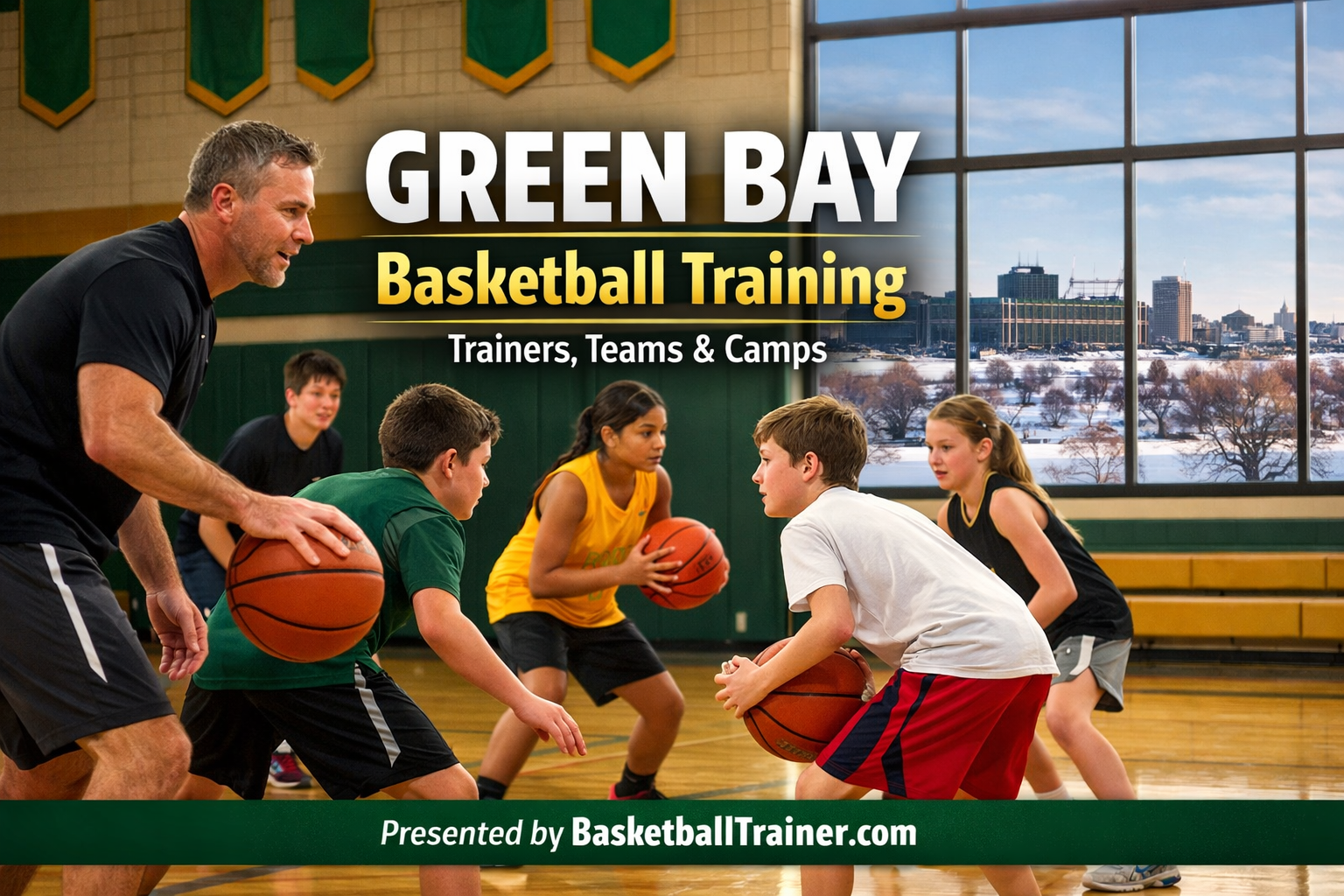
Green Bay Basketball Trainers
These Green Bay basketball trainers work with players across skill levels throughout the 920 area. Green Bay’s tight geography means most trainers can be accessible from anywhere in the metro — factor in their specialty and approach over location when evaluating your options.
Ryan Borowicz Basketball
Ryan Borowicz is a long-established name in Green Bay basketball circles, offering individual training and basketball camps year-round. His program is referenced by Green Bay Southwest High School’s basketball program as a trusted off-season development resource — a meaningful endorsement in a community where high school coaches carry significant influence. Borowicz works with players at multiple skill levels and age groups, focusing on skill refinement and preparation for school team tryouts. For families navigating their first experience with private basketball training in Green Bay, Borowicz’s reputation within the high school community makes him a natural first contact. Reach out directly to discuss scheduling, pricing, and whether his style matches your child’s learning needs.
Harry Boyce Basketball
Harry Boyce offers both camps and individual basketball training in the Green Bay area and is similarly cross-referenced by area high school programs as a go-to development option. His training approach draws from competitive experience and emphasizes both the technical and mental aspects of player development. Like Borowicz, Boyce is embedded enough in the local basketball community that area coaches are familiar with his work — something worth asking about when evaluating whether the training translates to on-court preparation for school teams. Boyce offers camp programs as well as individual sessions, giving families flexibility based on what’s most useful at a given point in the season.
Playpen Sports Academy
Playpen Sports Academy operates in Green Bay with a developmental approach specifically designed for early-age players — their “Tiny Tot Hoopers” and “Tot Shot Hoopers” programs target toddlers through elementary school with childhood development-first programming. Classes emphasize physical fundamentals like balance, coordination, and hand-eye coordination while naturally introducing basketball concepts. This is a strong option for families with young children (ages 2-8) who want structured introduction to the sport in a low-pressure environment. For parents wondering whether their child is “ready” for basketball, Playpen’s developmental philosophy meets kids exactly where they are rather than expecting them to keep pace with older or more experienced players.
The Workshop Basketball Training (Hobart)
The Workshop Basketball Training is located in Hobart, Wisconsin — a suburban community that borders Green Bay’s southwest edge — and consistently appears among the area’s most-reviewed basketball training facilities. For families on the West Side, Ashwaubenon, or De Pere, Hobart is a reasonable commute (typically 10-20 minutes) without the congestion of navigating into the city core. The Workshop focuses on skill development for serious players seeking structured improvement in game-specific situations. This is generally a better fit for competitive-level players in middle or high school range who have established fundamentals and want to refine them, rather than complete beginners looking for introductory instruction.
ETS Performance (Green Bay)
ETS Performance offers sports performance and basketball-specific athletic development training in Green Bay. The program was built by Alex, a former collegiate track All-American who applies sports science principles to athlete development rather than focusing solely on basketball skills in isolation. This athletic performance angle makes ETS a strong complement to skill-specific training — useful for players who’ve been told they need to improve their quickness, explosiveness, or body control. ETS works with players at various competitive levels and age groups, focusing on building the physical tools that transfer to performance on the court. Families considering ETS should ask specifically about how their programming integrates with basketball skill work to ensure the training connects to game needs.
Green Bay Basketball Camps
Green Bay basketball camps run primarily during summer (June-August), with some options during school breaks. The city’s relationship with UWGB Phoenix basketball gives local youth an uncommon access point — D1-level instruction is available at Kress Events Center for players of all age groups and experience levels.
UWGB Phoenix Basketball Camps (Men’s & Women’s)
University of Wisconsin-Green Bay offers separate men’s and women’s basketball camps each summer at the Kress Events Center on campus (2358 Leon Bond Dr). The women’s program, run by head coach Kayla Karius and the Phoenix women’s staff, offers multiple camp formats from Little Phoenix co-ed introductory camps for grades K-2 ($80) through elite camps for grades 8-12 ($85). The men’s program, currently under head coach Doug Gottlieb’s staff, follows a similar structure with youth camps (grades 1-8) and elite-level sessions for high school players. Both programs use actual D1 practice facilities, meaning campers train in the same environment where Phoenix players develop. This D1-facility access at mid-range camp prices is a genuine advantage that peer cities without D1 programs don’t have. Scholarships are available through UWGB’s camp scholarship fund.
Saint Norbert College Basketball Camps (De Pere)
Saint Norbert College in De Pere (approximately 6 miles south of downtown Green Bay) offers summer basketball camps led by the D3 Green Knights basketball staff. For families on the South Side, De Pere, Allouez, or Bellevue, Saint Norbert camps offer strong college-quality instruction with a shorter commute than heading into the city. D3 programs often get overlooked in favor of D1 name recognition, but the instruction quality at a program like Saint Norbert is genuinely excellent for youth development — coaches working at the D3 level have chosen teaching and development over recruiting and national exposure, which often translates to better-organized camp experiences for youth players. Camp fees and exact schedules vary year to year; contact the SNC athletics office for current session details.
Greater Green Bay YMCA Basketball Clinics & Camps
The Greater Green Bay YMCA offers youth basketball leagues and one-day clinics at both the West Side Y (601 Cardinal Ln) and Broadview YMCA (235 N Jefferson). Their recreational sports basketball program for grades 1-8 focuses on ball handling, offense, and defense in a game-setting format — less intensive than private training camps but more structured than open gym. The YMCA also co-hosts basketball clinics with local college and high school coaches throughout the year. For budget-conscious families or those testing whether a child is actually interested in basketball before investing in private training, the YMCA’s league programs offer low-stakes entry points with flexible scheduling. Financial assistance is available through YMCA scholarship programs for qualifying families.
Harry Boyce Basketball Camps
Harry Boyce runs basketball camps throughout the year in the Green Bay area, making his program available for players who want structured development outside of the June-August summer window. This year-round availability is meaningful in a Wisconsin market where the November-March high school season creates a natural demand for skill-building in the shoulder seasons — September-October before tryouts, and late March through May after the school season ends. Boyce’s reputation within the local high school coaching community (referenced by Green Bay Southwest’s program) suggests a camp experience calibrated to actually prepare players for what school coaches look for, rather than generic showcase-style training.
Green Bay Select Basketball Teams
Green Bay AAU and select basketball teams compete in regional circuits primarily March through August, with tryouts typically in February-March. Wisconsin teams travel within the state and often compete in Illinois and Minnesota. The Bay Area Development League (BADL) provides a girls-focused local tournament structure for families seeking more accessible competition before committing to travel-heavy AAU programs.
Green Bay Metro Hoops Club
Green Bay Metro Hoops Club is a non-profit instructional basketball program for boys and girls in grades 3-11 with volunteer coaches who prioritize basketball fundamentals and life skills development. The program operates as a traveling team competing in tournaments throughout Wisconsin, Illinois, and Minnesota. Metro Hoops occupies an important middle ground in the Green Bay basketball landscape — more competitive than recreational YMCA leagues, but structured around player development rather than winning-at-all-costs tournament culture. Many older-division teams draw interest from college coaches, providing meaningful exposure for players in the 15U-17U range. The non-profit structure typically translates to more accessible fees than for-profit select programs, though families should ask directly about current costs and tournament travel expectations when inquiring.
Purple Aces Basketball (Girls)
Purple Aces Basketball is an elite girls select program based in Green Bay and affiliated with the Green Bay Southwest basketball community. The Purple Aces operate in the Select 40 system and focus on developing girls’ confidence, basketball skills, and leadership alongside competitive play. For families with daughters who have demonstrated serious basketball interest and want exposure to elite competition and the college recruitment pathway, Purple Aces provides one of the more focused girls-specific programs in the 920 area. The Southwest connection means players receive coaching with philosophical continuity between their club program and the high school they’ll eventually play for — a meaningful alignment that not all AAU programs offer. Interested families should contact the organization directly about tryout schedules and program costs.
Wisconsin Blaze (Green Bay)
Wisconsin Blaze is a non-profit sports organization operating in Green Bay that fields competitive basketball teams while explicitly blending athletic development with character-building and mentorship. The program’s non-profit status means scholarship opportunities and sliding-scale approaches are more common than in for-profit club programs. Wisconsin Blaze trains players to compete at regional and national levels with the stated goal of increasing the visibility of Wisconsin-area players to college programs and scouts. The organization competes in both boys and girls basketball across multiple age groups, with coaches who are accountable to the values-based mission rather than purely win-loss results. For families where character development matters as much as competitive experience, Blaze’s organizational philosophy aligns well.
Wisconsin Blizzard (Fox Cities/Green Bay)
The Wisconsin Blizzard is one of the largest youth basketball programs in the country, headquartered in the Fox Cities (Appleton area, approximately 30 miles south of Green Bay) but actively recruiting players from across the region including Green Bay, Howard, Suamico, and surrounding communities. The Blizzard fields over 60 boys and girls teams annually from 3rd through 11th grade, competing in the NY2LA Basketball Association — one of the premier grassroots circuits for college exposure at the 15U-17U level. For Green Bay families considering the Blizzard, the commute to Appleton for practices is the honest trade-off for access to one of the most tournament-tested programs in Wisconsin. The Blizzard has won over 150 championships and places players at D1, D2, and D3 programs regularly. Ask specifically about practice location logistics before committing if you’re coming from the north end of Green Bay or Howard-Suamico.
Green Bay Area High School Basketball
The Green Bay area’s high school basketball landscape is defined primarily by the Green Bay Area Public Schools (GBAPS), which fields four competitive high school programs competing in the Fox River Classic Conference (FRCC). Several independent suburban districts also field strong programs.
Green Bay Area Public Schools (GBAPS)
- Green Bay Preble (2222 Deckner Ave — East Side) — Largest high school in the district; East Side identity
- Green Bay Southwest (1331 Packerland Dr — West Side) — Home of the Fighting Trojans; affiliated with Purple Aces girls program
- Green Bay East (1415 E Walnut St — Central/Downtown) — Historic program along the Fox River corridor
- Green Bay West (966 Shawano Ave — West Side) — Compact program with strong community following
Suburban Districts
- Ashwaubenon High School (2391 S Ridge Rd) — Embedded within Green Bay’s West Side borders; competes in WIAA Division 2
- Bay Port High School (Howard-Suamico district) — Consistently competitive program north of the city
- Notre Dame Academy (De Pere area) — Private school; traditionally strong program in WIAA competition
- De Pere High School — Southwest Green Bay area; plays in FRCC
- West De Pere High School — Separate district from De Pere; competitive mid-size program
- Pulaski High School — Southwest of Green Bay; consistently strong WIAA program, especially boys basketball
WIAA high school basketball season typically runs from mid-November through late February/early March, with state tournament play at the Kohl Center (Madison) in March. School tryouts generally occur in late October to early November.
How to Use These Listings
These are Green Bay trainers, camps, and teams that families in the area work with. We don’t rank them as “best” or endorse specific programs. Use the evaluation questions in the next section when contacting any of these options. The right fit depends on your child’s age, skill level, goals, your family’s schedule, and your budget. Contact 2-3 options before committing to see which feels right for your family.
YMCA & Community Basketball: The Affordable Foundation
Before evaluating private trainers or select teams, understand what Green Bay’s community basketball infrastructure actually looks like. Unlike Sun Belt cities with extensive municipal rec center systems, Green Bay relies on the YMCA and school-based programs as its primary affordable entry points. In a Wisconsin winter, knowing where indoor courts are available — and at what cost — is genuinely practical.
West Side YMCA — The Main Hub
Address: 601 Cardinal Ln, Green Bay, WI 54313
The West Side Y is Green Bay’s largest and most heavily used YMCA facility — featuring multiple basketball courts, an indoor running track, aquatic center, weight room, racquetball courts, and a youth gym. For families on the west side of the city or in Ashwaubenon, this is likely the most convenient community court option.
Hours:
- Monday-Thursday: 5:00 AM – 10:00 PM
- Friday: 5:00 AM – 9:00 PM
- Saturday: 6:00 AM – 8:00 PM
- Sunday: 6:00 AM – 4:00 PM
Membership Note: Court access requires YMCA membership. Family memberships and financial assistance scholarships are available for qualifying households — ask at the front desk. Don’t assume you can’t afford it before asking.
Broadview YMCA — Downtown/Central Option
Address: 235 N Jefferson St, Green Bay, WI 54301
The Broadview YMCA serves downtown and central Green Bay with gym facilities, pool, fitness center, and youth programs. For families near Green Bay East High School or in central neighborhoods, Broadview is the more convenient YMCA option without driving across the city to Cardinal Lane. The Broadview facility is smaller than the West Side Y but perfectly functional for open basketball and youth programs.
Practical Note: Both YMCA locations are covered under a single membership — join at either location and access both.
City of Green Bay Parks Programs: Open Gym & Clinics
The Green Bay Parks, Recreation & Forestry Department runs basketball programs throughout the year using school gymnasium facilities across the city. Key programs include:
Open Gym (November-March): Drop-in basketball at various Green Bay school gyms. Low cost, no registration required for most sessions. Check the city parks website for current schedule and locations. Requires Green Bay area residency — ID required for adults.
Mini-Dribblers: Basketball skill-building clinic for boys and girls focused on fundamentals and teamwork in a fun environment. Sessions are held at locations including Red Smith School and King School. Programs fill quickly — register early when registration opens.
Youth Basketball Skill Building: Structured clinic covering dribbling, passing, shooting, game situations, and fundamentals for all skill levels. City resident registration opens before non-resident registration — a meaningful head start in programs that fill to capacity.
The Wisconsin Winter Reality Check
Green Bay averages over 40 inches of snow per year with temperatures regularly below 0°F in January and February. This makes indoor court access critical from November through March — not optional. Outdoor courts are largely unusable six months of the year. When evaluating any training program, ask specifically about their winter facility arrangement. Programs operating out of church gyms, school facilities, or community spaces sometimes lose court access unpredictably during this window. The YMCA and dedicated training facilities (The Workshop, ETS Performance) offer the most reliable year-round indoor access.
Evaluating Basketball Training Options in Green Bay
We provide evaluation frameworks, not recommendations. These questions help you assess trainers, camps, and teams based on what matters for YOUR family.
Questions to Ask Private Trainers
Why this matters in Green Bay: Green Bay is a tight community. Trainers whose development philosophy aligns with what GBAPS, Ashwaubenon, and area coaches value tend to produce players who make the transition to school basketball more smoothly.
Why this matters in Green Bay: Any trainer without a reliable indoor facility from November through March is going to have scheduling disruptions. Ask specifically about their winter court arrangement before committing to a program.
Why this matters: Vague promises of “improvement” mean nothing. Specific targets like “30% better free throw percentage” or “complete this drill at game speed” = clarity.
Why this matters: A trainer primarily working with high school varsity players may not be the right fit for a developing 6th grader, even if their credentials are excellent.
Why this matters: Wisconsin weather cancels things. Family emergencies happen. Understanding policies upfront prevents awkward conversations later.
Questions to Ask About Select Teams
Why this matters in Green Bay: Green Bay teams typically travel within Wisconsin, plus Illinois and Minnesota. Hotels in Milwaukee or Chicago for weekend tournaments add quickly. Understand total cost, not just team fees.
Why this matters: Green Bay teams competing in early spring need consistent practice space through January-March when the WIAA school season is consuming high school gym time. Ask specifically.
Why this matters: Wisconsin’s AAU tryout window (February-March) overlaps directly with the high school playoff season. Programs that respect the school season schedule typically have healthier parent relationships.
Why this matters: Team fees plus hotel, gas, and food for 4-6 tournament weekends can easily double the advertised price. Ask for a realistic total estimate before signing.
Green Bay Pricing Reality
YMCA Leagues & City Programs: $40-$120 per session (most accessible entry point)
Private Training (Individual): $40-$80 per session typical for Green Bay market
Summer Camps: $80-$200 per week (UWGB camps on the lower end, specialty programs higher)
AAU/Select Teams: $800-$2,500 annual fees plus $1,500-$3,000 in realistic travel costs
Free Basketball Training Evaluation Guide
Download our comprehensive guide with specific questions to ask trainers, camps, and teams before committing.
Green Bay Basketball Season: What to Expect
Wisconsin’s basketball calendar runs year-round, but Green Bay’s winter climate creates a specific indoor-outdoor rhythm. Understanding this calendar helps families plan without panic — these are typical timing patterns, not deadlines you must meet.
WIAA High School Season
Typical Timeline: Tryouts late October to early November, regular season games through February, sectionals and state tournament in March at the Kohl Center in Madison.
Green Bay Reality: School basketball is the dominant commitment October through March. Programs that ask players to prioritize AAU over school season — including playoff runs — create significant family conflict. Ask any select program how they handle this before committing.
AAU / Select Basketball Season
- February-March: Tryouts (overlapping with school season — plan accordingly)
- March-April: Early tournament season begins after WIAA playoffs wrap
- April-June: Peak spring circuit tournaments in Wisconsin, Illinois, Minnesota
- June-August: National tournament opportunities for elite teams; most families at regional level
- September-October: Fall league or pre-season skill building before school season restarts
Basketball Camps
- May-June: Early summer camps (UWGB Karius women’s camps, men’s elite camps)
- June-July: Peak camp season — UWGB youth camps, Saint Norbert, area trainer programs
- July-August: Final summer sessions before school year returns
Green Bay Advantage: UWGB camps typically open registration in late winter and don’t sell out as fast as nationally marketed programs. Register within the first few weeks of registration opening to secure your spot, particularly for the elite sessions that cap at smaller numbers.
Green Bay’s Basketball Culture
Green Bay is unambiguously a Packers town. The NFL team casts a long cultural shadow — every local conversation about youth sports happens in that context. But basketball has a distinct identity here, built around UWGB Phoenix basketball and a competitive high school culture that consistently punches above its weight class in WIAA state tournament play.
The Phoenix Factor
University of Wisconsin-Green Bay has fielded Division I basketball since 1982, competing in the Horizon League. The Phoenix program has made five NCAA tournament appearances including a second-round run in 1994, and current men’s head coach Doug Gottlieb (a former ESPN analyst and college star) has brought national visibility back to a program with strong community roots.
For Green Bay families, the Phoenix matter in a practical way: their Kress Events Center training facility hosts summer camps, their coaching staff is embedded in the local community, and watching D1 basketball at a mid-major level provides youth players a realistic look at what college basketball preparation actually looks like. This isn’t Madison or Milwaukee — it’s a D1 program that grew out of the same community your child is training in.
Saint Norbert College in nearby De Pere (D3) adds a second collegiate presence, with coaches who prioritize teaching over recruiting intensity. The Saint Norbert program regularly places athletes and coaching staff into the local youth development ecosystem — worth tracking for families who value long-term relationships with program coaches.
Fox River Classic Conference Competition
The FRCC — home to Green Bay’s four GBAPS high schools plus area suburban programs — is legitimately competitive. Preble, Southwest, East, and West all push each other in ways that smaller markets don’t experience. The intra-city rivalries create a season-long intensity that, for serious players, is excellent preparation for post-high school competition.
Bay Port (Howard-Suamico), Notre Dame Academy, and Pulaski regularly mix into the upper tier of WIAA competition in this region. Parents of players in these programs often find that the January-February conference stretch is as intense as any playoff environment — which means summer skill development that translates to conference-level play has genuine stakes.
The Wisconsin Basketball Identity
Wisconsin basketball doesn’t chase the style of play you see in Texas or California AAU circuits. The state tends to produce disciplined, fundamentals-first players who are difficult to pressure in November-February conditions. Green Bay families choosing training programs benefit from asking whether a trainer’s philosophy fits this style — or whether they’re trying to import an out-of-state approach that doesn’t naturally connect to what area high school coaches value and recruit for.
Frequently Asked Questions About Green Bay Basketball Training
How much does basketball training cost in Green Bay?
Green Bay basketball training costs are generally lower than major metros but comparable to the upper Midwest market. The city’s park programs and YMCA leagues represent the most affordable entry points, typically $40-$120 for a full session or program. Private individual training sessions generally run $40-$80 in the Green Bay market. Summer camps at UWGB range from $80 for introductory formats to around $200 for elite sessions. Select team fees vary widely — expect $800-$2,500 in annual team fees with an additional $1,500-$3,000 in realistic travel costs for programs that compete in Wisconsin, Illinois, and Minnesota. Many programs offer financial assistance; ask directly rather than assuming you don’t qualify.
When do AAU basketball tryouts happen in Green Bay?
Most Green Bay area AAU and select teams hold tryouts in February and March — which overlaps directly with the WIAA high school basketball playoff season. This creates a real tension for families whose children are playing school ball through sectionals in late February or early March. Programs that handle this scheduling respectfully (not requiring players to choose between their school playoff run and AAU tryouts) tend to have more sustainable parent relationships. Some organizations also hold fall tryouts in September or October for teams competing in fall league or next spring’s circuit. Contact specific programs in December or January to learn their exact timing for the upcoming season.
Do I need YMCA membership to use the basketball courts?
Yes — both Green Bay YMCA locations (West Side and Broadview) require membership for court access outside of specific programs or open events. That said, YMCA membership is structured with sliding-scale pricing based on household income, and financial assistance is explicitly available for qualifying families. Before assuming you can’t afford membership, contact the front desk at either location to discuss scholarship options. Both locations are covered under a single membership. For families who are only looking for occasional open gym access rather than ongoing use, the city parks department’s Open Gym program (held at school gyms November through March) offers a lower-cost alternative — check the city’s parks website for current schedules and requirements.
How does Green Bay’s winter affect youth basketball training?
Wisconsin winters have a direct impact on youth basketball logistics that families new to the area underestimate. Outdoor courts are unusable from roughly November through April. Indoor facility access becomes essential — and demand peaks precisely when the WIAA high school season is competing for school gym availability. Trainers and programs without secure facility arrangements for winter often experience schedule disruptions. When evaluating any training program, ask specifically where sessions are held between November and March. Programs operating out of dedicated facilities (YMCA, The Workshop, ETS Performance, training-specific gyms) offer more reliable scheduling than those renting school or church gym time that can evaporate during playoff periods. Plan your winter training commitments around this reality rather than discovering it mid-season.
Is the Wisconsin Blizzard worth the commute from Green Bay?
The Wisconsin Blizzard is based in the Fox Cities (Appleton area, roughly 30 miles from Green Bay), which means families in the 920 who join the program are typically commuting to Appleton for practices. Whether that’s worth it depends entirely on the player’s competitive level and goals. For players in the 15U-17U range seriously pursuing college recruitment, the Blizzard’s NY2LA circuit participation and strong college coach relationships may justify the commute. For players in younger age groups focused on development rather than recruitment exposure, a Green Bay-based program like Metro Hoops or Wisconsin Blaze likely provides comparable development without the added driving. Ask the Blizzard specifically where practices are held for your child’s age group — some teams may train in Green Bay for part of the season.
When is the right age to start private basketball training in Green Bay?
There’s no universally right age, and the Green Bay market reflects this with programs spanning toddlers through high school. For very young children (ages 2-7), developmental programs like Playpen Sports Academy or YMCA fundamental leagues provide age-appropriate introduction without pressure. Private one-on-one training generally starts making practical sense around ages 8-10 when children can focus on specific skill instructions and retain what they learn between sessions. The pre-tryout period (September-October before school team tryouts) is the time Green Bay families most commonly reach out to private trainers — Borowicz and Boyce are frequently contacted during this window. The most honest framework: start when your child is actively asking to play more basketball, not when you think the competitive landscape requires it.
Green Bay Basketball Training Options at a Glance
| Training Option | Cost Range | Best For | Time Commitment |
|---|---|---|---|
| City Programs & YMCA Leagues | $40-$120/session or program | Beginners, recreational players, budget-conscious families | 6-8 week sessions; 1-2x per week |
| Private Training (Individual) | $40-$80/session | Pre-tryout prep, specific skill gaps, focused development | Flexible; typically 1-2 sessions/week |
| Summer Basketball Camps | $80-$200/week | Summer skill building, college facility experience (UWGB) | 1-3 day or 1-week camps, June-August |
| Select/AAU Teams (Local) | $800-$1,800 fees + travel | Competitive players, skill development, regional competition | Spring-summer season; 2x practices + weekend tournaments |
| Select/AAU Teams (Elite/Regional) | $1,800-$2,500+ fees + travel | College recruitment exposure (15U-17U), national competition | Year-round; significant travel commitment |
Note: Costs represent typical Green Bay market ranges as of 2026. Always ask about scholarship opportunities and financial assistance.
Getting Started with Basketball Training in Green Bay
Whether you’re new to the Green Bay area or just beginning your child’s basketball development journey, here’s a practical path forward:
Step 1: Define Your Goals
Are you preparing your child for school team tryouts? Developing fundamentals? Finding a structured activity? Pursuing college recruitment? Your goal determines which option makes sense. Green Bay families without a specific goal often start with YMCA leagues or city programs before stepping up to private training.
Step 2: Account for Wisconsin Winter
Any training plan needs a reliable indoor option from November through April. Before committing to any trainer or program, ask where sessions are held in January and February. Programs without clear answers to this are showing you something important about their organizational readiness.
Step 3: Contact 2-3 Options
Use the evaluation questions from this page. Review the trainer, camp, and team profiles. Reach out to 2-3 that match your goals. Ask about their approach, experience with your child’s age group, winter facility situation, and total costs. Most offer trial sessions or initial consultations.
Step 4: Trust the Fit
After conversations and trial sessions, trust your instincts. Does your child seem energized or drained after practice? Does the coach communicate clearly? Does the logistics actually work for your family? Green Bay is small enough that switching programs isn’t a big deal if the first choice doesn’t fit — don’t feel locked in.
Free Basketball Training Evaluation Guide
Download our guide with specific questions to ask trainers, camps, and teams before committing.
Green Bay Quick Links
Basketball Resources
Nearby Cities
About BasketballTrainer.com
© 2026 BasketballTrainer.com. All rights reserved. Green Bay, Wisconsin basketball training resource. Context, not direction.