Layton Utah Basketball Training – Trainers, Camps & Teams
Layton basketball sits at the intersection of Davis County’s family-first culture and the shadow of Hill Air Force Base — 85,000+ residents, two high schools in the same building zone, and a Jr. Jazz ecosystem that feeds thousands of kids every year. This page helps families understand your options from Central Davis to Syracuse Road, without prescribing which one is “best.”
Basketball Trainers
Basketball Camps
Select Teams
Courts & Rec Facilities
⚡ Looking for Basketball Training Options?
Skip the background info — jump straight to what you need:
Why This Layton Basketball Resource Exists
Layton’s 85,000+ residents live in a narrow strip of the Wasatch Front between Hill Air Force Base to the north and Kaysville to the south — spread across I-15 and Highway 89 in ways that make “nearby” a relative term. This page helps families understand Layton’s specific basketball landscape, from Jr. Jazz leagues at Central Davis Jr. High to select clubs drawing players from across Davis County, without telling you which one is right for yours.
Our Approach: Context, Not Direction
We don’t rank trainers or camps as “best” — we help you understand what makes different programs right for different needs. The best fit depends on your child’s age, skill level, goals, your family’s schedule, budget, and where you live in Layton’s spread-out geography. This page provides evaluation frameworks and local context, not prescriptive recommendations. Learn how BasketballTrainer.com works • Read our editorial standards
Understanding Layton’s Basketball Geography
Layton runs roughly 22 square miles along the I-15/Highway 89 corridor, pressed between the Wasatch Mountains to the east and the Great Salt Lake flats to the west. It’s more elongated than spread — north-to-south travel is relatively manageable, but east-west commutes can surprise new families. Where you live within Layton shapes which training options are realistic for a Tuesday night with homework and dinner to manage.
Central/West Layton
What to Know: City Hall corridor, Layton Hills Mall area, home to both Layton High and Central Davis Jr. High. The densest concentration of rec activity in the city.
- Commute Reality: 10-15 min to most Layton facilities; I-15 access puts Syracuse, Clearfield within 10 min
- Schools: Layton High (6A), Central Davis Jr. High
- Basketball Asset: Jr. Jazz leagues play here; walkable to Surf ‘n Swim basketball courts
North Layton / Hill AFB Adjacent
What to Know: Military families, Hill Air Force Base boundary, newer subdivisions. High concentration of transient families with unique scheduling needs around deployments and PCS moves.
- Commute Reality: 5-10 min to Central Layton; Clearfield/Syracuse easily accessible via I-15 N
- Schools: Northridge High (5A), Shoreline Jr. High
- Basketball Context: Military families benefit from programs with flexible scheduling and transparent refund policies
East Layton / Wasatch Foothills
What to Know: Higher-elevation neighborhoods, longer east-west drives to I-15 facilities. Families often find Highway 89 their primary artery for reaching training options.
- Commute Reality: 15-20 min to most Layton gyms; add 10 min to Ogden-area programs
- Schools: Feeds both Layton High and Northridge depending on address
- Basketball Context: Elite Skills Academy in Syracuse (10 min) is a frequent destination
South Layton / Kaysville Border
What to Know: Quieter residential, transitional zone between Layton and Kaysville. Families here have easy access to Davis County programs in either direction.
- Commute Reality: 10-15 min to Layton city center; 10 min to Davis High in Kaysville
- Schools: Davis High, Legacy Jr. High
- Basketball Context: Club Utah Davis County operates nearby; access to both Layton and Kaysville club options
The Wasatch Front Compact Advantage
Unlike sprawling Sun Belt cities, Layton’s geography actually works in your favor. Most of the city fits within a 15-20 minute drive of anything else — you can get from Ellison Park to Elite Skills Academy in Syracuse in under 15 minutes on a Tuesday evening. The real commute danger isn’t cross-town travel; it’s the I-15 corridor during 5-6pm rush hour, when what looks like a 10-minute drive can stretch to 25. If your child’s training runs 5-6pm on weekdays, account for that. Once you’re past 6:30pm, traffic thins quickly
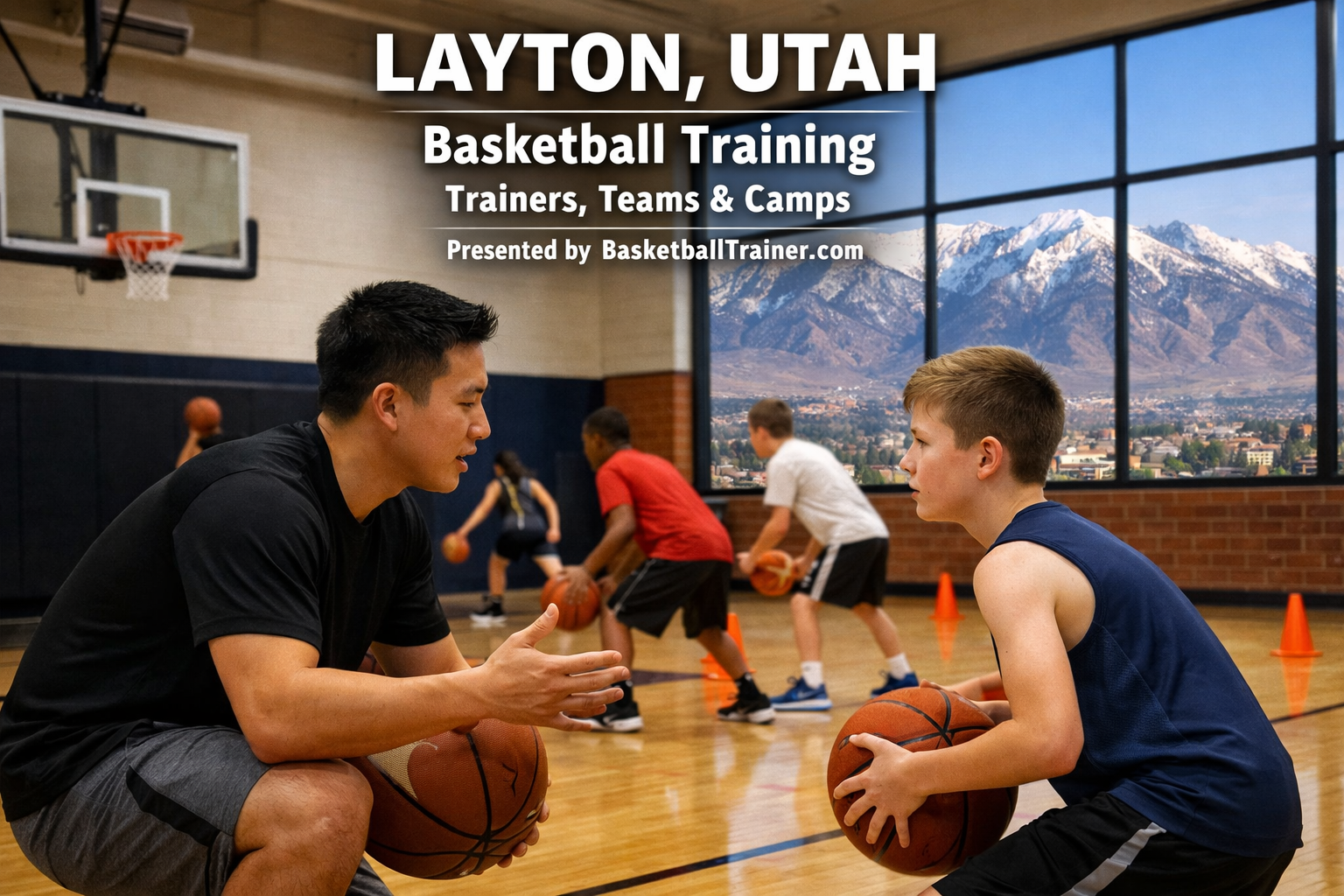
Layton Area Basketball Trainers
Layton’s basketball training ecosystem is less concentrated than Salt Lake City’s but more developed than most people expect. The best trainers in this part of Davis County draw players from Layton, Clearfield, Syracuse, Kaysville, and even West Ogden — so don’t think of these as strictly “Layton programs.” Think of them as northern Wasatch Front programs that happen to be within reach.
Elite Skills Academy (Syracuse — 10 min from Layton)
Founded by Duane Koski (BYU-Idaho grad, long-time skill development coach) and Coach Terry Schriver, Elite Skills Academy operates out of their dedicated facility in Syracuse at 3242 S 750th W — just 10 minutes from most of Layton. The academy markets itself as “Utah’s Premier Basketball Specific Training Facility” and backs that up with patented shooting and ball-handling technology used to accelerate development. Coaches Koski and Schriver both bring extensive individual skill development backgrounds, and the program has helped players reach collegiate levels including Westminster College. Sessions focus on shooting mechanics, ball-handling, footwork, and game-situation reads. Individual sessions typically run $60-90 per hour; small group sessions (3-5 players) run $25-40 per player. The academy offers a free evaluation session for new players, which is worth taking before committing. Best for competitive middle school and high school players who want measurable skill improvements with high-repetition, technology-assisted training.
Club Utah Davis County (Coach Bry)
Club Utah’s Davis/Morgan County location is led by Coach Bry, a former collegiate player at Southern Oregon University who holds a degree in Health, P.E., and Psychology and is a certified mental performance coach. She has been with Club Utah since 2020 and coaches players ages K through 8th grade across the Davis County region, with training locations throughout the area. The program offers structured development tiers: a foundational track for K-2nd graders learning basics twice weekly, and a full skill-development track for 3rd-8th graders working on all five skill areas in group settings. Coach Bry also runs “Coach Bry Training” for individual athletes focused on mental performance alongside physical development. Academy-style group training typically runs $50-80/month; contact the program for individual session pricing. Best for elementary and early middle school players looking for consistent, structured skill development with a coach who integrates mental performance alongside the physical game.
Utah Speed and Strength (Performance Training — Layton)
Note: This is performance/athletic training, not basketball-specific skill instruction. Utah Speed and Strength operates by appointment at 2105 North Fort Lane #5 in Layton, focusing on speed, strength, and agility development for multi-sport athletes including basketball players. Many Layton-area basketball families use performance facilities like this as a complement to skill work — particularly for players trying to improve their athleticism, quickness, or vertical jump before tryouts. Sessions are appointment-only and customized to the athlete. Pricing typically runs $50-80/session for individual athletic performance work. Best for competitive middle school and high school players who already have solid basketball skills and need to close the athleticism gap, or players recovering from minor injuries who need structured strength and conditioning.
Athletes Untapped (Platform — Multiple Layton-Based Coaches)
Athletes Untapped is a platform connecting families with background-checked private basketball coaches in the Layton area, rather than a single facility. The coaches listed in their Layton directory have played at various levels — D1, D2, D3, and professionally — and can train at your driveway, local park, or preferred court. This is particularly convenient for families who can’t commit to a fixed facility location, or military families near Hill AFB who need flexible scheduling. Individual session rates through the platform typically run $40-75/hour depending on the coach’s credentials and experience. The platform handles scheduling, payment, and background verification, which simplifies the vetting process for busy parents. Best for families who value geographic flexibility and want to compare multiple coaches before committing long-term, or those new to private basketball training who want a lower-commitment entry point.
Layton City Jr. Jazz Programs (Recreational League)
Note: This is a recreational league program, not individual skill training. Layton City Parks and Recreation runs a Jr. Jazz program affiliated with the Utah Jazz that spans kindergarten through high school. The program divides by grade (K-3rd boys is instructional; 4th-Jr. High is competitive league play) with games at Central Davis, Legacy, and Shoreline Jr. High. All participants receive a reversible Jazz jersey. League fees vary by grade level but are generally in the $40-80 range per season, making this the most affordable organized basketball available in Layton. Girls’ leagues exist separately, including a high school-level program for grades 10-12. This is where the majority of Layton’s youth basketball players get their start, and it provides a low-pressure environment to figure out if a child is genuinely interested before investing in private training. Best for beginners, K-6th graders learning the game, and families who want affordable, organized play without competitive pressure.
Layton Area Basketball Camps
Basketball camps in the Layton area run primarily June through August, with some available during school breaks. Given Layton’s position between Salt Lake City and Ogden, families have access to camps both locally and at Weber State University or University of Utah — both within 30-45 minutes.
Weber State University Basketball Camps (Ogden — 20 min)
Weber State University, just 20 minutes north of Layton in Ogden, offers summer basketball camps through the Big Sky Conference program using their on-campus Dee Events Center. Camp instruction comes from WSU coaching staff and current players, providing a genuine Division I college basketball perspective accessible to northern Utah families. Programs typically run for players grades 4 through high school, with skill-based sessions and position-specific instruction. Week-long day camps generally run $150-250 depending on the session. Weber State’s proximity to Layton makes this the closest D1 experience available — significantly more accessible than the Utah or BYU options much further south. Best for competitive middle school and high school players who want D1-adjacent coaching and exposure to a college basketball environment.
Elite Skills Academy Summer Camps (Syracuse)
Elite Skills Academy (the same facility described in the trainers section) runs summer camp sessions that give players intensive exposure to their technology-assisted development model. Parent reviews consistently praise the low coach-to-player ratio and the specificity of the instruction — kids come out with actual measurable improvements in shooting percentages and ball handling, not just “played a lot of basketball.” Week-long camps typically run $120-175. Their approach makes this a strong option for players who have already played recreational leagues and want to make a competitive jump before the next school season. Best for players entering 4th grade through high school who want concentrated skill work during summer, particularly those preparing for school team or AAU tryouts in the fall.
Layton City Parks & Recreation Basketball Programming
Layton City runs structured youth programming throughout the year through their parks and recreation department, including basketball clinics and seasonal leagues that function like entry-level camps for younger players. The K-3rd grade Jr. Jazz program is essentially an instructional program — focused on fundamentals and fun, not competition. City programs are subsidized, keeping costs accessible for all Layton families. Registration opens early and spots fill; military families and those with financial need should ask about priority registration and any fee assistance available. Cost typically runs $30-70 per program depending on age and format. Best for younger players (K-4th grade) taking their first organized basketball steps, and families prioritizing affordability and proximity over elite instruction.
Utah Hard Knox Skills Camps (Northern Utah)
Utah Hard Knox Basketball Club (based in the greater northern Utah area, operating for over 13 years) runs skills clinics and camps alongside their travel team programs. These aren’t traditional week-long day camps — they’re more targeted one-day or weekend skill clinics focused on specific aspects of the game. They operate 20+ competitive teams across girls and boys programs and use their camp sessions to identify players and develop skills before the select season. Camp costs typically run $50-100 per clinic session. Worth watching their social channels for clinics scheduled in the Layton/Davis County area. Best for players already playing organized rec ball who want competitive-level instruction and potentially a pathway to Hard Knox’s select teams.
Layton Area Select Basketball Teams
Select basketball in the Layton area means entering the northern Utah club ecosystem, which is competitive and geographically spread. Teams draw from all of Davis County and into Weber County. Tournament travel typically means Salt Lake City, Ogden, and Logan in-state — with select programs traveling to Phoenix, Las Vegas, Sacramento, and Denver for higher-level events. Budget accordingly: team fees are just the starting point.
Utah Hard Knox Basketball Club
Utah Hard Knox has been serving northern Utah for over 13 years and is one of the most established club programs in the Davis/Weber County corridor. They run 20+ competitive teams annually across boys (2nd grade through high school) and girls (4th grade through high school), organized into skill-level tiers from developmental to premier travel. Tryouts for travel teams are held in March, with spring/summer tournament seasons running out of state. Practices run twice weekly from September through March with coaches devoting half the time to individual skill work and half to team development. Annual team fees typically run $800-1,800 depending on level (developmental vs. premier) plus tournament travel costs that can add $1,000-2,500 for out-of-state events. Based in the greater northern Utah area with multiple Davis County practice locations. Best for players grades 2 through 12 who want organized competitive basketball at multiple commitment levels — one of the few northern Utah programs that genuinely accommodates multiple skill tiers rather than just elite players.
Club Utah Davis County — Competitive Track
Beyond their academy/training program, Club Utah Davis County (led by Coach Bry) offers competitive team placement for players ready to make the jump from developmental training to organized team competition. Coach Bry conducts in-season evaluations and places players on competitive teams, in the academy, or in foundational levels based on skill — meaning there’s no single tryout moment to miss. This rolling-admission approach is particularly useful for military families who arrive mid-season due to PCS moves. Competitive team fees vary by level and tournament schedule; typically in the $600-1,400 annual range plus tournament costs. Best for players 3rd grade through 8th who want a clear developmental pathway and a program that emphasizes process over politics — the rolling placement model keeps the focus on player growth rather than politics at tryout time.
Invictus Basketball Club (Northern Utah)
Invictus Basketball Club describes itself as the largest club organization in Utah after starting in 2017. They use an 8-level skill classification system designed to standardize player development and make it easier for coaches to target instruction to actual ability levels rather than age alone. The program serves players across northern Utah with multiple practice locations in the Davis County area. Invictus has developed pathways toward high school team preparation and college recruitment for identified athletes, with specific guidance for players who have been overlooked by traditional high school teams. Annual fees range widely depending on the level — expect $700-2,000 plus tournament travel. Their national rebrand in 2024 opened more partnership and tournament access than prior years. Best for players who want a larger organizational infrastructure, clear skill-level-based progression, and potential college recruitment exposure for older athletes.
Layton City Competitive Jr. Jazz League
Note: This is a recreational league, not a select team. For families not yet ready for the financial and time commitment of select basketball, Layton City runs a competitive Jr. Jazz league for 4th-9th graders (boys) and 4th-8th graders (girls) with eight guaranteed games. Boys play Saturday evenings at Central Davis, Legacy, and Shoreline Jr. Highs. Girls play Monday evenings. League registration is team-based (players are placed by school boundary). Cost runs roughly $40-80 per player per season — a fraction of select team costs. This is the right choice for families still testing competitive interest before committing to AAU-level expenses. Best for players in grades 4-9 who want competitive game experience at low cost before deciding whether select basketball makes sense.
Layton Area High School Basketball
Layton’s high school basketball programs sit within the Davis School District — Utah’s second-largest school district. Layton’s two home high schools compete in different UHSAA classifications, which affects the competitive landscape for players hoping to make varsity.
Layton High School (6A — Lancers)
Layton High competes in Region 1 of the UHSAA 6A classification alongside Weber, Fremont, Davis, Farmington, and Syracuse — the largest schools in northern Utah. The 6A classification means deeper rosters, more competition for playing time, and a higher baseline skill level. School team tryouts typically occur in October. The Lancers compete in state playoffs typically in February-March with the state tournament held at Weber State University.
Northridge High School (5A — Knights)
Northridge High, also in Layton at 2430 N. Hillfield Rd., competes in the 5A classification in Region 5 alongside Bonneville, Roy, Box Elder, Clearfield, Bountiful, Viewmont, and Woods Cross. The Knights have been an active 5A program with recent postseason appearances. A 5A classification provides slightly more playing opportunity for borderline players compared to 6A schools. Northridge boys compete for state spots in February with the same Weber State venue.
Other Nearby Davis School District Programs
- Clearfield High School (5A) — 10 min south on I-15; active program with consistent playoff presence
- Syracuse High School (6A) — 10 min west via I-15; one of the stronger 6A programs in Region 1 in recent years
- Davis High School (6A, Kaysville) — 10 min south; the Darts compete in the same 6A Region 1 as Layton High
- Fremont High School (6A) — 10 min north in Plain City; recent regional title contender
School team tryouts across Davis County typically occur in October. Most programs field varsity, JV, and freshman teams for both boys and girls. For official schedule and tryout information, visit the Davis School District athletics page.
How to Use These Listings
These are Layton-area trainers, camps, and teams that families in Davis County work with. We don’t rank them as “best” or endorse specific programs. Use the evaluation questions in the next section when contacting any of these options. The right fit depends on your child’s age, skill level, goals, your family’s schedule, geography, and budget. Contact 2-3 options before committing to see which feels right for your family.
Courts & Rec Options in Layton
Layton doesn’t have a sprawling municipal rec center network like El Paso or Fort Worth. What it does have is a distributed system of parks with courts, a city aquatic facility with rentable basketball space, and school gyms used for Jr. Jazz leagues. Here’s what families actually use.
Surf ‘n Swim — Rentable Basketball Courts
Address: 465 N Wasatch Dr, Layton, UT 84041 | Adjacent to Layton Commons Park
Layton’s primary city facility, Surf ‘n Swim, is primarily known for its wave pool and aquatic programming — but the facility also offers basketball court reservations. Courts are rentable by the hour for $4 per player, starting at every half hour (8:30, 9:30, etc.). This makes it one of the most affordable organized court times in Davis County for small groups and family training. The facility is open year-round with the pool under a bubble during cold months. Racquetball, weight area, and a small food court round out the amenities. It’s not a pickup-game destination — you need to reserve. But for a parent who wants to shoot with their kid for an hour without driving to a private facility, it’s a solid option at a very manageable price.
Tip: Book court time in advance online through Layton City’s recreation portal. Early morning and midday slots fill less quickly than afterschool times.
Layton City Parks with Outdoor Courts
Layton City maintains several parks with free outdoor basketball courts. These are open to the public and don’t require registration or fees — perfect for family shootarounds, pickup games in good weather, or supplementing paid training.
Legacy Park (325 N 3200 W) — 4 basketball courts, 2 picnic pavilions, 2 tennis courts, 0.35-mile walking trail. One of the largest outdoor court setups in Layton. Good for competitive outdoor pickup.
Ellison Park (700 N 2200 W) — Layton’s largest park at 44 acres. Basketball courts plus AAA baseball fields, skate park, splash pad, and a 1-mile walking trail. Family destination that also serves basketball players.
Additional neighborhood parks with courts are scattered throughout Layton’s residential areas. Visit the Layton City parks directory filtered by “Basketball Court” for a complete list.
School Gymnasiums (Jr. Jazz League Venues)
Layton City’s Jr. Jazz leagues use Davis County school gymnasiums as their primary venues — these aren’t open for drop-in play, but for families participating in city leagues, these become familiar spaces. Primary venues include:
- Central Davis Jr. High (663 Church St, Layton) — primary adult league and Jr. Jazz venue
- Legacy Jr. High — secondary league venue for Saturday evening Jr. Jazz games
- Shoreline Jr. High — third venue in the Saturday rotation
The Honest Assessment: Layton’s Rec Gap
Layton doesn’t have the kind of massive municipal recreation center that cities like Ogden, Salt Lake City, or El Paso have. The South Davis Recreation Center in Bountiful (20 min south) and Clearfield’s Aquatic & Fitness Center (10 min south) are both worth knowing about for families who want more robust drop-in options. For free court access, Legacy Park’s 4 outdoor courts are your best bet for open play. For paid indoor court time, Surf ‘n Swim’s reservation system at $4/player/hour is the most accessible option within city limits. This is not a weakness of Layton specifically — it reflects the broader suburban Utah model where youth basketball runs through school gyms and club facilities more than municipal recreation centers.
Evaluating Basketball Training Options in Layton
We provide evaluation frameworks, not recommendations. These questions help you assess trainers, camps, and teams based on what matters for YOUR family in Davis County.
Questions to Ask Private Trainers
Why this matters in Layton: Hill AFB creates a significant military family population in north Layton. Deployments, PCS moves, and training schedules don’t respect basketball calendars.
Why this matters: “Improvement” without specifics means nothing. Ask for concrete metrics — free throw percentage, drill completion time, live game situations mastered.
Why this matters in Layton: Some trainers have dedicated gym space; others use school gyms or public courts with variable availability. Consistent court access matters more than people realize.
Why this matters: A trainer who primarily works with high school varsity players may not be the right fit for your 4th grader, even if they’re excellent at what they do.
Why this matters: Winter weather along the Wasatch Front and school schedules create legitimate conflicts. Understanding the policy before paying prevents conflict later.
Questions to Ask About Camps
1:20 is glorified babysitting. 1:8 or better means actual individual instruction happening.
Both have value. But they’re different products. Know which one you’re buying before you pay.
Why this matters in Layton: Many programs offer assistance that isn’t prominently advertised. Asking directly — especially for Hill AFB families — often unlocks options.
Questions to Ask About Select Teams
Why this matters: Northern Utah travel teams frequently compete in Phoenix, Las Vegas, and Sacramento. A “$900 team fee” can easily become $2,500-3,500 with hotel, gas, and meals factored in.
Why this matters in Layton: PCS orders don’t come with notice. Programs experienced with military families — Hard Knox, Club Utah — often have partial-refund policies. Ask before you sign anything.
“Equal time” and “merit-based time” are both legitimate philosophies. They produce very different experiences for your child. Know which one you’re agreeing to.
Layton Pricing Reality Check
Jr. Jazz / City Leagues: $40-80 per season (most affordable entry point)
Court Rental (Surf ‘n Swim): $4/player/hour (reservable indoor courts)
Private Training: $40-90 per session individual; $25-40 per player in small groups
Summer Camps: $50-250 per week depending on facility and instruction level
Select/Travel Teams: $700-2,000 annual team fees, plus $1,000-2,500 in tournament travel for out-of-state programs
Free Basketball Training Evaluation Guide
Download our comprehensive guide with specific questions to ask trainers, camps, and teams before committing.
Layton Basketball Season: What to Expect
Understanding the Utah basketball calendar helps Layton families plan ahead instead of reacting. This is context for planning, not a list of deadlines.
High School Season (UHSAA)
Typical Timeline: First practices in mid-October, regular season November through January, region tournament in February, state tournament late February-early March at Weber State University.
Layton-Specific Note: Both Layton High (6A) and Northridge (5A) compete in different classifications with different state brackets. The 6A competition at Layton High is particularly deep — Region 1 has consistently been one of the toughest in the state.
Select / Club Basketball Season
- September-March: Club practices for programs like Hard Knox run twice weekly — the team-building phase before spring tournaments
- February-March: Travel team tryouts happen during high school season — timing creates overlap conflicts to manage
- March-April: Spring tournament season begins after high school playoffs conclude
- May-July: Peak tournament season — Phoenix, Las Vegas, Sacramento common destinations for northern Utah programs
- August: End of summer tournaments; transition to fall training and new season team formation
Jr. Jazz & City Leagues
Fall Season: Jr. Jazz competitive leagues typically begin in October, running through December-January with Saturday games at school gyms.
Spring Season: Layton City runs additional competitive leagues for spring. Adult recreation leagues run year-round on Thursday evenings at Central Davis Jr. High.
Summer Camps
May-August: Peak camp season across the Layton/Davis County area. Weber State camps and Elite Skills summer sessions fill up — watch for registration openings in March-April. The Wasatch Front’s dry heat means outdoor court work is comfortable before 10am and after 7pm during July and August; most organized camps run indoors for afternoon sessions.
Layton’s Basketball Culture & Context
Layton sits in interesting basketball territory — not a traditional hoops town, but shaped by an identity that’s uniquely its own: military families, LDS community structure, Wasatch Front competitiveness, and a connection to the Utah Jazz that runs deep in ways outsiders often underestimate.
John Collins: Born at Hill AFB
The most direct NBA connection Layton has is a literal birthplace story. Forward/center John Collins — who has averaged double figures in scoring throughout his NBA career — was born at Hill Air Force Base on September 23, 1997. Collins’s mother served in the Air Force and his father in the Navy, making him a military kid who happened to enter the world in Layton before the family moved around. In October 2024, the Utah Jazz brought Collins back to Hill AFB for a preseason scrimmage in front of hundreds of military families — a homecoming of sorts for a player who ranks third in Utah-born NBA history by career points behind Tom Chambers and Byron Scott.
That story matters beyond trivia. It reflects what Layton’s basketball landscape actually is: a place where military families pass through, where talented players start their journeys without local fanfare, and where the connection to the professional game runs more through proximity to Salt Lake City than through deep homegrown tradition. The Utah Jazz play 30 minutes south. Their presence shapes the recreational basketball landscape in ways that El Paso’s UTEP doesn’t — the Jazz Jr. Jazz program directly funds and structures youth leagues in Layton through the city’s Parks and Recreation department. That’s a real and tangible pipeline.
The Military and LDS Dual Identity
Two institutional forces shape Layton’s youth basketball culture in ways that aren’t always visible from the outside. Hill Air Force Base, Utah’s largest employer, brings a constant rotation of military families who often arrive not knowing anyone and need to find programs quickly. The best programs in the area know this and accommodate it — rolling admissions, flexible cancellation policies, and coaches who understand that a kid might need to rebuild their confidence after uprooting from another state.
The LDS community structure creates a different but complementary dynamic: strong family involvement, high participation rates in youth sports, and a culture that generally prioritizes character development alongside athletic achievement. Church-based leagues and community networks often provide informal basketball opportunities that don’t show up in any directory. If you’re new to Layton and LDS, those networks are worth tapping through your ward. If you’re not, the city’s Jr. Jazz program provides the same community-building function through a secular channel. Either way, Layton families approach youth basketball with a generally long-term, development-first orientation rather than the high-pressure, prove-it-now dynamic you find in bigger metropolitan markets.
Frequently Asked Questions About Layton Basketball Training
How much does basketball training cost in Layton?
Layton basketball costs span a wide range. Layton City Jr. Jazz leagues are the most affordable entry point at roughly $40-80 per season. Private basketball training in the area typically runs $40-90 per individual session, or $25-40 per player for small group work. Court rental at Surf ‘n Swim runs $4/player/hour — one of the better deals in northern Utah for organized indoor court time. Summer camps range from $50-250 per week. Select/AAU team fees typically run $700-2,000 annually, but that’s before tournament travel costs that can add another $1,000-2,500 for competitive programs traveling to Arizona, Nevada, or California. Many programs offer financial assistance or reduced rates for military families — it’s always worth asking.
When do AAU and select basketball tryouts happen in the Layton area?
Most northern Utah select programs — including Utah Hard Knox — hold travel team tryouts in March, which creates an awkward overlap with the high school basketball season. This timing is common across Utah because programs want rosters set before spring tournaments begin in late March and April. Some programs offer rolling evaluation (Club Utah Davis County does this explicitly) where there’s no single tryout event — you can join at various points during the season. For families PCS-ing to Hill AFB mid-season, rolling admission programs are significantly more accessible than those with annual tryout cutoffs. Contact specific programs in January-February to understand their current-year timeline.
Is it worth driving to Salt Lake City or Ogden for basketball training?
It depends on what you’re looking for. For most skill development needs, Layton and the immediate Davis County area have solid options — Elite Skills Academy in Syracuse, Club Utah Davis County, and several experienced individual trainers. Where the Salt Lake City metro becomes worth the drive is for elite-level AAU competition (Utah Prospects, Salt Lake Rebels), specialized programs not replicated locally, or specific trainers with national reputations. Weber State in Ogden is 20 minutes north and provides genuinely excellent D1 camp access that rivals anything in Salt Lake. The honest answer: for 90% of Layton families, driving to Salt Lake City isn’t necessary. For the top 5-10% of competitive players pursuing D1 recruitment, the Salt Lake City ecosystem eventually becomes important.
How competitive is high school basketball at Layton High vs. Northridge?
These are genuinely different competitive environments. Layton High (6A) competes in what’s consistently one of the toughest regions in Utah — Region 1 regularly produces state finalists. Getting playing time as a younger player is harder; rosters are deeper and the skill floor is higher. Northridge (5A) is competitive but the field is slightly less deep, which can mean more development opportunity for players still growing into their game. Neither is “easier” in an absolute sense — 5A state is legitimately competitive. But if your child is a strong-but-developing player trying to find meaningful playing time, the 5A Northridge path might provide more early-season opportunities than fighting for minutes in a loaded 6A program.
What options exist for military families at Hill AFB who need flexible basketball programs?
Military families at Hill AFB have several good options specifically suited to their situation. Club Utah Davis County uses rolling admissions with no fixed tryout cutoff, so a family arriving mid-year can still get their child placed appropriately. Athletes Untapped provides platform-based training with individual coaches who can accommodate irregular scheduling around deployments and training schedules. Utah Hard Knox has been operating in northern Utah for over 13 years and has experience with the military family demographic — ask specifically about their PCS policy when inquiring. Layton City’s Jr. Jazz program is the simplest entry point: it’s affordable, season-based, and doesn’t require any prior community knowledge to access. The Utah Jazz connection through Jr. Jazz also means the program feels familiar to kids who have followed the Jazz from a previous posting.
What age should my child start basketball training in Layton?
There’s no single right answer. Layton City’s K-3rd Jr. Jazz instructional program exists specifically for children just learning the game — it emphasizes fun and basic motor skills before any competitive pressure. Private skill training typically becomes productive around ages 8-10, when kids can follow complex instruction and develop consistent mechanics. Select team basketball can start as young as 2nd grade through programs like Hard Knox’s developmental tier, but most families wait until 4th-5th grade when the experience is more meaningful. The most important variable isn’t age — it’s whether your child is genuinely interested and whether your family has the time and budget to sustain the commitment. Starting at a lower cost entry point (Jr. Jazz) to confirm genuine interest before investing in private training is a pattern that saves a lot of families money and frustration.
Where are the best outdoor basketball courts in Layton?
Legacy Park (325 N 3200 W) has the most outdoor basketball courts in Layton at four full courts, making it the best option for finding pickup games or getting court time without waiting. Ellison Park (700 N 2200 W) is Layton’s signature large park and also has outdoor courts, though the broader amenities there mean more foot traffic from non-basketball users. Both parks are free and publicly accessible. For indoor court time, Surf ‘n Swim (465 N Wasatch Dr) offers reservable courts at $4/player/hour — the right choice when weather or scheduling requires a guaranteed indoor surface. The full list of Layton parks with basketball courts is available at Layton City’s park directory.
Layton Basketball Training Options at a Glance
| Training Option | Cost Range | Best For | Time Commitment |
|---|---|---|---|
| Jr. Jazz / City Leagues | $40-80/season | Beginners, K-9th grade, families testing interest | Weeknight/Saturday games, seasonal |
| Court Rental (Surf ‘n Swim) | $4/player/hour | Family practice, parent/child shootarounds, small groups | Reserved by hour, flexible |
| Private Training (Individual) | $40-90/session | Skill development, pre-tryout prep, specific weaknesses | Flexible, typically 1-2x/week |
| Group Training / Academy | $50-80/month | Consistent skill work, cost-effective alternative to 1-on-1 | 2x/week, seasonal or year-round |
| Summer Camps | $50-250/week | Summer skill building, pre-season ramp-up | 1-2 week sessions, June-August |
| Select / Travel Teams | $700-2,000+ (plus travel) | Competitive players, tournament experience, college exposure (older) | Sept-March practices 2x/week; spring-summer tournaments |
Costs represent typical Layton/Davis County ranges as of 2026. Many programs offer military discounts, financial assistance, or sliding-scale pricing. Always ask.
Getting Started with Basketball Training in Layton
Whether you just PCS’d to Hill AFB or you’ve lived in Layton for years and your kid just found a love for basketball — here’s a practical path forward.
Step 1: Clarify Your Goal
Fun and fitness? School team tryouts? Competitive AAU? These require very different paths and very different budgets. Get honest with yourself about what outcome you’re actually aiming for before you spend a dollar. A 3rd grader having fun in Jr. Jazz doesn’t need private training yet. A high school freshman trying to make varsity probably does.
Step 2: Know Your Geography
Layton is compact but not uniform. North Layton near the base has a 20-minute buffer to South Davis programs. East Layton has longer driveway-to-gym times. Pick programs that work for your actual Tuesday evening routine, not your theoretical best-case drive time.
Step 3: Contact 2-3 Options
Use the evaluation questions in this page. Look at the trainer and team profiles above. Reach out to 2-3 that match your geography and goals. Most offer trial sessions or initial consultations. Don’t commit from a website alone.
Step 4: Follow Your Kid’s Lead
After a trial session, watch your child’s face when it’s time to go to practice. Excitement and engagement matter more than any credentials on the wall. The best program is the one your kid wants to return to — that’s how sustainable development actually happens.
Free Basketball Training Evaluation Guide
Download our guide with specific questions to ask trainers, camps, and teams before committing.
Layton Quick Links
Basketball Resources
Nearby Utah Cities
About BasketballTrainer.com
© 2026 BasketballTrainer.com. All rights reserved. Layton, Utah basketball training resource. Context, not direction.