Little Rock Basketball Training – Trainers, Camps & Teams
Little Rock basketball training spans 120 square miles across the 501 — from Chenal Valley to East Little Rock, Dunbar to the Heights. This page helps families understand the capital city’s basketball landscape, neighborhood dynamics, and decision frameworks — not prescribe solutions.
Basketball Trainers
Basketball Camps
Select Teams
Community Centers
⚡ Looking for Basketball Training Options?
Skip the background info — jump straight to what you need:
Why This Little Rock Basketball Resource Exists
Little Rock’s 205,000+ residents spread across 120 square miles, with a metro area reaching nearly 770,000 when you factor in North Little Rock, Maumelle, Conway, and Bryant. This capital city has produced Hall of Famers and NBA champions — and its basketball training ecosystem reflects that rich tradition. This page helps families understand the 501’s geography, seasonal patterns, and decision frameworks. The best trainer near Dunbar might not work for a family in Chenal Valley, and vice versa.
Our Approach: Context, Not Direction
We don’t rank trainers or camps as “best” — we help you understand what makes different programs right for different needs. The best fit depends on your child’s age, skill level, goals, your family’s schedule, budget, and where you live across Little Rock’s geography. This page provides evaluation frameworks and local context, not prescriptive recommendations. Learn how BasketballTrainer.com works • Read our editorial standards
Understanding Little Rock’s Basketball Geography
Little Rock is a different geography than most cities you’ll read about in youth basketball discussions. At 120 square miles, it’s compact enough that you’re rarely more than 25 minutes from anything — but its interstates (I-630, I-30, I-430) create real neighborhood divides. Where you live matters less for commute time and more for which school district you’re in, which coaches know your family, and what community programs exist nearby.
West Little Rock / Chenal Valley
What to Know: The fastest-growing, highest-income area. Chenal Parkway corridor features newer private training facilities, multiple YMCA locations, and families with more flexibility for private training budgets.
- Commute to Downtown: 20-25 minutes via I-630 or Chenal Pkwy
- School Districts: LRSD (Parkview, Southwest) + PCSSD (Robinson)
- Basketball Access: Private clubs, YMCA, Episcopal Collegiate (Nike camp)
Heights / Hillcrest / Midtown
What to Know: Historic, established neighborhoods north of I-630. Walkable, community-oriented. Home to many long-time Little Rock families with deep connections to local school programs.
- Commute Reality: 10-15 minutes to Central, 20-25 to West LR
- School Districts: LRSD (Central High, Hall, Parkview zones)
- Basketball Culture: Access to private coaches, Episcopal Collegiate, club programs
Central / Downtown / University Area
What to Know: The historic heart of Little Rock basketball. Home to UA Little Rock’s Jack Stephens Center, Central High School (civil rights landmark), and Dunbar Community Center — one of the city’s most storied basketball facilities.
- Commute Reality: Central location, 15-20 minutes to most areas
- Basketball Legacy: Dunbar CC, UA Little Rock D1 program, Central High
- Access: D1 coaching staff camps, community center basketball leagues
Southwest / Geyer Springs / South Little Rock
What to Know: Diverse, working-class neighborhoods south of I-630 along Baseline Road and Geyer Springs. Home to P.A.R.K. (three full courts, hosts AAU tournaments) and Southwest Community Center — the most basketball-rich public facility in the southern half of the city.
- Commute Reality: 20 min to downtown via I-30, 25-30 to West LR
- School Districts: LRSD (Southwest, J.A. Fair zones)
- Basketball Access: P.A.R.K. Athletic Center, Southwest CC, affordable community options
The Cross-River Reality: Little Rock vs. North Little Rock
Many basketball families in the metro area straddle both cities. North Little Rock — separated by the Arkansas River and its bridges — has its own park system with five community centers, its own school district, and its own basketball culture. Programs like the Arkansas H.A.W.K.S. draw from both sides of the river. The bridge crossings are easy (10-15 minutes), but school district boundaries matter for recruiting and camp eligibility. If your family is near the riverfront, you have genuinely competitive programs available on both banks. Don’t artificially limit your search to one city’s border.
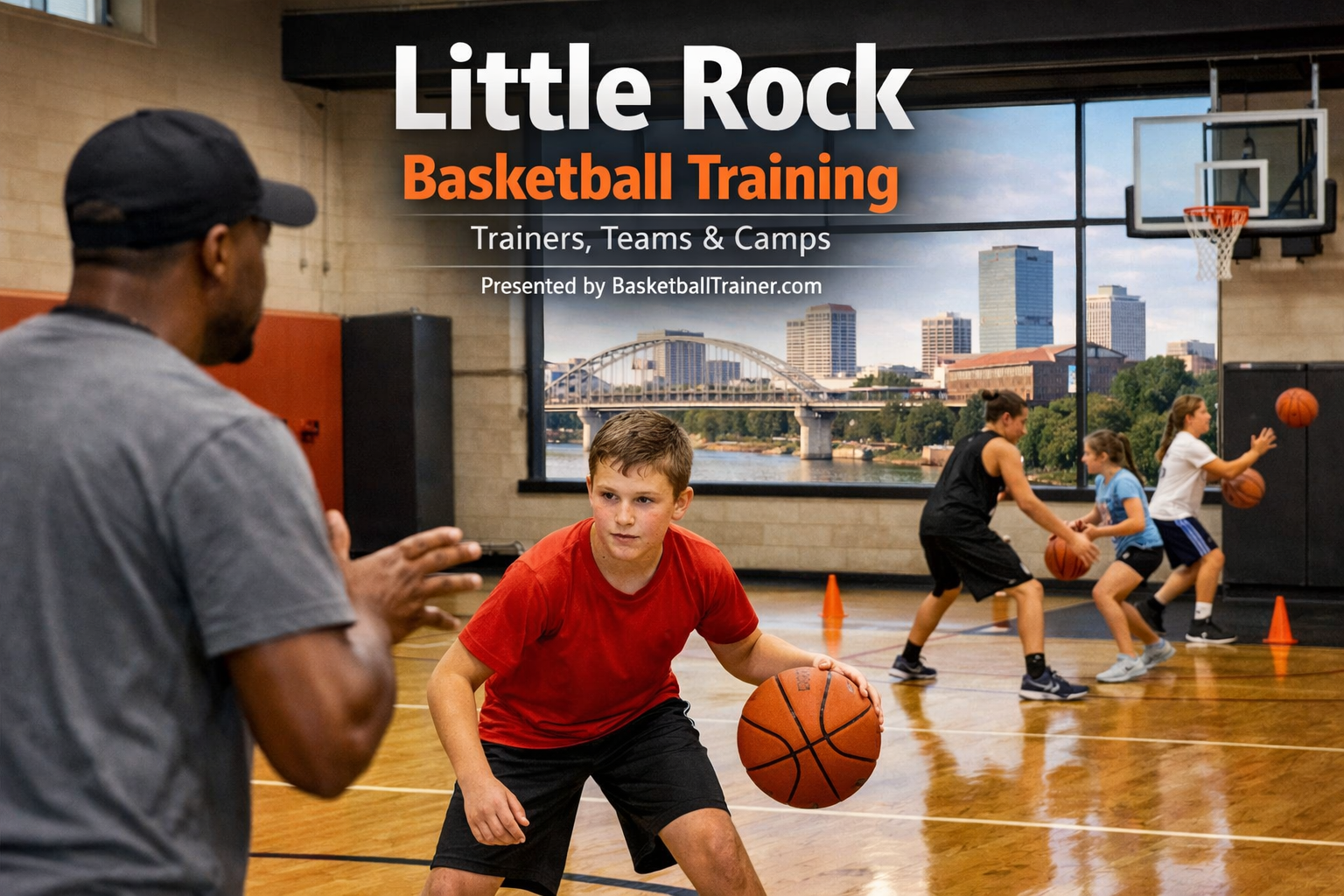
Little Rock Basketball Trainers
These Little Rock basketball trainers work with players across skill levels and age groups. The 501 has produced Hall of Famers and NBA champions, and that legacy lives in the coaching community today. Use the evaluation questions later on this page when reaching out to any of these basketball coaching Little Rock options.
The Athletic Club Basketball Academy (Coach Buster Perkins)
Coach Buster Perkins runs the Basketball Academy inside The Athletic Club (LRAC), one of Little Rock’s premier fitness facilities. Perkins grew up in McGehee, Arkansas, attended Joe T. Robinson High School in Little Rock, and went on to play professionally abroad after college. He brings genuine pro experience — not borrowed credibility — to his youth work. The Academy offers private lessons (individual or up to 4 players), small group sessions specifically designed for younger players ages 5-12 with a heavy fun-to-fundamentals balance, and seasonal camps during spring, summer, Thanksgiving, and holiday breaks. Sessions focus on defense, ball handling, shooting, passing, rebounding, and basketball IQ, with Coach Perkins explicitly positioning himself as a “guidance counselor” helping athletes navigate both basketball and school. Private lessons run approximately $65-100 per session at a club facility; small group sessions typically $30-45 per player. Located on the west side of Little Rock within LRAC’s club network.
The Basketball Trainer LLC
The Basketball Trainer LLC operates as an independent player development business with a dedicated Little Rock social media presence and a clear focus: pushing young basketball players to reach their full potential one day at a time. As an individual trainer-driven operation, this type of program offers more flexibility than club-based academies — often working at local gyms, school facilities, or outdoor courts across the metro area rather than a fixed location. Individual trainers in this model typically run $40-75 per session, with packages available for multi-session commitments. This is the kind of program worth a direct conversation before committing — ask about their background, what age groups they work with most, and where sessions are typically held. Best for players who want flexible scheduling or can’t commit to a fixed location program.
Greatness Sportz
Located in Alexander, Arkansas — a fast-growing suburb just south of Little Rock on I-30 — Greatness Sportz operates with a team of three coaches offering basketball, football, and personal training programs. For Little Rock families in the Otter Creek, Geyer Springs, and South Main corridor, Alexander is a reasonable 15-20 minute drive without the north-side traffic. The program emphasizes personalized coaching and skill development, working with individual athletes and small groups from beginner through competitive levels. The multi-coach model means more scheduling options and coverage when one trainer is unavailable — a practical advantage families don’t always think about until they’re mid-season and life gets complicated. Individual sessions typically run $40-70; group sessions $25-40 per player.
D1 Training Little Rock (Performance Training)
D1 Training is a national performance training franchise with a Little Rock location that serves youth and adult athletes across multiple sports, including basketball players looking for strength, speed, and agility development. To be clear about what this is: this is not a basketball skills program. It doesn’t teach shooting mechanics or ball handling. What it does — and does well — is the conditioning and athletic development that separates players who can play from players who can play at a high level for four quarters. Serious middle and high school basketball players often pair D1 Training with a separate skill-specific trainer. It’s complementary, not standalone. Youth programs at D1 locations typically run $100-200 per month for membership-style access. Best for competitive players ages 10 and up who want to improve athleticism alongside skill work.
About the Bounce
About the Bounce appears consistently in Little Rock’s basketball training landscape as a local training option with community recognition. Programs in this category typically offer a mix of open gym, skill sessions, and group training in an accessible, non-intimidating environment. For families who want to try skill-focused instruction before committing to private lessons or a competitive AAU program, accessible local trainers like this serve as an important “on-ramp” — getting players reps in a coached environment at more moderate pricing. Sessions in this market typically run $35-60 per session. Direct contact to confirm current program structure, age groups, and location is recommended before showing up.
ISO JOE Basketball Training
ISO JOE Basketball Training operates in the Little Rock metro area with a focus on individual skill development and one-on-one attention. The name itself signals the philosophy — isolation work, individual reps, personalized instruction — as opposed to group-heavy programs where your child gets 20 minutes of actual instruction in a two-hour session. Individual trainers operating under this model typically serve competitive players who are already in AAU programs or school ball and need targeted improvement in specific areas. Sessions run approximately $45-80 for individual work. For high school players trying to improve their scoring repertoire or pre-season conditioning before tryouts, this type of focused individual training is often where the real measurable improvement happens.
Little Rock Basketball Camps
Little Rock basketball camps run primarily during summer months with additional options during school breaks. The city’s D1 program (UA Little Rock) gives families access to college-level instruction at the Jack Stephens Center — something most cities this size don’t offer. These youth basketball Little Rock programs range from affordable city programs to competitive elite skill camps.
Darrell Walker Basketball Camp (UA Little Rock)
This is Little Rock’s signature elite camp experience. Darrell Walker — current UA Little Rock head coach, former NBA player (Chicago Bulls, New York Knicks, Washington Bullets, Detroit Pistons, and others), and 1993 NBA champion — runs summer sessions at the Jack Stephens Center on the UA Little Rock campus. When your kid gets instruction from someone who competed at the highest level of professional basketball for over a decade, that’s a different quality of insight than most cities can offer. Camp sessions are held in June and July at the Jack Stephens Center (2801 S. University Ave). Typical D1 coach-run summer camps run $150-250 per week; expect a similar range here. Best for middle school through high school players who want genuine college-level coaching exposure. Girls and boys sessions typically offered separately.
Joe Foley Basketball Camp (UA Little Rock)
Joe Foley coached women’s basketball at UA Little Rock for decades, becoming one of the most successful women’s coaches in program history. His camp — also based at the Jack Stephens Center — serves as a parallel track to the Walker camp, with a strong emphasis on fundamentals and the program-building philosophy that defined his tenure. For families with daughters in youth basketball, this is a notable option: genuine collegiate-level women’s basketball instruction delivered by someone who built a program over a career. Multiple summer sessions are offered (historically June and July). Camp fees comparable to the Walker camp range. This camp fills up — register early once sessions are announced.
Nike Basketball Camp at Episcopal Collegiate School
Directed by Coach Micah Marsh — Episcopal Collegiate’s head basketball coach, former Arkansas State four-year starter and all-time leading three-point shooter, former assistant at Arkansas State — this Nike-branded camp brings a polished, systematized curriculum to one of Little Rock’s strongest private school basketball facilities. Located at 1701 Cantrell Road in the Heights/Midtown area, the camp runs Monday-Thursday 9am-3pm and Friday 9am-12pm. Boys and girls sessions available. Camp fees for Nike programs typically run $200-350 per week depending on age group. The Nike curriculum is structured and well-tested nationally; what makes this one different is Coach Marsh’s SEC-conference playing background and local coaching track record. Best for players ages 7-17 wanting structured, supervised skill development in a quality facility with experienced basketball-specific instruction.
The Athletic Club (LRAC) Basketball Camps
Coach Buster Perkins runs skills-and-drills basketball camps through The Athletic Club throughout the year — not just summer. Spring break, Thanksgiving, holiday week, and summer sessions all appear on the calendar, which matters significantly for families with kids whose basketball development can’t take a five-month hiatus between June and January. The camps serve K-8th grade players with a clear emphasis: lots of reps, competitive drills, and fun in an environment that stays organized. LRAC is a premium facility, so camp fees reflect that context — typically $75-150 per week depending on session length. For families who are already LRAC members, this represents strong value bundled into an existing relationship. For non-members, it’s still worth the call to compare what you get here versus lower-cost alternatives.
City of Little Rock Parks & Recreation Youth Basketball Programs
The City of Little Rock Parks and Recreation Department runs youth basketball programs through its community center network — most notably at Dunbar Community Center (1001 W. 16th St.) and Southwest Community Center (6401 Baseline Rd). These programs are the affordable baseline that many Little Rock families use as an entry point, particularly for younger players ages 5-10 who are learning the game rather than training for competition. Dunbar’s program has 60+ years of history in the community and runs youth basketball alongside the Men’s Summer Basketball League. City recreation programs typically cost $20-60 per season or session depending on structure — dramatically less than private camp options. For families on tight budgets or uncertain whether their child will stick with basketball, city programs provide a low-risk, low-pressure first experience that still provides real coaching and game structure.
Little Rock Select Basketball Teams
Little Rock AAU and select basketball teams compete in regional circuits primarily March through August, with tournaments drawing players to Memphis, Nashville, Dallas, Oklahoma City, and Kansas City. Tryouts typically occur in February-March. Travel costs vary significantly depending on which circuit a team competes in — regional-only programs cost dramatically less than national circuit programs.
Arkansas H.A.W.K.S. (Hard at Work Kids)
The Arkansas H.A.W.K.S. are not just a team — they’re a piece of Little Rock basketball history. Founded in 1997 by Mike Conley Sr. (University of Arkansas track legend, 1992 Olympic gold medalist in the triple jump, 9-time NCAA individual champion), the first H.A.W.K.S. team had a ninth-grader named Mike Conley Jr. at point guard. That team won the program’s first AAU National Championship. Conley Jr. went on to become an NBA All-Star with the Memphis Grizzlies. Today, the H.A.W.K.S. are the only Adidas 3SSB (3 Stripe Basketball) program in Arkansas — the most exclusive shoe company circuit in grassroots basketball. This means exposure to top-level competition and college recruiting events. Annual team fees range $1,500-2,800 depending on age group and travel schedule, plus tournament travel to national events. This is a high-commitment, high-exposure program. It’s the right choice for serious, college-bound players 13U and above — not the starting point for a 9-year-old trying basketball for the first time.
Arkansas Supreme
Arkansas Supreme operates on the Puma NXTPRO Circuit for older boys (7th-11th grade) and runs local developmental teams for younger players (4th-6th grade) — a two-tier structure that serves families at different stages of the competitive basketball journey. The NXTPRO Circuit is a legitimate college-recruiting exposure circuit: college coaches attend these events, and programs on this circuit get to showcase players in front of decision-makers. Annual fees for competitive circuit teams typically run $1,200-2,200 plus travel. The local teams for younger players are less expensive and less travel-heavy — typically $400-800 for a season. This dual-track structure is worth asking about directly: families with younger players can start at the local level and move to the circuit program when ready, building continuity within the same organization rather than switching programs.
Arkansas Blazers Athletics
Arkansas Blazers Athletics is a 501(c)3 nonprofit with a mission that matters in Little Rock’s context: providing athletic opportunity for boys and girls ages 5-18 regardless of socioeconomic background, competing at local, state, and national levels. This isn’t just mission-statement language — it reflects a genuine community need in a city where income inequality is significant. For families who need a competitive program but can’t absorb the full fee structure of shoe-circuit organizations, nonprofits like the Blazers often represent the best actual access point to quality competition. Basketball fees at nonprofit organizations typically run $400-1,200 annually with scholarship assistance available. Directly asking about financial assistance is not embarrassing — it’s exactly what these organizations exist to accommodate.
P.A.R.K. Athletics Basketball
P.A.R.K. (Positive Atmosphere Reaches Kids), located at 6915 Geyer Springs Road in Southwest Little Rock, operates one of the most complete basketball facilities in the city — three full-size courts, a weight room, and enough space to host AAU tournaments (which it regularly does). P.A.R.K. functions as an after-school and summer hub that combines academics with athletics, meaning the basketball is embedded in a broader youth development mission rather than isolated competitive sports. The organization hosts outside teams and tournaments, which exposes P.A.R.K. players to competition without requiring extensive travel. For families in the southwest corridor, P.A.R.K. represents something important: elite-quality facilities in an accessible community setting. League and program fees are structured to serve the surrounding community — typically $200-600 per season.
Metro-Area Select Programs
Beyond the established organizations above, the Little Rock metro area has multiple independent select teams that operate without national circuit affiliations but compete in regional Arkansas and mid-South tournaments. These programs — often coach-founded, parent-supported, and community-based — represent an important middle ground: more competitive than recreational leagues but less expensive and less travel-heavy than NXTPRO or 3SSB programs. Annual fees typically run $600-1,500 with travel limited to Arkansas, Memphis, and occasionally Oklahoma City. For players who want competitive experience but aren’t yet ready for the time and financial commitment of national-circuit programs, these regional select teams are often the most appropriate choice. The Central Arkansas Basketball Association and local AAU chapters can point you toward current programs in your area.
Little Rock High School Basketball
Little Rock’s high school basketball programs span four school districts in the metro area, plus a competitive private school landscape. School team tryouts typically occur in October for winter season play. Understanding which district serves your address matters — and private school options create additional choices for families willing to consider non-zoned schools.
Little Rock School District (LRSD)
- Little Rock Central High School — historically one of Arkansas’s most storied programs and a civil rights landmark; Sidney Moncrief attended Hall, which feeds the same competitive ecosystem
- Hall High School — alma mater of both Sidney Moncrief (NBA Hall of Famer) and Bobby Portis (NBA champion); four consecutive Arkansas state championships under Portis’s class
- Parkview High School — consistently competitive LRSD program, West LR area
- Southwest High School — Baseline Road area, serves southwest corridor
- J.A. Fair High School — East Little Rock area
Pulaski County Special School District (PCSSD)
- Joe T. Robinson High School — Coach Buster Perkins’s alma mater; competitive west side program
- Mills High School
- Maumelle High School — newer program in growing Maumelle community north of LR
- Sylvan Hills High School
North Little Rock School District
- North Little Rock High School — across the river, historically strong program with its own distinct culture and rivalry with LRSD schools
Private / Independent Schools
- Episcopal Collegiate School — coached by Micah Marsh (Nike camp director); strong private school program on Cantrell Road
- Pulaski Academy — independent school league competition, west side
- Catholic High School for Boys — long-standing all-boys private school with competitive athletics
- Mount St. Mary Academy — all-girls private school with basketball program
School tryouts typically occur in October for the winter season. Most Little Rock area high schools field both varsity and JV teams for boys and girls basketball, with larger schools also offering freshman teams. The Arkansas Activities Association (AAA) governs eligibility and scheduling for public school programs.
How to Use These Listings
These are Little Rock trainers, camps, and teams that families in the area work with. We don’t rank them as “best” or endorse specific programs. Use the evaluation questions in the next section when contacting any of these options. The right fit depends on your child’s age, skill level, goals, your family’s schedule, and your budget. Contact 2-3 options before committing to see which feels right for your family.
Little Rock Recreation Centers: The Basketball Access Guide
Before committing to private training, understand Little Rock’s municipal recreation network. The City of Little Rock Parks and Recreation Department operates multiple community centers with basketball courts, youth leagues, and pickup opportunities — often at minimal cost. North Little Rock adds five additional centers across the river. Here’s what families actually need to know.
Central Little Rock: The Historic Hub
Dunbar Community Center — Little Rock’s Oldest Basketball Institution
Address: 1001 West 16th Street, Little Rock, AR 72202
Dunbar Community Center has been a fixture in central Little Rock for more than 60 years. Sidney Moncrief — NBA Hall of Famer, five-time All-Star, raised in the housing projects of East Little Rock — played on courts like these before making his way to Hall High and then the Razorbacks and the Bucks. That legacy isn’t lost on the community. Dunbar runs youth basketball programs, a Men’s Summer Basketball League, and provides after-school athletic programs in a full gymnasium with weight room, game room, kitchen, and banquet facilities.
Operating Hours:
- Monday–Thursday: 9:00 AM – 9:00 PM
- Friday: 9:00 AM – 6:00 PM
- Saturday: 8:00 AM – 5:00 PM
The Vibe: Community-rooted, multi-generational, historically significant. Volunteer coaches appreciated — if you’re available Monday-Thursday evenings or Saturday mornings, the center actively recruits experienced basketball people to mentor youth.
Southwest Little Rock: Courts and Courts
Southwest Community Center
Address: 6401 Baseline Road, Little Rock, AR 72209
Located between the Southwest Police Precinct and Dee Brown Library, the Southwest Community Center serves as the basketball access point for families along the Baseline Road corridor — one of Little Rock’s most diverse and active residential areas. Basketball courts, a fitness area, swimming pool, outdoor ball fields, and a walking trail make this a full-service facility rather than just a gym. The outdoor playground connection and walkable surroundings make it family-friendly for siblings of different ages.
Proximity note: P.A.R.K. (6915 Geyer Springs Rd) is nearby and offers three full basketball courts — these two facilities together give Southwest Little Rock families substantial court access without crossing town.
P.A.R.K. Athletic Center — Southwest’s Three-Court Hub
Address: 6915 Geyer Springs Rd, Little Rock, AR 72209
P.A.R.K.’s Athletic Center houses three full-size basketball courts — more court space than most private facilities — plus a weight room. Courts host both participant basketball during after-school and summer programs AND outside AAU tournaments, which means exposure to real competitive basketball action even for casual users. The academic-hour structure (students complete homework before hitting the courts) reflects the organization’s broader youth development mission.
Who it’s for: Families in southwest Little Rock who want quality facility access within the neighborhood rather than cross-town drives.
East Little Rock: The River Market Area
East Little Rock Community Center
Area: 2500 E. Sixth Street vicinity
The East Little Rock Community Center sits on 26 acres of park space — a 29,000 square foot building surrounded by lighted ball fields, three tennis courts, two playgrounds, picnic areas, and basketball courts. For families in the Clinton Library / River Market adjacent neighborhoods, this is the closest full-service recreation option without driving toward downtown proper. The multi-sport outdoor space makes it work well for multi-kid families with different sports interests.
Parking note: Lighted outdoor facilities mean evening games and practices are accessible — important during daylight savings time when kids get out of school in the dark.
North Little Rock: Across the River
North Little Rock Community Centers
North Little Rock Parks and Recreation operates five community centers across the river — Glenview, North Heights, Rose City, Sherman Park, and the North Little Rock Community Center. Memberships run $15/month for NLR residents and $20/month for non-residents.
Glenview Recreation Center — 4800 E. 19th St (North LR)
Two basketball courts, swimming pool, splash park — the most complete NLR option for basketball families.
North Heights Recreation Center — 4801 Allen St (North LR)
Gymnasium plus pool and softball facilities. Strong youth programming tradition.
Rose City Athletic Complex — 400 Rose Lane (North LR)
Good multi-sport option on the north side of North Little Rock for families near the Levy area.
How to Access City of Little Rock Recreation Centers
Contact the individual center directly to confirm current access, programming, and fee structure. Each center manages its own programming calendar.
How to Register:
- City of Little Rock programs: littlerock.gov/residents/parks-and-recreation
- North Little Rock programs: nlr.ar.gov/departments/parks-and-recreation
- What to bring: Proof of residency, child’s birth certificate or school ID
City Programs: Often $2-10 per session or low-cost seasonal registration
Always ask about youth scholarship programs — many exist and aren’t advertised prominently.
Evaluating Basketball Training Options in Little Rock
We provide evaluation frameworks, not recommendations. These questions help you assess trainers, camps, and teams based on what matters for YOUR family in the 501.
Questions to Ask Private Trainers
Why this matters in Little Rock: This city has produced Hall of Famers. That also means there are people claiming credentials they don’t have. Asking about actual background separates trainers who played the game from those who watched it.
Why this matters: A trainer who primarily works with competitive high school players may not have the patience or curriculum for a 9-year-old learning dribbling basics — even if they’re excellent with their primary audience.
Why this matters: Vague promises mean nothing. “Your child will improve” tells you nothing. “You’ll see their free throw percentage go from 40% to 60%” or “they’ll be able to complete this footwork sequence at game speed” — that’s a trainer who knows what they’re doing.
Why this matters: Some trainers bounce between school gyms, church courts, and driveways. That flexibility can be great or a logistical nightmare depending on your family’s schedule. Know what you’re agreeing to.
Why this matters: Life happens — school conflicts, sick days, family obligations. Understanding this before you pay protects your investment and prevents awkward conversations mid-season.
Questions to Ask About Camps
Why this matters: 1 coach per 20 kids is supervision. 1 coach per 8 kids is instruction. The difference matters enormously for how much your child actually learns vs. waits in line.
Why this matters: Some camps spend 80% of time on drills and 20% on games. Others flip that. Both have value — but know what you’re buying before you register.
Why this matters in Little Rock: Many programs — city camps, nonprofit teams, even some private camps — offer scholarships they don’t advertise prominently. Asking doesn’t hurt. Not asking might cost you real money.
Questions to Ask About AAU/Select Teams
Why this matters in Little Rock: Team fees ($800-2,800) are only the starting point. Memphis is 2 hours away. Dallas is 5. Oklahoma City is 6. A 15-tournament season with 5 overnight trips means hotel, gas, and food costs that can double the advertised price.
Why this matters: Adidas 3SSB (H.A.W.K.S.) and Puma NXTPRO (Arkansas Supreme) are high-exposure national circuits — college coaches attend. Regional-only circuits cost far less with minimal recruiting exposure. Match the circuit to your realistic goals.
Why this matters: “Everyone plays equal” and “best players play more” are both legitimate philosophies — but your child’s experience will be completely different depending on which one applies. Get this in writing if it matters to you.
Little Rock Pricing Reality
City Rec Leagues & Programs: $20-75 per season (most affordable entry point)
Private Training (Individual): $40-100 per session
Summer Camps: $75-350 per week depending on facility and instruction level
AAU/Select Teams: $400-2,800 annual team fees, plus travel costs of $1,000-3,500 for competitive programs
Investment vs. Outcome Reality
Sidney Moncrief grew up in a Little Rock housing project and played at community courts before reaching the NBA Hall of Fame. Bobby Portis developed his game at Hall High with city-level resources before becoming a first-round pick. The $150/month option at Dunbar has produced professionals. What matters isn’t the price — it’s the fit. The trainer whose style matches your child’s learning needs, the schedule that works for your family’s actual life, and the cost that’s sustainable for however long development takes. Basketball development happens over years, not weeks. Affordability and sustainability matter more than premium pricing.
Free Little Rock Basketball Training Evaluation Guide
Download our comprehensive guide with Little Rock-specific considerations, red flags to watch for, and questions to ask before committing to any program.
Little Rock Basketball Season: What to Expect
Understanding when different basketball programs run in Little Rock helps families plan without panic. This calendar shows typical timing — not deadlines you must meet.
High School Season (Arkansas Activities Association)
Typical Timeline: First practices in mid-October; games begin early November; Arkansas state playoffs run through February; state tournament late February/early March in Hot Springs or Fayetteville.
What This Means: October through March, school ball is your child’s primary commitment. Private training, AAU tryouts, and other programs compete for energy and time during these months.
AAU / Select Basketball Season
Typical Timeline:
- February-March: Tryouts — often overlapping with school season playoffs
- March-April: Spring season opens after school basketball wraps
- April-June: Regional tournament season (Memphis, Dallas, Oklahoma City circuits)
- June-August: Peak summer — national tournaments for top circuit programs
- September: Fall ball and early prep for the next cycle
Basketball Camps
- May-June: Early summer sessions begin — UA Little Rock camps typically open here
- June-July: Peak camp season across the metro area (Nike, LRAC, UA Little Rock)
- July-August: Late summer camps and skills prep before school year returns
- Year-round: LRAC holiday and break camps; city recreation programming throughout
Little Rock Camp Landscape: UA Little Rock’s Jack Stephens Center hosts the city’s highest-profile camps. The Nike program at Episcopal Collegiate runs June sessions. LRAC fills holiday weeks with Coach Perkins’s camps. City recreation programs run throughout summer at low cost. The range from $20 city sessions to $350 elite Nike weeks gives Little Rock families unusual flexibility regardless of budget.
Little Rock’s Basketball Culture & Heritage
Arkansas leads the nation in per-capita NBA talent production — 11 active NBA players from a state of 3.1 million people, the highest rate of any state in the country. Little Rock is the center of that tradition. Two of basketball’s most recognized names from this city grew up on the same side of town, attended the same high school, and became a Hall of Famer and a champion, respectively.
Sidney Moncrief: The Blueprint
Sidney Moncrief was born in 1957 in a housing project in East Little Rock and grew up in a racially segregated city in the same year Little Rock Central High School became the site of one of America’s defining civil rights confrontations. He played at Dunbar Junior High — the same community center that still hosts youth basketball today — before making varsity at Hall High School, becoming a McDonald’s All-American, and going on to the University of Arkansas.
At Arkansas, Moncrief was part of “The Triplets” alongside Ron Brewer and Marvin Delph — a backcourt that took the Razorbacks to the 1978 Final Four and launched Arkansas basketball to national relevance. The Milwaukee Bucks took him fifth overall in the 1979 NBA Draft. He played ten seasons there, won back-to-back NBA Defensive Player of the Year awards in 1983 and 1984, made five All-Star teams, and earned the respect of Michael Jordan and Larry Bird as one of the premier defenders of his era. His Milwaukee Bucks jersey number is retired. He entered the Naismith Memorial Basketball Hall of Fame in 2019.
Moncrief never fully left Little Rock. He’s coached at UA Little Rock, launched the Moncrief Career Professional Development Center in the city, and continues to appear in schools to work with youth. The trajectory from East Little Rock housing project to Hall of Fame isn’t just an inspiring story — it’s a demonstration of what this city’s basketball ecosystem has always been capable of producing.
Bobby Portis: The Champion Next Door
Bobby Portis grew up in Little Rock and attended Hall High School — the same school Sidney Moncrief attended decades earlier. Portis won four consecutive Arkansas state championships at Hall before going to the University of Arkansas, where he was named SEC Player of the Year in 2015. The Chicago Bulls drafted him 22nd overall. In 2021, as a Milwaukee Buck, he was a key contributor in the Bucks’ NBA Championship run — becoming an NBA champion while carrying the basketball flag of Little Rock, Arkansas on the biggest stage in the sport.
Portis’s foundation supports single mothers in Arkansas. He’s spoken openly about teachers who didn’t believe in his basketball future. He’s also the kind of player — relentless, energetic, working-class in his approach — that reflects something real about how Little Rock approaches the game. Not flashy. Not polished. Hard-working and serious about winning.
The H.A.W.K.S. Legacy and Mike Conley Sr.
The Arkansas H.A.W.K.S. story adds another dimension to Little Rock’s basketball identity. Mike Conley Sr. — a University of Arkansas track legend who won Olympic gold in the 1992 triple jump — founded the program in 1997 specifically to give Arkansas youth a gateway to elite competition. His son, Mike Conley Jr., played on the first team. They won an AAU National Championship. Conley Jr. became an NBA All-Star with the Memphis Grizzlies. The organization has now operated for more than 25 years as the longest-running grassroots basketball program in Arkansas. The H.A.W.K.S. are a Little Rock institution.
The UA Little Rock Connection
The University of Arkansas at Little Rock Trojans give this city something most cities its size don’t have: accessible Division I basketball. Current head coach Darrell Walker — former NBA player with eight pro teams across his career and a 1993 NBA champion — brings genuine professional credibility to a program that can serve local kids through camps and direct inspiration. Watching D1 Trojan basketball at the Jack Stephens Center for an affordable ticket price, then attending a Walker summer camp the following week, creates a continuity of basketball exposure that matters for development. Most 200,000-person cities don’t have this. Little Rock does.
Frequently Asked Questions About Little Rock Basketball Training
These are the questions Little Rock families ask most often about youth basketball programs, costs, and timing in the 501.
How much does basketball training cost in Little Rock?
Little Rock basketball training costs vary by program type. City recreation league programs cost $20-75 per season — the most affordable entry point. Private basketball coaching Little Rock runs $40-100 per session, with some performance-focused programs available at monthly membership rates ($100-200). Summer camps range from $75-350 per week depending on facility and instruction level — city programs on the low end, Nike and D1 programs on the high end. AAU select teams run $400-2,800 in annual team fees plus significant travel costs depending on the circuit. Many programs — city, nonprofit, and even some private — offer financial assistance that isn’t prominently advertised. Always ask.
When do AAU basketball tryouts happen in Little Rock?
Most Little Rock AAU teams hold tryouts in February and March, which happens to overlap with the end of the high school basketball season. Programs want rosters set before spring tournaments begin in late March and April. For families with high school players on school teams, this timing requires careful management — school coaches’ expectations about AAU participation during playoffs vary significantly. Some programs also hold secondary tryouts in May or June. Contact specific teams in December or January to confirm their tryout schedule for the upcoming season so you’re not caught scrambling.
What’s the difference between the H.A.W.K.S. and Arkansas Supreme?
Both are legitimate competitive programs, but they occupy different spaces. The Arkansas H.A.W.K.S. compete on the Adidas 3SSB circuit — the most exclusive shoe company grassroots circuit nationally — meaning maximum college recruiting exposure for older age groups but also maximum cost and travel commitment. Arkansas Supreme competes on the Puma NXTPRO circuit for older players and runs local developmental programs for younger ones, giving families a two-tier option within the same organization. For players under 13U primarily seeking development, the local Supreme programs offer competitive experience without the national travel burden. For 15U-17U players seriously pursuing college basketball, the H.A.W.K.S.’ 3SSB affiliation provides the most direct path to being seen by college coaches.
What’s the best age to start basketball training in Little Rock?
There’s no single “best” age. Many Little Rock families start with city recreation programs or YMCA options at ages 5-7 — programs that emphasize fun, basic movement, and learning the rules without pressure. Private basketball lessons Little Rock become more valuable around ages 8-10, when kids have the focus to actually work on specific skills. AAU programs start as early as 8U, but most experienced coaches recommend waiting until 10U or 11U when children can genuinely handle the travel, competition, and commitment involved. The most important factor at any age isn’t the program — it’s your child’s genuine interest and your family’s capacity for the time and financial commitment. Forced early specialization often produces burnout, not pros.
Are there affordable basketball programs for families on tight budgets?
Yes — and this is where Little Rock’s community center network genuinely shines. Dunbar Community Center (60+ years of youth basketball history), Southwest Community Center, and East Little Rock Community Center all offer basketball programs at accessible price points. P.A.R.K. on Geyer Springs runs youth programs with an explicit socioeconomic equity mission. The Arkansas Blazers Athletics is a 501(c)3 nonprofit specifically committed to serving families regardless of financial background. City programs typically run $20-60 per season. Several AAU organizations also offer sliding-scale pricing or direct scholarships — the key is asking. Organizations that care about the community will tell you. Those that only care about money will also tell you — in how they respond to the question.
How does Little Rock basketball compare to NWA (Northwest Arkansas)?
Northwest Arkansas (Fayetteville/Bentonville/Rogers) has experienced explosive growth and has its own developing youth basketball ecosystem, including AAU programs like The Flight Basketball Program and proximity to the University of Arkansas. Little Rock’s advantages are different: a longer-established basketball culture, a D1 program (UA Little Rock) directly in the city, and the H.A.W.K.S.’ 25-year organizational track record. NWA has more new money and faster growth; Little Rock has more basketball tradition and a deeper community center infrastructure. For families choosing between regions, this is ultimately a lifestyle and family decision that basketball access shouldn’t drive — but knowing both regions have quality options helps calibrate expectations.
Little Rock Basketball Training Options at a Glance
This table helps Little Rock families compare cost, time commitment, and best use cases across different basketball training options in the 501.
| Training Option | Cost Range | Best For | Time Commitment |
|---|---|---|---|
| City Rec Programs | $20-75/season | Beginners, recreational players, budget-conscious families | Seasonal, 1-2 practices/week plus games |
| Private Training (Individual) | $40-100/session | Skill development, pre-tryout prep, specific weaknesses | Flexible, typically 1-2 sessions/week |
| Performance Training (D1, etc.) | $100-200/month | Competitive players seeking athletic development alongside skill work | 2-4 sessions/week, membership model |
| Summer Basketball Camps | $75-350/week | Summer skill building, trying basketball, D1 coaching exposure | 1-2 week camps, May-August |
| Regional Select Teams | $400-1,200/year (plus modest travel) | Competitive experience without national travel burden | 6-7 months, 2-3 practices/week, weekend tournaments |
| National Circuit AAU (H.A.W.K.S., Supreme) | $1,500-2,800+ (plus national travel) | Serious college-bound players 13U+, maximum recruiting exposure | 8 months, 3-4 practices/week, 12-20 tournaments |
Note: Costs represent typical Little Rock metro ranges as of 2026. Many programs offer financial assistance, sliding-scale pricing, or scholarship opportunities. Always ask.
Getting Started with Basketball Training in Little Rock
New to Little Rock basketball or just starting your child’s journey? The 501 has a genuinely accessible entry point at every budget level. Here’s a practical path that works for most families.
Step 1: Define Your Goals
Is your child trying to make a school team? Build fundamental skills? Just stay active and have fun? Your goal shapes everything else. A 7-year-old discovering basketball needs something very different than a 14-year-old trying to earn a varsity spot at Hall or Central. Many Little Rock families start at Dunbar Community Center or a city rec league before deciding if private training makes sense. That’s a smart sequence, not a shortcut.
Step 2: Start Close to Home
Little Rock’s compact layout is a genuine advantage — most families are within 15-20 minutes of solid basketball options. Start with what’s geographically convenient. A good program 10 minutes away that your child attends consistently will outperform an elite program 30 minutes away that creates scheduling stress. Chenal families: LRAC is close. Southwest families: P.A.R.K. Athletics is right there. Heights families: UA Little Rock camps are a quick drive down University.
Step 3: Contact 2-3 Options
Use the evaluation questions from this page. Review the trainer, camp, and team profiles above. Reach out to 2-3 that match your geography and goals. Ask about their approach, experience with your child’s age group, schedules, and total costs including any travel. Most trainers offer a trial session. Most camps have an open house or early registration period. Don’t commit to anything without talking to the coach first.
Step 4: Trust What You See
After conversations and trial sessions, trust what you observe. Does your child come home energized or drained? Does the coach communicate clearly and explain the why behind drills? Does the logistics actually fit your real weekly schedule — not your optimistic version of it? Sometimes the trainer with fewer credentials but genuine connection with your kid is exactly the right choice. Little Rock’s basketball community is tight-knit. Word travels. Trust your gut and the parents around you.
Free Basketball Training Evaluation Guide
Download our comprehensive guide with specific questions to ask trainers, camps, and teams before committing — written for parents, not coaches.
Little Rock Quick Links
Basketball Resources
About BasketballTrainer.com
© 2026 BasketballTrainer.com. All rights reserved. Little Rock, Arkansas basketball training resource. Context, not direction.