Raleigh NC Basketball Training – Trainers, Camps & Teams
Raleigh basketball training spans 147 square miles from Brier Creek to Southeast Raleigh, with a D1 college, 28+ free community centers, and one of the most active youth basketball markets in the South. This page helps Wake County families understand options and make informed decisions — not tell you what to do.
Basketball Trainers
Basketball Camps
Select Teams
Community Centers (FREE)
⚡ Looking for Basketball Training Options?
Skip the background info — jump straight to what you need:
Why This Raleigh Basketball Resource Exists
Raleigh’s 490,000+ residents spread across 147 square miles create hundreds of basketball training options, from a nationally recognized NBA trainer’s facility to 28 free city community centers. This page helps Wake County families understand Raleigh’s basketball geography, seasonal patterns, and decision frameworks — not prescribe solutions. What works for a family in North Raleigh may not work for a family near Southeast Raleigh, and what works for a 5th grader learning fundamentals is different from what a high school sophomore needs before varsity tryouts.
Our Approach: Context, Not Direction
We don’t rank trainers or camps as “best” — we help you understand what makes different programs right for different needs. The best fit depends on your child’s age, skill level, goals, your family’s schedule, budget, and where you live in Wake County. This page provides evaluation frameworks and local context, not prescriptive recommendations. Learn how BasketballTrainer.com works • Read our editorial standards
Understanding Raleigh’s Basketball Geography
Raleigh is a city defined by beltlines. The I-440 inner beltline divides downtown and midtown (“Inside the Beltline,” or ITB) from the suburban neighborhoods spreading north, northwest, and southeast. A second outer loop, I-540, forms a ring around North Raleigh and Brier Creek. Where you live relative to these beltlines significantly shapes which basketball programs are actually sustainable for your family.
North Raleigh / North Hills
What to Know: Between I-440 and I-540, home to NRBA (Falls of Neuse Rd), Millbrook Exchange Community Center, and Sanderson High School. Established suburban feel with high sports participation rates.
- Commute Reality: 20-25 min to Southeast Raleigh, 15-20 min to downtown
- Key Facilities: NRBA, Millbrook Exchange CC, Lake Lynn CC
- Schools: Millbrook HS, Sanderson HS, Wakefield HS (nearby)
Northwest / Brier Creek
What to Know: Fastest-growing part of Wake County, near RTP and RDU airport. I’m Possible/Carolina United is based in nearby Fuquay-Varina; Brier Creek CC has one of the newer gym facilities.
- Commute Reality: 25-35 min to Southeast during rush hour; 15-20 min to North Raleigh via I-540
- Key Facilities: Brier Creek CC (10810 Globe Rd), Lake Lynn CC nearby
- Schools: Leesville Road HS, Green Hope HS (Cary)
Midtown / Downtown (ITB)
What to Know: Inside the Beltline, NC State campus, PNC Arena, and historic venues. Jaycee Community Center is the midtown gym hub. Broughton High School (where John Wall and Pistol Pete both played) is anchored here.
- Commute Reality: Central location; most city destinations 15-25 min
- Key Facilities: Jaycee CC, John Chavis Memorial Park, PNC Arena (NC State), NCSU campus courts
- Schools: Broughton HS, Athens Drive HS
East / Northeast Raleigh
What to Know: Diverse neighborhoods anchored by Capital Boulevard and Triangle Town Center. Historic basketball community — LeVelle Moton Park (formerly Lane Street Park) is located here. Green Road and Halifax community centers serve this area well.
- Commute Reality: 15-20 min to downtown, 25-30 min to Brier Creek
- Key Facilities: Green Road CC (2 gyms), Halifax CC, LeVelle Moton Park courts
- Schools: Enloe HS, Millbrook HS, Heritage HS (north)
South / Southeast Raleigh
What to Know: Mix of established neighborhoods and newer growth, anchored by Garner to the southeast. Barwell Road CC (2 gyms) and Biltmore Hills CC serve this area. Carolina Pines CC on Lake Wheeler Road is a solid option for families in the south end.
- Commute Reality: 20-30 min to North Raleigh during peak hours on I-440 south
- Key Facilities: Barwell Road CC (2 gyms), Biltmore Hills CC, Carolina Pines CC
- Schools: Garner HS, Southeast Raleigh HS, Rolesville HS (northeast)
The Beltline Reality Check
I-440 during weekday evening rush hour (4:30-6:30pm) is not fun. A trainer on the opposite side of the beltline from where you live adds 15-20 minutes each way — 30-40 minutes of extra driving per session. Over a 6-month season, that’s 50+ additional hours in the car. Raleigh families are often surprised by how cross-town trips feel different in practice than they look on a map. A program 15 minutes away that you’ll actually get to consistently beats the “perfect” program 40 minutes away that starts feeling unsustainable by week 6. Geography matters more than reputation for long-term commitment.
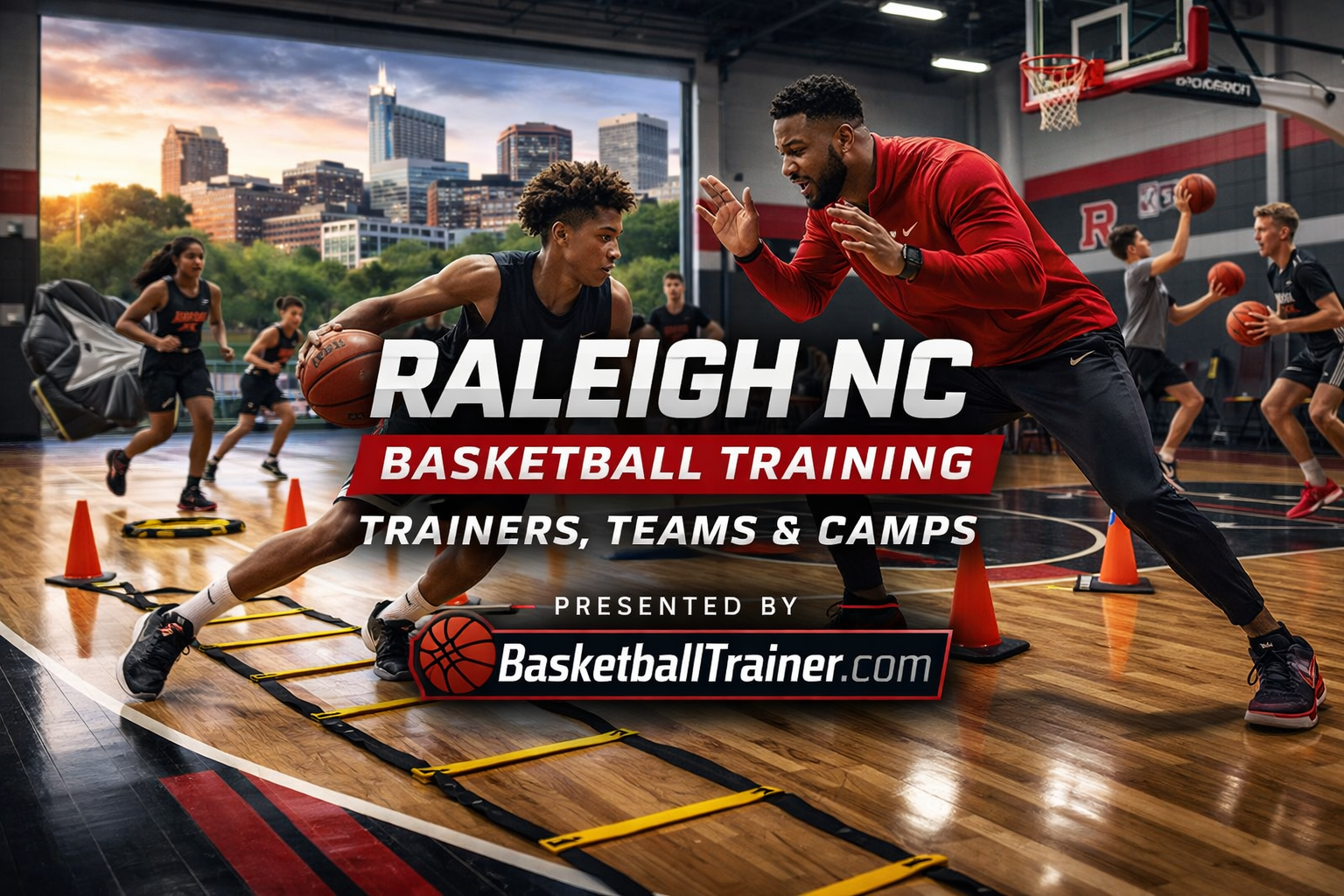
Raleigh NC Basketball Trainers
Raleigh’s basketball trainer market reflects the Research Triangle’s character: high standards, well-researched families, and a surprisingly deep pool of credentialed coaches. These trainers work with players across skill levels. Use the evaluation questions later on this page when reaching out to any of them.
Separation Team (Marcus Hodges)
Separation Team is Raleigh’s highest-profile private basketball training operation, founded by Marcus Hodges — a globally recognized NBA and WNBA skills coach with a 175,000+ Instagram following and a client list that has included Dwayne Wade, Ben Simmons, and NBA player Devonte Graham, whom Hodges began training in Raleigh during Graham’s 8th grade year. Hodges opened his dedicated training facility in Raleigh in 2023, creating a year-round hub for elite player development that now sees over 1,000 athletes annually. The program works with players ages 9-18 (boys and girls) offering group classes, private sessions, a competitive youth league for ages 7-11, and day camps. Pricing for group classes typically runs $25-50 per session; private sessions run $80-120 per hour based on comparable Triangle training programs. Hodges’ sister Danielle manages operations, earning consistent praise from families for making everyone feel welcomed regardless of skill level. The Separation Team brand is known for emphasizing “train smart, not just hard” — teaching game-applicable skills rather than showcase drills. This is the most nationally credentialed training option in Raleigh.
North Ridge Basketball Academy (NRBA) — Coach Mark Miller
Coach Mark Miller has built the North Ridge Basketball Academy into one of the Triangle’s most trusted Raleigh basketball training programs over more than a decade of work. Located at 7601 Falls of Neuse Road in North Raleigh, NRBA combines basketball instruction with a faith-based mentorship philosophy. Co-Director Seth Huber (Liberty University graduate) leads staff development and curriculum, while Nathan Miller directs the Explode Performance athletic training component that addresses vertical leap, strength, and conditioning specifically for basketball athletes. Staff credentials are notably strong — the program has drawn endorsements from NC Sports Hall of Fame coach Larry Lindsey and a former NCAA Division III Player of the Year. NRBA offers private lessons ($60-90/session based on staff level), partner sessions, shooting sessions, summer skills camps, and an invitational camp for advanced players. Critically, NRBA maintains an active Scholarship Assistance Program ensuring no player is turned away due to cost — a meaningful feature in a market where private training often feels out of reach for middle-income families. Best for: middle school and high school players, faith-oriented families, players who want structured curriculum-based development over one-off sessions.
Pristine Skills Training (Dominique Sutton)
Pristine Skills Training is run by Dominique Sutton, an NBA G-League Champion and professional overseas veteran who brings legitimate professional playing experience to his player development work in the Wake Forest area just north of Raleigh. Sutton offers individual and small group training for both male and female players, with a particularly strong focus on pre-season readiness programs for serious high school and college-level athletes. The program has attracted college players as training partners, including a Texas A&M transfer, which gives serious high school players access to competitive court environments rarely available in private training settings. Pre-season readiness membership provides monthly access and court reservation capability. Sessions run approximately $60-90 per hour for individual work; monthly memberships offer better value for committed players. Best for: competitive high school players, college-bound athletes, and players wanting to train alongside and against higher-level competition.
Fireball Basketball Academy
Fireball Basketball Academy is a shooting and skills academy serving the Raleigh and Wake Forest area, focused specifically on shooting mechanics and overall skills development across all age groups. The academy runs an annual multi-day summer basketball day camp alongside its year-round training offerings. Fireball’s specialized focus on shooting makes it worth considering for players whose primary development need is shot improvement — this level of specialization is harder to find in general skills trainers. Individual training sessions run $50-80 per hour; camp registration varies seasonally. The academy operates primarily in the Wake Forest/North Raleigh corridor, making it most accessible for families in northern Wake County. Best for: players specifically focused on shooting mechanics, North Raleigh and Wake Forest families wanting a specialist over a generalist trainer.
IVGreatness Basketball Academy
IVGreatness Basketball Academy is a Raleigh-based program oriented around college recruitment readiness and player exposure, with a track record of 30+ professional players trained and 300+ scholarship placements across its history. The program’s “Recruiting Lab” concept — a structured 10-minute assessment and guidance session for families navigating the college recruitment process — is a differentiating feature for families with high school players who have college basketball aspirations. IVGreatness works with players of high school age primarily, with individual training rates in the $70-100/session range for focused development work. Furthermore, the recruitment pathway focus means families should be clear-eyed about their child’s realistic college basketball prospects before investing at the higher end. Best for: high school players (grades 9-12) with legitimate college basketball interest and families wanting guidance navigating the recruitment process.
City of Raleigh Youth & Teen Basketball Training (Coach Carlos Dugan)
Operated through the City of Raleigh Parks and Recreation Department at Lake Lynn Park (7921 Ray Road), this city-run program under instructor Carlos Dugan is one of Raleigh’s most accessible structured basketball training options. Youth sessions (ages 8-12) run Monday evenings and Saturday mornings; teen sessions (ages 13-17) follow immediately after in the same slots. At $22.50-$40 per month for ongoing enrollment, this represents extraordinary value compared to private training rates in the same market. Register through RecLink at raleighnc.gov. Best for: families wanting structured skill development without private trainer pricing, players ages 8-17 in northwest/North Raleigh (Lake Lynn Park area), and families who want to test consistent skills training before committing to a private trainer.
Raleigh Basketball Camps
Raleigh basketball camps run primarily during summer months (June-August) with some available during school breaks. Wake County families have a genuine advantage here: NC State’s Division I facilities are accessible through the Wolfpack camp program, and city-run camps provide affordable alternatives across multiple neighborhoods.
NC State Wolfpack Basketball Camps
NC State University offers summer basketball camps through their Pre-College Programs, running June-August for ages 6-18 at Division I facilities including PNC Arena. Current head coach Will Wade and Wolfpack coaching staff lead sessions, providing campers genuine access to ACC-level instruction and facilities. Day camp options run approximately $150-250 per week; residential (overnight) programs typically run $400-600 per week. NC State also hosts the Wolfpack Women’s Basketball Camp for middle school girls (with scholarship opportunities available through the state’s electric cooperative program). The program splits into multiple age-appropriate groups ensuring developmental appropriateness rather than mixing elementary and high school players. Additionally, the facility experience — training on the same floor where the Wolfpack plays conference games — is a meaningful motivation factor for kids who watch NC State basketball. Best for: players ages 6-18 wanting D1 camp experience, families in Wake County looking for structured multi-day summer skill building, residential camp seekers.
NRBA Summer Skills Sessions & Camp
The North Ridge Basketball Academy (7601 Falls of Neuse Rd, North Raleigh) runs multiple summer camp formats including 3-hour Summer Skills Sessions and a multi-day Invitational Camp for advanced players selected by staff evaluation. Full-day camp options are also available throughout summer. NRBA’s Scholarship Assistance Program carries directly into camp offerings — families who cannot afford full fees can request scholarship support, and the camp won’t decline players based on financial limitations alone. Skills Sessions run from approximately $50 per session (3 hours); multi-day camps run $150-300 depending on format. The Invitational Camp is the highest-level offering and requires an application/selection. Best for: North Raleigh families, players who’ve already worked with NRBA staff and want camp-format continuity, families wanting faith-based instruction combined with high-quality basketball skill development.
Separation Team Day Camp
Separation Team runs year-round day camps at their Raleigh facility that combine basketball sessions, contests, games, and activities — including arts and crafts and obstacle courses — making this more of a full youth experience than pure skills instruction. This format works particularly well for younger players (ages 7-12) who need basketball and physical activity combined with non-sport engagement across a full day. Camp pricing runs approximately $120-180 per week, with the year-round availability giving families flexibility to use camps during teacher workdays and spring break in addition to summer. Best for: families who want basketball as part of a broader active camp experience, younger players (elementary age), Raleigh families who need childcare alternatives during school breaks throughout the year.
Pro Skills Basketball Raleigh Camps & Clinics
Pro Skills Basketball Raleigh operates camps and clinics alongside their club team program, running sessions affiliated with the Jr. NBA for youth players. This connection to the NBA’s developmental framework provides structured, standards-aligned instruction across age groups. Camps run during summer and school breaks with multiple session times allowing schedule flexibility. Typical camp fees run $100-175 per week for day camp formats. Additionally, families interested in PSB’s club team program (tryouts in the fall) can use camp participation as a low-pressure way to evaluate the organization before committing to a full club season. Best for: families considering the PSB club program who want a preview experience, players ages 8-15 wanting structured developmental basketball, families who prioritize NBA-affiliated programming standards.
Fireball Basketball Academy Summer Day Camp
Fireball Basketball Academy runs an annual multi-day summer day camp in the North Raleigh / Wake Forest area focused primarily on shooting fundamentals and overall skills development. At 6+ annual editions, the camp has established a consistent format and curriculum. This is a specialized offering — families whose child has a clear need for shooting mechanics work will find this more targeted than general skills camps. Day camp fees run approximately $100-150 per week. Best for: players with an identified shooting weakness, North Raleigh and Wake Forest families, parents who want a shooting-specialist camp alongside a general skills summer camp rather than relying solely on one option.
Raleigh Select & AAU Basketball Teams
Raleigh-area AAU and select teams compete primarily March through August. Tryouts typically happen in fall (October-November) and early spring (February). Travel for most Raleigh programs means tournaments in Charlotte, Greensboro, Durham, and Virginia Beach, with national travel an option for top teams. Before committing, always ask about the total cost including tournaments, hotels, and gas — in the Triangle, that often doubles the listed team fee.
Wake County Basketball Association (WCBA)
The Wake County Basketball Association is one of the most well-organized and long-running youth basketball organizations in the Triangle, offering both recreational league play and tryout-based travel teams for grades 3-8. WCBA runs five league seasons throughout the year (each season includes 9-11 games and 4-6 practices), creating consistent year-round development opportunity. The travel team program specifically targets players who want more competitive training than recreational leagues provide, emphasizing skill development, mental toughness, and sportsmanship alongside wins and losses. Recreational league fees typically run $80-120 per season; travel team fees run $400-800 per season depending on age group, before travel costs. Registration for each season opens 30-45 days before start. Best for: families wanting a homegrown Raleigh organization with deep roots, players grades 3-8 at any competitive level, families who want a single organization for both rec and travel options as their child develops.
Pro Skills Basketball Raleigh (PSB)
Pro Skills Basketball Raleigh operates club basketball teams as part of a national PSB network, providing a Jr. NBA-affiliated developmental framework across multiple age groups. PSB emphasizes experienced coaches and a positive player-first culture, with multiple parents citing the coaches’ genuine investment in player development beyond winning. Tryouts/evaluations occur in fall (November-December) and early spring (February), with a second tryout window in February for families who missed fall. Team fees run approximately $800-1,400 per season, not including tournament travel costs which typically add $500-1,500 annually depending on how many tournaments the team attends. Additionally, PSB families consistently note the organization’s transparency around costs and program expectations as a differentiator from programs that undersell total investment. Best for: families wanting a nationally recognized program framework, players wanting Jr. NBA-affiliated instruction standards, families new to AAU basketball who want a well-organized entry point.
Capital City Clutch (Cap City Clutch)
Capital City Clutch is a co-ed AAU travel basketball club structured as a 501(c)(3) non-profit organization, bringing a different financial model to Raleigh competitive basketball. The non-profit structure means the organization reinvests in player development rather than operating for profit, and typically allows for more accessible pricing and scholarship opportunities compared to for-profit clubs. Clutch emphasizes character development alongside competitive skill building, viewing basketball as a vehicle for life lessons including teamwork, dedication, and sportsmanship. Team fees for Clutch tend to run $600-1,200 annually, with some financial assistance available given the non-profit structure. Best for: families who prioritize character development alongside competition, players wanting co-ed AAU experience, families seeking a community-rooted program over a regionally prominent brand name.
Carolina United Basketball Club
Carolina United Basketball Club is powered by I’m Possible Basketball Training (Anthony Porter), based in Fuquay-Varina south of Raleigh. The club takes a development-first AAU approach, integrating the I’m Possible global training methodology directly into team practice structure — meaning players get skill-lab instruction alongside competitive game play rather than treating practice as game preparation only. Spring season fee is notably transparent: $1,040 total (payable in four $260 installments) plus $120 for uniforms if needed. This fee includes all practices, seven tournaments, custom player shirt, professional photos, and unlimited skill lab membership for the full season — an unusually comprehensive package for the price point. First-time visitors can try a class for $7. Best for: families in South Wake County (Fuquay-Varina, Holly Springs) wanting AAU experience built around a proven training system, players wanting development-integrated AAU rather than pure tournament experience.
Carolina Elite AAU Basketball
Carolina Elite is a girls-focused travel basketball program based in the Raleigh/Durham area, recognized as one of North Carolina’s premier girls AAU programs. Founded to help young female athletes become leaders, team players, and role models, Carolina Elite’s emphasis extends beyond basketball skills to developing competitive young women with strong character. The program participates in NC AAU competition with regional and some national travel. Team fees typically run $1,000-2,000 annually, not including tournament travel. Additionally, Carolina Waves (founded 2011) is another strong girls AAU option in the Triangle market for families evaluating girls travel basketball programs. Best for: girls ages 10-17 wanting competitive travel basketball, families in the Raleigh-Durham corridor prioritizing girls-specific programming and coaching philosophy.
Raleigh High School Basketball
All Raleigh public high schools are part of the Wake County Public School System (WCPSS) — the largest school district in North Carolina (198 schools, ~160,000 students) and recently named the #1 district for athletes in the state. WCPSS fields competitive basketball programs at nearly all 36 high schools, most offering varsity, JV, and freshman teams for both boys and girls.
Key Raleigh Basketball High Schools
- Millbrook High School (northeast Raleigh) — Strong athletic programs including IB academics; longtime competitive basketball tradition
- Broughton High School (midtown, near NCSU) — Historic program; John Wall and Pistol Pete Maravich both had connections to Broughton
- Enloe High School (east Raleigh) — LeVelle Moton played here; diverse, academically strong school
- Sanderson High School (north Raleigh) — LeVelle Moton coached here (59-25 record, back-to-back Cap-7 tournament championships 2006-07)
- Leesville Road High School (northwest Raleigh)
- Heritage High School (Wake Forest/north Wake)
- Wakefield High School (north Wake County)
- Garner High School (southeast Raleigh/Garner)
- Southeast Raleigh High School (southeast)
- Green Hope High School (Cary/West Wake) — Highly ranked academically, strong athletic programs
Private & Charter School Options
- Raleigh Charter High School (downtown) — Top-ranked academically; smaller athletics footprint
- North Carolina State University area — Several private/faith-based schools with competitive basketball programs
- Word of God Christian Academy — Program has produced highly-recruited players, including John Wall’s prep stint
School team tryouts typically occur in October-November for the winter season. WCPSS athletics schedules are published at . Most schools field multiple teams (varsity, JV, freshman) for both boys and girls.
How to Use These Listings
These are Raleigh-area trainers, camps, and teams that Wake County families work with. We don’t rank them as “best” or endorse specific programs. Use the evaluation questions in the next section when contacting any option. The right fit depends on your child’s age, skill level, goals, your family’s schedule, budget, and where you live in Wake County. Contact 2-3 options before committing to see which feels right for your family.
Raleigh Community Centers: Basketball’s Best-Kept Secret
Before spending money on private training, understand what Raleigh’s 28+ city community centers actually offer. Unlike most cities where drop-in gym access costs $1-5 per visit, Raleigh Parks operates an Open Play Pass system that is completely free for youth under 17. You register once through RecLink (online or at any community center), get your photo taken, and then show up for open play sessions whenever you want — no charge, no reservation needed during open play times. This is one of the best basketball access deals in the South.
The Raleigh Open Play Pass: How It Works
Cost: FREE for youth under 17. FREE for adults 18+.
Register: Online via RecLink or walk into any community center.
What you need: Registration (they take your photo); pass is good for the full calendar year and valid at all centers.
Important rules: No private lessons, personal training, or organized team practices during open play. This is pickup basketball and individual work only. Max 30 people per gym. Tennis shoes required.
North Raleigh: The Flagship Facilities
Millbrook Exchange Community Center
Address: Near Spring Forest Rd & Millbrook Rd (next to Millbrook High School) | Gym: 1 air-conditioned gymnasium
Conveniently located next to one of Raleigh’s strongest athletic high schools, this center gets serious pickup game traffic from Millbrook-area players and alumni. The air-conditioned gym matters — North Carolina summers are humid, and playing in a non-AC gym in August is genuinely miserable. Good for families in the North Raleigh / Spring Forest Rd corridor.
Also at Millbrook Exchange: Tennis center, pool, dog park — making this a multi-use park stop for the whole family while kids hoop.
Abbotts Creek Community Center
Address: 9950 Durant Rd, Raleigh NC 27614 | Gym: 1 air-conditioned gymnasium (full-size + cross-courts)
One of Raleigh’s newer facilities, featuring a bow-trussed gym that supports both full-size basketball and volleyball courts with additional cross-courts — meaning more shooting space available even when full games are running. LEED Silver certified facility. Located near I-540, making it accessible from both Brier Creek/Northwest and far North Raleigh.
More North Raleigh / Northwest Options
Lake Lynn Community Center (7921 Ray Road, 27613)
2 air-conditioned gyms. This is where the City of Raleigh’s structured Youth & Teen Basketball Training program (Coach Dugan) is held. Good for families in the northwest near Leesville Rd.
Brier Creek Community Center (10810 Globe Rd, 27617)
1 air-conditioned gym. The northwest Raleigh/Brier Creek option. Newer facility serving one of Wake County’s fastest-growing residential areas. Good for families near RDU airport and Research Triangle Park.
Laurel Hills Community Center (Northwest area)
2 air-conditioned gyms — one of the few multi-gym facilities in Raleigh outside the downtown area. Higher court availability during peak hours compared to single-gym centers.
Midtown / ITB: Downtown-Area Courts
Jaycee Community Center — The Midtown Hub
Address: 2405 Wade Ave, Raleigh NC 27607 | Gym: 1 air-conditioned gymnasium
Inside the beltline, convenient for families living in Midtown, Cameron Village, Five Points, and the NCSU campus area. Staff here are consistently reviewed as among Raleigh’s best for rec center friendliness. The center was recently remodeled including new air conditioning. Families reviewing NCSU camps often use Jaycee as their nearby pickup game option during the school year.
Hours: Mon-Fri 10am-9pm | Sat 9am-3pm | Sun 1pm-6pm
John Chavis Memorial Park Community Center — The Historic Downtown Option
Address: 505 Martin Luther King Jr. Blvd, Raleigh NC 27601 | Gym: 1 air-conditioned gym + indoor walking track
Downtown Raleigh’s most historic recreation facility, featuring an indoor track alongside the basketball gym and a historic carousel that’s been at the park since 1948. Families using Chavis for basketball regularly report the gym as beautifully maintained and immaculately clean. The indoor track lets players conditioning-walk or run while waiting for court time. This center serves downtown and East Raleigh families who prefer an ITB option over commuting north or south.
East & Northeast Raleigh: Community Gyms
Green Road Community Center
Address: 4201 Green Rd, Raleigh NC 27604 | Gym: 2 air-conditioned gymnasiums
Northeast Raleigh’s flagship, with two gyms creating better court availability during evening hours. Located near Spring Forest Road Park and Buffalo Road Athletic Park, this is the community hub for Northeast Raleigh families. Families near Triangle Town Center should start here before considering the longer commute to North Raleigh or downtown facilities.
Southeast Raleigh Options
Barwell Road Community Center (5857 Barwell Park Dr, 27610)
2 air-conditioned gyms — the best court availability in Southeast Raleigh. Families south of I-440 should start here. Lower cross-town traffic than North Raleigh flagships.
Biltmore Hills Community Center (2615 Fitzgerald Dr, 27610)
1 air-conditioned gym. Southeast Raleigh secondary option; lower traffic than Barwell for players wanting less crowded pickup time.
Carolina Pines Community Center (2305 Lake Wheeler Rd, 27603)
1 air-conditioned gym. South Raleigh option near Lake Wheeler. A quieter alternative to the larger flagships for focused practice work.
📍 Insider Note: Raleigh’s free Open Play Pass model is genuinely unusual. Most cities charge $1-5 per visit; Raleigh charges nothing after a one-time registration. If you have a child who wants to play pickup basketball, this is worth setting up before spending any money on private training. Get the pass, find your nearest center’s open play schedule, and let your kid develop a court feel before committing to structured instruction.
How to Use These Listings
These are Raleigh trainers, camps, and teams that families in the area work with. We don’t rank them as “best” or endorse specific programs. Use the evaluation questions in the next section when contacting any of these options. The right fit depends on your child’s age, skill level, goals, your family’s schedule, and your budget. Contact 2-3 options before committing to see which feels right for your family.
Evaluating Basketball Training Options in Raleigh
We provide evaluation frameworks, not recommendations. These questions help you assess trainers, camps, and teams based on what matters for YOUR family in the Triangle.
Questions to Ask Private Trainers
Why this matters in Raleigh: The I-440 beltline and I-540 loop create real commute math. A trainer in North Raleigh may be 35-40 minutes from Southeast Raleigh during evening rush. That’s 90 minutes round-trip twice a week — over a season, that’s 60+ hours in the car.
Why this matters: Vague promises of “getting better” mean nothing. Specific targets — free throw percentage improvement, mastering a specific move at game speed, making the school team — give you something to evaluate against.
Why this matters: A trainer whose clientele skews toward elite high school recruits may not be the best fit for your 5th grader building fundamentals, even if their credentials are impressive.
Why this matters: School conflicts, illness, family obligations happen. Understanding policies before paying protects your investment — and tells you something about how the trainer approaches the relationship.
Why this matters in Raleigh: Wake County’s 36 high schools all run tryouts on similar timelines in late October. Trainers who work regularly with local players understand the preparation arc — from summer development through fall pre-tryout intensity.
Questions to Ask About Camps
Why this matters: 1 coach per 20 players is supervised play. 1 per 8 is actual instruction. This single number tells you more about camp quality than any marketing language.
Why this matters: Camps that run games all day teach different things than camps that run drills all day. Neither is wrong — but they’re different products. Know what your child needs before registering.
Why this matters: Some camps include lunch and a t-shirt; others are instruction only. A $150 camp that includes lunch is a different value than a $150 camp that doesn’t. Total cost is the number that matters.
Why this matters in Raleigh: Several Raleigh programs — including NRBA, the City of Raleigh rec program, and Believe-type foundations — offer scholarship assistance. Many don’t advertise it prominently. Always ask. The answer may surprise you.
Questions to Ask About AAU / Select Teams
Why this matters: Team fees ($800-2,000) are just the entry point. Hotel rooms, gas, meals for tournament weekends in Charlotte, Greensboro, Virginia Beach, or Atlanta can easily double the stated cost. Ask for a realistic total-season budget before committing.
Why this matters in Raleigh: The Triangle’s location means competitive teams have access to strong regional circuits without always going national. Programs competing primarily in NC and neighboring states offer real competition without the cost of Vegas or Orlando showcases.
Why this matters: “Everyone gets equal time” and “best players earn more minutes” are both legitimate philosophies that create very different experiences. There’s no wrong answer — but mismatched expectations cause most AAU parent conflicts. Ask before the first tournament.
Why this matters: The best programs in Raleigh treat basketball as a vehicle, not the destination. Organizations with clear academic standards produce players who actually get recruited — and who have something to fall back on if basketball doesn’t pan out.
Raleigh Pricing Reality
Open Play / Drop-In: Free (City of Raleigh Open Play Pass — most accessible entry point in any major city)
City Youth Training Programs: $22.50-40/month (Coach Carlos Dugan at Lake Lynn)
Private Training: $50-120/session individual; group sessions typically $25-50/player
Summer Camps: $100-175/week recreational; $150-300/week skills-intensive; $400-600/week residential D1
AAU/Select Teams: $600-2,000 team fees annually, plus $1,500-3,500 in travel for competitive programs
Investment vs. Outcome Reality
Raleigh’s free rec center access changes the math that exists in most cities. Before spending $100/session on private training, spend a few weeks in open play. Watch your child in an unstructured environment. See what they gravitate toward, what frustrates them, where the gaps are. That observation is worth more than any intake session with a trainer — and it costs nothing. When you’re ready for private instruction, you’ll know exactly what to ask for.
Free Basketball Training Evaluation Guide
Download our comprehensive guide with questions to ask before committing to any trainer, camp, or team.
Raleigh Basketball Season: What to Expect
Understanding when different basketball programs run in the Triangle helps families plan without panic. This calendar shows typical timing — not deadlines you must meet.
High School Season (NCHSAA)
Typical Timeline: Tryouts late October, regular season begins mid-November, conference play December through February, NCHSAA playoffs in February and early March.
Wake County Reality: With 36 high schools in WCPSS, competition for roster spots is genuine. Tryouts typically happen within a two-week window across the district. Most high school coaches in the Triangle want to see AAU participation between April and July — not during their season.
AAU / Select Basketball Season
Typical Timeline:
- November-December: Tryouts for spring rosters (PSB, WCBA travel division)
- February-March: Secondary tryouts; spring season builds after school playoffs conclude
- March-May: Spring tournament season begins; primarily regional travel (NC, VA, SC)
- June-July: Peak summer circuit; national showcases for older age groups
- August-September: Fall ball; skills work before school season starts
Triangle Advantage: Raleigh’s central location in the Mid-Atlantic basketball corridor gives teams access to competitive regional circuits without mandatory national travel. Many programs compete effectively within 3-4 hours of home — Charlotte, Greensboro, Richmond, Virginia Beach — before considering flights to Vegas or Atlanta showcases.
Basketball Camps
- May: Early summer camps open; NRBA spring skills sessions
- June-July: Peak camp season — NC State Wolfpack Camps, Separation Team Day Camp, Fireball, i9 and PSB programs
- Late July-August: Final camp opportunities; transition to fall training
NC State’s Presence: PNC Arena and the Wolfpack’s D1 facilities give Raleigh campers access to a genuine college basketball environment. For younger players who’ve never been on a college court, that experience has real motivational value beyond the basketball instruction itself.
City of Raleigh Rec Leagues
Year-Round Structure: WCBA and City of Raleigh programs run multiple seasons annually, typically fall, winter, spring, and sometimes summer leagues. The City’s youth and teen training programs (Coach Dugan at Lake Lynn) run on consistent weekly schedules throughout the school year.
Registration Reality: City programs register through RecLink (raleighnc.gov). Seasons typically fill on a first-come basis. The Open Play Pass, however, has no registration window — set it up any time at any community center and it’s valid immediately across all facilities.
Raleigh’s Basketball Culture & Heritage
Raleigh sits at the intersection of two powerful basketball identities: the NC State Wolfpack’s D1 history on one side, and a grassroots community tradition that produced NBA players from the same public courts where your kids play today.
The Wolfpack Legacy: Reynolds to PNC
Reynolds Coliseum — built in 1949, capacity 12,400 — was the defining arena for ACC basketball for decades. It’s where David Thompson played, where the foundation of NC State’s basketball identity was built. When PNC Arena opened in 1999, it gave Raleigh a 19,000-seat D1 venue and an NBA-grade facility that now hosts both the Wolfpack and occasional elite events. Young players in Raleigh grow up with legitimate D1 basketball in their backyard in a way that most cities simply don’t.
David Thompson — Thompson’s name belongs in any honest conversation about Raleigh basketball. His #44 jersey is the only retired number in NC State history. He led the Wolfpack to the 1974 NCAA Championship, beating UCLA’s dynasty in a moment that still resonates. Thompson went on to become one of the NBA’s premier players of the late ’70s. His legacy shows up in every NC State camp that brings young Raleigh players onto the same court where he played.
Jim Valvano — The 1983 NCAA Championship run is Raleigh basketball lore. Valvano’s “don’t give up, don’t ever give up” speech remains one of the most quoted moments in sports. His legacy lives in the V Foundation for Cancer Research, and his spirit shows up in how Raleigh basketball communities talk about resilience, persistence, and not measuring success purely by wins and losses.
The Boys Club Pipeline: PJ Tucker, LeVelle Moton, and the Lane Street Story
The Boys & Girls Club of Wake County has been a quiet pipeline for Raleigh basketball talent for decades. PJ Tucker — 15-year NBA veteran, 2021 NBA Champion — grew up in Raleigh and developed his game at the Boys Club courts. His path from Raleigh’s northeast side to the NBA demonstrates that the community infrastructure here produces real players, not just rec league participants.
LeVelle Moton’s story is the one that deserves to be told more often. He grew up in the Lane Street housing projects in downtown Raleigh, developed his game at the same Boys Club, played at Enloe High School, became a standout at NC Central University, then coached at Sanderson High School before returning to NCCU as head coach — building one of the most respected programs in HBCU basketball. The City of Raleigh renamed Lane Street Park to LeVelle Moton Park in his honor. When local coaches talk about giving back, Moton is what that actually looks like.
John Wall played at Broughton High School before transferring to Word of God Christian Academy — and his path to becoming the #1 overall pick in the 2010 NBA Draft runs directly through Raleigh. Wall’s Raleigh roots are part of why families here understand that elite talent development doesn’t require leaving the Triangle.
Pistol Pete Played Here
Before he became “Pistol Pete” at LSU and in the NBA, Pete Maravich played high school basketball at Broughton High School in Raleigh. The building on St. Mary’s Street still stands. That history doesn’t get discussed enough — but it’s a reminder that Raleigh’s basketball roots go back farther than most people realize, and that the city has been producing basketball talent for generations.
Research Triangle Basketball Culture
Raleigh’s Research Triangle identity — tech companies, universities, transplant families — creates a specific basketball culture: parents who are serious about their children’s development and willing to invest, alongside a community foundation built on public courts and rec center pickup games. That combination produces a youth basketball ecosystem with more depth than most cities its size. The private trainer market is sophisticated because demand is real. The public rec infrastructure is strong because the city has invested in it. Families here have genuine options across the full spectrum, from free open play to elite private coaching, and most of the smart ones use both.
Frequently Asked Questions About Raleigh Basketball Training
These are the questions Triangle families ask most often about youth basketball programs, costs, and timing.
How much does basketball training cost in Raleigh?
Raleigh’s cost range is unusually wide. The City’s free Open Play Pass gives families access to 28+ rec centers at no charge — genuinely the lowest entry point of any major NC city. Municipal youth training programs (like Coach Dugan’s program at Lake Lynn) run $22.50-40 per month. Private trainers typically charge $50-120 per individual session, or $25-50 per player in small groups. Summer camps range from $100-175 per week for recreational programs to $400-600 per week for NC State residential camps. AAU select teams run $600-2,000 in team fees, plus $1,500-3,500 in travel for competitive programs. Many programs offer financial assistance — always ask.
What is the City of Raleigh Open Play Pass and how do I get one?
The Open Play Pass gives youth (under 17) and adults free access to open gym basketball at all City of Raleigh community centers. You register once — either online through RecLink at raleighnc.gov or in person at any community center — and the pass works at all facilities. Bring a photo ID for adults; youth registration may require a parent. The pass doesn’t guarantee court time (open play is first-come, first-served with a 30-person maximum per gym), but it eliminates the per-visit cost that exists in most cities. For families on a budget, this is the first step before spending anything on private training or leagues.
When do AAU basketball tryouts happen in Raleigh?
Most Raleigh AAU programs hold their primary tryouts in November and December, with secondary tryout opportunities in February-March. The November-December window surprises some families because it overlaps with school season for older players — but most programs want rosters set before spring tournament registration deadlines. Pro Skills Basketball and WCBA travel division both follow this pattern. If your child misses fall tryouts, February-March is typically a second window. Some programs like Capital City Clutch operate with more flexible, rolling enrollment. Contact programs in October to ask about their specific schedule for the upcoming season.
What age should my child start basketball training in Raleigh?
There’s no single right answer. Many Raleigh families start with recreational leagues ages 5-7 through WCBA’s rec division, i9 Sports, or YMCA programs — these focus on fun and basic coordination, not skill development. Private basketball instruction typically adds value around ages 8-10, when children can focus on specific skills like shooting form or ball-handling. AAU programs start as young as 8U, but most Triangle families don’t prioritize travel teams until 10U or 11U when kids can handle the tournament commitment. The most important factor isn’t age — it’s your child’s genuine interest and your family’s capacity to sustain the commitment over years, not weeks.
Which area of Raleigh has the best basketball training options?
Every part of Raleigh has quality options — the honest answer is that “best” usually means “closest to home.” North Raleigh and the Brier Creek corridor have the highest concentration of private trainers and newer facilities. Midtown/ITB has Jaycee Community Center and proximity to NC State. Southeast Raleigh has Barwell Road’s two-gym facility and a strong community tradition. East Raleigh has Green Road’s two-gym complex. The more relevant question is: which programs are within 20 minutes of your home, and which ones match your child’s age, skill level, and goals? Raleigh’s beltline geography means cross-town commutes during evening rush can run 35-40 minutes. Geography is a factor — pick something sustainable.
Can my child play both school basketball and AAU in Raleigh?
Yes, and many WCPSS players do. The school season runs November through early March; AAU peaks April through July. There’s minimal overlap when managed properly. The tricky period is February-March when school playoffs overlap with AAU tryouts — players have to navigate that carefully. Some high school coaches in Wake County actively support AAU participation as summer development; others prefer players rest in the offseason. Talk to your school coach about their expectations before joining an AAU program. The short version: school team comes first during its season, always. AAU fills the gap. Both can coexist when communication is handled upfront.
Raleigh Basketball Training Options at a Glance
This table helps Triangle families understand cost, time commitment, and best use cases for different basketball training options.
| Training Option | Cost Range | Best For | Time Commitment |
|---|---|---|---|
| Open Play (Rec Centers) | Free (one-time pass registration) | Pickup games, court time, conditioning, trying basketball before committing | Flexible — drop in any time during open play hours |
| City Youth Training Programs | $22.50-40/month | Ages 8-17, structured skill development at affordable price point | 2x/week (Mon evenings + Sat mornings) |
| Private Training | $50-120/session individual; $25-50/player group | Specific skill gaps, pre-tryout prep, serious competitive development | Flexible, typically 1-2 sessions/week |
| Summer Basketball Camps | $100-175/week rec; $150-300/week skills; $400-600/week D1 residential | Summer skill building, college campus experience, structured childcare alternative | 1-2 week sessions, June-August |
| Recreational Leagues | $80-120/season | Beginners, recreational players, organized game experience without travel | 8-10 week seasons, 1-2 practices + games/week |
| AAU / Select Teams | $600-2,000 team fees + $1,500-3,500 travel | Competitive players, college recruitment exposure, serious tournament experience | 6-8 months, 2-3 practices/week, weekend tournaments |
Note: Costs reflect typical Raleigh ranges as of 2026. Many programs offer financial assistance. Always ask about scholarship opportunities and military/first-responder discounts.
Getting Started with Basketball Training in Raleigh
If you’re new to Raleigh basketball or just starting your child’s training journey, here’s a practical path forward that matches how the Triangle actually works.
Step 1: Get the Free Pass First
Register for the City of Raleigh Open Play Pass before spending money on anything else. Visit raleighnc.gov or any community center. It’s free, it’s immediate, and it gives your child court access at 28+ facilities across the city. Use it for 2-3 weeks before making any other decisions.
Step 2: Define Your Goals Honestly
Is your child trying to make their school team? Stay active and learn the game? Compete at the AAU level? Play in college? Different goals require completely different paths. A child who wants to make JV as a sophomore needs different training than one who wants to play pickup for fun. Get clear on this before spending money.
Step 3: Map Your Beltline Reality
Be honest about which side of I-440 you live on and how far you’ll actually drive twice a week. A trainer 10 minutes away that you’ll see consistently beats a trainer 40 minutes away that you’ll bail on by week six. Raleigh’s beltline geography makes this a practical decision, not a philosophical one.
Step 4: Contact 2-3 Options and Trust Your Gut
Use the evaluation questions from this page. Reach out to 2-3 programs that match your geography and goals. Ask about approach, pricing, experience with your child’s age group. Most offer trial sessions or initial consultations. After the first session, trust your instincts — does your child come home energized or dreading the next one? That answer tells you most of what you need to know.
Free Basketball Training Evaluation Guide
Download our comprehensive guide with specific questions to ask trainers, camps, and teams before committing.
Raleigh Quick Links
Basketball Resources
Nearby NC Cities
About BasketballTrainer.com
© 2026 BasketballTrainer.com. All rights reserved. Raleigh, North Carolina basketball training resource. Context, not direction.