Tacoma Basketball Training – Trainers, Camps & Teams
Tacoma basketball training spans North End to South End to Lakewood, with options for every age, skill level, and budget. This page helps Pierce County families navigate the 253’s programs, understand local geography, and make informed decisions — not chase rankings.
Basketball Trainers
Basketball Camps
Select Teams
Rec Centers
⚡ Looking for Basketball Training Options?
Skip the background info — jump straight to what you need:
Why This Tacoma Basketball Resource Exists
Tacoma’s 225,000+ residents live in a compact, hilly city with a basketball footprint that extends into Lakewood, University Place, Puyallup, and Federal Way. This creates dozens of basketball training options across Pierce County, from free Parks Tacoma programs to nationally-recognized overnight camps. This page helps families understand the local landscape, compare program types, and ask the right questions — not tell you what to pick.
Our Approach: Context, Not Direction
We don’t rank trainers or camps as “best” — we help you understand what makes different programs right for different needs. The right fit depends on your child’s age, skill level, goals, your family’s schedule, budget, and where in the 253 you actually live. This page provides evaluation frameworks and local context, not prescriptive recommendations. Learn how BasketballTrainer.com works • Read our editorial standards
Understanding Tacoma’s Basketball Geography
Tacoma is a compact city — roughly 62 square miles — but don’t let that fool you. Hills, bridges, and I-5 congestion make cross-town trips slower than a map suggests. And Greater Tacoma extends well beyond city limits: Lakewood to the south, University Place to the west, Puyallup to the east, and Federal Way to the north all have active basketball programs that Pierce County families draw from. Understanding your neighborhood’s relationship to major facilities determines what’s actually sustainable long-term.
North End / Proctor District
What to Know: Historic, established neighborhood with tree-lined streets and strong community identity. Center at Norpoint serves the northeast corner. Proctor District is walkable and family-friendly.
- Commute Reality: 20-25 min to South Tacoma off-peak; 35-40 min during afternoon rush on I-5
- School District: Tacoma Public Schools (TPS)
- Basketball Access: Center at Norpoint for rec; Bellarmine Prep private school program nearby
Downtown / Hilltop / Stadium District
What to Know: Historic heart of the city. People’s Community Center anchors Hilltop. Stadium High School’s iconic castle building is here. Urban, diverse, community-focused basketball culture.
- Commute Reality: Central location; 15-20 min to most Tacoma neighborhoods
- Basketball Culture: People’s Community Center free for kids under 18; strong YBDL presence
- Note: Hilltop has revitalized significantly; community basketball has deep roots here
South Tacoma / South End
What to Know: Diverse, working-class neighborhoods. STAR Center anchors South Tacoma. Washington High School and Foss High serve this corridor. Tacoma Mall area is the commercial hub here.
- Commute Reality: Easy access to I-5; 15-20 min to downtown, 25-30 min to North End
- Basketball Access: STAR Center; proximity to Lakewood programs via SR-512
- Note: Gorin Sports Academy has a Tacoma location at Military Rd S
Lakewood / University Place / Puyallup
What to Know: These adjacent cities are functionally part of Greater Tacoma’s basketball ecosystem. Northwest Magic practices in this corridor. The new Game Time Sports Complex is in Lakewood. Pacific Lutheran University (PLU) is in nearby Parkland.
- Commute Reality: 15-25 min to Tacoma proper; SR-16 and I-5 are main arteries
- Basketball Programs: NW Magic, Game Time, PLU camps — some of the best infrastructure is here
- Isaiah Thomas connection: Curtis HS in University Place — the Tacoma-area school where IT played through 11th grade
The Tacoma Rain Factor: Why Indoor Access Matters More Here
El Paso kids train outdoors 10 months a year. In Tacoma, October through May means rain, and November through March can mean rain every day. That changes the calculus on program selection. A trainer who works exclusively at outdoor courts becomes unavailable for half your season. A rec center membership or program with consistent indoor facility access is worth significantly more here than in dry climates. When evaluating programs, always ask: where do you train in February? If the answer is vague, ask again.
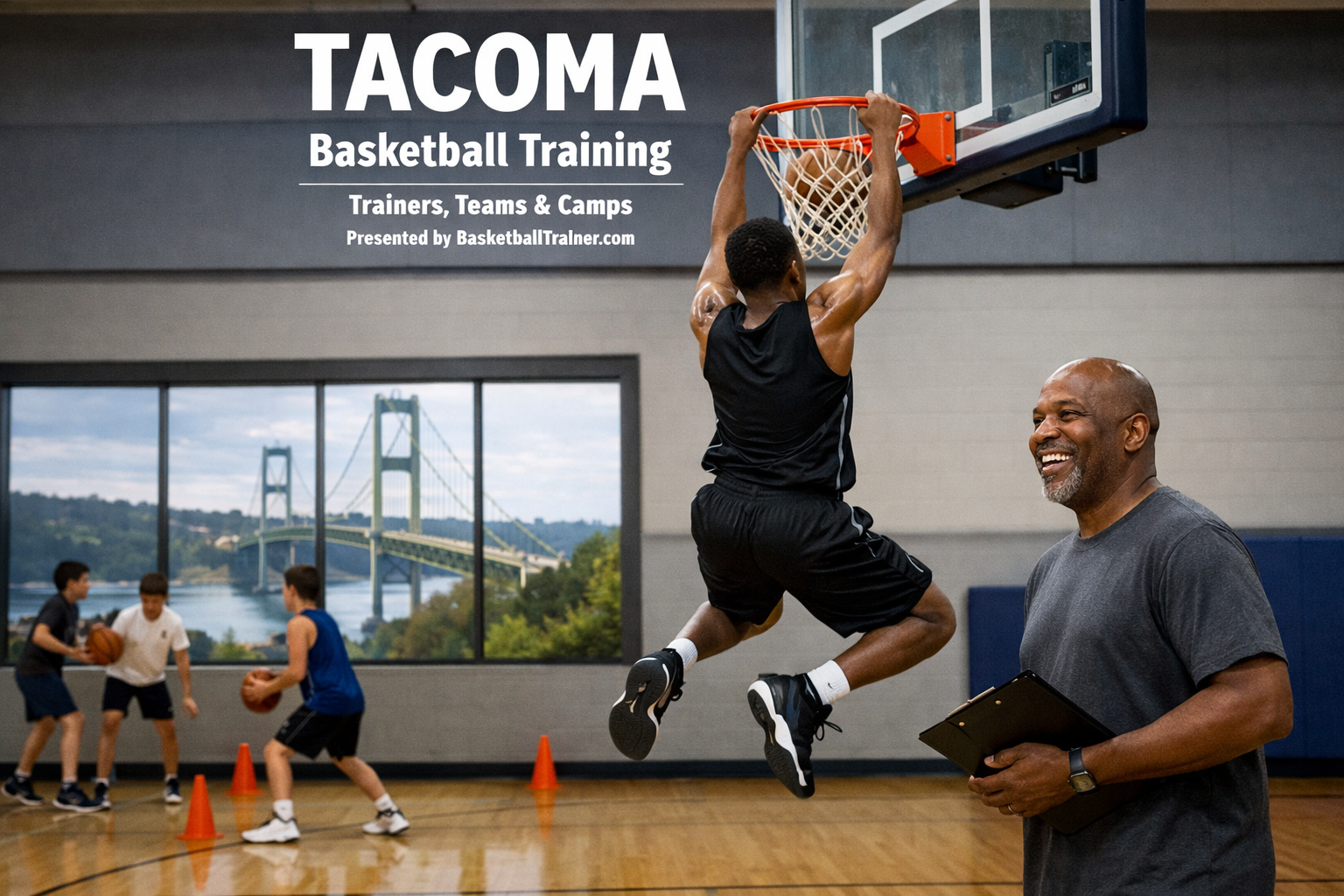
Tacoma Basketball Trainers
These Tacoma-area basketball trainers work with players across ages and skill levels. Use the evaluation questions later on this page when reaching out to any of them — geography, pricing, and coaching philosophy all matter before committing to regular sessions.
Evolve Skills Training (Coach Diondre Williams)
Evolve Skills Training was founded by Diondre Williams, a former collegiate basketball player who built the program around two parallel goals: improving basketball skills and developing the mental side of competition. The program works with young athletes across the Tacoma area with an emphasis on helping players grow both their game and their mindset. Sessions typically run $50-85 depending on format (individual vs. group) and are tailored to the player’s current level. Williams’ collegiate background shapes the program’s approach — he understands what it takes to compete at the next level and designs training progressions accordingly. This is a strong option for middle school through high school players who want to develop seriously without the tournament pressure of a full AAU commitment.
In The Zone Basketball (Coach Prince)
In The Zone Basketball is run by Coach Prince, who specializes in the art of shooting and offensive efficiency — his word is “art,” and parents consistently echo it in reviews. With 20+ years of playing experience including training with professionals, he coaches grades 3 through 12 with a shooting-first philosophy that emphasizes proper mechanics as the foundation of everything else. Parent feedback is uniformly strong: he evaluates players’ specific needs first, builds an instructional plan targeting weak areas, and coaches with patience and positivity. Sessions run $50-80 per session and are typically held at the coach’s location or home/venue arrangements. More information at itzbball.com. A particularly good fit for players whose shooting form needs a complete rebuild rather than minor tweaks.
Tyler Kidd Basketball Training
Tyler Kidd played Division I basketball at Eastern Washington University and professionally overseas, including with the Keilor Thunder in Australia’s NBL1 in 2022 — after winning the Big Sky Conference championship in 2020. He brings a legitimate playing pedigree to skill development work in the Tacoma area, focusing on basketball IQ, fundamentals, and skill-level refinement for local talent. His background competing against NBA-level players (O’Dea High School rivalries with pro talent; Gonzaga, Syracuse, Oregon, etc.) gives him credibility with competitive players who want training that mirrors what higher-level coaches actually value. Connect via Instagram: @tylovestein. Sessions typically run $60-100. A strong match for high school players eyeing college recruitment who want a trainer with recent professional playing experience.
Q-Time Basketball & Motivational Speaking (Coach Quincy)
Coach Quincy — known as “Coach Q” — runs a program that deliberately blends basketball skill development with motivational coaching and life skills. His approach acknowledges what most basketball trainers don’t say out loud: a young player’s belief in themselves matters as much as their crossover. Parent reviews describe him as “incredibly knowledgeable, motivational, kind, and responsive” — and specifically highlight how quickly he connects with players who might otherwise tune out coaches. Sessions run $50-80. This is an especially good fit for players who’ve had discouraging experiences with other programs, or for younger players (grades 4-8) who need to fall in love with the game before technical depth makes sense. The motivational component isn’t filler — it’s the structure the basketball sits inside.
Full Spectrum Athlete Basketball Training
Full Spectrum Athlete is run by a former NCAA basketball player who focuses on fundamentals, player development, and helping older players navigate college recruiting pathways. Parent feedback emphasizes that the coaching is grounded in fundamentals — building a proper base rather than flashy moves — and that the trainer can speak meaningfully to what college coaches actually look for during evaluation. Sessions typically run $60-90. This program is best suited for players in grades 7-12 who have a serious goal of playing at the collegiate level, or who simply want training that reflects what competitive basketball at the next level demands.
Gorin Sports Academy — Tacoma
Gorin Sports Academy operates a Tacoma-area location at 521 Military Road South, part of a larger multi-sport training operation with facilities in Bellevue and Redmond. The basketball program offers group and private lessons for youth and adults, with expert coaches focusing on fundamental skills, advanced techniques, court positioning, and conditioning. Group sessions run approximately $30-50 per session; private instruction typically $70-100 per hour. Summer basketball camps are also available at Tacoma and other Washington locations. The structured multi-sport facility environment means consistent indoor access year-round — important context for any parent who’s watched a fall league evaporate when November rain arrives. A good fit for families wanting a facility-based program with a consistent physical location rather than trainer-to-trainer variety.
Tacoma Basketball Camps
Tacoma-area basketball camps run primarily during summer months (June-August), with limited school-break options available. Pacific Lutheran University’s campus in Parkland gives the 253 access to a unique mix of national-caliber overnight programs alongside affordable municipal day camp options. Here’s what families actually need to know.
PGC Basketball at Pacific Lutheran University (Overnight)
Point Guard College (PGC) holds its annual Pacific Northwest overnight camps at Pacific Lutheran University in Parkland, just south of Tacoma — making this a rare opportunity to access one of basketball’s most respected IQ-development programs without flying across the country. PGC offers three progressive tiers: Playmaker College (grades 7-11), Scoring College (grades 9-12), and Point Guard College (grades 9-12+), each building on the last. The curriculum is distinctly different from most basketball camps — it prioritizes basketball IQ, mindset, decision-making, and leadership over showcase dunks or highlight-reel training. Former NBA players have credited PGC’s curriculum as genuinely game-changing. Camp costs run approximately $1,095-1,295 for 5 days and 4 nights (overnight format), including meals. This is not a beginner’s camp — PGC explicitly says it’s for “dedicated players who truly want to get better.” For a serious 8th-12th grader preparing for high school or college basketball, it’s one of the better investments available in the Pacific Northwest.
PLU Men’s Basketball Youth Development Camp
Pacific Lutheran University’s own men’s basketball coaching staff runs a 4-day youth development camp at Olson Gymnasium for boys ages 10-15. This is a more accessible entry point than PGC — it’s a day camp, more affordable, and emphasizes the “3 F’s: Fun, Focus, and Freedom” rather than advanced competitive preparation. Age groups split into morning (10-12) and afternoon (13-15) sessions so instruction is developmentally appropriate. PLU is an NCAA Division III program with a coaching staff focused on the teaching side of the game rather than recruiting exposure. Camp costs typically run $150-250 for the 4-day format. A strong option for families whose kids are serious enough to want college-facility instruction, but not yet at the stage where a $1,200+ overnight camp makes financial or developmental sense.
Parks Tacoma Basketball Camps
Parks Tacoma runs youth basketball programs for grades K-5 at multiple community centers across the city, making these the most geographically accessible and affordable options in the 253. Week-long summer camps typically cost $60-120 depending on the specific program and format. Financial aid is explicitly available for Tacoma residents who need cost assistance — the Parks Tacoma website notes that if cost is a barrier, residents can request financial aid for most fee-based programs. This is the right starting point for younger players (kindergarten through 5th grade) before families decide whether competitive or private training makes sense. Don’t overlook the geographic diversity here: multiple locations means you’re likely within 15 minutes of a Parks Tacoma option regardless of which neighborhood you live in.
YMCA of Pierce & Kitsap Counties Basketball Clinics
The YMCA of Pierce and Kitsap Counties offers summer basketball clinics across its Tacoma-area branches, providing a non-competitive, character-development-focused option for ages 5-14. The Y’s approach emphasizes skills building, teamwork, and a positive environment rather than competitive pressure or tournament preparation. Clinic costs typically run $80-140 depending on membership status, with financial assistance available through the Y’s scholarship program. Many Tacoma families use YMCA programs as their child’s first organized basketball experience before deciding whether they want to pursue more competitive options. The “no child turned away” policy means families facing financial difficulty can still access programming — ask explicitly about scholarship availability when calling.
Tacoma Select & AAU Basketball Teams
Tacoma-area AAU and select teams compete in regional tournaments primarily March through August, with travel to Seattle, Portland, Beaverton, Spokane, and occasionally national circuits. Pierce County is part of the Pacific Northwest AAU region, which is competitive and well-organized. Tryouts typically happen in February-March. Before committing to any program, ask specifically about travel requirements — regional Pacific Northwest travel is manageable, but some programs pursue national tournaments that can significantly increase annual costs.
Northwest Magic Basketball
Northwest Magic is one of the most established and recognized basketball organizations in the Pacific Northwest, based in the Tacoma/Lakewood/Puyallup corridor with nearly 20 years of history behind it. The program explicitly positions itself as a “college development program” rather than just a travel team — basketball is the platform, but preparation for the next level is the stated purpose. Boys and girls teams run K through 17U, with older players competing on the Super 24 Circuit (high school) for college recruitment visibility. The program emphasizes strong fundamentals, position-specific mastery, and developing basketball IQ alongside character and academic standards. Practices are held in the Tacoma/Lakewood/Puyallup area. Annual fees run approximately $1,500-2,800 depending on age group and level. This program makes the most sense for players who view basketball as a multi-year priority and want structured development that explicitly accounts for the college recruiting timeline — not for families whose child wants to play tournaments occasionally.
Game Time AAU / The Game Time Way
Game Time has been a fixture in Tacoma youth basketball since 2012 and operates as a nonprofit (The Game Time Way, 501(c)(3)) dedicated to providing affordable competitive basketball alongside mentorship and academic support. The program runs boys and girls teams from kindergarten through 17U and explicitly emphasizes affordability — their own materials describe their fees as among the most affordable in Washington. They require players to maintain a minimum 2.5 GPA and treat academic success as non-negotiable. Game Time has placed teams on Under Armour Future and Jr. circuits, meaning elite-level exposure is available within this same organization. The new Game Time Sports Complex in Lakewood (opening in early 2026) will provide a dedicated 22,500 sq ft multi-sport facility. Annual fees run approximately $600-1,600 depending on team level — significantly below market for competitive AAU. Executive Director Darren De Leon has described the program’s mission in terms of community safety and opportunity as much as athletics.
Narrows Elite Basketball
Narrows Elite is based in Gig Harbor but draws from across Pierce County and serves the greater Tacoma/Kitsap basketball market. The program is built on a philosophy of developing the whole athlete — character and competitive skill together — with strong coaching credentials and a faith-based values framework. Skills clinics, camps, and competitive teams are all available, making it possible to enter the program at the development level before committing to full competitive team fees. Annual competitive team fees run approximately $1,200-2,400 depending on age group. The Gig Harbor base means families on Tacoma’s west side (near SR-16) will find the commute more manageable than those in the South End or Eastside. Worth specifically evaluating if you want a program where character development is explicitly woven into the competitive basketball experience.
YBDL Tacoma (Youth Basketball Development League)
YBDL Tacoma is categorized differently than the programs above — it’s a developmental league rather than a select/AAU travel program, which is an important distinction. YBDL is specifically designed to introduce younger players to basketball while building foundational skills through organized league play. The focus is on age-appropriate fundamentals (shooting, dribbling, passing), coordinated offensive and defensive concepts, and building confidence through positive reinforcement. YBDL has received community recognition through ceremonies at Tacoma’s Pantages Theater for its contributions to youth development. League fees typically run $80-180 per season. This is the right starting point for families with younger players (K-5) who want more structure than a camp but aren’t ready for the time and financial commitment of AAU. Consider YBDL as a step on the path — not an endpoint, but an excellent foundation for what comes next.
Tacoma Area High School Basketball
Greater Tacoma’s basketball programs span multiple school districts. Tacoma Public Schools handles the city proper, while surrounding communities have their own districts with competitive programs. All compete under WIAA (Washington Interscholastic Activities Association) governance.
Tacoma Public Schools (TPS)
- Lincoln High School (701 S 37th St) — The Abes; active program in South Tacoma
- Stadium High School (111 N E St) — The Tigers; iconic castle building near downtown; historic City League rivalry
- Henry Foss High School — South Tacoma; Falcons; active boys and girls programs
- Washington High School (12420 Ainsworth Ave S) — Patriots; South area
- Mount Tahoma High School — Thunderbirds; Southeast Tacoma area
Private Schools (Tacoma/Pierce County)
- Bellarmine Preparatory School — Catholic; Class 3A; alum Avery Bradley played here; strong program with college pipeline
Surrounding District Schools
- Curtis Senior High School (University Place/Bethel SD) — Isaiah Thomas attended through 11th grade; set state tournament scoring records here
- Bethel High School (Bethel SD, Spanaway area) — Bruins
- Clover Park High School (Clover Park SD, Lakewood) — Papermakers; Ahmaad Rorie started here
- Franklin Pierce High School (Franklin Pierce SD) — Cardinals
- Fife High School (Fife SD) — Trojans
School team tryouts in Washington typically occur in late October for the winter season. Most schools field varsity, JV, and freshman teams for both boys and girls. WIAA classifies schools into 4A, 3A, 2A, 1A, and 2B divisions based on enrollment — Tacoma schools primarily compete in 4A and 3A.
Tacoma Recreation Centers: Your Basketball Starting Point
Before exploring private trainers, understand what Parks Tacoma provides. The Center Pass is free for kids 18 and under. That means your child can access indoor basketball courts, drop-in gym time, and youth programs at multiple community centers across the city at zero cost. This is one of the better deals in Pacific Northwest youth basketball — and most families don’t know it exists until they’ve already spent money on alternatives.
Parks Tacoma Community Centers
The Access Pass You Need to Know About
Parks Tacoma’s Center Pass: FREE for all youth 18 and under. Adults 19+: $25/month.
This single card provides access to all five Parks Tacoma community centers. Get your child a Center Pass before spending anything on paid programs. Visit any Parks Tacoma community center to sign up, or visit parkstacoma.gov for information. Financial aid is also available for Parks Tacoma fee-based programs if cost remains a barrier.
People’s Community Center — The Hilltop Hub
Location: Hilltop neighborhood, central Tacoma
The People’s Community Center anchors the Hilltop neighborhood with indoor basketball courts, a swimming pool, splash pad, and year-round programming. This is Tacoma’s most community-rooted basketball venue — Hilltop has deep basketball culture, and this center is where pickup games and youth leagues have happened for generations. The free-for-kids-under-18 Center Pass applies here, making it the most accessible drop-in option in the city.
Best for: Families in the Central, Hilltop, Downtown, and Stadium areas. Teen Late Night events and youth leagues add structured programming options beyond drop-in play.
STAR Center — South Tacoma’s Multi-Sport Hub
Location: South Tacoma area (near Tacoma Mall corridor)
The STAR Center serves South Tacoma with a multi-purpose fitness and recreation facility that includes basketball courts alongside fitness and programming space. This is the go-to center for families in South Tacoma, South End, and the Tacoma Mall area. Its location near the I-5/SR-512 interchange also makes it accessible from Lakewood and the surrounding corridor.
Best for: South Tacoma and South End families. Also accessible from Lakewood via SR-512 — one of the few Tacoma centers that serves both city residents and nearby suburb communities without a difficult commute.
Center at Norpoint — Northeast Tacoma
Location: Northeast Tacoma, natural park setting near Browns Point
A multi-purpose community fitness center set in a natural park environment on Tacoma’s northeast side. Basketball courts, fitness programming, and community events. This is the primary Parks Tacoma facility for North End and Northeast neighborhood families. The scenic park setting gives it a different atmosphere than urban centers — less intensity, more community feel.
Eastside Community Center — East Tacoma
Location: Eastside neighborhood
Serves the Eastside neighborhood community. Basketball and general recreation programming. The Center Pass applies here as with all Parks Tacoma facilities. For Eastside families, this eliminates the need to cross I-5 for quality indoor court access.
YMCA of Pierce & Kitsap Counties
The YMCA operates multiple branches across the Tacoma area, providing membership-based court access and basketball programming beyond what Parks Tacoma offers. Membership fees vary by branch and family size, with financial assistance available through the Y’s scholarship programs. YMCA branches also run league basketball and summer clinics (documented in the Camps section above).
Key distinction from Parks Tacoma: YMCA requires paid membership (though financial assistance is available), while Parks Tacoma’s Center Pass is genuinely free for kids 18 and under. If cost is a primary concern, start with Parks Tacoma. If you want extended programming, leagues, and multiple facility amenities, explore YMCA membership options.
📍 Insider Note: Tacoma’s Parks system has a legitimate “no barriers for youth” philosophy baked into its Center Pass pricing. Many Tacoma families in tight budget situations don’t realize their kids can access indoor courts year-round for free. That matters especially from October through April when outdoor training isn’t a realistic option. Get the pass first, then decide what paid options make sense on top of it.
How to Use These Listings
These are Tacoma-area trainers, camps, and teams that families in the 253 work with. We don’t rank them as “best” or endorse specific programs. Use the evaluation questions in the next section when contacting any of these options. The right fit depends on your child’s age, skill level, goals, your family’s schedule, and your budget. Contact 2-3 options before committing to see which feels right for your family.
Evaluating Basketball Training Options in Tacoma
We provide evaluation frameworks, not recommendations. These questions help you assess trainers, camps, and teams based on what matters for YOUR family in the 253.
Questions to Ask Private Trainers
Why this matters in Tacoma: Tacoma gets 38+ inches of rain annually. A trainer who works outdoors in summer might not have an indoor solution during the core skill-building months. Ask specifically — not just “do you have indoor access” but where and when.
Why this matters: A trainer working mostly with high school varsity players might not be ideal for your 5th grader, even if they’re excellent at what they do. You want someone whose primary experience is at your child’s developmental stage.
Why this matters: Vague promises of “improvement” mean nothing. Specific targets — “30% better free throw percentage” or “complete this dribble series at game speed” — give you something to evaluate. Trainers who can’t answer this question specifically haven’t thought hard enough about your child’s development.
Why this matters in Washington: WIAA rules govern when high school coaches can work with their own players outside of season. A trainer connected to your child’s school program needs to stay within those rules. Understanding whether they do speaks to their professionalism.
Why this matters: Life happens — family emergencies, illness, unexpected schedule changes. Understanding cancellation policies before paying protects your investment. A good trainer has a clear, fair policy they can explain in 30 seconds.
Questions to Ask About Camps
Why this matters: 1 coach per 20 kids is babysitting. 1 coach per 8 kids is actual instruction. The ratio tells you more about instruction quality than the camp name or marketing materials.
Why this matters: Camps emphasizing games teach different lessons than camps emphasizing drills and technique. Both have value — but know which one your child needs right now. A player who needs shooting mechanics doesn’t benefit from a week of 5-on-5.
Why this matters: Some camps include lunch and a t-shirt. Others are instruction only. Understand total cost before registering — $200 per week sounds different if it includes 8 hours of daily instruction versus 4.
Why this matters in Tacoma: Many Tacoma organizations — Parks, YMCA, even private camps — offer need-based scholarships but don’t advertise them prominently. Asking directly can unlock opportunities that are sitting there waiting to be claimed.
Questions to Ask About AAU/Select Teams
Why this matters in Tacoma: Most Tacoma-area select teams compete heavily in the Seattle/Bellevue metro, Spokane, Portland, and occasionally Las Vegas or Southern California for national events. Seattle is 30-45 minutes without traffic. Weekend tournaments in Portland or Spokane mean hotel costs on top of team fees.
Why this matters: Team fees ($800-2,800) plus hotels, gas, food for tournaments = real cost often doubles or triples the advertised price. Ask for an honest estimate of total annual cost from parents whose kids are currently on the team — not from the organization’s marketing materials.
Why this matters: “Everyone plays equal” and “best players play more” are both valid philosophies — but very different experiences for your child. Know what you’re signing up for before you sign. Most conflicts in youth select basketball trace back to mismatched playing-time expectations.
Why this matters: Programs like Game Time require a 2.5 GPA. Others have no academic standards. What a program requires tells you something about its values and the culture you’re putting your child into for 6-8 months.
Tacoma Pricing Reality
Parks Tacoma Center Pass: Free for youth 18 and under — start here before spending anything
Municipal Rec Leagues: $60-150 per season (most accessible entry point)
Private Training: $45-100 per session, or $150-300/month for small group programs
Summer Camps: $60-300 per week depending on facility and instruction level
AAU/Select Teams: $800-2,800 annual team fees, plus $1,500-4,000 in travel costs for active tournament schedules
Investment vs. Outcome Reality
Isaiah Thomas was the last player picked in the entire 2011 NBA Draft. He worked out at Tacoma gyms that looked nothing like premium training facilities. More money doesn’t guarantee better results. The free Parks Tacoma Center Pass might be perfect for your 6th grader learning fundamentals. The $80/week Parks camp might provide everything your 4th grader needs this summer. What matters is fit — the trainer’s approach matching your child’s learning style, the schedule working with your family’s life, the cost being sustainable over the months and years it actually takes to develop. Basketball development happens over years, not weeks.
Free Tacoma Basketball Training Evaluation Guide
Download our comprehensive guide with Tacoma-specific considerations, red flags to watch for, and questions to ask before committing to any program.
Tacoma Basketball Season: What to Expect
Understanding when different basketball programs run in Tacoma helps families plan without panic. This calendar shows typical timing — not deadlines you must meet. One note unique to the 253: indoor access matters more here than almost anywhere. October through April, outdoor training is often impractical. Plan around it, not against it.
High School Season (WIAA)
Typical Timeline: First practices late October, games begin November, district playoffs in late February, state tournament at the Tacoma Dome in late February or early March.
What This Means: Your child’s school season is their primary commitment from late October through February or March. Everything else — AAU tryouts, private training intensity — should work around this, not compete with it.
The Tacoma Dome Connection: Washington State’s 4A and some 3A high school basketball championships are held at the Tacoma Dome. Local players grow up watching state tournaments in their own backyard — it’s a motivating reality that’s woven into the culture here.
AAU / Select Basketball Season
Pierce County Reality: Most Tacoma-area select teams compete in the Pacific Northwest AAU circuit with tournaments primarily in Seattle, Bellevue, Spokane, and Portland. Occasional national events take teams to Las Vegas or Southern California.
- February-March: Tryouts (often overlapping with school season — communicate with school coaches)
- March-April: Early spring tournaments begin as school season ends
- April-June: Spring tournament circuit (regional PNW travel)
- June-August: Peak summer tournaments (potential national travel)
- September-October: Fall ball wraps up; school season preparation begins
Basketball Camps
- June: Summer camps open — PLU camps, Parks Tacoma sessions, YMCA programs
- July: Peak camp season — PGC Basketball typically runs at PLU in July
- August: Final summer opportunities; some fall skill camps begin
Registration Tip: PGC Basketball and PLU programs fill quickly — typically register in March or April for summer sessions. Parks Tacoma programs are more flexible on registration timing and have more availability due to multiple sessions and locations.
Year-Round Municipal Access
Tacoma’s Built-In Advantage: The free Center Pass for youth under 18 means year-round indoor court access regardless of whether a formal program is running. During the November-April rainy season when outdoor training is unrealistic, this matters enormously. Your child can work on skills in a gym rather than waiting for spring.
Private Training Reality: Most Tacoma private trainers work year-round with indoor facility access through agreements at schools, rec centers, and training facilities. When evaluating trainers for fall/winter commitments, verify specifically that they have reliable indoor space secured — not just assumed.
Tacoma’s Basketball Culture & Heritage
Tacoma basketball exists in the shadow of Seattle — and has always been better for it. The 253 isn’t Seattle, and it’s never pretended to be. What Tacoma basketball has is something different: a grind-first identity shaped by working-class roots, players who bet on themselves when nobody else would, and a community that knows how to produce talent without fanfare.
Isaiah Thomas: The 253’s Defining Story
Born and raised in Tacoma, Isaiah Thomas is the defining basketball story of this city. Standing 5’9″ in a sport built for giants, Thomas attended Curtis Senior High School (through 11th grade) and developed his game in Pierce County gyms before heading to the University of Washington. In 2011, he was selected 60th in the NBA Draft — the very last pick. Dead last.
Then he proved everyone wrong. Thomas became a two-time NBA All-Star, earned an All-NBA Second Team selection, and had one of the most remarkable individual seasons in Celtics history during the 2016-17 campaign — doing much of it while playing through a hip injury and grieving the loss of his sister. His jersey number 4 isn’t retired in Tacoma — but his story is embedded in the city’s basketball identity in a way no banner can capture.
For youth players in the 253, the Thomas story means something specific: being overlooked is not the same as being wrong. The gyms where Thomas developed his game are the same gyms where today’s players train. That’s not marketing copy — that’s the local inheritance.
Avery Bradley and the Bellarmine Pipeline
Avery Bradley was born in Tacoma and attended Bellarmine Prep, developing into one of the best defensive guards of his NBA generation. He was twice named to the All-Defensive Team and won an NBA championship with the Los Angeles Lakers in 2020. Bellarmine Prep’s basketball program carries that legacy — and it’s one reason the school’s program attracts serious players from across Pierce County today.
The Tacoma Dome Connection
The Tacoma Dome hosted the Women’s NCAA Final Four in both 1988 and 1989, establishing the city as a legitimate basketball venue before most people outside the Pacific Northwest paid attention. During the 1994-95 NBA season, the Seattle SuperSonics played a portion of their home schedule at the Tacoma Dome — bringing NBA basketball directly into Pierce County homes. Washington State’s 4A and 3A high school state basketball tournaments are held at the Dome, meaning local players grow up watching — and dreaming about — state championship games in their own backyard.
The 253 Identity
Tacoma basketball doesn’t have the visibility of Seattle. There’s no D1 program within the city limits. The most prominent NBA figure from here spent his formative years being told he was too small. None of that has made the local basketball culture smaller — it’s made it more honest. Families here generally approach youth basketball with realistic expectations: develop real skills, commit to real training, understand that the path is longer than the highlights suggest. That’s the 253 way. It’s produced NBA players, college players, and thousands of young people who learned how to work. For families navigating basketball options in Tacoma, that culture is the context worth understanding.
Frequently Asked Questions About Tacoma Basketball Training
These are the questions Tacoma-area families ask most often about youth basketball programs, costs, and timing in the 253.
How much does basketball training cost in Tacoma?
Start with what’s free: Parks Tacoma’s Center Pass costs nothing for youth 18 and under and provides indoor court access year-round. From there, private training runs $45-100 per session, or $150-300 monthly for small group programs. Summer camps range $60-300 per week. AAU and select team fees run $800-2,800 annually in team fees, with an additional $1,500-4,000 in travel costs depending on tournament schedule. Many programs — Parks Tacoma, YMCA, Game Time Way — offer financial assistance or scholarship opportunities for families who qualify. Always ask directly; these programs often don’t advertise what’s available.
When do AAU basketball tryouts happen in Tacoma?
Most Tacoma-area select teams hold tryouts in February and March, sometimes overlapping with high school basketball season. Teams want rosters assembled before spring tournaments begin in late March and April. Some programs — including Game Time Way — have rolling enrollment or developmental tiers that don’t require formal tryouts. Contact specific programs in December or January to understand their timeline and process. If your child is currently on a school team during February tryout windows, communicate with both the school coach and the AAU program about scheduling before committing to either.
What’s the best age to start basketball training in Tacoma?
There’s no single best age — it depends on your child’s interest and your family’s capacity. Many Tacoma families start with recreational leagues ages 5-7 through Parks Tacoma programs that emphasize fun over competition. Private basketball-specific training becomes more valuable around ages 8-10 when kids can focus on individual skills. AAU and select teams typically start at 8U or 9U, but most families wait until 10U or 11U when kids can handle travel commitments. The most important factor at any age isn’t the program — it’s whether your child is genuinely interested. Forced early specialization in basketball rarely produces better outcomes than later entry with real motivation.
Where can my child train indoors during Tacoma’s rainy season?
This is the right question to ask in the 253. Options include: Parks Tacoma community centers (free for youth under 18 with Center Pass), YMCA branches across Pierce County (membership-based, financial assistance available), Pacific Lutheran University when facilities are scheduled for community use, Gorin Sports Academy at 521 Military Rd S (year-round indoor training facility), and school gyms when trainers have secured court access. When evaluating any private trainer for fall or winter sessions, ask specifically: “Where do you train November through March, and do you have that gym time confirmed?” An honest answer to that question tells you a lot about whether the commitment is real.
Is Tacoma basketball competitive enough to help my child get recruited to college?
The Pacific Northwest AAU circuit provides competitive exposure to college coaches, and Tacoma players routinely go on to college programs. What Tacoma offers specifically is access to Seattle-area tournaments and events where college coaches recruit — Northwest Magic and similar programs compete in circuits with college visibility built in. That said, college recruitment is one possible outcome of youth development, not an expectation. Isaiah Thomas was the last pick in his draft. Most players who develop seriously in the 253 will play college basketball at some level if they want to. Whether that’s D1 at the University of Washington or D3 at a smaller school depends on the player, not the geography. Tacoma doesn’t limit college opportunities — it’s produced NBA players, after all.
What’s different about Tacoma basketball compared to Seattle?
Cost, culture, and community. Tacoma programs are generally more affordable than their Seattle counterparts, with the free Parks Tacoma Center Pass being a differentiator that Seattle’s parks system doesn’t match. The culture is less brand-driven — you won’t find the same emphasis on elite circuit positioning and national rankings that some Seattle-area programs push. What you will find is more community-embedded programs where coaches know families personally and long-term development matters more than showcase appearances. For families who want serious training without the Seattle price tag and performance culture, Tacoma is a legitimate choice on its own merits — not just as a Seattle alternative.
Tacoma Basketball Training Options at a Glance
This table helps 253 families understand the cost, time commitment, and best use cases for different basketball training options across Pierce County.
| Training Option | Cost Range | Best For | Time Commitment |
|---|---|---|---|
| Parks Tacoma Drop-In | Free (Center Pass, youth 18 & under) | All ages, pickup play, supplemental court time | Flexible, self-directed |
| Municipal/Parks Leagues | $60-150/season | Beginners, recreational players, first team experience | 8-10 week seasons, 1-2 practices/week plus games |
| Private Training (Individual) | $45-100/session | Skill development, pre-tryout prep, specific weaknesses | Flexible, typically 1-2 sessions/week |
| Private Training (Small Group) | $150-300/month | Consistent skill work, cost-effective alternative to 1-on-1 | 2-4 sessions/week, year-round or seasonal |
| Summer Basketball Camps | $60-300/week ($1,095-1,295 overnight) | Summer skill building, immersive development, trying basketball | 1-week programs, June-August |
| AAU/Select Teams | $800-2,800/year (plus travel) | Competitive players, college exposure, tournament experience | 6-8 months, 2-3 practices/week, weekend tournaments |
Note: Costs represent typical Tacoma/Pierce County ranges as of 2026. Many programs offer financial assistance or sliding-scale pricing. Always ask about scholarship opportunities — they’re often available but not prominently advertised.
Getting Started with Basketball Training in Tacoma
If you’re new to Tacoma basketball or just starting your child’s training journey, here’s a practical path forward that accounts for what actually matters in the 253:
Step 1: Get the Center Pass
Before spending a dollar on paid training, get your child a Parks Tacoma Center Pass. It’s free for youth under 18. Visit any Parks Tacoma community center to sign up. This gives you year-round indoor court access across five facilities — an honest foundation before you know what paid options make sense for your family.
Step 2: Define Your Goals
Are you trying to help your child make their school team? Develop fundamental skills? Learn the game while staying active and off screens? Your goal determines which training option makes sense. Most Tacoma families start with affordable Parks leagues before considering private training or AAU. There’s no single right goal — clarity helps you evaluate options honestly.
Step 3: Account for Rain
Any trainer or program you’re considering for October through April needs to have confirmed indoor facility access — not “we’ll figure it out.” Ask specifically. This is Tacoma, not Phoenix. Seven months of the year, indoor access is the difference between consistent development and a lapsed commitment. A program that trains outside in July is fine. Verify what they do in February.
Step 4: Contact 2-3 Options and Trust Your Gut
Use the evaluation questions from this page. Review the trainer and team profiles above. Reach out to 2-3 that match your geography and goals. Ask about their approach, experience with your child’s age group, and costs. Then trust your instincts — does your child seem engaged or dreading it? Does the coach communicate clearly? Does the schedule actually work? Sometimes the “less credentialed” option is right because your child connects with that coach. That connection is worth more than a resume.
Free Basketball Training Evaluation Guide
Download our comprehensive guide with specific questions to ask trainers, camps, and teams before committing — including red flags to watch for.
Tacoma Quick Links
Basketball Resources
Nearby Cities
About BasketballTrainer.com
© 2026 BasketballTrainer.com. All rights reserved. Tacoma, Washington basketball training resource. Context, not direction.