Tucson, Arizona Basketball Training – Trainers, Camps & Teams
Tucson basketball training spans 227 square miles surrounded by five mountain ranges. This page helps families understand the 520’s unique geography, UA Wildcats heritage, and decision frameworks — not prescribe solutions.
Basketball Trainers
Basketball Camps
Select Teams
Municipal Rec Centers
⚡ Looking for Basketball Training Options?
Skip the background info — jump straight to what you need:
Why This Tucson Basketball Resource Exists
Tucson’s 554,000 residents spread across 227 square miles — surrounded by five mountain ranges and anchored by a Division I university with a national championship pedigree. That creates dozens of basketball training options from the Foothills to South Tucson to the Far East Side. This page helps families understand Tucson’s geography, seasonal patterns, and decision frameworks — not prescribe solutions. The right trainer near the UA campus might not work for a family in Vail or Marana, and vice versa.
Our Approach: Context, Not Direction
We don’t rank trainers or camps as “best” — we help you understand what makes different programs right for different needs. The best fit depends on your child’s age, skill level, goals, your family’s schedule, budget, and where you live in Tucson’s sprawling desert landscape. This page provides evaluation frameworks and local context, not prescriptive recommendations. Learn how BasketballTrainer.com works • Read our editorial standards
Understanding Tucson’s Basketball Geography
Tucson’s grid layout is interrupted by mountains, washes, and university campus boundaries. Where you live significantly impacts which training options are realistic. A 20-minute drive in midtown feels different than a 40-minute cross-town haul from Vail to the Northwest during evening rush on Speedway. Tucson isn’t linear like El Paso — it spreads in every direction — but geography still matters enormously for sustainable commitment.
The Foothills / North Tucson
What to Know: North of River Road up to the Santa Catalinas. Affluent, family-focused neighborhoods. Home to Oro Valley and Catalina Foothills communities with strong high school programs.
- Commute Reality: 30-40 min to South Tucson peak hours via I-10
- School Districts: Amphitheater USD, Catalina Foothills USD, TUSD (northern zones)
- Basketball Culture: Canyon del Oro, Amphitheater High strong programs; proximity to Oracle Road corridor facilities
Midtown / University District
What to Know: The geographic and cultural center of Tucson basketball. Home to McKale Center and the UA Wildcats. Randolph Recreation Center is the midtown basketball hub.
- Commute Reality: Central location; 20-25 minutes to most quadrants
- Basketball Legacy: Sean Elliott played at Cholla High School blocks from here
- Basketball Culture: D1 presence shapes the local standard; Reid Park hoops culture; diverse neighborhood play
East Side / Tanque Verde
What to Know: Growing suburban corridor east of Kolb Road toward the Rincon Mountains. Home to Clements Regional Center and Udall Center — Tucson’s best-equipped public basketball facilities.
- Commute Reality: 25-35 min to Northwest on Speedway or River Road
- School Districts: TUSD (eastern), Vail USD (far east)
- Basketball Culture: Family-oriented programs, newer facilities, strong club scene
South Tucson / Southwest
What to Know: Rich basketball tradition rooted in community. Lafayette “Fat” Lever grew up here, attending Pueblo High School. Free rec centers and Boys & Girls Club programs make basketball accessible across income levels.
- Commute Reality: 25-40 min to North Tucson/Foothills on I-10
- School Districts: Sunnyside USD, TUSD southern schools
- Basketball Culture: Deep community roots, free recreation centers, Pueblo and Sunnyside programs
The Tucson Commute Reality
Tucson isn’t the I-10 linear corridor of El Paso — it spreads north, south, east, and west. But Speedway Boulevard, Broadway, and Grant Road still back up significantly from 4:30-6:30pm. A trainer near Marana (northwest) represents a 45-minute commitment from Vail (southeast). Over six months of twice-weekly sessions, that’s 90+ hours of driving. Tucson families who choose a “good enough” trainer 15 minutes away over an “excellent” one 45 minutes away often make the smarter long-term decision. Proximity and sustainability matter more than prestige.
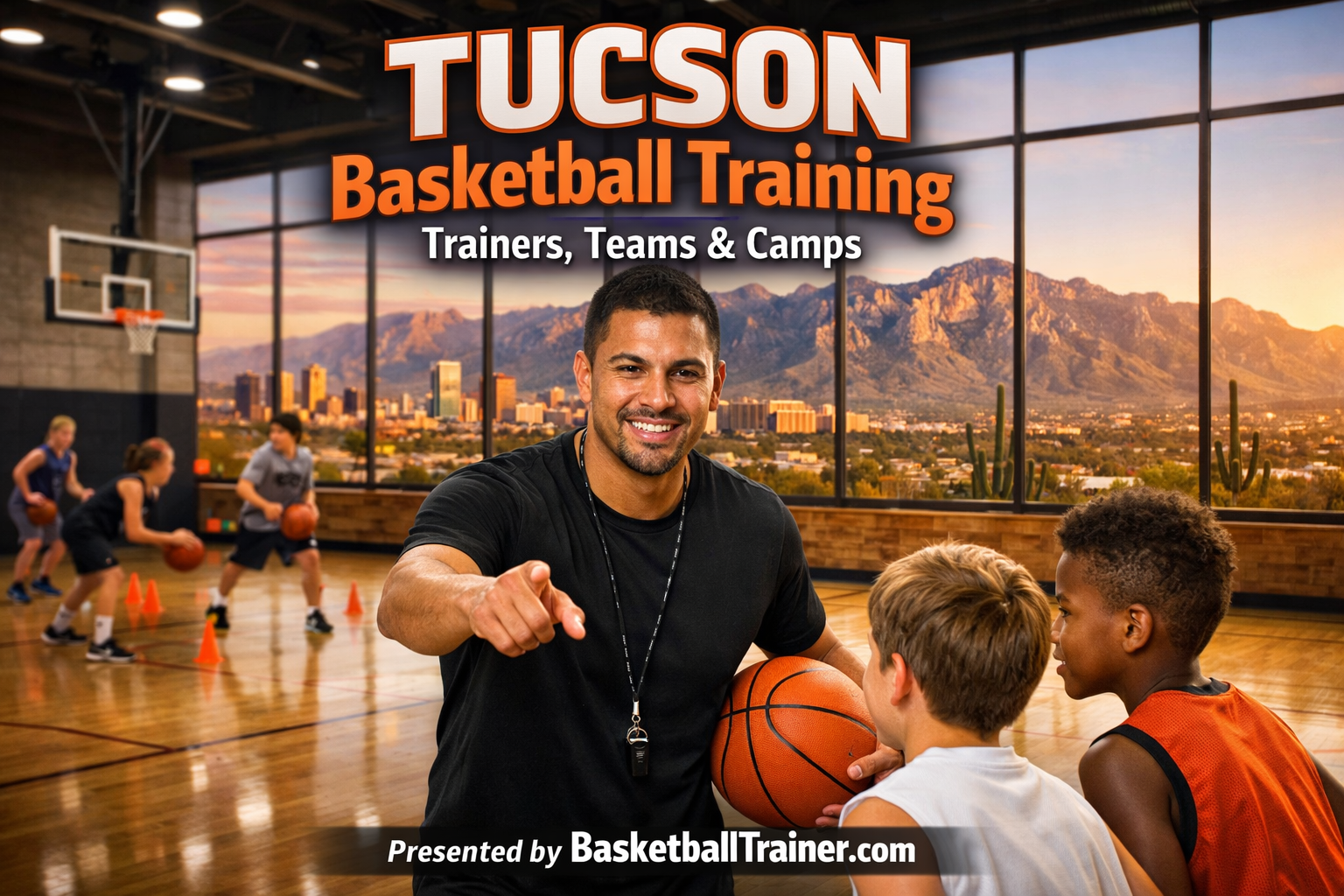
Tucson Basketball Trainers
These Tucson basketball trainers work with players across skill levels. Tucson’s trainer landscape reflects the city’s college town character — several coaches have direct University of Arizona connections, which shapes their approach and the standard they hold players to. Use the evaluation questions later on this page when reaching out to any option.
Coach Elijah Roth
Coach Roth is a Tucson native whose basketball resume is anchored in University of Arizona basketball — four years as a student manager under Sean Miller, followed by a graduate assistant role with the Arkansas Razorbacks during their Elite Eight run, and then a stint as Director of Scouting and Analytics before transitioning to an assistant coaching role at Sacramento State. He returned home to Tucson to train youth players. His background in high-level analytics and scheme-based coaching translates to sessions emphasizing decision-making, body-ball movement, and finishing footwork rather than isolated, repetitive drills. This is training informed by what college coaches actually want to see. Sessions are available through Athletes Untapped. Best for: competitive middle school and high school players serious about developing a college-ready skill set.
Tucson Basketball Factory (Coach Ricky)
Tucson Basketball Factory positions itself as Southern Arizona’s comprehensive youth basketball organization, running development leagues, club teams, and elite training programs for players of all ages and skill levels. Coach Ricky has been coaching since 2015 and has led championship-caliber teams through the program. The Factory’s model is more integrated than a standalone trainer — players can access skill training, competitive leagues, and club team experience through a single organization. This structure works well for families who want a one-stop environment rather than piecing together a trainer here, a league there. Multiple pricing tiers make entry accessible. Best for: families seeking structured, year-round youth basketball development without managing multiple organizations.
Apex Athletix Academy
Apex Athletix Academy operates as both an AAU club team and a skills training organization, which gives them a useful dual perspective — coaches understand what skills translate to game situations because they coach in game situations. The program serves all ages and skill levels, making it accessible as both a starting point for younger players and a development vehicle for competitive athletes. Training sessions emphasize the fundamentals that hold up under pressure rather than showcase-style moves that look impressive in drills but break down in games. Best for: players who want skill training with coaches who also see them in competitive team settings.
Breakthrough Basketball (Tucson)
Breakthrough Basketball runs structured youth camps and clinics in Tucson across multiple age segments — younger beginners, developmental middle schoolers, and dedicated high school players. Their approach is built around teaching basketball thinking, not just basketball movement. Players learn why they’re doing a drill, not just how to execute it. Breakthrough runs programs nationally and their Tucson presence brings a structured curriculum that smaller local trainers often can’t match. The trade-off is that a national program may feel less personalized than working one-on-one with a local coach who knows Tucson’s high school landscape. Best for: skill-building camps during school breaks; families new to youth basketball who want a proven curriculum.
YMCA of Southern Arizona Basketball Programs
The YMCA of Southern Arizona runs seasonal basketball leagues and programs through multiple Tucson locations (Ott, Dusenberry, and other branches). Their three-season calendar — Winter (January-March), Summer (June-August), and Fall (September-November) — serves grades 1-9 with an emphasis on age-appropriate development rather than elite competition. Financial assistance is available through the Y’s scholarship fund, making this one of the most financially accessible structured basketball options in Tucson beyond free drop-in at rec centers. Best for: younger players (grades 1-6) learning the game in a non-pressure environment; families needing financial assistance options.
Tucson Basketball Camps
Tucson basketball camps run primarily in summer (June-August) with some options during school breaks. Tucson’s summer heat — regularly 100+ degrees — makes indoor facility access more important here than in most cities. Before registering for any camp, confirm it’s held in an air-conditioned facility, not outdoors. This matters for player safety and sustained performance over multi-day camps.
University of Arizona Basketball Camps
The University of Arizona runs youth basketball camps utilizing McKale Center and related D1 facilities during summer months. Instruction from UA coaching staff and players gives young athletes an authentic college basketball perspective — the same courts, the same standards, the same facility where Wildcats like Andre Iguodala and Deandre Ayton developed. UA camps typically serve elementary through high school age groups with programs separated by age and skill level. For serious Tucson players, training in the building where Arizona basketball has produced 70+ NBA alumni is a unique opportunity that other cities simply can’t offer. Camps typically run June through August. Contact the UA Athletics department directly for current season schedules and registration.
Breakthrough Basketball Camps
Breakthrough Basketball runs structured Tucson camps across multiple age segments: younger beginners (ages 6-11), developmental players (ages 8-14), and dedicated high school players (grades 9-12, ages 14-18). Their curriculum emphasizes understanding the game rather than just executing drills. Camps typically run one week with instruction covering shooting mechanics, ball-handling fundamentals, footwork, and decision-making. The structured curriculum and proven teaching methodology make Breakthrough a reliable option for families who want more than glorified pickup games. Costs typically range $150-250 per week depending on program level. Financial assistance may be available; contact organizers directly.
Tucson Basketball Factory Camps
Tucson Basketball Factory runs camps and clinics aligned with their year-round development philosophy. Because the Factory also operates leagues and club teams, their camps feed directly into a broader competitive ecosystem — players who attend Factory camps often transition into Factory leagues, creating continuity that standalone camps can’t provide. This is both an advantage (built-in pathway) and something to consider (are you interested in committing to their broader program, or just looking for a standalone camp experience?). Camp costs are competitive with other local options. Multiple session times accommodate different family schedules.
YMCA Summer Basketball Camps
The YMCA runs summer basketball programs across Tucson branches (Ott, Dusenberry, and others) that combine skill instruction with the Y’s characteristic emphasis on character development and inclusion. Extended hours (typically 7am-6pm for summer programs) make the YMCA a legitimate childcare alternative for working parents — basketball instruction is the core, but the full-day structure solves a real family logistical problem. Costs run $90-150 per week depending on membership status, with Y scholarship funds available for qualifying families. No child is turned away due to inability to pay. Best for: grades 1-8; families who need summer day program structure alongside basketball development.
Tucson Select Basketball Teams
Tucson AAU and select basketball teams compete primarily March through August. Tryouts typically occur February-March. Tournament travel often includes Phoenix, Flagstaff, and occasionally Las Vegas or California events — which significantly impacts budgets compared to cities with larger local tournament ecosystems. Factor in hotel and gas costs when evaluating total program cost.
Tucson Spartans Basketball
The Tucson Spartans are now in their 15th season as a 501(c)3 non-profit AAU organization — longevity in youth sports is a meaningful signal about organizational stability. Director and head coach Marvin Beckwith (Tucson High class of 2006) runs the program with an explicit philosophy that basketball is a vehicle for life skills, not an end in itself. Teams serve boys from 4th grade through varsity level, plus girls from 7th-9th grade. The all-volunteer structure keeps costs down and creates genuine community investment. The Spartans compete in local leagues and tournaments with some out-of-town play. Scholarship assistance is available for low-income families. Best for: families who value character-development emphasis alongside competitive basketball; those needing financial assistance.
Tucson HEAT
Tucson HEAT — High Standards, Education, Attitude, Teamwork — operates with a dual mandate: developing basketball passion and sending players to national tournaments for competitive exposure. The national tournament focus distinguishes HEAT from programs that compete primarily within Arizona. For players with genuine college aspirations, exposure at national events matters. But national travel also means higher costs and more weekends away from home. HEAT serves players focused on reaching their greatest potential rather than recreational participation. Best for: competitive players (typically 13U and older) whose families can commit to a full national tournament schedule and associated travel costs.
Oro Valley Basketball Academy (OVBA)
OVBA is a 501(c)3 non-profit AAU organization based in Oro Valley (northwest Tucson metro), serving players from 3rd grade up. Their stated philosophy emphasizes basketball skills alongside social and leadership development — the kind of well-rounded mission that tends to retain coaches and build sustainable programs. OVBA competes in state tournaments and local leagues, with year-round programming rather than a strictly seasonal commitment. For families in Marana, Oro Valley, and Northwest Tucson, OVBA’s location is a significant geographic advantage compared to programs based in midtown or east Tucson. Best for: Northwest Tucson families; players from 3rd grade looking for structured competitive basketball with character development built in.
Young Americans Basketball Club
Young Americans draws players from across Southern Arizona, giving them a broader talent pool than purely city-based programs. The club competes in state and regional tournaments with an emphasis on developing players within a disciplined, structured environment. Their Southern Arizona footprint means they understand the travel landscape better than programs that haven’t navigated Tucson-to-Phoenix tournament logistics. Annual fees, practice schedules, and tournament commitments vary by age group — contact the club directly for current season details. Best for: competitive players willing to travel regionally; families comfortable with a program that serves a broader Southern Arizona player base rather than hyper-local community focus.
Tucson Dragons
Tucson Dragons is a community-based select program competing in Arizona leagues and regional tournaments. The program serves multiple age groups with practices at various Tucson facilities. For families looking for competitive basketball without the full national tournament commitment and costs associated with programs like HEAT, Dragons offers a middle path — structured competition and development with a more manageable travel schedule. Best for: players ready for competitive basketball beyond recreational leagues, but whose families aren’t ready for the full national tournament circuit commitment.
TEAM P.R.E.P.
TEAM P.R.E.P. (Preparing Responsible Elite Athletes for Professionals) is a Tucson-based select program that explicitly frames basketball preparation in terms of professional-level habits, discipline, and attitude — not just physical skills. The program targets competitive players serious about maximizing their development through structure. For parents who want a program that teaches their child how to practice and compete, not just what drills to run, TEAM P.R.E.P.’s philosophy offers a different emphasis than pure skills-focused training. Best for: players 12 and up with genuine competitive ambitions; families who value structured, high-expectation environments.
Tucson High School Basketball
Tucson’s seven school districts produce competitive high school basketball across Arizona’s 6A, 5A, 4A, and smaller classifications. School team tryouts typically occur in late October with the season running through February. Understanding which district your child’s school feeds into helps you understand their competitive landscape — Amphitheater and Sunnyside programs operate in different competitive environments despite being the same metro.
Tucson Unified School District (TUSD)
- Tucson High Magnet School (Downtown, deep history in city basketball)
- Cholla High School (Midtown; alma mater of NBA champion Sean Elliott)
- Rincon/University High School (East Midtown)
- Sahuaro High School (Midtown/North Central)
- Palo Verde High School (Midtown)
- Mountain View High School (South Central)
Amphitheater Unified School District
- Amphitheater High School (North Tucson; recent Division II state championship contender)
- Canyon del Oro High School (Oro Valley; consistently competitive program)
- Ironwood Ridge High School (Northwest Tucson/Marana border)
- Marana High School (Northwest)
Sunnyside Unified School District
- Sunnyside High School (Southwest Tucson; 6A competitive program)
- Pueblo High School (South Tucson; home of Lafayette “Fat” Lever’s legacy, gym named in his honor)
Other Districts & Private Schools
- Catalina Foothills High School (Catalina Foothills USD; North Tucson, strong academic-athletic program)
- Flowing Wells High School (Flowing Wells USD; Northwest, consistently strong girls program)
- Cienega High School (Vail USD; Southeast Tucson metro, competitive growing program)
- Salpointe Catholic High School (Private; consistently competitive 4A program, Midtown location)
- Pusch Ridge Christian Academy (Private; smaller classification, Northwest area)
- Desert Christian High School (Private; smaller classification)
Arizona high school basketball follows an AIA classification system (6A through 1A) based on enrollment. Most Tucson metro schools compete in 5A or 6A, though private schools often play in smaller classifications where they’re consistently competitive. School tryouts typically occur in late October with games running November through February.
How to Use These Listings
These are Tucson trainers, camps, and teams that families in the area work with. We don’t rank them as “best” or endorse specific programs. Use the evaluation questions in the next section when contacting any of these options. The right fit depends on your child’s age, skill level, goals, your family’s schedule, and your budget. Contact 2-3 options before committing to see which feels right for your family.
Tucson Recreation Centers: The Basketball Insider’s Guide
Before committing to private trainers or select teams, understand what Tucson’s 19 municipal recreation centers offer. The City of Tucson Parks & Recreation Department operates one of the more accessible public basketball systems in Arizona — with eight completely free centers and others requiring only a nominal daily pass. This is the affordable foundation that makes basketball possible for families across income levels in the 520.
East Side: The Premium Facilities
William M. Clements Regional Recreation Center
Address: 8155 E. Poinciana Dr, Tucson, AZ 85730 | Location: Lincoln Regional Park, Far East Side
Clements is Tucson’s premier public basketball facility — a full regional center with multiple courts, dedicated gym space, a weight room, walking track, racquetball courts, and pickleball. For East Side families, this is the flagship. The facility sees high volume from the Far East neighborhood communities and the Vail corridor.
Verified Operating Hours:
- Monday-Friday: 6:00 AM – 7:30 PM
- Saturday: 8:00 AM – 3:30 PM | Sunday: Closed
Basketball Schedule Notes: Full court available Monday mornings through early afternoon, Tuesday afternoons, Wednesday, and Saturday mornings. Scheduled times are posted at the facility and may shift seasonally.
Universal Pass Required: Daily adult resident: $2, non-resident: $3. Youth: $1.50 resident, $2 non-resident. Quarterly and annual passes available for frequent users.
Morris K. Udall Recreation Center
Address: 7200 E. Tanque Verde Rd, Tucson, AZ 85715 | Location: East Side / Tanque Verde Corridor
Udall is the East Side’s second premium facility — featuring basketball courts, racquetball, a weight room, and an indoor track. The Tanque Verde corridor location means it serves families between midtown and the Far East, reducing the commute burden for families who don’t want to drive all the way to Clements. The indoor track is useful for conditioning work while you wait for court time.
Verified Operating Hours:
- Monday-Friday: 6:00 AM – 8:00 PM
- Saturday: 8:00 AM – 4:00 PM | Sunday: Hours vary, call ahead
Universal Pass Required. Same daily pass rates as Clements. Speedway to Kolb to Tanque Verde is your best route from central Tucson avoiding the worst afternoon backup.
Midtown / Central: The Hub
Randolph Regional Recreation Center
Address: 200 S. Alvernon Way, Tucson, AZ 85711 | Location: Midtown, near Reid Park
Randolph is Tucson’s most centrally located premium facility. Sitting near Reid Park in the heart of midtown, it draws players from all quadrants and often has the most diverse pickup game scene in the city. If you live anywhere in central Tucson, this is your most accessible regional center. The central location makes it equally impractical or practical depending on traffic patterns on Broadway and Alvernon.
Verified Operating Hours:
- Monday-Saturday: 6:00 AM – 10:00 PM
Restricted Pass Required (different tier than Universal Pass). Parking on Alvernon fills quickly during evening league nights — arrive by 5:30 PM to secure a spot. Sun Tran Route 11 serves this corridor for families using public transit.
Northwest / County: The Sporting Chance Center
Sporting Chance Center (Pima County)
Address: 2100 W. Curtis Road, Tucson, AZ | Location: Northwest Tucson (River & La Cholla area)
The Sporting Chance Center is a Pima County facility (separate from the City of Tucson system), serving the Northwest Tucson communities of Marana, Casas Adobes, and Flowing Wells. Multiple basketball courts, volleyball, and open gym make this the most accessible facility for families northwest of the city without driving all the way into midtown. The county system means separate membership from City rec centers.
General Hours: Afternoons and evenings on weekdays (generally 3pm-9pm), broader hours weekends. Hours vary by season — confirm current schedule directly with the facility.
Drop-In Fees: Under 18: $1 | Adults 18+: $2 | The Sporting Chance Center is listed on the Sporting Chance Center’s youth basketball links page as the primary resource for Northwest area youth organizations. Several Tucson AAU club teams hold practices here.
The Free Centers: Eight Locations Across Tucson
Eight Tucson recreation centers offer completely free access — no membership or daily pass required. These centers serve as the community basketball backbone in neighborhoods that otherwise would have significant barriers to court access:
Cherry Avenue Community Center
Central location serving the Barrio Hollywood and Cherry Avenue neighborhoods. Accessible via Sun Tran.
El Rio Community Center
West Side community hub serving the neighborhoods west of I-10. Consistent youth programming throughout the year.
Freedom Park Community Center
Eastside neighborhood center serving Grant Road corridor families.
Oury Community Center
Southside community with deep neighborhood roots. Youth basketball leagues throughout the year.
Quincie Douglas Community Center
Southeast Tucson neighborhood facility with active youth programs.
Santa Rosa Community Center
South Tucson area serving families in the Santa Rosa and surrounding neighborhoods.
Fred Archer Community Center
Community hub with youth programming. Contact Parks & Rec directly for current court schedules.
Marty Birdman Community Center
Tucson neighborhood facility serving families who need free court access closest to home.
💡 Insider Note: Free centers typically see lower drop-in traffic than the regional facilities. If your child wants consistent practice time without competing for court space, these neighborhood centers often provide uninterrupted gym time — especially on weekday mornings and early afternoons.
How to Access Tucson Recreation Centers
Universal Pass vs. Free Centers
Free Centers (8 locations):
No pass required. Walk in. Play basketball. Free. These eight neighborhood centers are the most accessible entry point to public basketball in Tucson.
Universal Pass Facilities (Clements, Udall, and others):
- Daily: $1.50-$2 for youth, $2-$3 for adults (resident vs. non-resident)
- Quarterly passes: $18-$51 depending on age category
- Annual passes: $66-$420 for full access
Visit tucsonaz.gov/parks for current schedules, membership options, and to find the center nearest you.
The Tucson Summer Reality Check
Tucson sits at 2,643 feet elevation in the Sonoran Desert. Summers regularly reach 105+ degrees. This matters for basketball in two ways: (1) Outdoor courts become unusable from late May through September during afternoon hours. If a program advertises outdoor summer basketball, ask about heat protocols. (2) Indoor facilities see higher demand during summer, which means court competition at rec centers peaks June-August. For serious summer skill work, arriving early or coming on weekdays is your best strategy to avoid wait times at the premium facilities.
Evaluating Basketball Training Options in Tucson
We provide evaluation frameworks, not recommendations. These questions help you assess trainers, camps, and teams based on what matters for YOUR family in Tucson — including some questions specific to Tucson’s college town character and desert climate.
Questions to Ask Private Trainers
Why this matters in Tucson: Tucson’s trainers range from former UA program staff to coaches who moved here recently. Someone with genuine roots in the 520 basketball ecosystem understands local high school coaches, what Amphi and Salpointe coaches want to see, and how local club culture operates.
Why this matters in Tucson: Outdoor training in Tucson summer means 105-degree sessions by midafternoon. Any trainer who doesn’t have reliable indoor court access June-September is going to create scheduling problems during your most available months.
Why this matters: Specific goals — improved shooting percentage, mastery of particular footwork patterns, ability to run certain sets at game speed — are trackable. “Better player” is not. Trainers who can define specific milestones understand development timelines.
Why this matters: A trainer who defaults to college-recruitment framing for a 10-year-old learning fundamentals has misaligned expectations. The best trainers adjust intensity and focus to match the player’s actual goals and development stage.
Why this matters: Tucson’s summer monsoon season (July-August) can disrupt outdoor sessions. School schedules and UA game days create competing commitments. Understanding policies protects your investment.
Questions to Ask About Camps
Why this matters in Tucson: Not a luxury — a safety question during Tucson summer. If a camp runs June-August, confirm it’s indoors and ask about heat protocols. This is a non-negotiable for player wellbeing.
Why this matters: 1:20 ratio = supervision. 1:8 ratio = coaching. Know which experience you’re paying for before you register.
Why this matters: Some Tucson camps (like Tucson Basketball Factory) serve as pipelines into their broader programs. This is great if you want continuity. It’s worth knowing if there’s an implicit expectation before you attend.
Why this matters: YMCA and several community programs offer need-based assistance but don’t always advertise it prominently. Asking directly can unlock options that make a program accessible.
Questions to Ask About AAU/Select Teams
Why this matters in Tucson: Most Tucson teams travel to Phoenix regularly (1.5-2 hours). More competitive programs add Las Vegas, California, or out-of-state national events. Hotel costs for every Phoenix weekend add up significantly over a season.
Why this matters: Team fees ($800-$2,500) plus Phoenix weekends ($150/trip x 10 trips = $1,500) plus potential national travel ($1,500-$3,000) means the real cost often doubles or triples the headline number. Get a full picture before committing.
Why this matters: “Equal time” and “merit-based time” are both valid philosophies that create completely different experiences. Know which one you’re signing up for before your child rides the bench at a Phoenix tournament.
Why this matters in Tucson: Tucson’s college town character means many families here are explicitly thinking about their child’s academic future alongside athletic development. Programs that require grade maintenance aren’t just good for academics — they tend to attract more serious, committed players.
Tucson Pricing Reality
Free Public Courts: Eight city rec centers with zero drop-in cost
Municipal Rec (Universal Pass Centers): $1.50-$3 daily, $18-$51 quarterly, $66-$420 annual
Recreational Leagues (YMCA, Boys & Girls Club, NYS): $60-$150 per season
Private Training: $40-$100+ per session; $150-$300/month for small group
Summer Camps: $90-$300 per week depending on program
AAU Select Teams: $800-$2,500 team fees, plus $1,500-$4,000 in travel for competitive programs
Investment vs. Outcome Reality
More money doesn’t guarantee better development. Tucson’s free rec centers and YMCA programs have produced players who made varsity and went on to college basketball. The $90/week YMCA camp might be exactly right for your 3rd grader. The $250 UA camp might be perfect for your 9th grader with genuine aspirations. What matters is honest alignment between program expectations and your family’s actual goals — not the price tag.
Free Basketball Training Evaluation Guide
Download our comprehensive guide with Tucson-specific considerations, red flags to watch for, and questions to ask before committing to any program.
Tucson Basketball Season: What to Expect
Understanding when different basketball programs run in Tucson helps families plan thoughtfully rather than react to last-minute pressure. This calendar shows typical timing — not deadlines you must meet.
High School Season (AIA)
Typical Timeline: Tryouts in late October, games begin in November, playoffs through February, state tournament in late February/early March.
What This Means: October through early March, your child’s school team is the primary athletic commitment. Everything else must work around that schedule. Coaches at Amphitheater, Salpointe, and Catalina Foothills have clear expectations about AAU participation during school season — ask before committing to both simultaneously.
AAU / Select Basketball Season
- February-March: Tryouts (often during the high school season’s final weeks — timing to note)
- March-May: Spring tournaments begin; primarily Phoenix-based events
- June-August: Peak summer tournament season; potential travel to Las Vegas, California, or national events
- September: Fall ball wraps up; prep for next school season begins
Tucson Travel Reality: Unlike Dallas or Phoenix programs that have abundant local tournament options, Tucson teams generally drive to Phoenix for most tournaments. Budget 1.5-2 hours each way plus hotel costs for out-of-town events when calculating total program commitment.
Basketball Camps
- May-June: Early summer camps open registration; UA camps begin
- June-July: Peak camp season across Tucson; YMCA summer programs fully operational
- July-August: Monsoon season begins mid-July; indoor facilities especially important
- Late August: Final camp sessions before school year; skill-sharpening for fall tryouts
Year-Round Municipal Rec Leagues
Tucson Parks & Recreation runs youth basketball leagues year-round at various facilities. The YMCA’s three-season calendar (Winter January-March, Summer June-August, Fall September-November) creates a consistent low-commitment entry point that many Tucson families use before or instead of competitive programs. Multiple locations across the city eliminate the cross-town commute problem that makes private options unsustainable for some families.
Tucson’s Basketball Culture & Heritage
Tucson basketball exists in the shadow of something extraordinary: a University of Arizona program that has produced over 70 NBA players, won a national championship, and defined what serious college basketball looks like in the Southwest. Growing up in this city means playing in a place where McKale Center sells out, where Wildcat legends are recognizable at the grocery store, and where the standard for what basketball can become is concrete and visible rather than abstract.
Sean Elliott: Tucson’s Own
Sean Elliott grew up in Tucson and attended Cholla High School before becoming the University of Arizona’s greatest player — finishing as the Pac-10’s all-time scoring leader with 2,555 career points, breaking the mark set by Lew Alcindor at UCLA. Elliott was the third overall pick in the 1989 NBA Draft and spent his career with the San Antonio Spurs, winning an NBA championship in 1999. The “Memorial Day Miracle” three-pointer he banked in against Portland remains one of the most famous shots in Finals history.
For Tucson youth basketball players, Sean Elliott is proof of what this city produces — not a distant national story, but a local kid from a TUSD high school who became an NBA champion. That’s not a small thing in a city trying to maintain basketball ambition without the resources of Phoenix or Dallas.
The UA Pipeline
The University of Arizona basketball program under Lute Olson (1983-2008) built one of the most impressive pipelines in college basketball history. The 1997 national championship team led by Mike Bibby, and the 1988 Final Four team featuring Sean Elliott and Tom Tolbert, established Tucson as a legitimate basketball city. The names who passed through McKale Center read like a Hall of Fame roster:
- Steve Kerr — Three-time NBA champion as a player, then Golden State dynasty coach
- Andre Iguodala — Three NBA championships with Golden State, 2015 Finals MVP
- Gilbert Arenas — Three-time NBA All-Star, one of the most electrifying scorers of his era
- Richard Jefferson — NBA champion, Olympic bronze medalist
- Deandre Ayton — 2018 #1 overall NBA Draft pick (one of only six players drafted first overall from a Pacific-12 school)
- Bennedict Mathurin — Current NBA player (Indiana Pacers), continuing the pipeline
Lafayette “Fat” Lever and South Tucson’s Legacy
Before Sean Elliott, Lafayette “Fat” Lever attended Pueblo High School in South Tucson, went on to Arizona State, and became one of the most complete guards in NBA history — twice recording 20-point, 20-rebound, 20-assist statistical lines in a single game, something no player has matched. Pueblo High School named their gymnasium after him in 1988. That legacy still lives in South Tucson’s basketball culture, where community programs trace their values back to players who came from these neighborhoods and made something extraordinary.
The College Town Effect
Living in a college town with a major D1 basketball program shapes youth basketball culture in specific ways. Tucson families can watch live Division I basketball at McKale Center for reasonable ticket prices. Young players can attend UA camps and receive instruction from actual college coaches and players. Trainers like Coach Elijah Roth bring genuine D1 analytical frameworks to youth sessions because they’ve worked in that environment. The presence of the university sets an ambient standard for what the game looks like at the next level — that standard is both inspiring and occasionally creates unrealistic expectations for 8-year-olds. Parents who understand the UA program as context — not as a destination their child must reach — tend to navigate youth basketball more successfully.
TucsonHoops.com (tucsonhoops.com) is the community hub for 520 basketball information — run since 2010, it serves as a central clearinghouse for camps, clinics, leagues, tournaments, open gyms, and tryout announcements from coaches and organizations across Southern Arizona. It’s the first place to check for current program listings and event schedules.
Frequently Asked Questions About Tucson Basketball Training
These are the questions Tucson families ask most often about youth basketball programs, costs, and timing.
How much does basketball training cost in Tucson?
Tucson offers a wider range than most Arizona cities. Eight city rec centers provide free court access with no membership required. The premium Universal Pass facilities (Clements, Udall, Randolph) cost $1.50-$3 per day or up to $420 annually for unlimited access. Recreational leagues through the YMCA, Boys & Girls Clubs, and National Youth Sports typically run $60-$150 per season. Private training sessions range from $40-$100+ per hour depending on trainer experience and whether it’s individual or small group. Summer camps range $90-$300 per week. Select AAU teams typically cost $800-$2,500 in team fees plus significant travel costs for Phoenix and beyond. Many programs offer financial assistance — always ask.
Does the University of Arizona offer basketball camps for youth?
Yes. The University of Arizona runs youth basketball camps at McKale Center during summer months. These programs give young Tucson players the chance to train in an actual D1 facility under coaching staff and players from one of the most prolific NBA-pipeline programs in college basketball history. Programs typically run in age and skill-level segments. Contact the UA Athletics department directly for current season details since schedules and registration open through their official channels. For a Tucson kid with basketball ambitions, this is a unique opportunity that families outside our city genuinely envy.
When do AAU basketball tryouts happen in Tucson?
Most Tucson-area select basketball teams hold tryouts in February and March, which overlaps with the final stretch of the high school season. Teams want rosters set before spring tournaments begin in late March and April. This timing means players sometimes juggle school team playoff commitments with AAU tryout schedules — communicate with your school coach before making that commitment. Some programs hold supplemental tryouts or rolling admissions in May or June to fill roster spots. Contact specific teams in January for their current season tryout details. TucsonHoops.com (tucsonhoops.com) announces local tryouts from many area organizations.
What’s the best age to start youth basketball in Tucson?
There is no single correct answer. Many Tucson families start with recreational YMCA or Boys & Girls Club leagues at ages 5-7 — these programs teach basic rules and movement without competitive pressure. Private skill training becomes more valuable around ages 8-10 when children can focus on specific techniques. Select AAU programs typically start at 8U or 9U, though many Tucson families wait until 10U or 11U when kids can genuinely handle weekend tournament travel commitments. The most important factor isn’t age — it’s your child’s genuine interest level and your family’s capacity for the time and financial commitment. Starting early with a miserable experience teaches nothing except that basketball is miserable.
Can my child play both school basketball and AAU in Tucson?
Many Tucson players participate in both, since the school season (November-February) and AAU season (March-August) have limited overlap. The overlap period during February-March tryouts can create scheduling tension when school playoff runs conflict with AAU commitments. The key variable is your child’s school coach — some Tucson coaches actively support AAU, others strongly prefer their players avoid external commitments even in the off-season. Have that conversation early. Also honestly assess your child’s physical capacity for year-round high-intensity basketball. Some players thrive on it; others wear down and lose their love for the game.
Which part of Tucson has the best basketball training options?
Every area of Tucson offers quality basketball — but what’s “best” depends on where you live. The East Side has Tucson’s two premium rec facilities (Clements and Udall) with full court access and weight rooms. Midtown/Central has the most centrally accessible option at Randolph and proximity to UA camps. North Tucson/Foothills has strong high school programs at CDO and Amphitheater and access to the Sporting Chance Center. South Tucson has deep community basketball roots, free rec centers, and the legacy of players like Sean Elliott and Fat Lever. Northwest families in Marana and Oro Valley have OVBA and the Sporting Chance Center as primary options. The pattern across all Tucson basketball is consistent: a program 15-20 minutes from home that your family can sustain beats a theoretically superior program 45 minutes away that you’ll quietly stop attending by December.
Tucson Basketball Training Options at a Glance
This table helps Tucson families compare program types across cost, time commitment, and best use cases.
| Training Option | Cost Range | Best For | Time Commitment |
|---|---|---|---|
| Free Rec Centers (8 locations) | Free | Drop-in practice, pickup games, unstructured skill work | Completely flexible |
| Municipal Rec (Clements/Udall/Randolph) | $1.50-$3/day; $66-$420/year | Structured open play, better facilities, conditioning access | Flexible, facility hours |
| Recreational Leagues (YMCA, B&G Club) | $60-$150/season | Beginners, grades 1-9, non-competitive fun | 6-8 week seasons, 1-2x/week |
| Private Training (Individual) | $40-$100+/session | Targeted skill development, pre-tryout prep | Flexible, typically 1-2x/week |
| Summer Basketball Camps | $90-$300/week | Summer skill-building; UA camps for competitive players | 1-2 week camps, June-August |
| AAU/Select Teams | $800-$2,500+ (plus travel) | Competitive players; recruitment exposure for older age groups | 6-8 months, 2-3x/week + weekend tournaments |
Note: Costs represent typical Tucson ranges as of 2026. Many programs offer financial assistance or sliding-scale pricing. Always ask about scholarship opportunities before assuming a program is out of budget.
Getting Started with Basketball Training in Tucson
If you’re new to Tucson basketball or just starting your child’s development journey, here’s a practical path forward that respects both your child’s timeline and your family’s life:
Step 1: Define Honest Goals
Is this about your child having a fun activity? Learning fundamental skills? Improving enough to make their school team? The goal shapes everything. Many Tucson families start with free rec center pickup or YMCA leagues to see if their child even enjoys basketball before spending money on private training. There’s wisdom in that approach.
Step 2: Map Your Geography
Where in Tucson’s 227 square miles do you live? A program 15 minutes from your neighborhood beats a theoretically superior program requiring 40 minutes on Speedway during rush hour. Be honest about what’s sustainable twice a week for six months. Families who choose proximity over prestige usually stick with the commitment.
Step 3: Contact 2-3 Options
Review the trainer, camp, and team profiles on this page. Use the evaluation questions in the prior section. Reach out to 2-3 that match your geography and goals. Most offer trial sessions or initial consultations. Check TucsonHoops.com for announcements about open gyms and tryouts happening right now.
Step 4: Watch Your Child
After a trial session, watch whether your child talks about it on the drive home. Enthusiasm is data. Dread is also data. The trainer with the best resume and the UA connection might be the wrong fit for your 8-year-old who needs encouragement before technical correction. Trust what you see.
Free Basketball Training Evaluation Guide
Download our comprehensive guide with specific questions to ask trainers, camps, and teams before committing.
Tucson Quick Links
Basketball Resources
Nearby Arizona Cities
About BasketballTrainer.com
© 2026 BasketballTrainer.com. All rights reserved. Tucson, Arizona basketball training resource. Context, not direction.