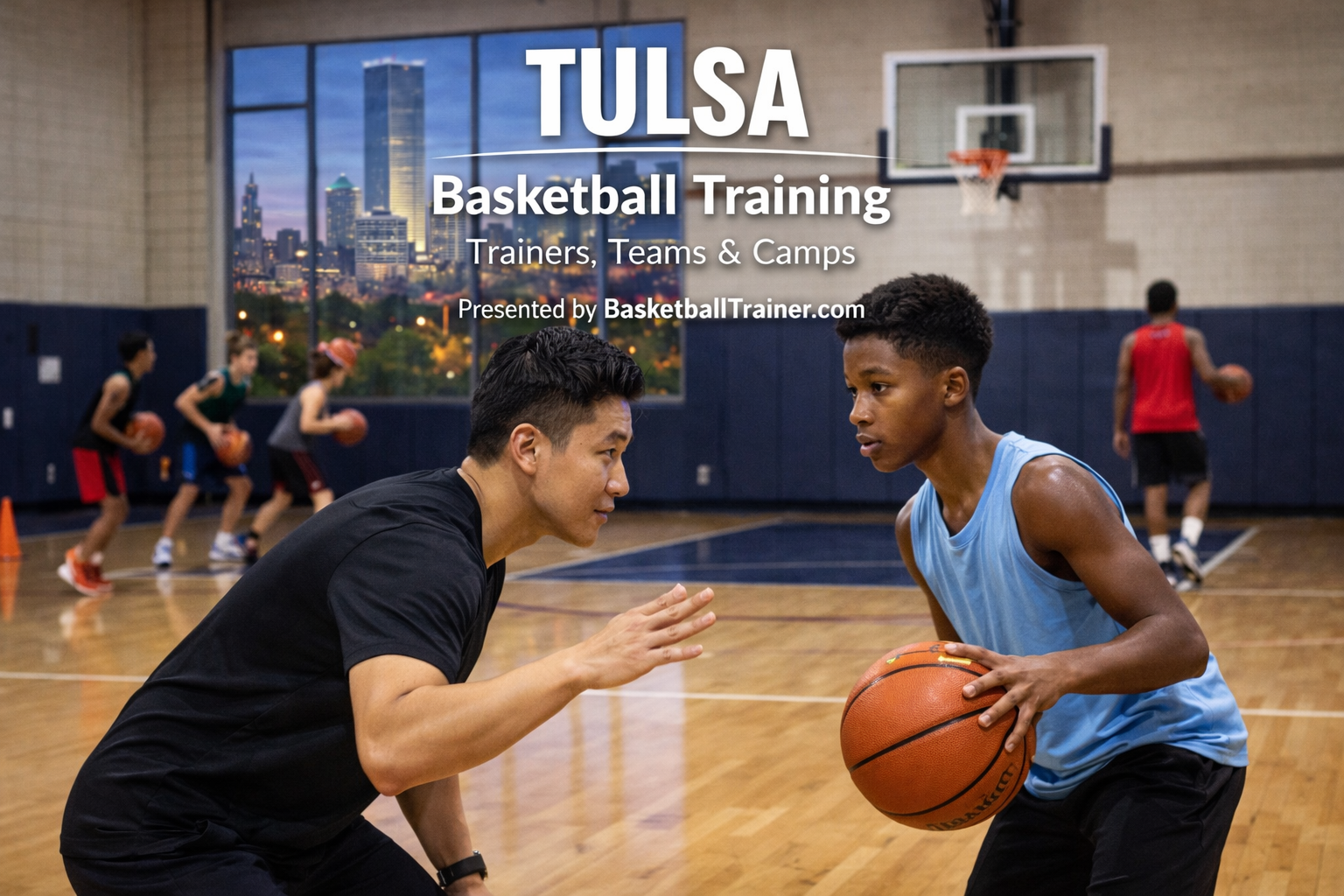
Tulsa Basketball Training – Trainers, Camps & Teams
Tulsa basketball training spans 187 square miles from North Tulsa’s historic Greenwood District to the South Tulsa suburbs. This page helps families navigate the 918’s unique geography, deep basketball heritage, and the decision frameworks that matter — not prescribe solutions.
Basketball Trainers
Basketball Camps
Select Teams
Community Centers
⚡ Looking for Basketball Training Options?
Skip the background info — jump straight to what you need:
Why This Tulsa Basketball Resource Exists
Tulsa’s 413,000+ residents spread across 187 square miles from North Tulsa’s historic Greenwood District down through Midtown to the sprawling South Tulsa and Broken Arrow suburbs. That geography creates a scattered landscape of training options that can feel overwhelming to navigate. This page helps families understand Tulsa’s unique layout, seasonal patterns, and what to ask — not tell you who to hire.
Our Approach: Context, Not Direction
We don’t rank trainers or camps as “best” — we help you understand what makes different programs right for different needs. The right fit depends on your child’s age, skill level, goals, your family’s schedule, budget, and where you live across Tulsa’s north-south divide. This page provides evaluation frameworks and local context, not prescriptive recommendations. Learn how BasketballTrainer.com works • Read our editorial standards
Understanding Tulsa’s Basketball Geography
Tulsa is a tale of two cities — actually three or four, depending on how you count. The Arkansas River divides the metro east-to-west, while the railroad tracks and the legacy of the 1921 Tulsa Race Massacre created a persistent north-south divide that still shapes where programs are located and who they serve. Where you live matters enormously for which training options make practical sense.
North Tulsa / Greenwood
What to Know: Historic heart of Black Tulsa, home to the Greenwood District (“Black Wall Street”) and Booker T. Washington High School — the crown jewel of Tulsa basketball. Deep community roots, working-class neighborhoods, rising investment.
- Commute Reality: 20–30 minutes to South Tulsa during non-peak hours; 35–45 with rush hour on US-75
- School District: Tulsa Public Schools — Booker T. Washington, Central, Memorial
- Basketball Culture: Strongest basketball heritage in the city. Wayman Tisdale country.
Midtown / Cherry Street
What to Know: The University of Tulsa campus anchors this area. Mix of established neighborhoods, professional families, and the Reynolds Center — TU’s Division I basketball home. Good central access to the whole city.
- Commute Reality: 15–20 minutes north or south during normal hours; true geographic center
- School District: Tulsa Public Schools — Edison, Memorial, McLain
- Basketball Culture: TU campus gives young players access to D1 training atmosphere
South Tulsa / Jenks / Bixby
What to Know: Fastest-growing area. Newer developments, higher household incomes, strong suburban school programs at Union and Jenks. Where most private trainers and commercial facilities are concentrated.
- Commute Reality: 25–40 minutes to North Tulsa via US-75 or I-244; South Tulsa to South Tulsa = easy
- School Districts: Union, Jenks, Bixby, Broken Arrow public schools
- Basketball Culture: Competitive suburban programs, strong AAU infrastructure
East Tulsa / Broken Arrow
What to Know: Broken Arrow is Tulsa’s largest suburb with 122,000+ residents. East Tulsa neighborhoods are diverse and growing. Strong Hicks Park community center presence. East Mingo corridor has multiple training options.
- Commute Reality: 20–30 minutes to Midtown; Hicks Park is the local community hub
- School Districts: Broken Arrow, Union (East side), Tulsa Public Schools (East Central)
- Basketball Culture: East Central HS has historically produced talent; Broken Arrow has strong programs
The North-South Reality Check
Tulsa’s north-south divide isn’t just geography — it has real implications for families choosing programs. Many of the city’s highest-profile private trainers and commercial facilities are concentrated in South Tulsa and Broken Arrow. North Tulsa has deeper basketball heritage and community roots, but fewer commercial training options. A family in Greenwood choosing a trainer near 91st & Yale is looking at 35+ minutes each way, three times a week. That’s 350+ hours in the car over a season. Geography isn’t a footnote. In Tulsa, it’s often the deciding factor.
Tulsa Basketball Trainers
These Tulsa basketball trainers work with players across skill levels and age groups. Each brings a distinct approach and background. Use the evaluation questions later on this page when reaching out to any program.
JP3 Training & Performance (Dr. Jason Parker)
JP3 Training is run by Dr. Jason Parker — a Tulsa native, University of Tulsa guard who played on the 2001 NIT Championship team and in the 2002–2003 NCAA tournaments, then played professionally in Italy, Russia, and Greece for six years. Parker also holds a Juris Doctorate from TU Law. His training philosophy centers on what he calls “aggressiveness” — the intersection of focus and force — which he argues is the most underdeveloped skill in youth basketball. JP3 works primarily with junior high and high school players who are serious about varsity or college-level competition. The program emphasizes structured, intentional work with measurable benchmarks rather than feel-good drill packages. Parker launched JP3 formally in 2025 after more than a decade as an athletic director in the Tulsa area, so he understands both the player development and institutional sides. Sessions are individual or small group; typical pricing runs $60–90 per session, with multi-session packages available. Best for: competitive middle and high school players who want film-based skill analysis and a trainer with genuine elite-level playing experience.
Nolan Richardson IV Basketball Training
Nolan Richardson IV is a former professional basketball player training out of Tulsa, working with players ages 7 and up. Sessions are one hour and tailored to each player’s specific needs — not a one-size template. As the grandson of the legendary Nolan Richardson (who coached Arkansas to the 1994 NCAA Championship and built his coaching career in Tulsa before that), there is family basketball DNA here that goes deep. Richardson IV focuses on getting players’ bodies and minds prepared to compete at any level, drawing on training methodologies from elite players and coaches he worked with during his professional career. Pricing runs approximately $50–80 per individual session. Best for: players of any age who want personalized one-on-one instruction from someone who has competed at the professional level and understands what the game demands at each stage of development.
Elev8 Hoops (David Mason)
Elev8 Hoops was built by David Mason, a former Division I athlete, on the principles of character, intelligence, and trust — in that order. Mason describes the organization as Oklahoma’s premier basketball training program designed by former D1 athletes, which is a strong claim in a state with serious basketball roots. The program offers individual skills training, team training, and group sessions, with a membership structure that makes regular training more cost-effective than drop-in sessions. Monthly membership options typically run $150–250 depending on frequency and format. The program operates out of multiple Tulsa-area facilities. Best for: families looking for a structured, ongoing training relationship rather than occasional drop-in work — particularly those with serious competitive goals over a 6–12 month horizon.
Score Basketball (Coach Don Calvert)
Score Basketball is one of the longest-running training programs in the Tulsa area, founded in the early 1990s and led by Coach Don Calvert, whose coaching lineage traces back to legendary Oklahoma State coach Henry Iba. Calvert has trained players who’ve gone on to college (Kansas, Georgia, Pepperdine, Arizona, Oklahoma State) and professional careers, including Kelena Azukuke (NBA — Knicks, Mavericks, Warriors) and Shea Seals (Tulsa University, NBA Lakers). The program covers all aspects of skill development — footwork, ball handling, shooting mechanics, post moves — with an emphasis on character alongside basketball. Private lessons run $50–85 per session; the program operates across Tulsa, Owasso, and surrounding communities. Best for: players at any skill level who want instruction grounded in fundamental, proven methodology rather than trendy workout-style training.
Athletes Untapped — Tulsa Coaches Network
Athletes Untapped is a vetted marketplace connecting families with private coaches in the Tulsa area rather than a single trainer. This is worth including because the platform vets coaches for background checks and playing experience, making it a lower-friction option for families trying basketball training for the first time or looking for a specific location match. Private basketball coaching through Athletes Untapped in Tulsa typically runs $30–60 per session — generally the most affordable end of the private training market. Coaches listed specialize in areas like shooting form, ball handling, footwork, and defensive positioning. Best for: families newer to private training who want to try different coaches before committing to a longer-term relationship, or those working with a tighter budget who still want some individual skill work.
K2C Gyms — Facility & Training Access (Rogers County / Broken Arrow Area)
Note: K2C is a private sports complex with gym rental and training services, not a stand-alone basketball trainer. Listed here because they host Elev8 Hoops and other trainers, and families east of Tulsa often train here. Built by Doug and Kayce Nelson — a coach/educator and CPA who raised four daughters through competitive sports — K2C Gyms serves teams and athletes in the Tulsa and Rogers County area. The facility provides a clean, safe environment for individual skill work, team practices, and training sessions. Gym rental runs $30–60 per hour depending on court size and time of day; trainers using the facility may price sessions separately. Best for: families east of Tulsa near Claremore, Owasso, or Broken Arrow who want quality court access without the drive into Midtown or South Tulsa.
Tulsa Basketball Camps
Tulsa basketball camps run primarily during summer months with University of Tulsa leading the way with D1 facilities. Options range from affordable community camps through Tulsa Parks to intensive skill development experiences on the TU campus.
Eric Konkol Basketball Camps (University of Tulsa)
The University of Tulsa’s head coach Eric Konkol runs a full summer camp series on the TU campus, using the Reynolds Center facilities. Programs span kindergarten through 12th grade across multiple formats. The Junior Golden Hurricane Camps (K–7th grade) run mornings in late July/early August and cost approximately $100–150 per camper for the multi-day session. The Youth Day Camp (2nd–10th grade, coed) runs a full week in June for around $300, with daily skill instruction and game play. Elite and High School camps for grades 9–12 provide exposure to TU coaching staff and regional competition — the High School Elite Camp runs about $85 per player. All camps are led by TU coaching staff and current players, which gives young players genuine Division I contact. Best for: any age from beginner (Junior camps) to competitive high school players seeking regional exposure and D1 coaching perspective.
YMCA of Greater Tulsa — Thunder Youth Basketball & Camps
The YMCA of Greater Tulsa runs the Thunder Youth Basketball League (ages 3–12) as well as summer camp programming across multiple Tulsa branches. The Thunder League emphasizes learning the game with lenient officiating and an 8-game season structure — jerseys run about $25, and seasonal fees are typically $60–90. Summer day camps that incorporate basketball skills run $90–140 per week depending on YMCA membership status, with financial assistance available. The Y’s “no child turned away” philosophy means scholarship funds exist — ask directly. Best for: beginner and recreational players ages 3–12 who want structured introduction to the game without competitive pressure, and for working families who need reliable summer childcare with athletic programming built in.
Score Basketball Camps
Score Basketball runs clinics and camp-style training programs across the Tulsa area, drawing on Coach Don Calvert’s 30+ years of coaching methodology. Camp programming covers shooting mechanics, ball handling, footwork, defense, and post play — with a character development component integrated throughout. Camps typically run $100–175 per session depending on length and format, and operate at multiple locations including Owasso and other suburbs. The program also offers girls-specific basketball camps, which are rarer in the Tulsa area private camp landscape. Best for: players of all ages (including girls who want gender-specific instruction) who want fundamental-heavy training from coaches with a long track record of developing Tulsa-area talent.
Tulsa Parks Department Summer Basketball Programming
The City of Tulsa Parks Department runs youth basketball leagues and summer programming through its eight community centers spread across North Tulsa, Midtown, East Tulsa, and South Tulsa. Seasonal youth leagues focus on fundamentals and team play at very affordable price points — typically $30–80 per season with reduced rates for Tulsa residents. Summer programming varies by center location; many centers offer youth day camps that include basketball skills alongside other activities. The Tulsa Parks ID card (free for all participants ages 10+) is required — see the Rec Centers section below for how to get one. Best for: families looking for the most affordable organized basketball experience in the city, particularly those in North or Central Tulsa where Parks centers have strong neighborhood roots.
Tulsa Select Basketball Teams
Tulsa AAU and select basketball teams compete in regional circuits that typically run March through August. Travel commonly includes Oklahoma City, Dallas, Wichita, and Kansas City — with some programs reaching national tournaments in cities like Memphis or Las Vegas. Factor in tournament travel costs (hotels, gas, food) on top of team fees when budgeting.
Oklahoma Swarm
Oklahoma Swarm is one of the more established AAU programs in the Tulsa area, with over 130 alumni who have gone on to play college basketball. That’s a legitimate track record worth noting — not every program can document where its players landed. The Swarm forms both travel and local teams for spring and summer competition, which gives families flexibility: local teams have lower travel costs, while travel teams compete at regional and national events. Annual team fees typically run $1,200–2,500 depending on age group and travel schedule, with tournament travel costs adding $1,500–3,000 annually on top. Best for: competitive players (9U through 17U) with genuine college aspirations, particularly those in the 13U–17U range where showcase tournament exposure to college coaches becomes meaningful.
Christ First Angels (Coach David Brown Sr.)
Christ First Angels was founded by Coach David Brown Sr., a former University of Tulsa basketball player who went on to play professionally in Europe for 14 years. The program operates as a faith-based competitive AAU club that genuinely means what it says about character development — participation requires meeting academic and conduct standards before touching the court. Boys and girls compete together on rosters, which is intentional: Coach Brown values the cross-gender and cross-ethnic relationships the program builds alongside basketball skills. Annual fees are community-accessible, typically $800–1,500 depending on tournament schedule. Best for: families who want faith-integrated player development with a coach who has elite playing experience, and who value character formation as much as the win-loss record.
Tulsa Hawks Basketball
The Tulsa Hawks draw athletes from across the Tulsa area and regularly compete in the Dallas, Wichita, Oklahoma City, and Kansas City markets. The organization promotes team culture and character development alongside competitive basketball, targeting players who “want to make it to the next level” — which should be understood as a competitive program, not a recreational one. Travel competition means families should expect weekend tournament commitments monthly during the spring-summer season. Annual fees run approximately $1,000–2,000, with tournament travel adding $1,500–2,500 per season depending on how many events the team attends. Best for: competitive players (10U through 17U) looking for regional circuit exposure who want a program that balances team chemistry with skill development and doesn’t require the most aggressive national travel schedule.
Tulsa Bulldogs AAU
Tulsa Bulldogs is a competitive AAU organization operating in the Tulsa market, competing in regional tournament circuits. Like most Tulsa-based AAU programs, their primary tournament circuit covers Oklahoma, Texas, and Kansas, with national events for top age groups. Fees and structure are competitive with other regional programs — expect $1,000–2,000 in team fees plus travel costs. The organization maintains an active social media presence showing game action and player development, which gives families a reasonable sense of the program’s culture before reaching out. Best for: competitive players looking for additional AAU options beyond the larger established organizations, particularly families who want to evaluate culture and coaching approach through direct contact before committing.
YMCA Thunder Basketball — Recreational Option
Note: This is a recreational league, not a competitive travel team. Listed here for families whose primary goal is organized game play rather than tournament competition. The YMCA of Greater Tulsa Thunder Youth Basketball provides an 8-game season with volunteer coaches, guaranteed playing time philosophy, and zero travel requirements. Jersey cost ($25) plus seasonal registration ($60–90) represents the most accessible organized league option in the city. Games rotate across YMCA branches depending on league size. Best for: players ages 3–12 whose families want organized basketball as a fun activity rather than a competitive pathway — particularly useful as a first experience before evaluating whether higher-commitment programs make sense.
Tulsa High School Basketball
Tulsa’s school landscape includes Tulsa Public Schools (TPS) and several strong suburban districts. School team tryouts typically happen in October under OSSAA (Oklahoma Secondary School Activities Association) rules.
Tulsa Public Schools (TPS)
- Booker T. Washington High School — The crown jewel of Tulsa basketball. National Blue Ribbon school. 2025 OSSAA state tournament run. Wayman Tisdale’s alma mater. The BTW Hornets carry basketball tradition unlike any program in Tulsa.
- Memorial High School — Midtown program; produced Jason Parker (JP3 Training) as all-time leading scorer before his TU career
- East Central High School — Historic East Tulsa program; produced Anthony Bowie (NBA player from the legendary 1982 Oklahoma HS class)
- Edison High School (Midtown), McLain High School (North Tulsa), Rogers High School (North Tulsa — Lee Mayberry’s alma mater, NBA Milwaukee Bucks)
South Tulsa / Suburban Districts
- Union High School (Union Public Schools) — One of the largest programs in the state, regularly competitive in 6A. Multiple TPS-adjacent alumni have gone to D1 programs.
- Jenks High School — Perennial South Tulsa contender; strong basketball culture in one of Oklahoma’s fastest-growing communities
- Broken Arrow High School — Large suburban program representing the city’s biggest suburb (122,000+ residents)
- Bixby High School — Growing program in one of Tulsa’s fastest-developing communities south of the river
- Owasso High School (North suburbs) — Strong program serving Tulsa’s fastest-growing northern suburb
High school tryouts typically occur in October. Most Tulsa-area schools field both varsity and JV teams for boys and girls, with larger programs adding freshman teams. The suburban schools (Union, Jenks, Broken Arrow) typically field the deepest rosters with the most competition for spots.
How to Use These Listings
These are Tulsa trainers, camps, and teams that families in the area work with. We don’t rank them as “best” or endorse specific programs. Use the evaluation questions in the next section when contacting any of these options. The right fit depends on your child’s age, skill level, goals, your family’s schedule, and your budget. Contact 2–3 options before committing to see which feels right. Download our free trainer evaluation guide for help.
Tulsa Recreation Centers: Basketball on a Budget
Before diving into private trainers, understand what Tulsa’s community centers offer. The City of Tulsa operates eight community centers with gym facilities, and Tulsa County runs additional options including O’Brien Park and LaFortune Park. Combined with outdoor courts at places like Gathering Place, Tulsa has substantial affordable basketball infrastructure. The Free Tulsa Parks ID card (required ages 10+) unlocks access to all City community center programming.
North Tulsa: Community Roots
Owen Park Community Center
Address: 560 N. Maybelle Ave. | The Oldest Park in Tulsa (est. 1909)
Owen Park recently completed a renovation of its full-size gymnasium, adding new flooring and updated facilities while maintaining its deep north Tulsa community identity. The center sits just northwest of downtown, making it accessible from multiple North Tulsa neighborhoods without requiring a long cross-town drive.
Operating Hours:
- Monday: 8:30 AM – 8:00 PM | Tuesday: 8:30 AM – 7:00 PM
- Wednesday: 8:30 AM – 5:00 PM | Thursday: 8:30 AM – 8:00 PM
- Friday: 8:30 AM – 5:00 PM | Saturday: 9:00 AM – 1:00 PM (2nd & 4th Saturdays only)
What Sets It Apart: Full-size newly renovated gym, fitness room, kitchen facility, multipurpose rooms. The community-roots vibe makes this a comfortable entry point for North Tulsa families new to organized basketball.
Jane A. Malone Center (Chamberlain Park)
Address: 4940 N. Frankfort Ave. | North Tulsa Alternative
Additional North Tulsa community center option for families who need proximity to northern neighborhoods rather than the cross-town drive to South Tulsa facilities. Part of the Tulsa Parks family; same Free ID card applies.
Lacy Park Community Center
Address: 2134 N. Madison Place | North Tulsa / Near Midtown
Accessible location bridging North Tulsa and Midtown neighborhoods. Good option for families living in the transition zone between historic North Tulsa and the University District. Gym and programming available with Parks ID.
Midtown / Central: The University District Hub
Centennial Center (Veterans Park)
Address: 1028 East 6th Street | Midtown Anchor
The Centennial Center sits near the heart of Midtown Tulsa, making it one of the more geographically central options in the city. Veterans Park itself is a well-maintained green space that draws families from across the midtown corridor. The center is part of Tulsa Parks’ community center system with full programming access on the free ID.
Commute Advantage: If you’re splitting trips between North and South Tulsa programs, this is one of the few locations that doesn’t require a directional commitment — it’s genuinely central.
East Tulsa: The Community Hub
Hicks Park Community Center — East Tulsa Flagship
Address: 3443 S. Mingo Road | Serving East Tulsa Neighborhoods
Hicks Park is the clear flagship for East Tulsa — it’s the most active community center east of downtown, with the widest range of programming including sports leagues, fitness, youth day camp, and senior programs. The center runs youth basketball leagues seasonally and has strong community engagement through its basketball programming.
Operating Hours:
- Monday–Thursday: 8:00 AM – 8:00 PM
- Friday: 8:00 AM – 5:00 PM | Saturday: 9:00 AM – 1:00 PM (1st & 3rd Saturday only)
Note on Non-Residents: A 25% additional fee applies to non-Tulsa-city residents. Broken Arrow families should factor this in — it may or may not be worth it depending on your home proximity to the center.
Whiteside Park Community Center
Address: 4009 South Pittsburg Ave. | Southeast / Near East Tulsa
South-of-center option that bridges East Tulsa and South Tulsa neighborhoods. Useful for families who find themselves geographically between the Hicks Park corridor and the South Tulsa private facility corridor.
South Tulsa: County Options
Reed Park Community Center
Address: 4233 S. Yukon Ave. | South Tulsa
One of the more southern City of Tulsa community centers, helping bridge the gap between city-operated facilities and the private facility-heavy South Tulsa corridor.
O’Brien Park Recreation Center (Tulsa County)
Tulsa County Parks — Full Court Gym, Fitness Center, Pool Access
O’Brien Park is a Tulsa County (not City) facility with a full-court gym, fitness center, two pool tables, and pickleball. Day passes run $5 and include gym access. County membership options available as of 2026. This was renovated in 2018, damaged in the 2019 Arkansas River flood, and fully reopened in 2022 — it’s a quality facility.
Gathering Place — Outdoor Courts (Free, No ID Required)
Location: Energy Transfer Sports Courts, Riverside Drive | Open 7 AM – 10 PM (weather permitting)
Tulsa’s world-class riverfront park includes free outdoor basketball courts with night lighting, making this one of the most accessible pickup game spots in the city. No fees, no ID required. The setting along the Arkansas River is genuinely beautiful — a great place for informal games and skills work when the Oklahoma weather cooperates.
The Tulsa Parks ID Card — Your Access Key
To participate in programs at any City of Tulsa community center, all patrons ages 10 and older need a FREE Tulsa Parks ID card.
How to Get Your Card:
- Visit any Tulsa Parks Community Center
- Bring valid ID or school ID for children
- Card is FREE for all Tulsa residents
- Non-residents pay a 25% surcharge on programs
Register online or in-person at tulsaparks.recdesk.com — this is the same system used to sign up for basketball leagues, youth sports, and fitness classes. Getting the ID card early in the fall means you’re ready when winter basketball leagues open for registration.
Tulsa Traffic Reality: North-South Is the Hard Drive
The US-75 corridor and I-244 connect North and South Tulsa, but these routes are notorious for congestion during 5–7 PM rush hour. A 15-mile drive from Greenwood to Broken Arrow can take 20 minutes at noon and 45 minutes at 5:30 PM. If your child’s practice or training session ends at 6 PM, you’re managing that commute twice per week during basketball season. The practical advice: if you’re in North Tulsa, prioritize programs north of 51st Street unless the South Tulsa option is genuinely irreplaceable. Going the other direction applies equally — a South Tulsa family committing to a North Tulsa program should do a trial run at rush hour before signing up.
Evaluating Basketball Training Options in Tulsa
We provide frameworks, not recommendations. These questions help you assess trainers, camps, and teams based on what matters for YOUR family’s situation in the 918.
Questions to Ask Private Trainers
Why this matters in Tulsa: A trainer in South Tulsa means a 35–45 minute drive from Greenwood three times a week. That’s sustainable for some families; for others it’s the thing that eventually kills the commitment. Know upfront.
Why this matters: Tulsa has legitimate D1, professional, and European-level playing talent training players right now. That’s a real edge — someone who has played at that level understands what’s required in ways that clipboard coaches don’t. Credentials matter but aren’t the only thing.
Why this matters: “They’ll get better” is not an answer. “Your child’s free throw percentage should improve 15–20 points and they should be able to complete X drill at game speed” — that’s an answer. Specificity signals experience.
Why this matters: You’re investing significant money. Knowing whether you’ll get verbal updates, written notes, or video clips after sessions tells you a lot about how a trainer thinks about the parent relationship.
Why this matters: Life happens. School events, family emergencies, illness. A clear policy discussed upfront prevents friction later and signals professional operation.
Questions to Ask About AAU/Select Teams
Why this matters in Tulsa: Team fees ($1,000–2,500) are just the starting point. Tulsa teams regularly travel to Dallas, Wichita, Kansas City, and OKC — figure $300–600 per tournament weekend in hotels, gas, and food. A season with 6–8 tournaments doubles the real cost.
Why this matters: “Everyone gets equal time” and “best players play most” are both legitimate philosophies. The issue is discovering the answer after paying fees. Ask before writing the check.
Why this matters: Some Tulsa programs offer both local leagues and travel teams. A local team lets a player experience competitive basketball at a fraction of the cost — useful for families testing commitment before going full AAU.
Tulsa Pricing Reality Check
City Rec Leagues: $30–80 per season (most affordable baseline)
Private Training: $30–90 per session, or $150–250/month for structured membership programs
Summer Camps: $85–300 per week depending on facility and instruction level
AAU Teams: $1,000–2,500 annual team fees, plus $1,500–3,000 in travel costs for active regional programs
Free Tulsa Basketball Evaluation Guide
Download our comprehensive guide with Tulsa-specific considerations, red flags to watch for, and questions to ask before committing to any program.
Tulsa Basketball Season: What to Expect
This calendar reflects typical Tulsa timing — not deadlines you must meet. Oklahoma’s weather reality (ice storms in February, brutal heat in July) shapes when programs run and when outdoor courts are actually usable.
High School Season (OSSAA)
Typical Timeline: Tryouts in October, games begin November, playoffs through February, state tournament in late February/early March.
Tulsa Reality: High school basketball is the primary commitment October through March. During this period, a school coach’s stance on AAU participation matters — some Union/Jenks coaches are fine with it, others expect full focus on the school program during the season.
AAU / Select Basketball Season
- February–March: Tryouts (often overlapping with school season playoffs)
- March–April: Early spring tournaments — Oklahoma City, Dallas, Wichita
- April–June: Core spring tournament season (regional competition)
- June–August: Peak summer tournaments; national events for top programs
- September: Fall ball wraps up, transition back to school season
Summer Camps
- June: University of Tulsa Youth Day Camp and Elite Camp (register early — Elite Camp caps at 80)
- July: TU Junior Golden Hurricane Camp I; Score Basketball camp series; peak YMCA summer programming
- August: TU Junior Golden Hurricane Camp II; final summer opportunities before fall training begins
Oklahoma Weather Note: July and August in Tulsa routinely hit 100°F+. Outdoor work and some non-climate-controlled facilities become impractical. The Reynolds Center and private facility gyms are worth the cost during peak summer heat. Indoor community centers become valuable during this period for affordable skill work.
Tulsa’s Basketball Culture & Heritage
Tulsa basketball isn’t just a secondary story in Oklahoma — it’s a primary one. The city produced one of the most decorated college players in the history of the game, built a D1 program that punched well above its weight for decades, and has a high school basketball tradition rooted in community survival as much as athletic achievement.
Wayman Tisdale: The City’s Basketball Soul
Wayman Tisdale grew up in Tulsa and graduated from Booker T. Washington High School before going to the University of Oklahoma, where he became the first player in college basketball history named First-Team All-American in all three seasons of his career. He was a member of the 1984 U.S. Olympic gold medal team and was selected 2nd overall in the 1985 NBA Draft by the Indiana Pacers. Over 12 NBA seasons, he averaged 15.3 points per game. He died in Tulsa in 2009 from cancer, at 44.
What the Tisdale story means for Tulsa basketball today is real: when a trainer at Booker T. Washington talks about producing NBA talent, this is the lineage they’re speaking about. The 1982 Oklahoma high school class — Tisdale from Washington, Anthony Bowie from East Central, Steve Hale from Jenks — is described by basketball historians as possibly the greatest single-state recruiting class in history. That was Tulsa producing nationally.
Booker T. Washington: More Than a High School
BTW isn’t a typical basketball powerhouse in the sense of a program built around recruiting transfers or chasing state championships for their own sake. Founded in 1913 to serve Tulsa’s Black community — surviving the 1921 Race Massacre that destroyed much of Greenwood — and transformed into a magnet school with admission by academic merit, BTW represents something more complex. The basketball program is an expression of a school culture that has insisted on excellence across everything. The 2025 OSSAA tournament run, consistently ranked nationally by MaxPreps, is a continuation of that tradition.
The University of Tulsa: Small School, Big Game
TU’s Golden Hurricanes play in the American Athletic Conference at the Reynolds Center (capacity ~8,300). The program has had coaches who became legends elsewhere — Nolan Richardson left TU for Arkansas, where he won the 1994 NCAA Championship; Bill Self went on to coach Kansas to multiple Final Fours and an NCAA title. The professional pipeline runs through TU too: Jason Parker (JP3 Training) played there before going overseas. Shea Seals (NBA) came through TU. The Reynolds Center offers young Tulsa players access to D1 basketball without leaving the city, and Coach Konkol’s summer camp program makes that access more direct.
Tulsa Basketball in 2026
The current basketball landscape reflects Tulsa’s wider dynamic: the highest concentration of private training facilities and AAU infrastructure exists in South Tulsa and the Broken Arrow suburbs, while the deepest basketball heritage and community roots live in North Tulsa. Families navigating both halves of the city sometimes feel like they’re choosing between access and tradition. The honest answer is you don’t have to choose — but you do need to factor in the commute math honestly, because 40 minutes each way three times a week adds up to hundreds of hours over a season.
Frequently Asked Questions About Tulsa Basketball Training
These are the questions Tulsa families ask most often about youth basketball programs, costs, and timing in the 918.
How much does basketball training cost in Tulsa?
Tulsa basketball training costs vary significantly by program type. City rec leagues run $30–80 per season, making them the most affordable entry point. Private basketball coaching in Tulsa typically costs $30–90 per session, or $150–250 monthly for structured membership programs. Summer camps range from $85 (TU Elite Camp, single day) to $300 per week for full youth day camp experiences. AAU select teams cost $1,000–2,500 in annual team fees, plus $1,500–3,000 in tournament travel costs for regionally active programs. Many programs offer financial assistance or sliding-scale pricing — asking directly about scholarship options can open doors that aren’t advertised.
When do AAU basketball tryouts happen in Tulsa?
Most Tulsa AAU programs hold tryouts in February and March — which frequently overlaps with high school playoff season under OSSAA. Programs want rosters set before spring tournaments begin in late March and April. This timing creates genuine tension for players still on school teams during this period. If your child is on a school team that makes a deep playoff run, some AAU programs will accommodate late tryouts or hold roster spots — it’s worth asking upfront how programs handle this specific situation.
Which side of Tulsa has better basketball training options?
The highest concentration of private training facilities and commercial options is in South Tulsa and Broken Arrow. But the deepest basketball heritage — Booker T. Washington, community programs built around the Greenwood legacy, trainers like Coach Brown who played professionally after coming through TU — lives in North and Central Tulsa. The practical answer: the “best” side is usually the one closest to where you actually live. Sustainable commitment beats optimal-but-unreachable. If you’re in North Tulsa, there are legitimately excellent options without the 35-minute drive to Jenks and back.
Is Booker T. Washington basketball actually as good as people say?
Yes, genuinely. BTW regularly earns national MaxPreps recognition, made a deep run in the 2025 OSSAA 5A state tournament, and carries a tradition that includes Wayman Tisdale and Lee Mayberry among its alumni. What makes it unusual is the combination: it’s a magnet school requiring academic merit for admission, meaning the student body is academically strong AND athletically competitive. That combination is rare. For families with a child who qualifies academically and can handle the commute to North Tulsa (the school draws citywide), BTW is worth serious consideration.
What’s the best age to start private basketball training in Tulsa?
There’s no single right age — it depends entirely on what you’re trying to accomplish. For kids 5–8, recreational programs at the Y or Tulsa Parks are better investments than private training: they need game exposure and fun, not isolated skill work. Private lessons become genuinely valuable around ages 9–11 when players can focus on specific skills over multiple sessions and remember what they worked on last week. By 13–14, serious competitive players should have some consistent skill development happening. The biggest mistake I see is families starting private training too early and burning out the child’s motivation before the years when it actually matters.
How do I get access to Tulsa Parks community center basketball courts?
All patrons ages 10 and older need a free Tulsa Parks ID card to use City of Tulsa community center facilities. Get the card at any Tulsa Parks Community Center — bring valid ID or school ID for children. The card is free for Tulsa city residents (non-residents pay a 25% surcharge on programs). Once you have the card, you can register for youth basketball leagues, open gym times, and sports programs online at tulsaparks.recdesk.com. For outdoor courts like those at Gathering Place along the river, no ID is needed — those are open to the public and free of charge.
Are there basketball training options that don’t require choosing North or South Tulsa?
Yes — Midtown and the University of Tulsa corridor is genuinely central. The Reynolds Center and University of Tulsa programs draw from across the city without requiring a full directional commitment. The Centennial Center in Veterans Park sits near the geographic middle of the city. Athletes Untapped coaches can often come to you or meet at a court convenient to your location, which is worth exploring if commute is a real constraint. Balr Basketball and similar mobile training models are specifically designed to eliminate the commute problem entirely by bringing the trainer to your location.
Tulsa Basketball Training Options at a Glance
| Training Option | Cost Range | Best For | Time Commitment |
|---|---|---|---|
| City Rec Leagues (Tulsa Parks) | $30–80/season | Beginners, recreational players, budget-conscious families | Seasonal, 1–2 events/week |
| Private Training (Individual) | $30–90/session | Skill development, pre-tryout prep, specific weaknesses | Flexible, typically 1–2 sessions/week |
| Training Membership (Elev8, etc.) | $150–250/month | Consistent skill work, competitive-minded players | 2–4 sessions/week, year-round or seasonal |
| Summer Basketball Camps | $85–300/week | Summer skill building, D1 atmosphere exposure | 1-week sessions, June–August |
| AAU/Select Teams | $1,000–2,500+ (plus travel) | Competitive players, college exposure, tournament experience | 6–8 months, 2–3 practices/week, weekend tournaments |
Note: Costs represent typical Tulsa ranges as of 2026. Many programs offer financial assistance or sliding-scale pricing. Always ask.
Getting Started with Basketball Training in Tulsa
New to Tulsa basketball or starting your child’s journey? Here’s a practical approach that actually works:
Step 1: Define Your Goal
Are you trying to make a school team? Develop fundamentals? Give your child a structured activity? Your goal determines which program type makes sense. Many Tulsa families start with an affordable YMCA or Parks league before deciding if more investment is warranted.
Step 2: Map Your Geography
Where in Tulsa do you live? North, Midtown, South, East? Be honest about what you’ll actually drive. A program 15 minutes away that you’ll consistently use beats a “better” program 45 minutes away that becomes a source of family stress by December.
Step 3: Contact 2–3 Options
Use the evaluation questions from this page. Review the profiles above. Reach out to 2–3 that fit your geography and goals. Ask about approach, credentials, scheduling, and costs. Most trainers and programs will do an initial consultation or trial session.
Step 4: Trust Your Read
After conversations and a trial session, trust your gut. Does your child seem excited or deflated? Does the trainer communicate clearly? Does the logistics actually work? The “less credentialed” option nearby that your kid loves often beats the “more impressive” option across town they dread.
Free Basketball Training Evaluation Guide
Download our guide with specific questions to ask trainers, camps, and teams before committing to any program in the 918.
Tulsa Quick Links
Basketball Resources
Nearby Oklahoma Cities
About BasketballTrainer.com
© 2026 BasketballTrainer.com. All rights reserved. Tulsa, Oklahoma basketball training resource. Context, not direction.