Texas basketball is deep, competitive, and often overwhelming for families trying to make good decisions about Texas basketball training, trainers, camps & teams From packed high school gyms to year-round club schedules and a wide range of college pathways, the state offers opportunity — but also noise.
This page exists to provide context, not direction.
BasketballTrainer.com is not here to tell families who to choose, where to play, or what level to chase. Our goal is to help parents and players understand the Texas basketball landscape so they can ask better questions, compare options thoughtfully, and move forward without pressure.
Who This Page Is For
This page is built for parents and players who:
Want to understand what options exist in Texas
Care about development, fit, and long-term health
Are willing to slow down rather than rush decisions
Value clarity over hype
It is also useful for trainers, camps, and teams who want to understand how families view the broader basketball ecosystem.
Find Basketball Trainers by City in Texas
Training environments vary widely across the state. The most practical way to begin is to look locally and compare options within your city.
Explore trainers in major Texas basketball markets:
- Arlington Basketball Training
- Plano Basketball Training -Trainers, Camps, Teams
- Waco Basketball Training – Trainers, Camps, & Teams
- McAllen Basketball Trainers
Each city page is designed to help families understand what is available locally, not to rank or recommend specific trainers.
How to Choose a Basketball Trainer in Texas
Texas has no shortage of basketball content online. Distinguishing between influence and instruction can be difficult.
When evaluating trainers, we encourage families to focus on fundamentals rather than marketing:
Texas Context Matters
Does the trainer understand the realities of Texas basketball — including UIL seasons, private school schedules, and year-round workload thru things like double book basketball class?Clear Development Philosophy
Ask how progress is defined over time. Avoid vague promises or generic drill lists.Game-Relevant Training
Training should reflect how basketball is actually played — spacing, decision-making, footwork, and pace — not just what looks impressive on video.Evaluation Before Commitment
A professional trainer should be willing to assess fit before long-term commitments are discussed.
Families should feel comfortable walking away from any environment that relies on urgency or guarantees.
To understand how profiles and informational scores are used on this site, see How BasketballTrainer.com Works.
Basketball Governance & Competitive Context in Texas
Basketball in Texas operates within a structured ecosystem shaped by governing bodies and professional organizations. Understanding this context helps families make better training and scheduling decisions.
High School Basketball in Texas is governed by the University Interscholastic League (UIL), with additional support from organizations such as the Texas Association of Basketball Coaches (TABC), which focuses on coaching education and the health of the game.
Private and Parochial Schools compete under separate associations, including TAPPS and the Southwest Preparatory Conference, each with different eligibility rules, seasons, and competitive rhythms.
Officiating Standards are maintained by organizations such as the Texas Association of Sports Officials, influencing how games are called across levels.
Trainers, camps, and teams operate within — or alongside — these frameworks. Families benefit when training aligns with the realities of competition rather than working against them.
Basketball Camps & Club Teams in Texas
Texas offers a wide range of camps and competitive teams, each serving different purposes.
Basketball Camps may focus on skill development, evaluation, exposure, or experience. University camps, private academies, and local programs all play different roles.
AAU and Select Teams provide competition, travel, and exposure, but vary widely in structure, coaching quality, and philosophy.
This site lists camps and teams to provide visibility and comparison, not endorsement.
The Texas College Basketball Landscape
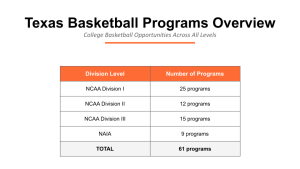 Texas is one of the most densely populated recruiting regions in the country. With a large high school base and multiple college levels, there is no single path that fits every athlete. Texas is ranked number 2 in producing D1 college players behind mighty California and their vast training and team structure.
The lists below are provided to help families understand the range of opportunities that exist, not to define where a player should aim.
NCAA Division I Programs (Texas)
Division I represents the highest level of college basketball competition. These programs typically recruit physically mature, highly skilled players who are ready to contribute quickly. Full athletic scholarships are available, but roster spots are limited.
Division I should be viewed as one possible outcome, not an expectation.
Texas Division I Programs include:
Abilene Christian, Baylor, Houston, Houston Christian, Lamar, North Texas, Prairie View A&M, Rice, Sam Houston, SMU, Stephen F. Austin, Tarleton State, TCU, Texas, Texas A&M, Texas A&M–Commerce, Texas A&M–Corpus Christi, Texas Southern, Texas State, Texas Tech, UT Arlington, UTEP, UTRGV, UTSA, Incarnate Word.
These programs differ widely in campus culture, academic priorities, and playing style. Families should evaluate them individually.
NCAA Division II Programs (Texas)
Division II programs balance competitive basketball with academic engagement. Scholarships are often partial, allowing flexibility for both programs and families.
This level can be a strong fit for athletes who continue to develop later or who value balance.
Texas Division II Programs include:
Angelo State, Dallas Baptist, Lubbock Christian, Midwestern State, St. Edward’s, St. Mary’s, Sul Ross State, Texas A&M International, Texas A&M–Kingsville, UT Permian Basin, UT Tyler, West Texas A&M.
NCAA Division III Programs (Texas)
Division III emphasizes the student-athlete experience. Athletic scholarships are not offered, but academic aid and competitive basketball environments are common.
This level often suits families who prioritize academics while still valuing structured college basketball.
Texas Division III Programs include:
Austin College, Concordia Texas, East Texas Baptist, Hardin-Simmons, Howard Payne, LeTourneau, McMurry, Schreiner, Southwestern, Texas Lutheran, Trinity University, Mary Hardin-Baylor, University of St. Thomas, UT Dallas.
NAIA Programs (Texas)
NAIA programs offer flexible recruiting and scholarship structures. These schools vary widely in size, competitiveness, and academic focus.
For some players, NAIA programs provide opportunity and personalization not found elsewhere.
Texas NAIA Programs include:
Huston-Tillotson, Jarvis Christian, North American University, Our Lady of the Lake, Paul Quinn, SAGU, Texas A&M–San Antonio, Texas College, Texas Wesleyan, UNT Dallas, Wayland Baptist, Wiley University.
NJCAA / Junior College Basketball (Texas)
Texas junior college basketball is among the strongest in the nation. JUCO programs can serve as development or re-recruitment pathways for players who need time to mature academically, physically, or skill-wise.
This route can be effective, but it requires careful academic planning and realistic expectations.
Texas NJCAA Programs include:
Angelina, Blinn, Cisco, Clarendon, Coastal Bend, Collin, Frank Phillips, Grayson, Hill, Howard, Jacksonville, Kilgore, Lamar State–Port Arthur, McLennan, Midland, Navarro, North Central Texas, Odessa, Panola, Paris, Ranger, San Jacinto, South Plains, Southwestern Christian, Temple, Trinity Valley, Tyler, Vernon, Weatherford, Western Texas.
A Note for Parents and Players
Most families do not leave this page with a decision. They leave with better questions — and that is often the most important first step.
BasketballTrainer.com exists to reduce pressure, not create it. We believe families deserve time, clarity, and honest information as they navigate youth and college basketball.
To learn how profiles are created, how information is presented, and what this platform is — and is not — please review our Editorial Standards and Terms of Service .