What Is Protein and Why Is It Important for Basketball Players?
Proteins are chains of molecules that are vital to life. Named more than 150 years ago after the Greek word proteios (meaning of “prime importance”), proteins have been studied and found to hold the answers to many physiological questions about the human body.
Protein is the second must abundant substance in the body, aside from water, and makes up roughly 18-20% of a person’s total body weight. In fact, it can be found in every single one of the trillions of cells that make up the human body.
Protein is a macronutrient along with carbohydrates and fats, meaning that it provides calories and energy for the body –providing 4 calories of energy for every gram consumed.
Unlike healthy carbohydrates, which mostly benefit the metabolic system; protein plays a key role in several functions of the body including: immune function, achieving a healthy pH balance, maintaining fluid and electrolyte balance, transporting nutrients, supporting growth of muscles and maintaining healthy muscles, as well as building enzymes, hormones and other important chemical compounds in the body.[1]
As you can see, protein’s role in the body is much broader than simply supporting healthy muscles which is why it’s so important to take this macronutrient seriously!
What are the building blocks of proteins?
 Amino acids are the building blocks of protein and are classified as either essential amino acids or non-essential amino acids. The body can make about half of the 20 amino acids that it needs which are known as the non-essential amino acids. The other 10 that the body cannot product on its own, known as essential amino acids, must be attained through diet and supplementation in order to keep up with the demands of a basketball body.
There are three essential amino acids that are classified as ‘branched chain amino acids’, more popularly referred to as BCAA’s. These three amino acids include L-leucine, L-isoleucine and L-valine, which are particularly important to basketball players and athletes as they play a big role in muscle recovery and new muscle tissue synthesis.
L-arginine is another essential amino acid that is popular for being the pre-cursor to nitric oxide in the body. Nitric oxide is a vasodilator meaning that it will cause the blood vessels to expand and allow for increased total blood circulation to the entire body. Where blood flows, so do nutrients, vitamins and minerals for faster, more effective recovery. As L-arginine converts into nitric oxide, the stimulation of the release of the human growth hormone (HGH) from the pituitary gland also which means that the body is going to be able to grow bigger, stronger muscle mass in much less time than someone who is deficient in this particular amino acid.
Amino acids are what make protein so unique. You can attain all of these amino acids through your diet, however many people do choose to add nutritional supplementation in order to give themselves a natural, healthy protein boost. This can be beneficial especially after a longer than normal workout or on those days when you feel like you are dragging because of consecutive intense training days. It’s always better to focus on taking a full amino acid profile nutritional supplement rather than isolating specific amino acids since this can cause an imbalance in overall levels overtime.
Why is protein so important for basketball players?
 The lifestyle of a basketball player is incredibly demanding. Aside from being under loads of stress and pressure to maintain good grades and healthy personal and professional relationships, the body must undergo hours of physical wear and tear so to speak. The entire body is left depleted often after basketball workouts, practices and games and is need of important protein replenishment. Without the right amount of protein to support your basketball body, you will be left with a weakened immune system, less muscle mass, as well as being more likely to fill your diet with too many carbohydrates and fats which can lead to an undesirable body fat percentage.
On the other hand, players who are getting enough quality protein each day in their diets will more easily build strong, lean muscles in the weight room as well as maintaining an ideal body fat percentage to support their endurance efforts out on the court. Basketball weight training is essential to college basketball dreams and protein fuels that growth and dream.
Basketball players ought to keep a close watch on their daily protein intake to build up a healthy body and to help the body recover after intense physical activity. Keeping a food journal is an easy way to track your exact protein amounts and also the timing of your protein consumption throughout the day.
How much protein do basketball players need?
You might be wondering exactly how much protein you should be getting as a basketball player every day.
Most nutritionists and dieticians are going to recommend that you reserve at least 20% of your daily diet for your protein consumption. However, the easiest way to determine exactly how much you should be getting is based upon body weight.
Here is a simple formulation that can help you set a daily target goal:
Take your body weight in pounds and divide it by 2.2 to get your weight in kilograms. Then, multiply your body weight in kilograms by 1.8 to get the number of grams of protein per day you should strive for.
Also note, a recent Canadian study determined that highly active athletes should be consuming a little bit more than the average person, at anywhere from 1.8-2.8 grams of protein per 1 kilogram of body weight. [2]
Many athletes thrive on a slightly higher protein intake than a person who is only moderately active or sedentary considering that athletes are constantly having to rest and recover their muscles and body.
What types of protein should basketball players consume?
 After calculating the minimum amount of protein you should be consuming each day, go ahead and jot it down in your food journal as you begin tracking your daily intake to ensure that you’re getting enough.
You can easily get enough protein each day from your diet.
Some proteins are classified as ‘complete proteins’, while others are known as being ‘incomplete proteins’. Complete proteins are sources that contain a full profile of amino acids, while the incomplete proteins contain only a few of the amino acids necessary for basic bodily functions. It’s important that you get plenty of complete proteins from both animal protein choices and some plant-based choices like quinoa, hemp, chia and brown rice.
American culture tends to lean towards animal proteins as primary sources, however in order to lead the healthiest lifestyle possible, you are going to want to mix up your daily protein intake with both animal and plant-based sources.
Stick with most of your animal protein choices coming from sources like turkey, chicken, fish and eggs. If you’re going to go for beef or pork, just be sure that you pick the leanest cuts possible, otherwise the fat content of those meats can ultimately make them not worth adding into your healthy basketball diet.
Plant-based sources of foods can provide with you just as much protein as animal sources can along with a full amino acid profile and much less fat. Go for whole foods like quinoa, buckwheat, hemp seed, chia seed, soy, Ezekiel bread, beans, legumes, seeds, nuts and brown rice to stay on top of your protein needs.
What about protein shakes, drinks and bars supplemented into the diet?
While it is very possible for most of your daily protein needs to be met through your actual food sources, you’ll find that most highly active people still choose to supplement protein into their diets through shake mixes, pre-made drinks and bars.
The great thing about supplementing protein into diet like this is that there are some really quality products out there that can give you 20 or more grams of protein in one single serving.
 Most athletes add in the protein powder mixes, because they are delicious, lower sugar and can be taken on-the-go and simply mixed with your choice of water, milk or a milk alternative. Some of the shake formulations are complete meal replacements featuring vitamins, minerals and superfoods and superfruits while other products are just protein. Still others look to smoothies to add or maintain weight in baksetball training. Here is a good resource for that: Basketball Smoothie Recipe. It’s all in what you feel like you need, but these can be a smart way to go to support your basketball protein needs!
A few of my top protein shake mixes are:
- Genesis PURE’s Complete Shake (http://www.genesispure.com/products/display/2087/complete-shake)
- Genesis PURE’s Sports Recovery Shake (http://www.genesispure.com/products/display/2082/recovery)
- Vega Sport Performance Protein (http://vegasport.com/product/performance-protein/)
- Sun Warrior Warrior Blend (http://www.sunwarrior.com/store/)
Protein bars are another convenient, easy way to get in extra protein when you need it most! Be careful to double check the sugar content of the bars you are consuming, because many brands contain anywhere from 15 to 24 grams of sugar per single bar, which takes away from the nutritional value of the protein content. Other than that, be sure to fill your sports bag with them, because they can be an ideal mid-practice snack or even a quick pre-workout boost that you are needing to fuel your body for practice or a game.
 A couple of my favorite healthy protein bars include:
- Quest Bars (http://www.questnutrition.com/protein-bars/)
- Power Crunch Bars (http://powercrunch.com/products/energy-bars/original/)
- Vega Sport Protein Bars (http://vegasport.com/product/protein-bar/)
What is the difference between Whey, Casein, Natural and Blends of Proteins?
 When you walk into any nutritional supplement store like the Vitamin Shoppe or GNC, you will notice that there are different types of protein powders to choose from which can be very confusing.
The distinct difference between the different kinds is that whey and casein are derived from cow as a by-product of cheese, while natural proteins come from plant-based sources like quinoa, soy, hemp, chia, brown rice and other grains and sprouts. So if you lead a more plant-based diet, the obvious choice is to stick with the natural proteins.
You will notice that most whey protein these days is hydrolyzed whey, which basically means that it is partially pre-digested for faster assimilation and absorption in the body. Many heavy weight lifters like to use whey so that they can gain an almost instant protein boost any time they might need it.
On the other hand, casein protein is a more slowly digested and absorbed protein that many athletes will take before bedtime so that the body has protein to utilize over the course of the night. Not too many people actually use just casein by itself aside from athletes who are heavy weight lifters, but it is more popular for athletes to use casein in general if it is in a protein blend.
Blended proteins are pretty straightforward and are not specific to the milk derived or plant-based protein sources. You can find whey and casein blends, as well as natural protein blends that combine the above mentioned proteins together as well. Your natural blended proteins are also going to be your complete meal replacement products, which are a very wise choice since they can provide the vitamins, minerals and nutrients that protein specific supplements cannot.
According to a study published in the Journal of Applied Physiology, researchers at the University of Texas Medical found that compared to whey, a combination of soy (25%), casein (50%), and whey (25%) after a weight-training session delivered amino acids to muscles for an hour longer. This suggests that muscle building goes on for a longer period of time with the blended formulations then with whey by itself.
Protein is a big part of our society, while some people are consuming too much, others not enough. As a basketball player, it’s your responsibility to know exactly how much protein you are getting each day to meet your needs. Start by calculating what you need and then begin to keep track and consider your sources. Are you consuming too much or too little? Could you benefit from adding more plant-based or animal sources of protein into your diet? Do you think that keeping protein supplements handy might enable you to stay on top of your daily intake in situations where you need a boost? All of these are things to start considering as you refine your basketball diet to help you build a strong, lean body that can make you a better basketball player and athlete!
Get Started Adding Quality Basketball Protein To Your Diet Today!
[1] Nutrition Concepts and Controversies, pgs. 186-194
[2] http://www.wikihow.com/Determine-How-Much-Protein-You-Need


 You know those players that seem to always have something to say about everything regardless of whether it’s in response to a reprimand or when they make a good play? Typically those players are not very good listeners and tend to go about simply running their mouths for the sake of hearing themselves talk. This is not a good example of a coachable player, in fact, just the opposite type of player is ideal. By listening more and talking less you are showing that you believe what your coaches have to say is more important and you are more likely to retain what they are teaching you than if you are always talking while they are or interrupting them.
 It’s not always easy to take personal responsibility whether in life or on the basketball court. It’s especially challenging when coming into practice after a lousy game performance where you missed most of your free throws or allowed your player too many offensive points that was a big part in costing your team the game. Those are the moments that are tough to swallow knowing that you might have let some people down. Coachable players understand that this is all part of the self-development process as an athlete and you have to be willing to take the good times with the bad. You can’t always accept the glory without being able to tough out the failures as well. Taking personal responsibility for your daily performance shows your coaches that you are able to be realistic for where you are really at with your skills and within your role on the
  This trait goes along with the previous one in that the most coachable players are always focusing on inner reflection rather than looking to their coaches and their teammates to justify their behavior or performance. Instead of worrying about your point guard who seems to always turn the ball over on every other play or your post player who refuses to use the backboard and has a frustratingly low shooting percentage, simply spend your time thinking about the areas that you need to improve. The best, more effective players in the game of
  Has your coach ever said something to you during practice that didn’t quite make sense or that you didn’t completely catch? Coachable players understand that communication is key to success and when there is a misunderstanding between coach and player it’s not just the coach’s responsibility to ensure that everything is clear from a communication aspect. Your coach will respect you more if you take the time to show up to practice early or stay late to drop by their office to keep lines of communication open. It can be an incredibly difficult challenge for
  This is one of the most difficult traits to develop as you become a coachable basketball player. It’s easy to think that after the 5th time of your coach or teammate coming to you about the same issue that you are simply being criticized for your hard efforts. By keeping everything in a positive perspective and remembering that you can’t always take tone of voice, facial expressions and other bodily language so literally you will be happier. Sometimes, your coaches and teammates are going to say things that might come across as abrupt and critical, but so long as you keeping in mind that they are all human and you choose to always hear instruction over criticism you will soar as a coachable

 As you go throughout your day you will notice that you are always talking to yourself. Sometimes what you are saying is positive and sometimes it’s negative. By beginning to pay closer attention to the way you are talking to yourself you can gain a great idea of why you tend be more positive or negative in general. Your
  Reflecting upon the questions you are asking yourself throughout the day when you face difficult situations takes self-talk a step further. It’s easy to fall into a negative, stress inducing pattern of beating ourselves up with self-defeating questions like, “Why do I always miss my second free throw?” or “Why do I always have to mess up that play?” Instead, ask yourself questions that are going to help you overcome the situation or circumstance like “What do I need to learn from my failed attempts to make it better the next time?” or “How can I adjust my form and visualize my shots going in so that I can improve my free throw percentage?” These are the kinds of questions that are focused on the positive and are going to get you much better results.
 Positive affirmations are one of the most powerful tools that you can equip yourself with as a competitor to overcome adversity and stress. Affirmations are things that we believe and they become imprinted on our subconscious mind, so regardless of whether you are consciously thinking a positive or negative thought at the time, what your subconscious believes is typically how you will behave when you are faced with stress. For example, if you believe that you are not a
  Learning to set positive goals is a great way to
  While thinking positive thoughts is incredibly powerful, putting energy into positive visualizations can bring success as well. How about picturing yourself hitting the game winning shot before you even take it, or how about seeing yourself shutting down the other teams’ best player? If you can create visualization in your
  Lightening up for more laughter and humor throughout your day no matter how hectic it may seem may be just what you need to take off that stressful edge. In fact, making time to laugh often is the most powerful stress-buster around. Research and studies are also now showing that laughing has the potential to boost the immune system as well considering that stress levels and immunity do go hand-in-hand.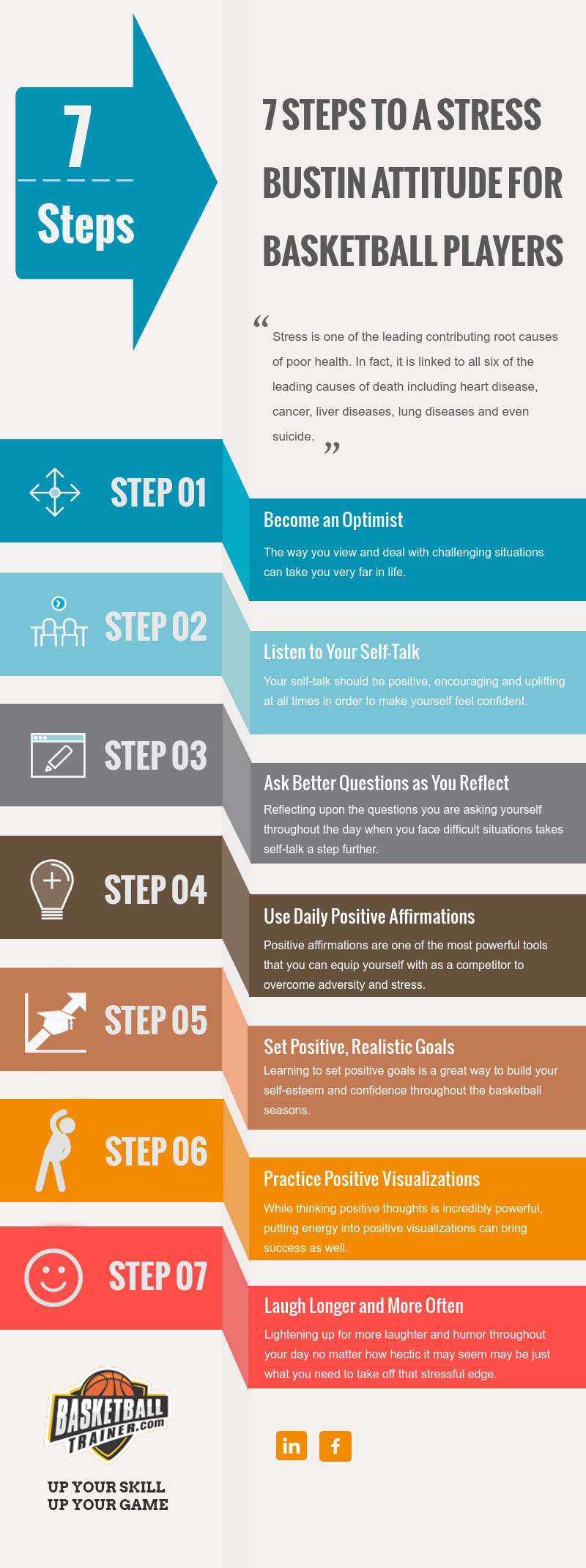



 In an effort to gain more exposure prospects will often attend showcase events run by a variety of different organizations in the summer, fall and spring. Showcase events also occur during the high school season when organizers look to schedule multiple games pitting non-conference opponents against each other in a day-long, weekend or a holiday setting drawing recruiters while they look to cash in on sponsors, fans, concessions and merchandise. Showcases are very often attended by college, prep and junior college coaches from all levels and give kids a chance to really make a great impression. However, prospects can also often leave these events overwhelmed, intimidated and under the radar with such an influx of talent all at one location in a condensed time setting. Various factors including politicking by high school and all-star coaches as well as parents and even the showcase promoters cause a high percentage of quality prospects to miss out. These events have become platforms for grassroots organizers to promote their product while putting on a great show which showcases individualized play.
  New York City is known as a breeding ground for point guards. Nate Archibald (Bronx), Mark Jackson (Brooklyn), Earl “The Pearl” Washington (Brooklyn), Bob Cousy (Cambria Heights), Sebastian Telfair (Brooklyn) and Kenny Anderson (Queens) to name just a few have given the world of basketball some of the best pure point guards ever seen.[2] On the flip side of the city life, there are the Larry Bird-prospects that rise to the NBA from rural small towns in underpopulated remote areas. The
 The NCAA also require SAT or ACT minimum “sliding scale” scores for admissions. The sliding scale is in place to give students flexibility in regards to their low GPA or test scores.[10] To qualify to play intercollegiate athletics at the NAIA level, students must meet two out of the following three requirements; a minimum of 18 on the ACT or 860 on the SAT (Critical Reading and Match only), earn an overall high school GPA of 2.0 on a 4.0 scale and/or graduate in the top 50% of their graduating class.[11] The NAIA offers the two out of three instead of the NCAA sliding scale test score method but both have the same purpose, give lower academic students some flexibility to become eligible. Passing through NCAA and/or NAIA Eligibility Center does not guarantee admission into a given school. The final decision for acceptance to a school and the completion of The Process lies in the hands of the admissions department at each respective institution.
 A typical admissions checklist for a college or university will include an application ($40 fee), official high school transcripts, letter of recommendation and a brief essay. Admissions departments will also encourage a campus visit and once they have the prospective student touring their grounds, they will conduct an interview. More and more schools have moved to the on-line approach of recruiting which enables them to attract and filter through large numbers of recruits without physically having them on-campus. While college coaches are targeting student-athletes for their teams as early as middle schools, the admissions process typically begins junior year in high school when students, guidance counselors along with parents and or guardians will target schools and map out some possible campus visits. Some highly regarded academic high schools have students begin this process their sophomore year but generally some prep work and “feeling out” is done junior year and The Process really takes flight senior year. Students will prepare essays (1-2 pages), gather letters of recommendation (usually 1 or 2 from a teach, guidance counselor or other school official) and official transcripts (complete with grades, class rank and test scores) while deciding which colleges they would like to apply to and figure out if they want to go for early or general admissions to the chosen institution(s).[12] Once application files are complete, schools make a decision and put the ball in the court of the recruit.
 Financial planning and financial aid are often a deal breaker in the recruits’ decision to where they go to school. While the hope is that students will be able to afford college with a full-ride athletic scholarship (Part 1) or some sort of family trust, nest egg or a big dip into savings, the reality is that two thirds[13] of all students take advantage of academic merit scholarships, athletic scholarships and/or FAFSA as discussed in Part 2 (link or even excerpt here). Students can apply for FAFSA beginning on January 1 of their senior year in high school. Early application is encouraged as much of the funds are awarded first come, first serve once the need is determined to be equal. The Process for the ‘average’
  Put quite simply, the more a coach wants a player, the more attention he or she is going to get during The Process. However, recruits should never stop trying to prove themselves and should not settle for a team because it is local, or their sibling or friend is there or because they are being pushed there by a community, parents, high school coach or some other outside influence. If you are looking to get a start in narrowing down college choices that might be a fit for you, then I recommend you use a tool developed by a company I am involved with. The Sport Source has a tool that is free for 24 hours use that permits you to input some of your criteria and also qualifications and then helps create a personalized database of which schools could be a fit for you.


 Water is the most important source of life on Earth. You can survive more than three weeks without food, but water is a completely different story. It would only take about three days for you to perish without this precious life source.
 As you are first starting out, it’s important to keep track of how much water you are or aren’t drinking each day. Keeping a daily water log might give you surprising answers since it’s impossible to keep up with fluid intakes by memory. You will learn exactly how much you need to increase your water intake or maybe you will find that you are doing just fine.
 “Do your homework!” is a common school night phrase in households worldwide for students growing up. Prospects would be wise to listen to this advice. In fact, “there is 22 times more academic aid available (each year) than athletic scholarships.”[1] The more intelligent the
  Additionally, prospects that do well in The Numbers Game often take advantage of the Free Application for Federal Student Aid, better known as FAFSA, which is a form that can be prepared annually for United States students looking for financial assistance for undergraduate and post-graduate studies within their country. The application awards aid of a given student based on Expected Family Contribution (EFC) which is determined by household size, income, number of students from household in college and assets.[3] The U.S. Department of Education begins accepting applications January 1 of each year and prospective students are encouraged to apply quickly to ensure that they will get as much aid as possible. FAFSA will open the door to nine federal student-aid programs, 605 state aid programs and most of the institutional aid available from a school of the student’s choice.[4] From a
  As discussed in Part I, NCAA D1 schools are the only programs that offer exclusive full rides. However, there are very few available in a given recruiting year. Although NCAA D2 can offer full ride athletic scholarships, it is not the norm and very often, coaches will try to maximize their athletic scholarship money by recruiting prospects that are able to draw from other resources such as merit scholarships and/or a substantial FAFSA package. All NCAA D2 sports are considered “equivalency” sports, which means that the NCAA restricts the total financial aid that a school can offer in a given sport such as basketball to the equivalent of a set number of full scholarships.[5] These programs have a total of 10 athletic scholarships available in men’s and women’s basketball while NCAA D3 programs do not offer athletic money. The problem is some institutions and in some cases entire conferences choose not to offer the full allotment granted by the NCAA. In addition, Coaches simply don’t have many scholarships available in a given year and will often look to offer partial scholarships to try to get as many players as possible. They may sometimes pitch a “pay two, earn two” situation to prospects in which they receive no athletic scholarship money their first two years but if they remain in the program, get an athletic scholarship their last two years. D2 coaches do try to land the big fish but most full rides at the D2 level are reserved for NCAA D1 transfers who can come in and make an immediate impact in the win column. In NAIA D1, basketball is sponsored by just over 100 men’s and women’s programs with each team offering a maximum of 11 athletic scholarships. In NAIA D2, there are nearly 150 men’s and women’s teams with each program equipped with the equivalent of six scholarships. NAIA coaches operate very similar to NCAA D2 coaches offering full rides to mainly NCAA D1 transfers while looking to fill their rosters utilizing partial scholarships, especially at the NAIA D2 level where they only have a maximum of six full scholarships. The best bet in The Numbers
  In conclusion, The Number Game in College


 Big men, the game has changed for you. Twenty years ago you were relied on more heavily for offense and because of that were more celebrated by the viewing public. However coaches and basketball people still know how important you are to basketball teams. We still love you and value the things that you do. You are the defensive anchor, rim protector and possession finisher that teams still need to win games. And you can still be effective in today’s more perimeter oriented offensive attacks.

 Every basketball player is susceptible to muscular imbalances simply because of the nature of the game. Hours of strength training, maneuvering laterally on cuts and explosive jumping take a toll on the muscles and joints.
 Some of the most common basketball injuries involve the hips, knees, ankles and feet. From ligament tears in the knees, chronic ankle sprains, inflammation of the tendons in the feet and pulled hip muscles – all of these injuries can cause players to miss several games if not the rest of the season.
 A strenuous basketball workout or game can really push your physical limits leaving you sore and less mobile for hours and sometimes days after.
 Daily stretching is a practice that not only benefits your muscles, but also helps to strengthen your nervous system.


 Part 2; “The Numbers Game,” in this 7 part series, will discuss academic and athletic scholarship options and we will begin to look at the best ways to package yourself as a basketball recruit. Subscribe to our email feed to get the other 7 parts delivered to your email inbox. This series is written primarily by