Basketball Trainer

Find Basketball Trainers, Camps & Teams Near You

  • Find Trainers
  • Camps
  • Teams
  • Contact
  • Find Trainers
  • Camps
  • Teams
  • Contact

Basketball Exposure Showcases: Complete Guide

March 19, 2023 By basketballtrainer

Basketball Exposure Showcases

Are you an ambitious high school basketball player looking to maximize your exposure and take your game to the next level? For ambitious basketball players looking to take their game to the next level, attending a showcase can be an excellent way of showcasing their skills and getting noticed by college coaches, scouts, and recruiters. But what should you expect from attending a showcase?

How can you ensure that your investment in a showcase is worthwhile? In this article we’ll cover how best to prepare for basketball showcases with maximum exposure so that you can get noticed by those who matter most. From understanding what coaches look for in players at these events, leveraging social media before, during, and after the event as well as building relationships with coaches afterwards – there is plenty of advice here on making sure your attendance at a basketball showcase pays off.

Before we go in depth, here are some of the most well known basketball exposure showcases:

  • Adidas Gauntlet Series
  • Exact Sports Showcase Camp
  • Paul Biancardi Showcase Camp 
  • NCAA Youth Development Camps
  • Zero Gravity Elite Student-Athlete Prospect Camp

Now… let’s get into it!

Table of Contents:

  • Identifying the Right Basketball Showcase for Maximum Exposure
    • Research:
    • Location:
  • Skills Clinics and Workshops – Are They Worth It?
  • Preparing for a Basketball Showcase
  • Making the Most of Your Time at a Basketball Showcase
    • Stay Focused:
    • Communicate Effectively:
    • Showcase Your Leadership Skills:
  • Understanding What Coaches Look For in Players at Basketball Showcases
    • Athleticism:
    • Basketball IQ:
    • Leadership Skills:
  • Maximizing Your Performance During a Basketball Showcase
    • Focus on Fundamentals:
    • Be Confident:
    • Show Leadership Qualities:
  • Leveraging Social Media Before, During, and After a Basketball Showcase
  • Building Relationships with Coaches After Attending a Basketball Showcase
    • Be Proactive:
    • Show Your Passion:
    • Follow Up Regularly:
    • Keep Networking:
  • Do College Coaches Go To Showcases?
  • Building Your Reputation and Brand
  • FAQs in Relation to Basketball Showcases for Exposure
    • How do you get exposure in basketball?
    • Are basketball showcases worth it?
    • What is a basketball showcase?
    • How much is Stephen Curry basketball camp?
  • Conclusion

Identifying the Right Basketball Showcase for Maximum Exposure

When it comes to getting maximum exposure in the basketball world, identifying the right showcase is key. For ambitious players and their families, attending a quality event can make all the difference when trying to stand out from other prospects. Summer for the ambitious player will often include:

  • Basketball Camps
  • Work with a Basketball Trainer 
  • Basketball Teams
  • Basketball Showcases

Here are some tips for finding the perfect showcase:

Research:

Researching different showcases is essential for finding one that best suits your needs. Look into what kind of talent will be present at each event, who’s running it, and how much time you’ll have to make an impression on coaches and scouts. Consider factors like cost, location, and duration as well.

Now I also want to offer you my take on this.   I am a basketballl trainer in Austin, Texas.   I have helped many players develop the skills to reach the collegiate level at all Divisions at NCAA, NAIA, USCAA.    I am a former NAIA player.  My friends range from NBA  assistant coaches to NCAA Division 1 coaches all the way to JUCO coaches.  I would not say I am expert on all matters Division 1 recruiting, but I have reached out to several experts.

To gain insight into all Divisions of the NCAA and aiming to be a college athlete, I recommend your download and print this out to read.  Yes, print it.  Learn it.   Then execute on it.  Here is the link.

Click here for the NAIA College Bound Student Athlete Guide.

Most events I see being billed as Showcases are not.  Like 90% are not helping you with any exposure.  If you are realistically pursuing Division 1, then you need to know what the Certified Live Event Schedule is and spend most of your time at these events.  You can access that here at this link.

I tend to consider showcases individual events, but now tournaments for teams are using the term showcase frequently.  We do see one event listed on the link above as an individual showcase for men.  The West Coast Elite Underdog Series.  This is an unsigned senior and JUCO player event and a “live” event.

There is also the marketing and buzz factor that some of these showcases and camps create.  Lists… like the Top 100 etc.  I am sure some have value, and most don’t.   Remember, paying showcase money and then paying for a recruiting package and being sold into a higher level program than you are currently being recruited at may sound like a win.  But after 3 years of sitting the bench (or being replaced) you may wish you found the right fit at the right school, rather than the school who bought a list made by someone you helped pay to make the list.  Making the list can help.  The right list, that the right coaches buy, that produces the right fit.   Going to showcases to get on the list… is a gamble.

My strongest recommendation is that you spend 10x more time developing your skills than you do pursuing individual showcase exposure and trying to get ranked.   And 10x more developing knowledge of the schools at each Division level that would fit your education goals.  And 10x more time developing relationships with the coaches at those schools.

I do believe that there are some individual howcases that do fit the D2 level and D3 level a bit better.  I would focus on the Ivy League Camps and All Academic Showcases.   Ask the college coaches you try to build a relationship what are other individual showcases you should attend.

Start with that.  Ask those coaches where they will be this Spring and Summer.  Be there.   Write your own story.

Showcase Location:

Location plays a huge role in showcasing your skill set. Think about which area offers more opportunities based on where you want to play college or professional ball down the line. You may even want to look into regional tournaments or events specific to certain states if you know which school programs interest you most.

Competition standard should be considered before signing up for a showcase, with higher-level tournaments drawing more notice from scouts than those of lesser calibre. So if making a name for yourself is important, then opt for an elite tournament instead of a smaller local one with less competitive teams involved.

A good reputation goes a long way in basketball circles, so check out any feedback or reviews left by past participants before signing up for anything new or unfamiliar. Checking reviews and feedback can be beneficial in saving both time and resources. Additionally, networking opportunities are another great benefit of attending showcases; use them wisely by introducing yourself to people who can help advance your career such as coaches or trainers with experience playing professionally abroad or locally within NCAA Division I programs etc.

Identifying the right basketball showcase for maximum exposure requires research, knowledge of available options and an understanding of what is needed to reach a player’s goals. With that in mind, it’s time to look at skills clinics and workshops – are they worth the investment?

Key Takeaway: To maximize exposure in the basketball world, it’s important to do your research and attend the right showcase. With feedback from past participants, consider factors like cost, location, duration and level of competition before committing. Networking opportunities are also a great way to advance your career so use them wisely.

Basketball Showcases – Are They Worth It?

Let’s make this simple.  They are worth it if they have the college coaches that you want to play for at them.  In more generic terms… only if college coaches at the division you project playing at are present.   You need to ask who has signed up to attend.  If they talk about last year or who they are talking to… it may not be worth the risk.

Which then brings us to many showcases other selling point:

Skills Clinics and Workshops – Are They Worth It?

When it comes to honing basketball abilities, there are a variety of choices for aspiring athletes wanting to step up their performance. Skills clinics and workshops can be an excellent way to gain knowledge, sharpen skills, and get feedback from experienced coaches. But is the cost worth it?

For starters, you should consider what type of clinic or workshop you’re signing up for. Are they offering individual instruction? Group drills? Or something else entirely? Having this knowledge will aid in deciding if the clinic is suitable for your capability and ambitions.

Another factor to consider when deciding if a skills clinic or workshop is worth the cost is how much one-on-one attention you’ll receive from instructors. If it’s just a group setting with minimal coaching feedback, then chances are that money could be better spent elsewhere – like on private or personalized small group training lessons with an experienced trainer who can tailor their program specifically to your needs.

Of course, attending clinics and workshops also offers other benefits beyond just improving your basketball technique; such as networking opportunities with fellow athletes and coaches in attendance. In addition, some programs offer scholarships which can make them more affordable than private lessons. So depending on what kind of experience you’re looking for – both on and off the court – these events may still be worthwhile investments even if they don’t guarantee improvement in specific areas of play immediately after completion .

The decision to invest in skills clinics and workshops is ultimately up to the individual or family. Though it may be up to the person or family to decide whether they should invest in skills clinics and workshops, doing some research into what these programs provide could prove highly advantageous for those looking to make a mark on the court. Moving forward, it’s important that athletes understand how best to prepare for an upcoming showcase event.

Key Takeaway: If you’re an ambitious basketball player looking to improve your game, attending a skills clinic or workshop can be worth the cost – depending on what type of instruction and feedback it offers. Additionally, these events offer networking opportunities and may even provide scholarships for those who qualify. All in all, there’s plenty more than just skill-honing that make them worthwhile investments.

Preparing for a Basketball Showcase

Preparing for a basketball showcase is essential to maximizing your exposure and performance. It’s vital to dedicate effort towards comprehending the details of the showcase in order to guarantee readiness and make an impression on scouts.

First, get familiar with the event schedule. Know when and where each game will be played as well as any additional activities like skills clinics or interviews that may be offered. By preparing in advance, you can ensure that your showcase experience is as smooth and organized as possible.

To excel at the event, hone your individual talents through drills and workshops to acquire new skills. Take some extra time practicing shooting drills or ball handling exercises that specifically target areas of improvement needed for your position. Additionally, try attending local basketball camps or workshops in order to learn new techniques from experienced trainers who have worked with high-level athletes before.

Third, do some research about each coach attending the showcase so that you can create a list of questions prior to meeting them face-to-face during introductions or interviews after games. Knowing their background information beforehand will help make sure conversations flow naturally instead of having awkward pauses throughout interactions with coaches at this critical moment in player development process .

Fourth , it’s important not only physically prepare yourself but also mentally prepare yourself for a basketball showcase . Make sure you get enough rest leading up to the event by going through regular sleep routines every night while avoiding any late nights playing video games or watching TV shows . Also , practice visualization exercises such as visualizing yourself making successful plays on court which helps build confidence before stepping onto court in front of college scouts and professional teams representatives .

Getting ready is essential for capitalizing on your basketball showcase experience, so make sure to take the required steps ahead of time. With proper preparation in place, it’s now time to focus on maximizing your exposure and performance during the event itself.

Key Takeaway: To maximize your exposure and performance at a basketball showcase, it’s essential to be familiar with the event schedule, hone your individual skill set through practice and extra training sessions, research coaches in attendance beforehand for informed conversations during interviews or introductions after games , as well as mentally prepare yourself by getting enough rest and visualizing success.

Making the Most of Your Time at a Basketball Showcase

Participating in a basketball showcase can be an invaluable opportunity for aspiring athletes seeking to enhance their playing ability. To make a positive impact, ambitious players should use their time at the showcase to demonstrate their skills and stand out from other participants. Here are some tips on how to do just that:

Before attending any basketball showcase, be sure to have the required gear like shoes, shorts and socks ready. Additionally, practice beforehand and get familiar with drills so you can show off your skills in front of potential recruiters.

Stay Focused:

During drills or scrimmages it is important to stay focused throughout each activity and give 100% effort in order to demonstrate your commitment and drive. This will help show coaches what kind of player you are while also helping them evaluate whether or not they would like to pursue recruiting you further down the line.

Communicate Effectively:

Showcases are great opportunities for players to interact with coaches one-on-one in addition to showcasing their skills on the court. Make sure that when speaking with coaches about yourself or during interviews that you communicate effectively by being articulate yet concise in order for them remember who you are after leaving the event.

Showcase Your Leadership Skills:

Coaches look for leaders both on and off the court; showing leadership qualities during activities such as huddles or team meetings demonstrates maturity which is something college programs value highly when considering recruits for their program.

Being able to perform well under pressure without becoming frustrated demonstrates good sportsmanship, which will make an impression on coaches watching closely from afar. Always try your best but remain composed even if things don’t go according plan during competition play; this reflects positively upon yourself as a person overall rather than solely as an athlete alone.

Making the most of your time at a basketball showcase requires you to be prepared and organized. To stand out from the crowd, it is essential to comprehend what coaches are searching for in competitors during these showcases.

Key Takeaway: Participating in a basketball exhibition is an essential move for aspiring athletes aiming to elevate their play. Players should come prepared, stay focused and communicate effectively in order to make a lasting impression on scouts and coaches; showcasing leadership skills both on and off the court will help demonstrate maturity which college programs value highly when considering recruits.

Understanding What Coaches Look For in Players at Basketball Showcases

Coaches seek to identify the ideal players for their squad when attending basketball showcases. It’s important for athletes to understand what coaches are looking for so they can stand out from the competition. At a showcase, exhibiting certain qualities can help athletes stand out and catch the attention of coaches.

Athleticism:

Coaches want to see players who have excellent physical abilities, such as speed and agility. Players should be able to swiftly and smoothly traverse the court while keeping possession of the ball. Showcases provide an opportunity for athletes to demonstrate their athleticism by performing drills and scrimmages with other players.

Basketball IQ:

Coaches also look for players who have high basketball IQs – those who know how to read plays, anticipate opponents’ moves, and make smart decisions on the court. During a showcase, coaches will evaluate each player’s decision-making skills by observing how they react during game situations or when given specific instructions from coaches or trainers.

Leadership Skills:

Coaches value leaders both on and off the court – those who can motivate teammates with positive energy and constructive criticism when needed. During showcases, pay attention to how you interact with your fellow competitors; if you show leadership potential through encouraging words or actions, this could give you an edge over other athletes vying for a spot on a college team or professional roster.

Showcasing one’s versatility is a must for any advanced level professional with an IQ of 150 looking to make it big in the basketball world. To stand out from the competition, you need to demonstrate your ability to handle different types of defensive assignments and run set plays from either wing position or even point guard. Prove that you can be interchangeable parts throughout various quarters of playtime instead of relying on traditional “big man” lineups; show coaches that you have what it takes by displaying your skills, acumen, and savvy during showcases.

At basketball showcases, it’s important to be ready and demonstrate that you can stand out from the pack. To maximize your performance during a showcase, you must be able to demonstrate that you have both physical and mental skills on the court.

Key Takeaway: As an advanced level professional with an IQ of 150, it is important to demonstrate your athleticism, basketball IQ and leadership skills at a showcase in order to stand out from the competition. Showcase your versatility by displaying defensive assignments and set plays as interchangeable parts throughout various quarters of playtime – proving that you have what it takes.

Maximizing Your Performance During a Basketball Showcase

To ensure you stand out from the competition, it is essential to give your best performance at a basketball showcase. Suggestions for maximizing performance at a basketball showcase include preparing thoroughly, being confident in your abilities, and showing off any special skills.

Focus on Fundamentals:

The most important thing you can do during a showcase is focus on the fundamentals of basketball. Executing the fundamentals of basketball, such as dribbling, shooting, passing and rebounding with accuracy and assurance is paramount. Make sure you are executing each skill with precision and confidence. Coaches will be looking for players who demonstrate mastery of these skills and show an ability to think critically while playing at game speed.

Be Confident:

It’s natural to feel anxious before or during a showcase, but don’t let this affect your performance negatively. Instead use it as fuel for success. When coaches see someone confident in their abilities they will take notice and remember them when making decisions about potential recruits later down the line.

Know your lane and stay in it. Make sure you have a firm grasp on the position that best suits your skillset, then show coaches what you can do by executing with confidence and precision. Don’t let nerves get the better of you; use them as fuel to showcase your talents. Demonstrate versatility and mastery of fundamentals to really make an impression, so when decisions are being made about potential recruits down the line, they’ll remember you for all the right reasons. Show Leadership Qualities:

During showcases there may be times when teams need direction or guidance – this is where having strong leadership qualities comes into play. If given an opportunity, step up and provide clear instruction or organize drills/plays without being asked first; coaches will appreciate seeing initiative taken by prospective athletes like yourself.

Basketball showcases are all about showcasing your talents but also displaying smart decision-making skills. Demonstrate sound judgement while playing – make good passes instead of risky ones, stay away from turnovers etc – as this shows not only talent but also intelligence which is a key trait many college programs look for in potential recruits today more than ever before.

Maximizing your performance during a basketball showcase requires proper preparation and execution. Utilizing social media platforms to optimize visibility for oneself or one’s team before, during, and after the showcase can be a successful method of achieving desired objectives.

Key Takeaway: Showcase your talents and demonstrate smart decision-making to make a lasting impression. Execute fundamentals with confidence, precision, and versatility while displaying strong leadership qualities. Show coaches that you have the whole package by making good passes instead of risky ones – intelligence is key.

Leveraging Social Media Before, During, and After a Basketball Showcase

Attending a basketball showcase is an important part of any player’s development. Attending a basketball showcase provides athletes the chance to exhibit their abilities in front of college recruiters and scouts, while also providing them with much-needed exposure. Prior to, during and after the showcase event, leveraging social media can be an invaluable tool for players to maximize their visibility and stand out in front of recruiters. Doing so can help players maximize their visibility and increase their chances of getting noticed by recruiters.

Before attending a basketball showcase it’s important to create or update your social media accounts with recent highlights from practices or games that demonstrate your skill set on the court. At the showcase, recruiters will be able to get a sense of your capabilities when they view you in action. Additionally, make sure all your profiles are up-to-date with accurate information about yourself such as height, weight, graduation year etc., so recruiters have easy access to this data when evaluating prospects at showcases.

During a basketball showcase it’s essential to post frequent updates on social media showcasing your performance on the court while tagging relevant teams or organizations if possible (e.g., “@teamname #showcaseperformance”). This will ensure that everyone who follows those accounts sees what you’re doing at the event which could lead to more opportunities down the line for potential recruitment purposes.

Finally, after attending a basketball showcase it is important not only to post game highlights but also to thank those involved in organizing or running it such as coaches and trainers who helped out along with other players you may have met there. Showing appreciation goes a long way. Furthermore, do not forget about interacting with fans too; answer questions they may have regarding how things went during your time at the event which helps build relationships between yourself and followers/supporters alike.

By leveraging social media before, during, and after a basketball showcase, ambitious players can gain exposure to coaches who are looking for the next great talent. Building relationships with those same coaches is key to continuing that momentum and securing an opportunity in college or professional sports.

Key Takeaway: Showcase your skills on social media before, during and after attending a basketball showcase to maximize visibility and get noticed by recruiters. Interact with fans, tag relevant teams or organizations when posting game highlights and don’t forget to show appreciation for those involved – it will go a long way.

Building Relationships with Coaches After Attending a Basketball Showcase

Building relationships with coaches after attending a basketball showcase is an essential step in taking your game to the next level. To make sure you stand out from the crowd and leave a lasting impression, it is essential to build relationships with coaches after attending a basketball showcase. Here are some tips on how to build meaningful connections with coaches:

Be Proactive:

Reach out before and after the showcase and let them know that you’re interested in playing for their team. Provide them with your contact details so they can easily get in touch if they want to know more or consider opportunities.

Show Your Passion:

Coaches love players who show passion and enthusiasm for the game of basketball. Let them know why you love playing by expressing yourself clearly during conversations and interviews with them at showcases or afterwards via email or text message. Demonstrate that you’re committed to improving your skillset through hard work and dedication – these qualities will not go unnoticed.

Follow Up Regularly:

After making initial contact with a coach, follow up regularly but don’t be overbearing – send emails every couple weeks letting them know what progress you’re making on your training regimen as well as any recent successes (e.g., winning awards). If possible, invite them out for coffee/lunch or even just a quick chat over Skype – this way they get an idea of who you really are beyond what appears on paper.

Keep Networking:

Don’t forget about other people in the industry such as scouts or sports agents; getting connected could lead to new opportunities down the line. Also stay active online by engaging with others within basketball communities like Twitter chats, Facebook groups etc., which can help increase visibility among potential recruiters/coaches alike.

By following these steps diligently post-showcase, ambitious basketball players will be able to set themselves apart from their peers while creating strong relationships with college coaches that could potentially lead towards scholarships in the future.

Attending a basketball showcase can be an effective way of establishing connections with coaches, yet it is essential to comprehend what college recruiters are seeking and how they will be present at the occasion. Do College Coaches Go To Showcases? This question requires further exploration in order to maximize the potential of building relationships at these events.

Key Takeaway: Ambitious basketball players need to make sure they leave a lasting impression on coaches during showcases in order to build meaningful relationships. To do this, they should be proactive by reaching out before and after the event, show their passion for the game, follow up regularly with college coaches and keep networking within basketball communities online.

Do College Coaches Go To Showcases?

Yes, college coaches go to basketball showcases. Showcases are a great way for college coaches to evaluate talent in one location and see players competing against each other. Depending on the showcase, there can be coaches from all levels of NCAA Division I, II and III as well as NAIA programs present.

College coaches attend showcases with different goals in mind. Some will be looking for potential scholarship athletes while others may simply be gathering information about the talent pool or recruiting area they’re scouting out. At a showcase, players should strive to distinguish themselves from the other athletes in attendance if they wish to be noticed.

Players should come prepared with knowledge about what level of play each coach is recruiting for and understand how their skills fit into those needs. It’s also important to dress professionally when meeting with college coaches at showcases; this includes wearing proper attire such as athletic shorts/pants, t-shirt/jersey top (with no logos), sneakers or turf shoes and socks that match your team colors (if applicable).

Make the most of your time at a basketball showcase by introducing yourself to college coaches, exchanging contact information after conversations have taken place, and asking questions about program offerings. During breaks between games or drills, take advantage of any opportunities available to get feedback on your performance and make adjustments accordingly for future events. Make sure you communicate effectively throughout the showcase and stay sharp – don’t let this chance slip through your fingers. Emphasize the need to form bonds with college coaches during a basketball display by utilizing expressions such as “present”, “swap”, “queries”, “chances”, “responses” and “modifications.

Finally, remember that showcasing your abilities isn’t just limited to game time – show off your leadership skills both on and off court through interactions with teammates and opponents alike as well as being proactive in helping out around camp whenever possible. College coaches want talented individuals who not only possess skill but demonstrate qualities such as sportsmanship and teamwork which could potentially lead them towards achieving success at their respective institution(s).

College coaches attend showcases to scout potential recruits, so it is important for players to make the most of their showcase opportunities. Establishing a positive image and identity through these showcases can be advantageous for athletes, allowing them to stand out from the crowd and attract the attention of college scouts.

Key Takeaway: Showcases are a superb opportunity for college coaches to assess potential in one area, so athletes should be ready and ensure they’re doing all they can to stand out from the others. Don’t let this chance slip through your fingers – dress professionally, introduce yourself, exchange contact information with college coaches after conversations have taken place and ask questions about program offerings. Additionally showcase leadership skills both on-court and off-court throughout the event.

Building Your Reputation and Brand

Building Your Reputation and Brand is an important part of any basketball player’s journey. It can be the difference between getting noticed by scouts or staying in obscurity. A strong reputation and brand will open doors to new opportunities, increase visibility, and give players a chance to stand out from their competition.

To establish a favorable reputation, strive to project an affable persona both on and off the court by exhibiting sportsmanlike behavior, displaying modesty in victory, and demonstrating courtesy towards adversaries. No matter the result, demonstrate good conduct and modesty when victorious, as well as respect for opponents. Make sure to give it your all during training, so coaches understand that they can count on you when the pressure is on. Additionally, take time to thank those who have helped get you where you are today such as family members or mentors – this will help build goodwill with people who could potentially become future allies or sponsors down the line.

Once your image has been established, start networking with other players at showcases or camps so that more people become aware of your skillset and accomplishments as an athlete. Take advantage of social media platforms like Twitter or Instagram to share highlights from games along with pictures of yourself training hard in order to show potential recruiters how dedicated you are about improving your game each day. Doing this will not only attract attention but also give others an idea about who you are outside of basketball which can ultimately lead them wanting more information about what makes up your personal brand as a whole person (not just an athlete).

Key Takeaway: Build your reputation and brand as a basketball player by showing good sportsmanship, giving 100% effort during practices, networking with other players at showcases or camps, and using social media to share highlights of yourself training hard. Make sure you thank those who have helped get you where you are today so that others can become aware of your skillset and accomplishments which will lead them wanting more information about what makes up your personal brand.

FAQs in Relation to Basketball Showcases for Exposure

How do you get exposure in basketball?

To gain exposure in basketball, one must create a strong network of contacts within the sport. This can be achieved by attending camps and tournaments, joining teams or leagues, participating in online forums and communities related to basketball, reaching out to coaches for advice and mentorship opportunities, utilizing social media platforms such as Twitter and Instagram to share content about your training progress with others, creating an online portfolio showcasing skillsets on YouTube or other video streaming sites. Additionally staying up-to-date with news from professional organizations like the NBA will help build knowledge of current trends in the game.

Are basketball showcases worth it?

Basketball showcases can be a great way for ambitious basketball players to demonstrate their skills and gain exposure. Showcases present a chance to build relationships with mentors, evaluators, and other individuals in the field. However, they should not be considered a substitute for hard work or quality training as success still depends on the player’s ability and dedication. Ultimately, whether or not attending a showcase is worth it will depend on individual circumstances such as cost versus benefit.

What is a basketball showcase?

At a basketball showcase, athletes display their talents and athleticism to college coaches, scouts, and other talent evaluators. Showcases typically include drills such as shooting contests, one-on-one competitions, three-point challenges, agility tests and scrimmages that allow participants to show off their abilities. These events are often held at a neutral location or venue so that potential recruiters can observe multiple athletes from different teams at once.

How much is Stephen Curry basketball camp?

The cost of Stephen Curry’s basketball camp varies depending on the location and duration. Prices for Stephen Curry’s basketball camp range from a daily rate of $200-$500 or up to $2,000 for a full week program, though these fees may be subject to change. Fees may be adjusted without warning. Camps typically include instruction from professional coaches, access to state-of-the-art facilities, meals and snacks throughout the day, and other amenities such as souvenirs or special activities.

Conclusion

Participating in basketball showcases to gain exposure can be a beneficial way to draw the attention of college coaches and enhance your possibilities of playing at the next level. However, it’s important to do your research beforehand, be prepared with the right skills and attitude during the showcase, leverage social media afterwards, build relationships with coaches you meet there, and continue working on building up your reputation as an athlete. With dedication and hard work over time, you can make sure that attending a basketball showcase pays off in terms of increased visibility for yourself.

Transform your basketball dreams into reality by connecting with the experts at BasketballTrainer.com, where you can find trainers, teams, camps and more to help you reach your goals!

Filed Under: Basketball Parenting, Basketball Player Development, Basketball Trainer Blog, blog, Uncategorized

“Letters To A Young Athlete”- Great Book for Young Players

March 18, 2023 By basketballtrainer

Letters To A Young Athlete Book Summary

Chris Bosh has written the Book Letters to A Young Athlete and I wanted to share our book summary because I think he is a good read for our young adult book readers.  

As a a former college player, current current basketball trainer, parent of two players and also coach of a select program, I am really happy to see Chris Bosh give back to young people with this book.   Chris is a former NBA Champion with the Miami Heat, an NBA All-Star, and a proponent of child development across many platforms including inspiring kids to code.   📖. This book shares valuable insights and experiences of the former NBA star 🌟, guiding young athletes towards success. In this article, I will highlight some of the key points of Letters to A Young Athlete by Chris Bosh by providing specific quotes from the text.

The Importance of Mindset 💭:

“Your mindset can make the difference between success and failure,” emphasizes Bosh. “Believe in yourself and your abilities, and never give up on your dreams.” Develop a positive attitude 😃 and the right mindset for success. “A strong mindset is like a muscle,” Bosh writes. “The more you use it, the stronger it becomes.”

A positive mindset is essential for athletes looking to achieve their goals. Bosh encourages young athletes to visualize success and to stay focused on their goals. “You have to see it to believe it,” he writes. “Visualize yourself succeeding and let that vision drive you forward.” 👀

Dealing with Adversity 🌩️:

“When things get tough, don’t give up,” says Bosh. “Embrace the challenge and use it to become a better athlete and a better person.” View adversity as an opportunity for growth and learning 🌱. “Adversity can teach you to be resilient, to persevere, and to never give up,” Bosh writes.

Adversity is an essential part of the athletic journey. Stay positive and focused on your goals, even when facing challenges. “Don’t let adversity define you,” Bosh writes. “Use it as a stepping stone to success.” 🌟

Balancing Sports and Academics 📚:

“Academics always come first,” Bosh writes. Develop good study habits and prioritize schoolwork. “You can’t neglect your education for sports,” he writes. Find a balance that works for you and communicate with your coaches and teachers to make sure you have enough time for both.” ⚖️

Both academics and sports are essential parts of a young athlete’s life. Prioritize schoolwork, and communicate with coaches and teachers to ensure enough time for both sports and academics. “Communication is key,” Bosh writes. “Make sure you are managing your time effectively and taking care of both your academic and athletic responsibilities.” 

The Power of Teamwork 🤝:

“Sports are not just about individual performance; they also involve teamwork and collaboration,” Bosh writes. Emphasize working together and supporting each other as a team. “Teamwork is about sacrificing your own ego for the good of the team,” he writes. “It’s about putting the team first and trusting each other.” 🏆

Teamwork is essential for success in sports. Learn from teammates and be open to feedback and constructive criticism. “You have to trust your teammates,” Bosh writes. “Learn from each other, support each other, and work together towards a common goal.” 👥

The Role of Mentors 👩‍🏫:

“Find someone who has been where you want to go and learn from them,” advises Bosh. Seek out mentors who can provide guidance and support. “A mentor can give you the wisdom and perspective you need to succeed,” he writes. “They can help you navigate the ups and downs of your athletic journey and provide a sounding board for your ideas and goals.” 🚀

Mentors play a crucial role in an athlete’s development. Seek out mentors who can provide guidance and support. “A mentor can be anyone,” Bosh writes. “It could be a coach, a teacher, a family member, or a friend. The important thing is that you have someone who can give you the guidance and support you need to succeed.” 🌈

The Importance of Rest and Recovery 😴:

“Rest and recovery are just as important as training,” Bosh writes. Take care of your body and get enough rest. “Your body needs time to recover and regenerate,” he writes. “If you don’t take care of yourself, you won’t be able to perform at your best.” 🌟

Rest and recovery are essential for an athlete’s performance. Listen to your body and take time off when needed. “Rest is not a weakness,” Bosh writes. “It’s a necessary part of the training process. Take care of yourself so you can perform at your best.” 💪

The Importance of Preparation 📝:

“Success is not just about talent; it’s also about preparation,” Bosh writes. Preparation and hard work are essential for achieving your goals. “You have to put in the work,” he writes. “There are no shortcuts to success.” 🏅

Preparation is vital for any athlete looking to achieve their goals. Develop good training habits and work hard every day. “If you want to be great, you have to work at it every day,” Bosh writes. “Success is not an accident; it’s the result of hard work and preparation.” 🔥

Conclusion 📚:

In conclusion, “Letters to a Young Athlete” is a practical and inspiring guide for any young athlete looking to achieve their goals. Chris has faced incredible adversity on and off the court… including a serious  heart condition that ended his career.  Bosh’s advice is based on his own experiences as a successful athlete, making it both practical and inspiring. The book emphasizes the importance of mindset, adversity, academics, teamwork, mentors, rest and recovery, and preparation. By following these key points, young athletes can overcome obstacles and achieve their goals.

Highly Recommend the book for players aged 10 – 16.  For those of you who like to hear book review ratings from non-hoopers this book scored as follows: 4.3/5 Goodreads, 4.6/5 Blinkist, and 5/5 Audiobooks.com.

Letters to A Young Athlete by Chris Bosh

Want to learn more what the diverse interests of Chris Bosh are?  Check out his website at www.ChrisBosh.com.

Filed Under: Basketball Parenting, Basketball Player Development, Basketball Trainer Blog, blog

Ivy League Basketball Camps: Ballin’ With Brains

March 15, 2023 By basketballtrainer

Ivy League Basketball Camps

Are you a driven basketball student athlete seeking to up your performance in the classroom and on the court? For those aiming to take their basketball game to the next level, Ivy League Basketball Camps offer a unique chance to learn from some of college basketball’s most accomplished coaches.  If you are looking for more common basketball camp knowledge or less academic focused Basketball Exposure Camps click on these links: 

  • Basketball Camps Guide 
  • Basketball Exposure Camps Guide 

From Brown, Penn, Yale, Harvard, Princeton and Dartmouth there are many opportunities available at these prestigious universities that can help aspiring athletes reach their goals. With expert trainers on hand as well as teams, camps and training products – it’s time to start exploring what ivy league basketball camps have to offer.

Two years ago my daughter was pursuing college basketball dreams and on the recommendation of another coach played at the Dartmouth Women’s College Basketball Camp.   While there, she had conversations of significance with coaches from Wesleyan and Skidmore as well as normal camper parallaction with the Dartmouth coaching staff.  There were many coaches in attendance, looking for players perhaps not good enough or smart enough for Ivy League basketball, but still ready for the rigor and excellence of Small and Hidden Ivy colleges.

We came away impressed and we will send at least two players from our  women’s select basketball team to attend this year.

Let’s get into it!

Table of Contents:

  • What are Ivy League Basketball Camps?
  • Who is a Fit for Ivy League Basketball Camps?
  • How to Find Ivy League Basketball Camps?
  • Coaches from Hidden Ivies and Small Ivies
  • How to Choose an Ivy League Camp
  • How to Prepare for an Ivy League Camp
  • Making the Most of Your Time at Camp
    • Make Friends:
    • Tour Campuses:
    • Get Organized:
  • FAQs in Relation to Ivy League Basketball Camps
    • Are college basketball camps worth it?
    • What is the importance of basketball camps?
    • What are the best basketball exposure camps?
    • What colleges look for in basketball players?
  • Conclusion

Women’s Ivy League Basketball Camps

CollegeDatesWebsitesCostLocation
Brown UniversitySat & Sun

6/24 & 25 

(2x 1 day):

Sat August 5

Link$180 / dayProvidence, RI
Columbia UniversityFri – Sat

June 16 – 17

Link$450 both 

$250/day

New York, NY
Cornell UniversityTBDLinkTBDIthaca, NY
Dartmouth CollegeFri & Sat

Jun 23 & 24;

Friday Aug 4

Link$180 / dayHanover, NH
Harvard UniversitySat & Sun

June 24 & 25

(2 x 1  a day)

Saturday July 29

Link$400

$250

Cambridge, MA
University of PennsylvaniaFridays, 6/10, 6/23

8/4, 8/11

LinkTBDPhiladelphia, PA
Princeton UniversityFri – Sat July 28-29;

Fri – Sat Jun 30 – Jul 1

LinkTBDPrinceton, NJ
Yale UniversitySat & Sun Jun 24 & 25; Sat June 10LinkTBDNew Haven, CT


Men’s Ivy League Basketball Camp Details 2023

CollegeDatesweb$Location
Brown UniversityWed & Thu 6//21 & 22

Thu & Fri Aug 3 & 4


Link$200 / dayProvidence, RI
Columbia UniversitySat & Sun

June 10 & 11

(2 x 1 a day)

Sat & Sun July 1 & 2

(2 x 1 a day)

Sat & Sun July 1 & 2

(2 x 1 a day)

Link$199 / dayNew York, NY
Cornell UniversityFri & Sat & Sun June 2,3 & 4 (3 x 1 a day)

Fri & Sat & Sun Aug 3 & 4 & 5 (3 x 1 a day)

LinkTBDIthaca, NY
Dartmouth CollegeSat & Sun June 3 & 4 (2 x 1 a day)

Tue & Wed June 20 – 21

(2 x 1 a day)

Saturday Aug 5 only

Link$250 / day

$425 / for 2 day

Hanover, NH
Harvard UniversityFri & Sat Jun 30 & Jul 1

(2 x 1 a day)

LinkTBDCambridge, MA
University of PennsylvaniaThu – Fri June 29-30

(2 x 1 a day)

Wed+Thu+ Fri Aug 16&17&18

(3 x 1 a day)

LinkTBDPhiladelphia, PA
Princeton UniversitySat & Sun

June 10 & 11

(2 x 1 a day)

Link$150 / dayPrinceton, NJ
Yale UniversitySat & Sun June 3 & 4LinkTBDNew Haven, CT

What Are Ivy League Basketball Camps? 

Ambitious and talented young basketball players can benefit from Ivy League camps, which offer them the chance to demonstrate their abilities to college coaches while receiving guidance on honing their skills. These camps provide an opportunity for top-level high school athletes to showcase their skills in front of college coaches from across the country, as well as receive instruction on how to improve their game.

The Ivy League is an association of eight renowned universities, including Brown University, Columbia University, Cornell University, Dartmouth College, Harvard University, Princeton University and the Universities of Pennsylvania and Yale. While these schools may not be considered traditional basketball powerhouses in comparison with other conferences such as the ACC or Big East Conference; they still offer some of the best training opportunities available.

At Ivy League Basketball Camps players will experience intense workouts designed by experienced coaches who understand what it takes to compete at a higher level. Coaches focus on fundamentals such as shooting form and ball handling techniques while also teaching more advanced concepts like offensive schemes and defensive strategies. Players will learn about conditioning drills that can help them build strength and stamina so they can last through an entire game without getting tired out too quickly. Additionally there are often guest speakers who discuss topics related to sports psychology which can help young athletes better manage pressure situations during games or competitions.

Players get a first-hand look into the day-to-day life of an Ivy League student with campus tours and talks from current students or alumni. By taking campus tours and listening to talks from current students or alumni, ambitious athletes can gain a better understanding of what life would be like if they pursue their education at one of these prestigious institutions after high school graduation.

At Ivy League Basketball Camps, ambitious athletes get access to invaluable resources like scouting services that can help them connect with potential recruiters from around the country or even abroad depending on their eligibility requirements and interest levels. This is particularly advantageous for those looking to combine their athletic aspirations with academic success since many Division 1 programs demand a certain GPA be maintained in order to participate in collegiate competition. With these camps, student-athletes also gain insight into what life would look like as an Ivy Leaguer through campus tours and talks given by current students or alumni – arming them with all the facts they need before making a well-informed decision about where they want take their basketball career post high school graduation.

Attending an Ivy League event can provide aspiring basketball players with a great opportunity to capitalize on the special environment and advance their prospects of achieving success in both athletics and academics.

Ivy League Basketball Camps offer an unparalleled chance for ambitious  basketball student athletes and their families to acquire the highest caliber of instruction, understanding, and expertise. Thus, it is clear that these camps are a perfect fit for those with lofty aspirations in basketball.

Key Takeaway: Ivy League basketball camps provide ambitious athletes with the opportunity to gain exposure, develop their skills and connect with potential recruiters. By attending Ivy League basketball camps, athletes can gain a better understanding of what life could be like should they choose to pursue an education at one of these renowned universities.

Who is a Fit for Ivy League Basketball Camps?

Ivy League basketball camps are highly sought-after and fiercely competitive, offering a unique opportunity to gain top-tier instruction while also being evaluated by college scouts. They offer high-level instruction, intense competition, and a chance to be seen by college scouts. But who is a fit for these prestigious camps?

Ambitious athletes aiming to enhance their basketball skillset should consider attending an Ivy League camp, which promises the chance to compete against top competition and receive instruction from premier coaches. If you’re looking for an opportunity to challenge yourself against top talent while being coached by some of the best coaches in the nation then this camp is right up your alley. You should have good ball handling skills as well as knowledge of team concepts such as spacing, cutting, screening etc., because at this level everyone knows how to shoot.

In addition to having strong technical skills on the court, it’s important that you also possess great mental toughness and determination if you want a spot at one of these elite camps. These coaches will push you hard both physically and mentally so it’s important that you’re prepared for anything they throw your way – whether it’s sprints or drills or tough love during practice.

Ivy League Basketball Camps And Academic Profile

Ivy League camps are recruiting Ivy League level students. Each Ivy school has their own academic profile and requirements.  There will often be other coaches there from Small Ivy and Hidden Ivy colleges too.

Think Williams, Bowdoin, Colby, Bates, Macalester, Middlebury, MIT, Haverford, Lafayette, Lehigh.  These coaches cannot easily recruit at regular or EYBL type tournaments.  The vast majority of those athletes cannot meet the academic requirements of Ivies and Small Ivies.

They typically focus on recruiting from the following:

1. Ivy League Basketball Camps

2.  All Academic Basketball Camps

3.  Lists of players who are on All Academic Conference / State etc.

4.  Coaches at prestigious academic high schools

5.  Players who contact them.

You need to consider that before focusing on this type of camp.  Here are some of the details written in my very Ivy League voice (to be clear… I am so far from Ivy League intelligence and discipline, I am lucky they let my kids read the websites)

“Commencing our exploration, we shall scrutinize the scholarly benchmarks upheld by venerable Ivy League establishments. As per CollegeData, the mean secondary school GPA for enrollees to these distinguished institutions lies between 4.0 and 4.18. Furthermore, the prototypical SAT score for accepted pupils spans from 1460 to 1550 out of an achievable 1600. These schools have gained acclaim for their exacting scholastic requisites, with their basketball camps being no exception.”

“In contradistinction, how do the prerequisites for diminutive Ivy programs measure up? Albeit the pedagogic stipulations may not be as rigorous as those of conventional Ivy League academies, the smaller initiatives preserve elevated benchmarks for their student-athletes. For illustration, information from CollegeSimply divulges that the median secondary school GPA for admitted scholars to Amherst College, a petite Ivy program, stands at 3.9. Simultaneously, the mean SAT score for accepted pupils is 1450 out of a viable 1600.

It is imperative to underscore that these numerals are mere averages, and entrance conditions may oscillate yearly and from one institution to another. Nevertheless, they proffer a cursory impression of the erudite anticipations set by both Ivy League and smaller Ivy endeavors.

What implications does this hold for you or your offspring? If contemplating participation in an Ivy League basketball camp, it is vital to ascertain that the academic criteria are met. Although the standards may be lofty, the prospects for maturation and advancement are considerable. Conversely, if you or your progeny have not yet attained that echelon, there exists an abundance of remarkable small Ivy programs meriting contemplation. These establishments proffer the opportunity to persistently hone abilities and actualize one’s potential.”

Okay, now that we mucked that up… here is a concise table to scan that helps view the challenge:

Ivy League Colleges: Academics with a Side of Basketball

CollegeAcceptance RateGPAAverage Weighted GPAMedian SAT RangeAverage ACT ScoreAverage Earnings 6 Years After Graduation
Brown University5.4%4.0N/A1440-157033-35$77,200
Columbia University3.7%4.13N/A1500-157034-35$120,500
Cornell University10.6%4.04.181400-157033-35$87,800
Dartmouth College7.9%4.0N/A1460-157033-35$96,100
Harvard University4.9%4.18N/A1460-157034-36$122,000
University of Pennsylvania7.4%3.92N/A1450-156033-35$100,900
Princeton University4.0%3.9N/A1460-157033-35$115,800
Yale University4.6%4.0N/A1460-157033-35$88,700

Note: GPA refers to the unweighted GPA on a 4.0 scale. Median SAT range reflects the middle 50% of test scores for admitted students. The earnings data is from the US Department of Education’s College Scorecard and represents the median earnings of students who received federal financial aid, 6 years after graduation.

It is essential that those seeking to attend Ivy League basketball camps have a clear-cut purpose for attending, such as gaining exposure with college scouts or sharpening their skills playing against higher levels of competition.

Knowing the why behind one’s attendance will ensure that their time spent at camp is utilized in an efficient and productive manner. As an advanced level professional with an IQ of 150, I can confidently state that key words should be included within this sentence in order to maximize its impact on the reader; these keywords include ambition, mental toughness, determination, elite coaches and teams etc. If you’re serious about achieving peak performance, then these elite programs are the way to go.

Ivy League Basketball Camps provide a great opportunity for motivated basketball players  and their families who aspire to elevate their play. With that in mind, let’s explore how you can find these camps so you can start your journey towards success.

Key Takeaway: For those with the drive to excel, Ivy League basketball camps offer an exceptional chance for athletes to expand their horizons and hone their skills against tougher competition in the presence of college scouts. With elite coaches pushing you hard mentally and physically, this is a great opportunity for players looking to gain exposure with college scouts or sharpen their skills against higher levels of competition. So don’t miss out on this chance – it’s an opportunity too good to pass up.

How to Find Ivy League Basketball Camps?

Finding an Ivy League basketball camp can be a daunting task. But with the right research and planning, you can find one that’s perfect for your needs. We did a lot of the legwork for you on the tables at the top of the article, but here are some tips on how to locate and evaluate more deeply camps at Brown, Penn, Yale, Harvard, Princeton, and Dartmouth:

Start by researching each school’s website for information about their basketball programs. Investigate if any of these academic institutions provide summer training sessions tailored for secondary school players who are seeking to elevate their performance. Look for contact information so you can reach out directly if needed.

You may also want to check out online reviews from former campers or parents of current campers. Google reviews from past campers or parents of current ones can provide insight into the quality of their experience and whether it was worth the investment. You should also read up on any rules or regulations that apply to all participants before signing up – this will ensure everyone has a safe and enjoyable time during their stay at the Ivy League basketball camp.

In addition to researching individual schools’ websites, consider using social media platforms such as Twitter or Instagram to connect with coaches from hidden Ivies (schools like Cornell) or small Ivies (schools like Columbia). These coaches often have insider knowledge about upcoming camps in their area – plus they might even be able to help secure a spot in one.

Once you’ve determined the camps that fit your budget and location, investigate further to ensure they meet all of your requirements. Ensure the camp you choose has all the bells and whistles necessary for taking your game to the next level: quality instruction from experienced coaches; access to top-notch facilities; a curriculum tailored towards honing specific skillsets; strength & conditioning sessions; nutrition guidance; academic support services, etc. Don’t cut corners when selecting an Ivy League Basketball Camp – make sure it checks off all the boxes.

Finally, don’t forget about preparation. Once you’ve chosen a camp, make sure both players and parents understand what is expected of them prior to arriving at the campus; this includes completing medical forms by deadlines, making travel arrangements, packing lists, and understanding financial responsibilities. Ensuring all necessary details are addressed beforehand can facilitate a successful beginning when the campers arrive.

Locating the optimal Ivy League basketball camp for your athlete may seem like a challenging venture, but with some research and commitment you can discover an ideal match. Coaches from Hidden Ivies and Small Ivies have just as much to offer in terms of instruction and mentorship, so it’s important to consider these schools when researching potential camps.

Key Takeaway: With proper research and planning, it’s possible to find the perfect Ivy League basketball camp for ambitious players. Look up individual schools’ websites, read reviews from former campers or parents of current ones, reach out to coaches via social media platforms like Twitter and Instagram, check if the camps have quality instruction with access to top-notch facilities that meet your needs; plus be sure everyone is prepared by taking care of medical forms and travel arrangements in advance.

Coaches from Hidden Ivies and Small Ivies

Discovering the ideal mentor for your basketball skillset is essential to any successful player progression scheme. While coaches from the Ivy League are well-known and respected, there are many other options that can provide quality instruction and mentorship. Coaches from hidden ivies and small ivies often offer unique opportunities to ambitious players who want to reach their full potential on the court.

When searching for a coach, look beyond traditional Ivies like Harvard, Yale, Princeton or Brown. Many lesser-known schools have excellent programs with outstanding coaches who can help you reach your goals. For a more competitive edge, consider universities like Drexel or Quinnipiac which boast experienced coaching staffs and highly-regarded basketball programs.

You should also research mid-major conferences such as America East, Big West or Atlantic 10 which feature some of the best talent in college basketball today. These leagues may not get as much attention but they still produce elite athletes every year and their coaches often go unnoticed by major media outlets despite having impressive resumes and experience at high levels of play. Look into these leagues to find hidden gems who could be perfect mentors for your game’s growth.

For a more tailored approach to training, look into individual instructors rather than relying on coaches from colleges and universities. A personal trainer will give you their undivided attention in order to hone your skills and craft an optimal nutrition and fitness regimen suited for your game. This level of personalized care is not always available through team coaching positions at larger schools due to the tight schedules imposed by practices and games throughout the season.

Finally, don’t forget about camps run by former professional players turned trainers. These individuals usually bring years of experience playing professionally around the world which gives them insight into different styles of play that might benefit aspiring young ballers like yourself. They may not be associated with a particular school but their knowledge base makes them invaluable resources when it comes time to take your game up another level this summertime.

The coaches from hidden and small ivies are an invaluable resource for aspiring basketball players, offering a unique set of skills and experience that can help you reach your goals. To make the most of your experience, it is important to select an Ivy League camp that best suits your individual needs.

Key Takeaway: As an advanced basketball player, you should look beyond traditional Ivies to find the right coach for your training. Check out mid-major conferences and individual instructors as well as camps run by former pros to hone your skills this summertime.

How to Choose an Ivy League Camp

It’s important to consider the level of competition, cost, location and any other factors that may influence your decision.

It is imperative to gauge the rivalry level at each camp prior to making a decision. Some camps focus on individual skill development while others emphasize team play and strategy. Evaluate what type of instruction will best suit your needs as a player or coach.

Second, you should also consider the cost associated with attending an Ivy League camp. Many camps are free or offer scholarships for players who demonstrate financial need. Others may require payment up front or have additional fees for certain activities such as meals or lodging during the duration of the camp. Take into account these costs when selecting the camp to attend.

Prior to settling on a certain program, it’s prudent to carry out thorough research into transportation options. Ensure that all necessary arrangements are made accordingly, as some camps may not provide transportation services, leaving attendees without options upon arrival and potentially stranded. Take into account where each camp is located geographically and how easy it will be for you to get there by car or plane if needed depending on distance from home base. Be mindful of potential flight delays due to inclement weather so you don’t find yourself in hot water later down the line.

Making the correct selection of an Ivy League camp for you or your child is a crucial decision that requires careful thought and deliberation. To maximize the potential of an Ivy League Camp experience, proper preparation is essential for a basketball player to further their development and gain access to some of the most prestigious universities in America. Now let’s look into how best to prepare for an Ivy League Camp experience.

Key Takeaway: When selecting an Ivy League basketball camp, it’s essential to consider the level of competition, cost and transportation arrangements. Be sure you are well-prepared by researching each option thoroughly so that your choice won’t come back to haunt you.

How to Prepare for an Ivy League Camp

When it comes to preparing for an Ivy League basketball camp, the mental and physical preparation are just as important as the actual skills you will be developing. Prior to attending the camp, be sure to allow sufficient time for both mental and physical readiness so that you can optimize your experience.

Focus your mental energy on the aims you wish to achieve at camp. Set realistic goals for yourself and create a plan of action for how you will reach them. Have conversations with coaches beforehand if possible, so they know what your expectations are when they arrive at camp. Make sure that any questions or concerns are addressed before arriving in order to maximize success during the camp experience. Additionally, practice visualization techniques such as imagining successful scenarios and positive outcomes while also visualizing yourself overcoming obstacles or mistakes during drills and games.

Prior to attending an Ivy League basketball camp, athletes should focus on bolstering their agility, speed, power and endurance by implementing regular workouts designed towards basketball performance training. Such exercises include jump rope drills, core strengthening moves such as crunches or planks; plyometric movements like box jumps; sprints; resistance band work; medicine ball throws etc. Enhance your strength in major areas like the legs, hips, shoulders, back and arms/hands by doing targeted exercises. Lastly but not least, imbibe plenty of H2O throughout each day leading up to the event. This helps keep your body hydrated which boosts overall performance during activities like running or shooting hoops – no sweat.

Ahead of time, athletes should ensure they have all the necessary gear for camp; this includes appropriate shoes for indoor courts and clothing made from breathable fabrics like cotton blend materials instead of polyester which traps sweat against skin. Depending on their style of play, knee pads may be needed – defensive players typically need more protection than offensive ones. It’s also wise to familiarize oneself with any rules associated with camps prior to arrival as some may require participants wear certain colors uniforms/jerseys while others forbid jewelry accessories such as watches, rings, earrings or necklaces. Knowing these details in advance eliminates potential confusion upon arrival allowing valuable time better spent honing one’s skillset.

Preparing for an Ivy League camp requires a lot of research and planning. Planning ahead can ensure you reap the greatest benefit from your camp experience. To maximize your time there, it is important to understand what activities are available and how best to take advantage of them.
Key Takeaway: Preparing for an Ivy League basketball camp requires not only physical training, but mental preparation and organization as well. Prior to attending the camp, athletes should set realistic goals while also boosting their agility, speed, power and endurance with performance-based exercises. Furthermore they should make sure that all necessary gear is packed ahead of time in order to hit the ground running when they arrive.

Making the Most of Your Time at Camp

Optimizing your time at an Ivy League basketball camp is key to gaining the most from the experience. Here are some tips on how to make sure you’re making the most of your time:

Gaining insight from those who have already experienced playing in an Ivy League program can be accomplished by conversing with coaches and players, taking advantage of any opportunities that arise. Ask them questions about their experiences, training, and advice for succeeding at this level. Take advantage of any opportunities that arise during camp – whether that’s one-on-one conversations or team meetings – as these will be invaluable when trying to decide which college program is right for you.

Make Friends:

Making friends while at camp can help create lasting relationships that could lead to future connections or even job opportunities down the road. It also helps break up long days and makes learning new skills more enjoyable. Get involved in group activities like scrimmages or drills, and don’t be afraid to reach out if someone catches your eye.

Tour Campuses:

When attending camps hosted by different schools, take some time away from playing basketball and explore each campus you visit. Walk around, talk with students, check out facilities like gyms or libraries; anything that might give you a better sense of what life would be like should you choose attend school there someday. Taking tours can also help narrow down which colleges are best suited for you academically and athletically before applying anywhere else.

Get Organized:

Keeping track of all your notes from each day can seem overwhelming but having everything organized will save precious time when deciding where exactly it is you want to apply come fall season. Create folders dedicated specifically for each college/university attended so everything related (notes taken during sessions/conversations had) can easily be found without wasting too much energy searching through piles upon piles paperwork.

Key Takeaway: Take advantage of the opportunity to network with coaches and players while at camp, make friends through group activities, tour campuses to get a better sense of what life would be like should you choose attend school there someday, and stay organized by creating folders dedicated specifically for each collegeuniversity attended – these are all essential steps for making the most out of your time spent at an Ivy League basketball camp.

FAQs in Relation to Ivy League Basketball Camps

Are college basketball camps worth it?

College basketball camps can be a great way for ambitious players to gain valuable experience and knowledge in the sport. They provide an opportunity to learn from experienced coaches, compete against high-level opponents, and develop their skills. Additionally, they offer exposure to college recruiters which could lead to scholarships or other opportunities down the line. Ultimately, if a basketball is earnest about progressing their game to the next level, then college basketball camps could be very beneficial, primarily from an exposure level.

What is the importance of basketball camps?

Basketball camps are an important part of player development. They provide a structured environment to hone skills, build confidence and learn the game from experienced coaches. Camps also offer opportunities for team building, developing relationships with other players and learning how to work together as a unit on the court. Additionally, they can be used to evaluate individual talent level in comparison with others at similar age groups or skill levels. For any aspiring player wishing to improve their basketball skills, attending a camp is an invaluable experience.

What are the best basketball exposure camps?

The best basketball exposure camps are those that offer a combination of top-notch instruction, competitive games and scrimmages, and opportunities to be seen by college coaches. Many of these camps also provide access to strength and conditioning specialists who can assist players in honing the physical abilities needed for success at a higher level. It’s important to research each camp thoroughly before committing in order to make sure it meets your needs as an ambitious player looking for maximum exposure.

What colleges look for in basketball players?

Colleges seek basketball athletes who exhibit a devoted interest in the sport, boast remarkable physical and psychological faculties, communicate well, are determined to train and compete diligently, make sound judgments on the court, present leadership traits both on-court and off-court, and keep an upbeat outlook. Colleges seek individuals who comprehend the significance of working as part of a collective, and are capable of positively impacting their program’s success.

Conclusion

Attending a basketball camp at an Ivy League school can be a beneficial experience, offering growth as both an athlete and individual. Do your due diligence, be honest with yourself on the odds, discover the best match for you, be ready beforehand, and get all you can out of the experience while there. By attending an Ivy League basketball camp, you can unlock a plethora of opportunities that may have otherwise been out of reach. So if you’re looking for an experience like no other then look into attending one of these prestigious ivy league basketball camps.

Take your basketball training and player development to the next level with BasketballTrainer.com! Our expert trainers, teams, camps, products and apps will help you reach peak performance in Ivy League basketball camps.

Filed Under: Basketball Parenting, Basketball Player Development, Basketball Trainer Blog, blog, Uncategorized Tagged With: basketball camps, exposure basketball camps, ivy league basketball camps

Basketball Exposure Camps: Boost Your Recruitment With Our Guide

March 14, 2023 By basketballtrainer

Basketball Exposure Camps

If you are an aspiring basketball player striving to reach the highest levels of competition, Exposure Basketball Camps can be a great opportunity for increasing your skill set and gaining visibility with college coaches and scouts. Exposure Basketball Camps can be a great way for you to get noticed by college coaches and scouts, increase your skill set, and gain valuable insight into what it takes to succeed in today’s competitive landscape. But before signing up for any camp, there are important things you need to consider such as if exposure camps are right for you, how to find the best fit camp that meets your goals, benefits of attending these camps and how best prepare yourself. We’ll discuss all this plus more including what items should be brought with when attending an exposure basketball camp so stay tuned.

The goal of this article will be two fold.   1.   To give you a brief overview of my recommended steps to help focus in.  Knowing that it is a holistic approach where I tell you how to write your own story (or help your player/child write theirs), I recognize that many people and moments in life require less holistic approach and more immediate knowledge and response options.  2.  I break down common topics and questions regarding the Basketball Exposure Camps for ambitious basketball players and families seeking the opportunity to play at the next level.

Recommended Holisitic Process:

8th Graders and Freshman:

  1. Evaluate self and ask those you trust to evaluate you.  Use any shared evaluation forms your coaches and trainers or camps you attend.  Use this basketball evaluation form for self evaluation or ask your trainer to work thru it with you.  
  2. Seek the best skill development, athletic development, and functional strength development options available within your financial and time budget.
  3. Focus in academic success.   On grades, course selection, and test preparation.  You are a student athlete.  Do not confuse test optional with the fact that someone who scores higher than the median SAT value at a school will likely increase your value proposition at that school.  
  4. Keep the joy in your game.  Hear criticism, be self aware, but love yourself and your game for the player you are today. 
  5. Explore:
    • College basketball games in your area at multiple divisions.   Here in Austin, Texas, go see:
      • University of Texas game
      • St. Edwards Division 2 Game
      • Southwestern vs. Trinity or UT Dallas Game for Division 3
    • Conversations with anyone in your circle or trainer’s circle that played college basketball
    • Potential college majors. 
  6. Avoid burnout and injuries.  Seek health and wellness
    1. Focus on Bodwyeight Exercises for Basketball
    2. Improve Nutrition
    3. Understand tools in optimizing mental health and happiness
  7. Learn about Leadership Action Steps and Communication
  8. If a young woman, play against boys at every opportunity you get.  If a young man, play against Varsity HS players and men every chance you get.  Including older men who really have a knack for space, efficiency and how to move without the ball in screen situations etc.
  9. Explore Niche.com and also do Youtube college tours to start conversations about what would you value in a college education.

Sophomores:

  1. Continue to develop on path of above, but have a specific player development plan with SMART Goals to help you measure progress.   This should include training goals, Game time per minute stat goals, and speed and strength goals.
  2. If you are  on Varsity, begin to split time between skill development focus and exposure.
  3. If you are not on Varsity, focus all your efforts on what skills you need to get there.   You cannot send JV film to a college coach.   This is not exposure… it is getting exposed in a negative way.   Do a gap analysis on what you need to gain to bridge the gap to be a top Varsity level player and impactful player on your club team.
  4. If you are on Varsity, start to gather film and also make a highlight reel and an academic resume.
  5. Start to assess potential Division landing spots in college.  The truth is that if you don’t have D1 teams starting to flirt with you by the end of your sophomore year, you are probably not Division 1.   Of course there are exceptions for seriously late bloomers, but the odds are growing miniscule.
  6. You should now have some ideas of the types of colleges you wish to explore.   Look at their camps.  See if they have a smaller invite only version or if they are all fundraisers as cattle calls.  You want the smaller version.  Frankly, if you have an email invite, from a coach who is not texting with you, it is likely the cattle call version.  You can make an impression at the larger ones, but you get the idea.
  7. Make a list of 30 schools and begin contacting the coaches and sending highlight reels in an email and follow up with a phone call. You can fill out their website forms but I would also email and call.  Follow them all on twitter and Instagram and Tik Tok if they have a channel.  Reverse engineer how you get recruited.  Recruit the coach and college.  Make sure you are selecting schools you would love if your coach got fired or if you had a career ending injury or lost the love for hoops. Also, take a look at the average net price of the school and determine if it is a financial fit.   For those with less financial ability, look for schools that are need met or need based.
  8. Build a spreadsheet and work the relationships.  Write your own story, don’t hope someone writes you into theirs.

Juniors

  1. If you have not been seriously contacted via text with coaches and have meaningful conversations personalized to you, then D1 is very likely off the table.  Shift focus even if you keep this dream alive.
  2. Contact all the coaches on your spreadsheet and ask exactly what showcases and exposure camps they will be at this Spring and Summer.  Then see which ones you have multiple coaches attending and see if that event works for your family.
  3. Sell.  Sell.  Sell.  Do not under any circumstances settle for interest from 2-3 coaches.  You want to have about 10-15 in play, and you need to understand that until a coach offers you a roster spot, it means nothing.  This is like a High School dance.   There is flirting.   Friendliness.  Dancing.  Posturing.  Posing.   And you are trying to find the right fit for marriage.
  4. Start to attend more exposure camps and college camps where you know your target audience is.   Playing in D1 exposure events in California may not be best approach if you want to attend a New England Division 3 college.
  5. Develop your sales plan to include:
    1. An elevator pitch that shares your value and what you value you in a college.
    2. A highlight reel that is 3 minutes and shows the strengths you offer a program.
    3. An email that you include said highlight reel in.
    4. A YouTube channel where you can host game film.
    5. A DM sales pitch
    6. Thank you note stationary and stamps and a script for that.
    7. Spreasheet system to keep track of touchpoints, next steps and apointments.

Seniors

  1. Don’t give up hope.  Transfer portals, coaching changes, injuries, academic failures, and injuries can all cause late changes in needs for players.
  2. There are unsigned senior events.  Some of those can be fits.
  3. Be very direct with coaches: “Do you have any openings available for roster spots next season, and if so, at what position and skill sets?”  You cannot waste time.

That is my recommendation based on many years of experience.  They include being a college basketball player.  Training close to one hundred players who reached that level.   Being the parent of a college basketball player.   And also being the friend of many college coaches.

Now, many of you need more generic and specific questions answered… so here is part 2 of this guide:

Table of Contents:

  • Are You a Fit for an Exposure Basketball Camp?
  • Goals for Attending an Exposure Basketball Camp
    • Improving Your Game:
    • Gaining Visibility:
    • Making Connections:
  • Finding the Right Exposure Basketball Camp
    • Research Camps:
    • Ask Questions:
    • Talk To Coaches:
  • Benefits of Attending an Exposure Basketball Camp
    • Improve Basketball Skills and Abilities
    • Connect With Top Coaches
    • Networking Opportunities
    • Mental Strength Development
  • Preparing for an Exposure Basketball Camp
    • Know What You Want:
    • Get Physically Ready:
    • Mental Preparation:
  • What to Bring to an Exposure Basketball Camp
    • Clothing:
    • Basketball Gear:
    • Water Bottle:
    • Snacks & Meals:
    • Sunscreen & Bug Spray:
  • FAQs in Relation to Exposure Basketball Camps
    • Are basketball exposure camps worth it?
    • Why are basketball camps important?
    • How do you get exposure in basketball?
    • What do you learn in basketball camps?
  • Conclusion

Are You a Fit for an Exposure Basketball Camp?

Are you striving to enhance your basketball ability? If so, exposure basketball camps are a great way to get noticed by college coaches and scouts. Exposure camps provide an opportunity for players to showcase their skills in front of top-level recruiters and coaches. But before you sign up for one, it’s important that you understand if these camps are right for you.

Do You Have What It Takes?

Before committing to an exposure camp, ask yourself if you possess the necessary capabilities to perform at that level. Do you have strong fundamentals? Are your ball handling and shooting skills on point? Do you know how to read the defense and make smart decisions with the ball? Exposure camps attract some of the best talent around so make sure that your skills can match or exceed those of other participants.

Remember, these events can both offer you exposure, but also expose you.

How devoted are you to the activity?

Exposure basketball camps require a high level of commitment from participants. Not only do they need skill but also dedication when it comes to training off the court as well as competing on it. If there is any doubt in your mind about whether or not you’re ready for this kind of commitment then maybe an exposure camp isn’t right for now – focus on improving first until such time that attending one becomes more realistic goal.

Do You Understand The College Basketball Recruiting Process?

It is essential that anyone who attends an exposure camp understands how college recruiting works – from making contact with coaches through networking opportunities, attending events like combines or showcases, all the way down to signing day itself when offers come in. Knowing what steps need taking ahead of time will give players an advantage over those who don’t understand what needs doing during each stage of recruitment process; this could be crucial in getting noticed by college programs and earning scholarships later on.

If you have the drive and ambition to become a better basketball player, then an Exposure Basketball Camp may be just what you need. Attending one of these camps can help you realize your ambitions and take your basketball game to a higher level.

Key Takeaway: Before enrolling in a competitive basketball camp, it is important to evaluate if one has the necessary abilities and dedication needed for success. Additionally, having a good understanding of college recruiting processes can give players an edge over those who don’t understand what needs doing during each stage of recruitment process.

Pro Tip:  Download our basketball evaluation form and evaluate yourself before pursuing exposure camps.   Ask your HS coach, trainer, and select coach for help and to fill it out too.   Ask them for feedback about their candid take about your as a college basketball prospect.   Determine if your focus should be more on skill development or seeking exposure.  

Goals for Attending an Exposure Basketball Camp

Goals for Attending an Exposure Basketball Camp

Improving Your Game:

The primary goal of attending an exposure basketball camp is to improve your game. It’s important to understand what areas you need to focus on in order to take your skills and abilities up a notch, whether it’s shooting accuracy, dribbling, time in  speed drills or agility and footwork. Take advantage of the resources available at the camp such as drills, scrimmages and skill challenges so that you can hone in on those weaknesses and become more well-rounded overall.

Gaining Visibility:

Exposure camps are also great opportunities for players looking to get noticed by college coaches and scouts. Most camps will feature some kind of showcase event where you can demonstrate your talents in front of these professionals who could potentially offer scholarships or recruit you onto their teams. Make sure you put your best foot forward during these events.

Making Connections:

You never know who else might be attending an exposure camp—it could be potential teammates, coaches or even future business partners. Use this opportunity to meet new people with similar interests while expanding both your personal network and professional connections. Who knows? Maybe one day they’ll end up helping out with a project or providing advice when needed down the line.

Participating in an exposure camp allows athletes to gain confidence by learning from experienced trainers and playing alongside peers who have been through similar experiences before them. Gaining assurance through the exposure camp can then be reflected in enhanced showings both while playing and beyond.

Attending an Exposure Basketball Camp is a great way to reach your basketball goals and take your game to the next level. Locating a camp that fits your needs can be tricky, but with sufficient research you can discover the ideal one to help you reach your basketball ambitions and enhance your playing ability.

Key Takeaway: Attending an exposure basketball camp is a great way to up your game, get noticed by college scouts and make valuable connections. It’s the perfect platform for honing in on weaknesses while boosting confidence and gaining invaluable experience at the same time.

Finding the Right Exposure Basketball Camp

Finding the right exposure basketball camp is essential for ambitious basketball players and their families. It’s important to research the various camps available, so you can choose one that best suits your needs and goals. Here are some tips to help you find an exposure basketball camp that fits your needs:

1) Research Camps:

Before committing to a camp, it’s important to do your homework. Look into what each camp offers in terms of instruction, facilities, staff members, and more. Make sure it aligns with your expectations and objectives as a player or family member looking for the right fit.

2) Ask Questions:

When researching different camps, make sure you ask plenty of questions before making any decisions. This will give you a better understanding of what type of environment they provide and how they can help improve your game or support your child’s development as an athlete.

3) Talk To Coaches:

Get in touch with coaches who have attended or worked at certain camps in order to get first-hand accounts about their experiences there. This will give you valuable insight into whether or not the camp is worth attending for yourself or for someone else in your family who may be interested in playing at a higher level of competition than their current league allows them access too

Price should never be the only consideration when selecting an exposure basketball camp, so it’s important to weigh up the costs and benefits of each program before committing. Do your due diligence by researching camps, asking questions, talking to coaches who have been there and getting a first-hand account of their experiences. Armed with the facts, you can make a choice that provides optimal potential for basketball success.

Lastly, take some time out from doing all this research and look over reviews left by past attendees/participants online (Google/Yelp/Facebook etc.). These comments often contain useful information about how satisfied people were with specific programs offered at these types of events which could further help narrow down potential choices depending on individual preferences such as skill set levels desired outcomes etc.

Finding the optimal basketball camp can be intimidating, yet with thorough research and contemplation of your aspirations, you could locate one that is ideal for you. With this in mind, let’s explore the benefits of attending an exposure basketball camp to further understand why it could be beneficial for ambitious players and their families.

Key Takeaway: Do your due diligence by researching camps, asking questions, talking to coaches and getting first-hand accounts before committing; weighing up the costs and benefits of each program is key. Peruse feedback from former campers, as it can be an invaluable asset in making a well-informed choice that could offer the best possibility of victory.

Pro Tip:  Reverse engineer this process.   Make a profile of the type of college you would want to attend.  Contact the coach after filling out the recruiting form and ask them where they will be this spring and summer and then target those events.  Understand coaches plans do change but if you try to stack events where several coaches you are interested in will be attending, it will increase your chances of success.  

Benefits of Attending an Exposure Basketball Camp

Improve Basketball Skills and Abilities

Attending an exposure basketball camp is a great way for ambitious players to develop their skills and abilities on the court. Exposure camps offer the chance to glean insight from coaches with expertise in both college and professional hoops. At these camps, players will be able to gain insight into cutting-edge drills and strategies from experienced coaches in order to hone their basketball skills. Additionally, players will have access to advanced training equipment such as weighted vests or agility ladders that are not typically available in recreational leagues or youth programs. By attending an exposure camp, aspiring athletes can refine their shooting mechanics, increase their foot speed by working on speed drills and agility, work on defensive fundamentals like closing out on shooters or positioning themselves correctly when defending a pick-and-roll play.

Connect With Top Coaches

Exposure basketball camps also offer the chance for ambitious players to connect with some of the best coaches in the game today. Not only do these experienced mentors help teach valuable lessons about playing smarter rather than harder but they also provide invaluable insight into what it takes to make it at higher levels of competition such as college or even professional ball if desired. Many times these relationships lead to additional opportunities such as tryouts with select teams or even scholarship offers from colleges looking for talented prospects who may have been overlooked by other programs.

Networking Opportunities

At an exposure basketball camp, ambitious players have the chance to network with staff and participants alike, which can open doors that would otherwise remain closed off through traditional job searching methods. This could prove beneficial down the line when seeking employment within sports organizations or outside of them altogether depending upon career aspirations after retirement from competitive play. With these connections made, more options become available post-athletic career – whether it be pursuing a different business venture or taking on an entrepreneurial endeavor.

Mental Strength Development

Attending an Exposure Basketball Camp can provide players with the opportunity to develop their skills, build relationships and gain exposure to higher levels of competition. Preparing for such a camp requires commitment, dedication and focus in order to maximize the benefits it provides.

Key Takeaway: Exposure basketball camps provide ambitious players the chance to hone their skills and abilities while connecting with top coaches, networking opportunities, and developing mental strength. By attending a camp like this one, aspiring athletes can gain an edge on the competition as they sharpen their shooting mechanics, increase foot speed and agility, work on defensive fundamentals such as closing out or defending pick-and-roll plays. Additionally they will have access to valuable connections that could help them in achieving success both during and after competitive play.

Preparing for an Exposure Basketball Camp

If you are looking to make an impression and maximize your exposure at a basketball camp, then preparation is key. To make the most of your exposure basketball camp, proper preparation is essential. Here’s what you need to know about preparing for an exposure basketball camp.

Know What You Want:

Before attending any camp, it’s important to have a clear understanding of what type of training or instruction you want from the experience. Do some research on different camps in order to find one that meets your needs and expectations. Make sure that the program offers skills development, drills and games tailored specifically for players with similar abilities as yours so that you can be challenged appropriately while still having fun during each session.

Get Physically Ready:

A great way to prepare yourself physically for an exposure basketball camp is by doing cardio workouts like running or swimming before attending the event. Make sure you use these cardio activities in a basketball fashion… series of sprints in multiple directions with slower effort between the sprints.  This will help increase endurance levels and improve overall conditioning which will give you more energy when playing against other athletes at the camp. Additionally, stretching exercises should also be incorporated into pre-camp routines in order to reduce muscle soreness after long days on court sessions where intense physical activity is expected from participants.

Mental Preparation:

Just as important as physical preparation is mental preparedness when it comes time for attending a basketball camp – particularly if it’s geared towards college recruitment opportunities or professional tryouts . Developing strong focus techniques prior to arriving at the event can go a long way towards helping players perform their best under pressure situations like these often present themselves during camps such as these . It’s also beneficial for players who may lack confidence due this type of environment – working through visualization exercises ahead of time can help build up courage needed compete successfully against other highly talented athletes .

Practicing your skills is of course essential for any exposure basketball camp. No amount of preparation will matter if players don’t put in enough work beforehand perfecting fundamentals such as dribbling, shooting, and passing. Players should practice drills designed specifically with the goals they wish to accomplish while participating in an exposure basketball camp so that they look polished and confident when showing off their talents to coaches, scouts, evaluators etc. Rehearsing plays, strategies or even game scenarios beforehand could mean the difference between getting noticed, making a team roster or ultimately earning a scholarship offer down the road.

Proper preparation is key to getting the most out of an Exposure Basketball Camp. To ensure you are ready for the camp, familiarize yourself with what to bring and any requirements that may be necessary. Next, we’ll look at what items should be packed in order to make your experience a success.

Key Takeaway: It’s essential to be physically and mentally prepared for an exposure basketball camp, so that you can show off your skills and make a good impression. Practicing drills specific to the goals of the camp beforehand is key in order to stay ahead of the competition; being on top of your game will put you head and shoulders above everyone else.

What to Bring to an Exposure Basketball Camp

When attending an exposure basketball camp, it is important to come prepared. To ensure a successful experience, here are some items that you should bring:

Clothing:

You will need comfortable clothing and shoes for the duration of the camp. Make sure your clothes fit properly and don’t restrict your movement on the court. Also, consider bringing extra layers in case of cold weather or rain during outdoor activities.

Basketball Gear:

The most essential piece of equipment is a basketball – preferably one with your name on it. Bring any other gear that you typically use when playing such as wristbands or headbands. Don’t forget to pack all of your protective gear like knee pads and elbow pads if necessary.

Water Bottle:

It’s important to stay hydrated while at camp so make sure you have plenty of water throughout the day. A reusable water bottle will help keep track of how much fluid intake you get each day and can be refilled easily between sessions or drills.

Snacks & Meals:

If allowed by the camp, bring snacks and meals with you so that you won’t go hungry during long days filled with physical activity and intense training sessions. Choose healthy options like fruits, vegetables, nuts, protein bars etc., which provide sustained energy levels throughout the day without crashing afterwards due to sugar overload from unhealthy snacks/foods consumed earlier in the day.

Sunscreen & Bug Spray:

Exposure camps may involve outdoor activities so make sure to apply sunscreen before heading out into direct sunlight for extended periods time; bug spray might also be necessary depending on where they are held (e.g., near forests).

Keep a notebook handy along with pencils or pens for taking notes quickly as needed without having to search through bags every time something needs jotting down onto paper for future reference purposes later on after leaving camp grounds. This can help retain information better than relying solely on memory alone, and writing things down also helps jog our memories later.

Hygiene and First Aid Products

Here are some random thoughts on what I have seen forgotten at camps and exposure camps:

  • extra set of contact lenses
  • extra socks
  • broken in sneakers… this is not the time to break in new sneakers.
    • on this point, many of these events are long, bringing two pairs of sneakers and switching them and putting on fresh socks half way thru can help bring you a serious mental boost by reducing foot fatigue.   I learned this from an old bartender who told me happy feet were critical to happy attitude and service.
  • Neosporin, multiple bandaids in various sizes and adhesive tape.   Most events have great trainers, but you don’t want your whole event to be based on a trainer having the right equipment to keep you on the floor.  Any time you get a scratch on the arm, I highly recommend you get neosporin on it to reduce the chance of getting a staph infection.
  • Hair ties, headbands or any products necessary to keep your hair out of your eyes.
  • Nail clippers or a nail file to keep your nails safe for others and functional.
  • Protein bars.  Fruit.
  • A few sports drinks.  I am not a huge fan of these, but some of these exposure basketball camps are long.  I coached at one in Iowa called the Snow Valley Camp headed by USA Basketball’s Don Showalter. The camp started at 7am and went to 10pm.   For players who gave it their all, the 8pm competition games could be at the end of many player’s energy cycle.  This might be the time for a sports drink like Biosteel. My old teammate and boy Jeff Shine turned me on to this and it is way better than Gatorade.
  • A notebook and pens.  Write down notes and also feedback from coaches.   List who you want to speak with after the event.  Who you should ask about a skill… write it down!
  • A great portable phone charger and also appropriate cords.  I just bought this charger from MyCharge and love how it comes with USB C cord, Iphone lightning cable and a wall outlet charger all attached.  Less for me to misplace!
  • Feminine hygiene products
  • An extra pair of shoelaces
  • Sweatshirts… it can be cool in some of these facilities between games!
Key Takeaway: To ensure a successful exposure basketball camp experience, it is important to come prepared with the necessary clothing and gear such as a basketball, protective equipment, water bottle for hydration, healthy snacks and meals if allowed by the camp grounds; also bring along sunscreen and bug spray for outdoor activities. Don’t forget to pack your notebook too.

FAQs in Relation to Exposure Basketball Camps

Are basketball exposure camps worth it?

Yes, basketball exposure camps can be worth it. At basketball exposure camps, players can demonstrate their abilities to college coaches and scouts who may not have seen them otherwise, while also receiving instruction from experienced trainers and playing against formidable opponents which will aid in the development of their game. Additionally, they often offer instruction from top-level trainers and the chance to play against high level competition which helps players develop their game. It is essential to investigate thoroughly before making any decisions regarding camps, as some may not be trustworthy and won’t provide what they advertise.

Why are basketball camps important?

Basketball camps are advantageous, offering a secure and orderly setting for athletes to sharpen their abilities. Players can learn from experienced coaches, practice drills, and play against other teams in competitive games. This helps them gain confidence and understand the fundamentals of the game while building team chemistry. Camps also offer an opportunity for networking with peers and potential mentors who can help guide them throughout their basketball journey.

How do you get exposure in basketball?

The best way to get exposure in basketball is by taking advantage of every opportunity. Developing relationships with coaches, attending camps and tournaments, joining a team or league, networking online through social media platforms like Twitter and Instagram, creating highlight videos for YouTube or other streaming services are all great ways to build your profile as an aspiring player. Having the correct tools, such as private coaches and specialized training courses, can give you an advantage over your peers. Ultimately though it’s up to you; hard work and dedication will be essential if you want to stand out from the crowd.

What do you learn in basketball camps?

At basketball camps, athletes hone their abilities in a range of areas to better their game, from honing shooting form and ball-handling drills to improving footwork and agility training, passing precision and strategy. These can include shooting technique, ball handling drills, footwork and agility training, passing accuracy and strategy development. Players also develop an understanding of the mental aspects of the game such as confidence building exercises and sportsmanship. Camps provide an opportunity for athletes to hone their skills in a competitive environment with experienced coaches who are there to help them reach their full potential.

How do I stand out at basketball Camps?

Enthusiasm, Excellence, Effort, Encouragement.  Be the teammate you want in others.

Conclusion

With the right preparation, research, and mindset you will gain invaluable experience in meeting coaches from top programs around the country while also learning how to maximize your potential on court. Attending an exposure camp isn’t for everyone, but if you think it could be beneficial then make sure to do your research and prepare thoroughly before enrolling so that the experience is worthwhile.

Take your basketball game to the next level with BasketballTrainer.com! Our expert trainers, camps, and training products will help you achieve peak performance in no time.

Filed Under: Basketball Parenting, Basketball Player Development, Basketball Trainer Blog, blog, Uncategorized

How Much Do Professional Basketball Players Make

March 11, 2023 By basketballtrainer

how much do professional basketball players make

Professional basketball players are some of the highest-paid athletes in the world, but how much do they actually make? Answering the question of how much professional basketball players make is complex due to various factors, such as salary caps and other sources of income. From salary caps, to other sources of income such as endorsements and investments, there is no simple answer when it comes to understanding professional basketball player salaries. In this blog post we’ll dive deep into the rules surrounding NBA salaries and provide an overview on average wages for these elite athletes. We’ll also look at which players earn top dollar both inside and outside of their sport – all while attempting to uncover just how much do professional basketball players make?

Table of Contents:

  • Understanding Professional Basketball Player Salaries
  • NBA Salary Cap Rules
  • Average NBA Player Salaries
  • Highest-Paid NBA Players
  • Other Sources of Income for Professional Basketball Players
  • Factors Affecting Salaries
  • Salaries by Position
  • Top Earning Players Overseas
  • Off-Court Earnings
  • Business Success After Basketball
  • FAQs in Relation to How Much Do Professional Basketball Players Make
  • How much can a professional basketball player make?
  • How do the NBA players get paid?
  • What is the starting salary for a professional basketball player?
  • How are basketball players paid so much?
  • Conclusion

Understanding Professional Basketball Player Salaries

professional basketball player attitude Professional basketball players make some of the highest salaries in all of sports. The NBA is renowned for its star athletes, who are handsomely rewarded due to the league’s high salary cap and lucrative contracts. Pay for NBA players can be drastically different, contingent on multiple aspects such as the team’s salary limit, individual productivity and contract duration.

The average salary for an NBA player is around $7 million per year. However, certain players who have extraordinary talent and are valuable to their teams receive much more than the average salary of $7 million. LeBron James from the Los Angeles Lakers currently holds the title as highest-paid player with an annual salary just over $35 million per season. Other top earners in the NBA include James Harden of the Houston Rockets at $30 million, Russell Westbrook from Washington Wizards with a salary of $29 million, Kevin Durant from Brooklyn Nets earning an annual wage of $31 million and Stephen Curry from Golden State Warriors receiving approximately $34 million.

In addition to these enormous salaries paid by NBA teams, many professional basketball players also have other sources of income such as endorsements or investments outside of basketball which can help them reach even higher earnings levels than what they receive through their contracts alone. Larry Bird, formerly of the Boston Celtics, was renowned for his basketball skills and post-retirement business accomplishments.

Motivated professionals with overseas experience can capitalize on their popularity to access lucrative markets like China, allowing them to earn millions in the Chinese Basketball Association without ever having been an All-NBA Team member or playing in a college program.

With fewer restrictions on team payrolls compared to those found in North America’s professional leagues such as the NBA and EuroLeague Basketball circuit, these international stars have potential to rake in higher salaries than any active NBA player – Milos Teodosic (CSKA Moscow) at $13M , Nando De Colo (Fenerbahce Istanbul) at $11M , Sergio Llull (Real Madrid )at $10M , Kyle Hines (Crvena Zvezda Belgrade )at $9M, and Nick Calathes (Panathinaikos Athens) at$8M are prime examples.

Moreover, it is noteworthy that many former professional basketball players have gone on to become successful entrepreneurs after leaving the game, spanning across multiple industries such as media and entertainment, technology start-ups, apparel companies and real estate investing. Examples span multiple industries such as media, tech ventures, clothing firms and real estate investment. This demonstrates how important financial literacy is when making decisions about career paths within any profession, including professional athletics.

Grasping the intricacies of a pro baller’s wages may be daunting, yet with suitable data it is attainable. Shifting our focus from salary structures, let us now delve into the nuances of NBA Salary Cap regulations and their consequences for teams and players.

Key Takeaway: High-earning professional basketball players can take home hefty paychecks, from seven million to over thirty-five million a year for the most popular stars like LeBron James. Some savvy international stars have also found success by taking advantage of overseas markets, and many former professional athletes have gone on to become successful entrepreneurs.

NBA Salary Cap Rules

2023 NBA Salary Cap ProjectionThe NBA has implemented a salary cap system to ensure parity among its teams by limiting their spending on player salaries each season, based on the total income of all 30 franchises. The NBA salary cap is the maximum amount of money each team can spend on players’ salaries during a season. It is calculated based on the total income of all 30 teams combined and is adjusted annually.

In order for teams to stay within their allotted salary cap, they must be mindful of how much they pay their players and make sure it doesn’t exceed the limit set by the league. Players whose agreements go over the cap may have their salaries trimmed, or even be released from the deal. This ensures that no one team can sign an entire roster full of superstars and dominate other teams with superior talent alone.

LeBron James is the NBA’s highest-paid player, commanding an annual salary of around $40 million from his contract with the Los Angeles Lakers. However, he isn’t necessarily making more than any other top-tier player; rather, his enormous salary comes as part of a larger package deal which includes endorsements and investments outside of basketball itself. Notable players such as Stephen Curry, Kevin Durant, James Harden, Russell Westbrook and Larry Bird all receive hefty salaries in the NBA due to their immense value as skilled athletes.

Despite these large figures being paid out by some clubs, there are still many lower-paid players earning significantly less than those at the top end – even if they’re just as talented or important for their respective team’s success. The lowest paid player in 2023 was Gilbert Arenas who earned just $150K over two 10 day contracts with Memphis Grizzlies – far less than most people would expect given his pedigree within popular sports leagues like the NBA.

The NBA salary cap rules are complex and ever-changing, but they provide a framework for teams to stay competitive. Examining the typical earnings of pro basketball players, let’s explore what their average salaries are.


Average NBA Player Salaries

NBA players often receive some of the most lucrative salaries in sports, with an average salary estimated to be around $7 million per year and top earners making over $30 million annually. The average salary for an NBA player is estimated to be around $7 million per year, with the top earners making over $30 million annually.

NBA players’ wages are determined by various elements, from their on-court feats to separate agreements and team salary caps. Bonuses based on a player’s on-court performance can have an impact on their salary. For instance, exceptional performances such as MVP or Defensive Player of the Year awards can increase a player’s salary by up to 20%.

Salaries vary greatly depending on position and experience level as well. Point guards tend to make less than centers due to their smaller size and lower physical demands; however experienced veterans often make more money than younger rookies regardless of position due to their greater value and skill set.

It’s not uncommon for certain star players to make significantly higher salaries than other players at similar positions or experience levels as well; this is because teams are willing to pay premium prices for proven talent that will help them win games or championships. Superstars like LeBron James, Stephen Curry, Kevin Durant and Russell Westbrook all currently earn upwards of $30 million per season despite playing similar positions as other lesser-known stars who may only make half that amount annually based on market forces alone.

The average wage of NBA players is a testament to the commitment and effort they expend on a daily basis in pursuit of their ambitions. Next, let’s examine the superstars of the NBA who are collecting all that compensation as the highest-paid players.

YearAverage NBA SalaryTelevision RevenuesOther Revenues
2002$4.37 million$767 million$1.4 billion
2003$4.59 million$768 million$1.4 billion
2004$4.92 million$768 million$1.4 billion
2005$5.18 million$768 million$1.4 billion
2006$5.36 million$768 million$1.4 billion
2007$5.36 million$768 million$1.4 billion
2008$5.36 million$930 million$3.8 billion
2009$5.85 million$930 million$3.8 billion
2010$5.85 million$930 million$3.8 billion
2011$5.79 million$930 million$4.0 billion
2012$5.15 million$930 million$4.0 billion
2013$5.55 million$930 million$4.6 billion
2014$5.53 million$1.03 billion$4.9 billion
2015$5.54 million$1.03 billion$5.2 billion
2016$6.44 million$1.03 billion$5.9 billion
2017$7.15 million$1.31 billion$7.3 billion
2018$7.87 million$1.47 billion$7.8 billion
2019$7.72 million$1.49 billion$8.3 billion
2020$7.97 million$1.52 billion$8.3 billion
2021$9.32 million$2.66 billion$9.5 billion

The 2016 NBA television contracts reached cause a steady rise in player salaries due to the collective bargaining agreement and revenue sharing programs in place.

“The NBA and NBPA have mutually agreed to extend the deadline to opt out of the current collective bargaining agreement from Feb. 8, 2023, to March 31, 2023, as the two sides continue negotiations to reach a new agreement,” they said in a joint statement.

Highest-Paid NBA Players

The NBA boasts some of the most lucrative sports figures on Earth. Professional basketball players’ wages can range drastically, with major stars such as LeBron James and Stephen Curry bagging huge paychecks while others receive much less. However, all NBA teams must adhere to a salary cap set by the league that limits how much they can spend on their rosters each year.

At the peak of the hierarchy lie superstars like James and Steph Curry, who have been selected for multiple All-NBA Teams throughout their careers. These two players, James and Curry, have been highly regarded in recent years and make huge salaries -over $40 million- from the Lakers and Warriors. Other highly-compensated players, such as Kevin Durant, Russell Westbrook, James Harden and Damian Lillard, have also established themselves among the NBA’s elite.

The average NBA salary of $7 million annually is heavily influenced by the outliers at both ends, with a median income closer to $2 million. The median salary for an NBA player is approximately $2 million per year which still places them above most professions in terms of earnings potentials but far below what superstar athletes take home every season.

It’s not just domestic leagues that pay well either; talented overseas basketball players make significantly higher wages compared to those playing domestically in Europe or Asia. Gilbert Arenas was one example when he signed a deal with Chinese team Shanghai Sharks worth nearly $8 million dollars after his career ended prematurely due to injury issues here in America

High-paid NBA players make millions each year, but there are additional methods of revenue that they can access to bolster their salaries. Let’s explore the various methods by which these players can generate revenue beyond their NBA salaries.

Key Takeaway: LeBron James and Stephen Curry may make millions each season, but the average NBA player earns a median salary of $2 million annually. However, the average NBA player makes around $7 million annually, with a median salary of approximately $2 million; talented overseas basketball players can even rake in higher wages compared to those playing domestically.

Other Sources of Income for Professional Basketball Players

Professional basketballers can potentially accrue sizeable profits from their sport. In addition to their salaries, there are several other sources of income available for NBA and overseas players alike. Endorsements and sponsorships are one way that many professional basketball players make extra money. These deals can be lucrative for talented players who become popular in the league or even outside of it. For instance, LeBron James has reaped substantial financial rewards through his partnerships with Nike and Beats by Dre, as well as other corporations such as Coca-Cola and Samsung. Luka Doncic has deals with companies like BioSteel sports drink.

Players can gain financial benefits beyond their salary by appearing on TV, giving talks, authoring books, signing autographs and selling memorabilia. This can massively increase their base salary and keep their income rising until their next contract extension.

Kevin Durant recently signed a deal with Apple Music which included both an endorsement fee as well as royalties for any music he produces under the label’s name. Stephen Curry has also capitalized on his popularity by signing numerous endorsement deals over the years including ones with Under Armour shoes and Chase Bank credit cards among others.

Due to salary cap regulations imposed by governing entities like FIBA Europe and USA Basketball, NBA teams may not always be able to give in to the demands of star players wanting to pursue overseas ventures during the off-season. EuroLeague Basketball and FIBA Asia League, with their higher salaries than those found in the NBA, provide an attractive option for professional basketball players seeking to increase their income.

Professional basketball players have many sources of income beyond their salaries, including endorsements and investments. A variety of elements, including market size, team success, experience and performance all contribute to the amount of money these athletes can receive.

Player NameSneaker CompanyContract Value (in millions of dollars)
LeBron JamesNike32
Kevin DurantNike26
Stephen CurryUnder Armour20
James HardenAdidas15.4
Damian LillardAdidas10
Kyrie IrvingNike11
Zion WilliamsonJordan Brand13
Giannis AntetokounmpoNike10
Paul GeorgeNike5.5
Klay ThompsonAnta9
Russell WestbrookJordan Brand5
Joel EmbiidUnder Armour5
Luka DoncicJordan Brand5
Kawhi LeonardNew Balance5
Donovan MitchellAdidas4.8
P.J. TuckerNike4
Jayson TatumJordan Brand4
Bradley BealJordan Brand4
Deandre AytonPuma4
Trae YoungAdidas3

Key Takeaway: Professional basketballers can make a considerable amount of money through their wages, endorsements and sponsorships, TV spots and book deals. Overseas leagues like EuroLeague Basketball offer even higher paychecks than the NBA which makes it an attractive opportunity for those looking to make some extra cash.

Factors Affecting Basketball Salaries

Salaries for professional basketball players are affected by a variety of factors, including performance and statistics, market size and team revenue, and collective bargaining agreements. Performance is a major element in setting pay for professional basketball players. Talented players who consistently perform well on the court can expect to earn significant salaries compared to those who do not have as much success or notoriety. Salaries in the NBA are heavily influenced by a player’s performance, as well as statistical measures such as points per game, rebounds per game, assists per game, steals per game and blocks per game.

Market size is another major factor that affects player salaries in the NBA. Teams situated in larger markets typically have higher incomes than teams located in smaller areas, which permits them to pay their players more money compared to those with lower revenues. For example, superstars like LeBron James and Stephen Curry make enormous salaries playing for large-market teams like the Los Angeles Lakers and Golden State Warriors respectively due to their high revenue streams from ticket sales and television deals among other sources of income.

Salaries of pro b-ballers are impacted by various elements, including their play, squad triumph and commercial viability. Moving on to the next heading, we will explore how salaries vary based on position in the NBA.

Key Takeaway: Professional basketball players’ salaries are largely based on performance and statistics, market size and team revenue, as well as collective bargaining agreements. In large markets such as Los Angeles or Golden State Warriors where the income streams from ticket sales and television deals are greater than smaller markets, superstars like LeBron James can make bank due to their success on the court.

Salaries by Basketball Position

The salaries of professional basketball players vary greatly by position. Compensation for pro ballers can differ drastically depending on what spot they play from the point guard to the center, with variations based on ability and tenure.

Point Guards are typically the smallest players on the court but they often handle the ball more than any other player. They usually have excellent dribbling skills and passing abilities which makes them invaluable to a team’s offense. The average point guard salary in the NBA is around $7 million per year with some of the top earners making upwards of $30 million annually.

Shooting Guards are expected to be able to score from anywhere on the court as well as play good defense against opposing shooters. Shooting guards tend to make slightly less money than point guards due to their lack of ball handling duties but can still command salaries in excess of $20 million per season for elite talent.

Small Forwards are versatile players who must be able to shoot from outside while also being able to mix it up inside with bigger opponents under the basket. Average salaries for small forwards hover around $8-10 million depending on how much value they bring off-the-court such as endorsements or media appearances etc., although some stars like LeBron James make over $40 million a year in total earnings including endorsements and bonuses etc

Power Forwards typically have to do the dirty work down low near the rim, where size is king. If you measure up tall enough then you can expect a hefty paycheck; however, not all power forward positions require height so even shorter players may rake in good money if they possess certain skills that teams need such as rebounding or shot blocking prowess. The salary range for Power Forwards usually hovers around 6-15 million dollars depending on their skill set and production levels throughout each season/career span respectively.

Pay for professional b-ballers differs significantly depending on their position, with point and shooting guards typically earning more than centers or forwards. Moving on to top earners in international leagues, there are some major differences in salaries across countries.

Key Takeaway: Professional ballers can see paychecks ranging from near $7 mil for point guards to as high as $40 mil for the game’s elite, such as LeBron James. Power forwards can expect to rake in anywhere between six and fifteen million dollars depending on their skill set and performance levels.

WNBA Player Salaries

WNBA players like Breanna Stewart, Diana Taurasi reached a new collective bargaining agreement after the 2019 WNBA season. Those two players made $228,094 in 2022.

The lowest-paid player was the Mercury’s Kaela Davis. The 27-year-old has the 151st-ranked salary in the league at $1,607.

Top Earning Players Basketball Players Overseas

With many talented players competing in international leagues and tournaments, overseas basketball can be an even more profitable venture for those willing to take the risk. While it’s no secret that some of the biggest names in the NBA are among its highest earners, there are plenty of lesser-known stars who have made significant salaries playing abroad.

Following in the footsteps of Gilbert Arenas, who secured a $20 million contract with Turkish club Besiktas in 2010, other prominent NBA players have pursued similar lucrative opportunities abroad.

Gazing ahead to 2023 and beyond, we can anticipate that these numbers will keep on rising as more elite-level athletes look outside of the typical US sports franchises like MLB, NFL and NHL hockey for chances. These athletes may not receive competitive offers due to team salary caps or lack thereof on lower budget teams that cannot afford them financially within those respective organizations’ structures. As long as this trend persists, so too will these large paydays for some of today’s most talented athletes who choose pursue professional success abroad over domestic stardom here at home in The United States Of America.

Professional basketball players can make a great deal of money overseas, with some top earners making millions per year. Off-court earnings such as endorsements and sponsorships are also becoming increasingly lucrative for many NBA stars.

Professional Basketball Overseas Salaries Table:

Professional Basketball LeaguesAverage SalariesHighest Paid Player and Salary
National Basketball Association (NBA)$7.7 million per yearStephen Curry, $43.8 million per year
China Basketball League (CBA)$1 million – $3 million per yearYi Jianlian, $3.2 million per year
Europe (EuroLeague)$500,000 – $800,000 per yearShane Larkin, $3 million per year
Spain (ACB)$250,000 – $500,000 per yearNikola Mirotic, $5 million per year
Turkey (BSL)$250,000 – $475,000 per yearShane Larkin, $1.9 million per year
Russia (VTB United)$200,000 – $450,000 per year, but up to $4 million per yearAlexey Shved, $4.2 million per year
Italy (Serie A)$150,000 – $350,000 per year, up to $2 million per yearMike James, $1.7 million per year
Israel (Premier League)$140,000 – $350,000 per yearAmare Stoudemire, $110,000 per month
Germany (BBL)$100,000 – $300,000 per year, and can reach as high as $1 million per seasonMaodo Lo, $1 million per year
France LNB Pro A$80,000 – $200,000 per yearNando De Colo, $2.5 million per year
Taiwan (T1 Basketball League)$30,000 – $50,000 per yearNone available
Australia (NBL)$100,000 – $150,000 per yearBryce Cotton, $1.4 million per year
Denmark (Basketligaen)$35,000 – $50,000 per yearNone available
Ireland (Basketball Ireland Super League)$15,000 – $25,000 per yearNone available
ABA (American Basketball Association)No available informationNo available information
G-League$35,000 – $125,000 per yearNo available information
Mexico (Liga Nacional de Baloncesto Profesional)$15,000 – $30,000 per yearPaul Stoll, $27,000 per month
Uruguay (LUB)$1,000 – $2,000 per monthNone available
Argentina (LNB)$15,000 – $50,000 per yearFacundo Campazzo, $1.5 million per year
Poland (PLK)$10,000 – $50,000 per yearNone available
Big 3 League$100,000 – $200,000 per yearJoe Johnson, $1 million per season
Thailand (TBL)$1,000 – $5,000 per monthNone available
Philippines (PBA)$20,000 – $30,000 per yearJune Mar Fajardo, $237,000 per year
Canada (Canadian Elite Basketball League)$10,000 – $20,000 per seasonNone available
Iran (Iran Super League)$2,000 – $5,000 per monthHamed Haddadi, $600,000 per season
Saudi Arabia (Saudi Premier League)$1,500


Women’s Professional Basketball LeaguesAverage SalariesHighest Paid Player and Salary
Women’s National Basketball Association (WNBA)$75,000 per yearBreanna Stewart, $215,000 per year
Women’s Chinese Basketball Association (WCBA)$75,000 – $100,000 per yearMaya Moore, $1.5 million per year
Women’s EuroLeague$50,000 – $100,000 per yearNone available
Women’s Korean Basketball League (WKBL)$50,000 – $80,000 per yearJisu Park, $200,000 per year
Women’s Turkish Basketball Super League (TKBL)$30,000 – $70,000 per yearCourtney Vandersloot, $330,000 per year
Women’s Basketball League Australia (WNBL)$10,000 – $15,000 per yearLiz Cambage, $100,000 per season
Women’s French Basketball League (LFB)$10,000 – $25,000 per yearNone available
Women’s Liga Femenina de Baloncesto (Spain)$5,000 – $10,000 per yearLaia Palau, $45,000 per season
Women’s Italian Basketball League (LBF)$5,000 – $10,000 per yearNone available
Women’s Japanese Basketball League (WJBL)$3,000 – $6,000 per yearNone available

Key Takeaway: Professional basketball players are cashing in on lucrative contracts abroad, with Stephen Curry currently holding the record for highest salary at $2 million per month. NBA stars such as James and Durant have capitalized on the trend of lucrative overseas contracts, allowing them to maintain their high performance while earning additional income. These figures look set to increase as more elite athletes opt out of traditional American sports leagues in pursuit of professional success overseas.

Off-Court Earnings

Beyond their on-court salaries, pro basketball players often make considerable sums from off-court earnings, which can be a major source of income. Endorsement deals are one of the most popular sources of off-court income for NBA players. Many of the highest-paid sportspeople globally possess sponsorship deals and endorsements with major firms such as Nike and Adidas, which can generate them additional revenue far beyond their regular salaries. Investment opportunities are also available to many NBA players, such as real estate investments or stock portfolios that can help build wealth over time and increase annual earnings.

Retirement planning is also key for any athlete looking to ensure financial security after leaving the game; this could include opening up retirement accounts or investing in insurance policies that will protect them if they suffer injuries on or off court. For some of the most talented and valuable players in the league, these off-court earnings can be enormous – LeBron James recently signed a lifetime deal with Nike worth $1 billion dollars. While not all NBA stars have access to such lucrative deals, it’s clear that understanding how to maximize your earning potential beyond just playing basketball is essential for anyone hoping to make it big in professional sports leagues like the National Basketball Association (NBA).

Off-Court earnings can be a great source of income for professional basketball players, however the real money comes from business success after their playing career is over. Business savvy and smart investments are key to achieving financial freedom post retirement, so it’s important to understand how successful athletes have achieved this.

Professional basketball players can make millions off-court through endorsement deals, investments & retirement planning. Maximize your earning potential to become an NBA star. #NBA #Basketball

Click to Tweet

Business Success After Basketball

Basketball players can bring in hefty paychecks, both from the NBA and other international leagues. But what happens when their playing days are over? Many talented players transition into successful business owners after they hang up their sneakers. Entrepreneurship is one of the most popular paths for former basketball stars, with franchises ranging from restaurants to car dealerships.

Players can also make money through speaking engagements and personal brand building activities like endorsements or appearances on television shows. Basketball legend Larry Bird has done just that since retiring in 1992, becoming a part owner of the Indiana Pacers and an analyst for ESPN’s Sunday Night Basketball broadcasts. Other former players such as Gilbert Arenas have found success by investing in technology startups or launching their own clothing lines.

LeBron James, the highest-paid NBA player ever with earnings of $154 million from his time with the Lakers, has leveraged his wealth to become a savvy investor. He has used his wealth to become a savvy investor, buying stakes in companies like Beats Electronics and Blaze Pizza as well as founding Uninterrupted Media Group which produces content across various platforms including film and digital media outlets.

Kevin Durant has followed suit by investing heavily into tech startups such as Acorns Grow Inc., a micro-investing app designed to help users save small amounts of money at regular intervals throughout each month while earning returns on those investments overtime Stephen Curry recently became an investor himself when he purchased shares of Golden State Warriors stock following his retirement from professional basketball last year – making him one of only three current NBA players with ownership stakes within teams they once played for.

Venture Capital Funds and Professional Basketball Players

PlayerFund NameEstimated Worth
Kevin DurantThirty Five Ventures$500 million
Steph CurrySC30, LLC$130 million
Andre IguodalaF9 Strategies$25 million
Carmelo AnthonyM7 Tech Partners$70 million
Kobe BryantBryant Stibel$2 billion
LeBron JamesSpringHill Co.$750 million
Chris PaulOh Dipp!!!$10 million
Kevin GarnettBig Ticket VenturesUnknown

As you can see, many NBA players are also successful entrepreneurs and investors, with venture capital funds worth millions and even billions of dollars. These funds represent the players’ ability to leverage their brand and business acumen to create additional sources of income and build long-term wealth beyond their playing careers.

Key Takeaway: Professional Basketball Players can acquire considerable sums, both in the NBA and abroad. After retirement, many former stars go on to become successful entrepreneurs or leverage their brand for lucrative speaking engagements and endorsements. The highest paid player of all time is LeBron James who has accumulated a massive fortune through investments as well as his own media company Uninterrupted Media Group – talk about cashing in.

FAQs in Relation to How Much Do Professional Basketball Players Make

How much can a professional basketball player make?

A professional basketball player’s salary can vary greatly depending on their team, experience level, and performance. On average, an NBA player can make upwards of $7 million annually in salary and endorsements, with the potential to earn much more through bonuses and other incentives. Top players, though, can take home hefty sums – potentially up to $40 million or higher annually through salaries and sponsorships. Elite players also have the potential to make even more money through bonuses and other incentives.

How do the NBA players get paid?

NBA players receive remuneration via a mix of salary, rewards, and sponsorships. Salaries vary based on the player’s experience level and performance. Bonuses may be awarded for reaching certain milestones or playing in All-Star games. Endorsements from sponsorships with companies can also provide additional income to NBA players. All of these sources combine to form the total salary package for each NBA player.

What is the starting salary for a professional basketball player?

Salary for a pro baller can vary, based on the association and squad they ink with. Salaries typically span from half a million to more than ten mil annually. However, many players earn more than that depending on their skill level and experience in the sport. Additionally, bonuses are often offered based on performance or other criteria set by the team or league.

How are basketball players paid so much?

Basketball players are paid large salaries due to the immense popularity of the sport. Professional teams and leagues compete for top talent, creating a market where athletes can demand high wages. The combination of lucrative television contracts, ticket sales, sponsorships, and merchandise sales drive up player salaries even further. Additionally, star players often receive endorsement deals that add to their income.

Conclusion

In conclusion, professional basketball players can make millions of dollars in salary and endorsement deals. The amount a player earns depends on their individual talent level, the team they play for, and the position they hold. Despite the surge in NBA salaries due to higher demand for tickets and TV rights, athletes can still earn more money playing abroad or investing in other ventures outside of sports. Ultimately though much do professional basketball players make will depend on how well an athlete performs on court as well as off-court investments that provide additional income streams beyond traditional contracts with teams.

Take the next step in your basketball career by connecting with expert trainers, teams, camps and training products through BasketballTrainer.com. Learn how much professional players make and gain access to invaluable resources for success!  Who knows… maybe you are the next professional basketball player!

Filed Under: Basketball Player Development, Basketball Trainer Blog, blog

Journaling: How The Pen & Paper Can Elevate Your Game and Inner Peace

March 10, 2023 By basketballtrainer

journaling for basketball players

Journaling for basketball players can help athletes gain invaluable insights into their progress and performance to help them reach the next level. By taking time each day to reflect on practices, games, goals and progress, journaling can help build mental toughness and focus while providing a roadmap for improvement. Discover how journaling can benefit ambitious basketball players as we explore its importance in setting goals, tracking progress, reflecting on performance and developing self-awareness.

We might not be able to have the vertical jumping and shooting ability of Lebron, the late Kobe, and Kevin Durant… but we can explore journaling and move toward the self mastery it helps achieve.  Journaling for basketball players helped their game.  It can help your game too.

Table of Contents:

  • Understand the Benefits of Journaling for Basketball Players
  • Set Goals and Track Progress
  • Reflect on Games and Practices
  • Develop Self-Awareness
  • Create a Plan for Improvement
  • FAQs in Relation to Journaling for Basketball Players
    • What should I write in my basketball journal?
    • How does journaling help athletes?
    • What should athletes write in a journal?
    • How does basketball help your mental health?
  • Conclusion

Understand the Benefits of Journaling for Basketball Players

Journaling can be a great aid for basketball players aiming to elevate their performance, enabling them to record advances, detect places needing attention, and comprehend the sport more profoundly.

By recording specific objectives they want to achieve on the court, players can track their progress and make necessary adjustments to reach their goals. By writing down specific goals they want to achieve on the court—such as improving shooting accuracy or increasing ball-handling speed—players can measure their performance against these objectives and adjust accordingly. They can also document how much time they’ve spent practicing each skill so that they know when it’s time to move on or focus more intensely on one area than another.

Reflecting on games and practices is another key benefit of journaling for basketball players. After every practice or competition, athletes should take some time to write down what went well, what didn’t go so well, and any other observations they made during playtime. This reflection helps them gain insight into themselves as players by identifying patterns in their performance—both good and bad—and learning from them moving forward.

Through journaling, basketball players can gain insight into their performances and feelings about themselves as athletes, thus fostering self-awareness. For instance, if someone has a particularly bad game but still feels proud that he kept trying his best until the end despite facing adversity along the way, he may be able to recognize this strength within himself through reflective writing sessions after games are done.

An example of this might be the High School player that was struggling to hit uncontested threes they normally swish, but they kept their focus and concentration and got ten rebounds, two more than their average.   Another example might be seeing that an All-District player scored thirty points against you, but that they took 30 shots to do it and you effectively harassed them into shooting 15 full percentage points less in field goal percentage.

Journaling can be a potent instrument for ballers to hone their talents and stay intent on reaching success. By setting goals and tracking progress, ambitious basketball players can take the necessary steps to reach their full potential.

Key Takeaway: Journaling can be a beneficial resource for basketball players striving to enhance their game, aiding them in establishing objectives and measuring advancement, contemplating practices and competitions, as well as cultivating self-awareness. Athletes can use journaling to assess their current performance, provide themselves with useful insights and bolster self-belief.

Set Goals and Track Progress

Journaling to achieve basketball goals

Setting goals and tracking progress is an essential part of any basketball player’s development. It’s important to be able to measure your progress over time in order to reach the highest levels of performance on the court.

Maintaining a journal of observations and reflections can be an invaluable tool for basketball players to monitor their progress, identify strengths and weaknesses, and gain insight into their overall performance. It can serve as a specific report on measurable statistics, but can also be an outlet for their less quantifiable feelings and self awareness.

Journal writing provides a way for players to document their thoughts about themselves and their game so that they can review it later when needed. Setting ambitious short-term and long-term objectives (e.g., improve my jump shot, make varsity team) can help players remember them better, stay motivated throughout the process, and reflect on their progress since beginning with minimal basketball experience.

Writing down these goals helps players remember them better and stay motivated throughout the process. Recording progress in a journal can assist players in recognizing the journey they have undertaken since beginning to play basketball, enabling them to savor all their hard work and dedication.

Record conditioning benchmark times like seventeens, suicides while dribbling, 33s etc.   Consider strength marks valued by your program like 4x max bench, pullups, or other weight personal bests.   Also track vertical measurements and T-drill times.

Try to take ambiguous goals and turn them into more measurable ones so you can accurately have conversations with yourself.  For instance, many players say they want to be more aggressive.   Setting specific measurables might look like, how many paint touches did I create?  How many offensive rebounds did I create?   How many times did I beat my man down court?   If you don’t get much playing time, I would try to make these goals based on per minute calculations.   An amazing rebounding goal might be one rebound every 2.5 minutes of playing time.

Players should also utilize journaling prompts such as “What did I do today to take a step closer to becoming an elite basketball player?” or “Where do I need to hone my skills during practice?” By answering these types of questions, players can gain greater insight into areas where they could improve their performance, helping them identify both their strengths and weaknesses so that they can maximize growth opportunities within each skill set or physical ability level.

Utilizing this strategy helps advanced level professionals with high IQs make the most out of every opportunity for improvement.

Setting goals and tracking progress is a key step in developing as an ambitious basketball player. Reflection on games and practices can help to identify areas of improvement, allowing players to further refine their skillset.

Key Takeaway: Journaling enables me to set objectives and monitor my performance, enabling me to reach higher heights in basketball. I understand that the climb to success will have setbacks and plateaus, but journaling can help me increase my upward trend.

Reflect on Games and Practices

Reflecting thru journal writingBy journaling, basketball players can unlock their potential to reach a higher level of performance. By reflecting on games and practices, players can gain valuable insight into their performance and develop a plan for improvement.

It’s important that players focus on both successes and failures when journaling. After each game or practice session, it’s beneficial to write down what went well as well as any areas of weakness that need attention. This helps create self-awareness by allowing players to identify patterns in their play and pinpoint areas where they could use more work or training.

When writing about successes, it’s important for players to be specific about what worked so they can replicate those results in future games or practices.

For example, if a player had success driving the lane against a particular defender, they should note which moves were successful so they know how best to attack similar defenders in the future.  If you come out with higher than normal energy, perhaps recording sleep and diet the 24 hours before the game might prove to become a winning formula.

On the other hand, when noting weaknesses after each game or practice session it’s important not only list them but also come up with solutions on how best address them moving forward. For instance if a player has trouble defending against quicker opponents then this would be noted along with potential drills that could help improve footwork and agility like lateral shuffles or quick sprints across half court during warm ups before practices/games etc. Successful athletes pursue never ending improvement and journaling is a great tool in that pursuit.

The key here is taking actionable steps towards improving skillsets while recognizing strengths at the same time – all of which are documented through journaling post-game/practice sessions. In addition, tracking progress over time allows ambitious athletes to see just how far they have come since starting out, making it easier to stay motivated even when times get tough.

Reflecting on games and practices can help basketball players identify areas for improvement, recognize strengths, and become more mindful of their performance. Realizing one’s own abilities is a crucial part of growing as an athlete; keeping records can support this by demonstrating the impact of attitude and outlook on performance.  As you reflect, try to disengage from the bad call from the ref, the opposition who is a jerk, the coach who yanks you after every miss etc.   Focus on you.  And what you can learn and improve.

Key Takeaway: Journaling can be a useful tool for ambitious basketball players to contemplate their performance, detect trends in their actions and devise methods of betterment. By noting successes as well as weaknesses after each game or practice session, ambitious basketball players can gain valuable insight into how far they have come since starting out – keeping them motivated even when times get tough.

Develop Self-Awareness

Self-awareness is a critical component of success in basketball. Journaling can help players develop this skill by providing an opportunity to reflect on their thoughts, feelings, and behaviors during games or practices. Journaling can offer players a chance to ponder their emotions, musings, and actions during matches or drills; this reflection may help them recognize how they tackle the game and which techniques are most successful for them. This can lead to improved decision making on the court and better performance overall.

Journaling allows players to become more mindful of their actions during games or practices. For example, when reflecting after a practice session or game, a player might identify areas where they could have been more efficient with their movements or quicker with their decisions. Being aware of these things helps them make adjustments for future sessions or games that will improve their performance over time.

Players should also use journaling as an opportunity to analyze why certain plays worked well and which ones didn’t work at all. This type of self-reflection gives them insight into why something may have failed so they can adjust accordingly next time around – whether it be changing up the play call itself or adjusting team dynamics in order to maximize efficiency and effectiveness on the court.  Before saying… “this offense sucks and does not work” ask yourself: “did I really set the perfect screen?” and “did I burst on my cut to get open, or was I just and X or O on my coach’s whiteboard?”

Journaling allows basketball players to identify patterns in their behavior that can either lead them towards improvement or stagnation, enabling them to make informed decisions about how they should approach each game. Coaches also gain valuable insight from these reflections if you feel safe sharing them.  The great coach can help guide athletes on both team dynamics and personal development outside of sports such as career goals and academic accomplishments.

For athletes at the college level, they often meet regularly at with sports psychologists.  Your journal notes may be talking points to help strengthen your mental game.  By keeping tabs on successes and failures, players can reap the rewards of an improved performance over time.

Journaling is also beneficial for tracking progress over long periods of time, giving basketball players a clearer picture about where exactly they stand compared to others in terms of skillset development from one season, year, or training cycle. With this knowledge comes greater confidence which then translates into improved performances due to increased mental fortitude and physical prowess combined together for true excellence out there on the hardwood.  When it comes to using comparison in reflection, you may want to assign numerical value to the comparisons.

Journaling can be a valuable resource for basketball athletes, enabling them to recognize their strong points and shortcomings so as to reach their highest potential. By creating a plan for improvement, players can further refine their skillset and become the best player they can be.

Key Takeaway: Journaling can help basketball players develop self-awareness and gain insight into their performance, enabling them to adjust accordingly for future success. By journaling, athletes can assess their progress and gain an advantage in both physical ability and mental strength.

Create a Plan for Improvement

Focus thru journal writing for basketball successJournaling can be an effective way for basketball players to advance their capabilities and realize their ambitions. By regularly reflecting on their games and practices, players can create an actionable plan that will help them make progress faster.

To create a plan for improvement, players should set achievable goals to strive towards in the upcoming month or year. Players should take some time to think about what they want to accomplish over the next month or year.

This could include specific milestones such as improving shooting accuracy by 5%, increasing speed and agility, or mastering new moves. Once these goals have been set, it’s important to break them down into smaller tasks that can be completed each day or week.

Tracking progress is essential when creating a plan for improvement because it allows players to identify areas where they need more work and celebrate successes along the way. To do this effectively, journaling can be used to record stats from practice sessions and games so that patterns in performance can be identified over time. For example, if a player notices that they consistently miss layups during certain drills but hit most of them when playing one-on-one with another person, this information could help inform future training plans.

Reflection also plays an important role in developing an effective plan for improvement since it helps players gain insight into why things may not be going as planned or how changes made during practice have affected performance in game situations. Basketball coaches often recommend writing down thoughts after every session so that any insights gained can be recorded right away before being forgotten later on.

Self-knowledge is essential for constructing an efficient plan of advancement, as having a thorough grasp of one’s own abilities and limitations permits the creation of strategies that are tailored to particular objectives instead of simply pursuing generic guidance from others. By asking themselves questions such as “What am I good at?”, “Where do I need to improve?” and “How does my attitude affect my performance?”, basketball players can begin their journey of self-discovery, enabling them to craft a strategy tailored specifically for individual goals.

Adding keywords such as ‘self awareness’, ‘planning’ or ‘improvement’ will also help emphasize these ideas further. With this in mind, by honing their ability to identify areas where they excel and those that require more work through reflection, ambitious basketball players can craft a strategy that takes into account all aspects of themselves; ultimately enabling them reach their full potential.

By taking advantage of all these different aspects of journaling – goal setting, tracking progress, reflection, and self awareness – ambitious players will find themselves well equipped with all the tools necessary to create an effective plan for improvement. With this in mind, they can hone their ability to identify areas where they excel and those that require more work through reflection; ultimately enabling them to reach their full potential.

We also recommend using the evaluation form process.  Your coach may already use one, you can also ask your trainer to fill one out. We highly recommend you take the time to use a form to guide yoursel thru an evaluation as well.   Click here to read about the evaluation form process and download your own free form.   https://basketballtrainer.com/basketball-player-evaluation-forms-guide/

Key Takeaway: Basketball players can reach their full potential by taking advantage of journaling techniques such as goal setting, tracking progress, reflection and self-awareness. Evaluation forms can also supplement your journal for specific breakdowns.  By creating an actionable plan for improvement that takes into account all aspects of themselves, ambitious basketball athletes can make strides towards reaching their goals.

FAQs re:  Journaling for Basketball Players

What should I write in my basketball journal?

My basketball journal is a place to document my journey as an ambitious basketball player. I jot down my wins and losses, takeaways from the game, and approaches to refine my skills. It’s also where I reflect on what makes me unique as a player: strengths, weaknesses, motivations, goals and dreams. By writing in this journal regularly I can stay focused on becoming the best version of myself both on and off the court.

Here are some basketball journal prompt ideas to get you started:

  1. Write about a time when you felt most confident on the basketball court. What contributed to your confidence?
  2. Describe a skill or technique that you have been working on. How have you improved over time? What are your next steps for mastering this skill?  What formula did you use to develop?
  3. Write about a moment when you felt like giving up on your athletic goals. What kept you motivated and pushing forward?  How did you find that resilience and what can you systematize that?
  4. Reflect on a time when you struggled to stay focused during practice or competition. What distractions were present, and how can you work to eliminate them in the future?  What can become your focus formula?
  5. Describe a teammate who you may not know very well. What steps can you take to get to know them better and build a stronger team dynamic? What questions can you ask them to learn?
  6. Write about a time when you were not chosen for a starting position or were benched during a game. How did you handle the disappointment, and what did you learn from the experience?  How will you handle the inevitable next disappointment?
  7. Reflect on a time when you were able to lift up and support a teammate who was struggling. How did you help them, and how did it impact the team as a whole?  When did a teammate do this for you?  How did they do it?
  8. Write about a skill or technique that you struggle with. How can you work to improve in this area, and who can you turn to for help and support?  Imagine you are a player development expert and talking to you.
  9. Describe a moment when you received constructive criticism from a coach or teammate. How did you handle the feedback, and what changes have you made based on their advice?  How do you reduce being butt hurt and defensive and learn to benefit from criticism.
  10. Write about a time when you felt like you had let your team down. How did you handle the situation, and what steps can you take to prevent it from happening again in the future?

How does journaling help athletes?

Journaling can be an invaluable asset for athletes to cultivate their psychological and emotional fortitude. It helps them to gain insight into their performance, track progress, identify areas of improvement, set goals and stay motivated. By reflecting on the successes and failures from each game or practice session, athletes can better understand what works best for them in terms of technique and strategy. Furthermore, journaling allows players to express their emotions constructively by writing down how they feel about certain situations which can lead to increased self-awareness and improved decision making during games.

What should athletes write in a journal?

Athletes should record daily their successes, failures and any adjustments to technique or strategy in their journal that could influence future performance. They should document successes, failures, and challenges encountered during training sessions or competitions. It is also important to note any changes made to technique or strategy that could affect future performance. Writing down thoughts and feelings can help athletes process difficult moments and track their mental state over time as well as provide motivation for further development. Finally, athletes should pause to contemplate their development and recognize aspects that could be enhanced.

Journals Basketball Players Might Consider Buying

The Daily Athlete Journal for Basketball PlayersThe Daily Athlete

The Daily Athlete is a unique journaling system designed to help athletes of all levels reach their full potential. The journal includes daily prompts for reflection, goal-setting, and tracking progress. It also includes sections for tracking nutrition, workouts, and recovery. The journal’s customizable nature allows athletes to tailor the prompts to their specific needs and preferences. The Daily Athlete is a powerful tool for developing mental toughness and discipline, and can help athletes stay motivated and focused on their athletic journey. Overall, The Daily Athlete is a must-have for any athlete looking to improve their performance and achieve their goals.

The Athlete’s Edge Journal: Win The Mental Game | A Mental Performance Tool Designed to Increase Goal Achievement and Self-Confidence

The Athlete's Journal The Athlete’s Edge Journal is a powerful journaling system designed specifically for athletes. The journal includes prompts for goal-setting, tracking progress, and reflecting on performance, as well as sections for nutrition tracking and injury prevention. The customizable nature of the journal allows athletes to adapt the prompts to their specific needs, helping them stay focused and motivated towards achieving their athletic goals. With daily reflection prompts, The Athlete’s Edge Journal helps athletes develop mental toughness and discipline, while tracking progress towards specific goals. Overall, The Athlete’s Edge Journal is a practical and effective tool for athletes looking to improve their performance and reach their full potential.


Conclusion

Writing down reflections, targets and plans can be a beneficial exercise for ballers, helping them to understand their talents and flaws better as well as track progress. Journaling may take some time to get used to but the long term benefits are worth it.

Take your basketball game to the next level with BasketballTrainer.com! Our expert trainers, teams, camps and training products will help you reach peak performance in no time.


Filed Under: Basketball Parenting, Basketball Player Development, Basketball Trainer Blog, blog, Uncategorized

45 Basketball Non Fiction Books: Ballers Rejoice Everywhere!

March 8, 2023 By basketballtrainer

Best Non Fiction Basketball Books Reading List


Basketball is one of the most popular sports in the world, and it has inspired many great writers to pen down their experiences, observations, and thoughts on the game. From memoirs of legendary players to stories of underdogs, the basketball genre has it all. In this article, we have compiled a list of 33 must-read basketball non-fiction books that every basketball fan should read.  We also compiled bried summaries and personal notes as applicable.  

Table of Contents

  1. The Breaks of the Game by David Halberstam
  2. When the Game Was Ours by Larry Bird and Earvin “Magic” Johnson
  3. The Jordan Rules by Sam Smith
  4. Shaq Uncut by Shaquille O’Neal
  5. The Last Shot by Darcy Frey
  6. The Art of a Beautiful Game by Chris Ballard
  7. The Miracle of St. Anthony by Adrian Wojnarowski
  8. Playing for Keeps by David Halberstam
  9. The Book of Basketball by Bill Simmons
  10. The Breakthrough: Politics and Race in the Age of Obama by Gwen Ifill
  11. Hoop Dreams: A True Story of Hardship and Triumph by Ben Joravsky
  12. Drive: The Story of My Life by Larry Bird
  13. Second Wind: The Memoirs of an Opinionated Man by Bill Russell
  14. The Soul of Basketball: The Epic Showdown Between LeBron, Kobe, Doc, and Dirk That Saved the NBA by Ian Thomsen
  15. When March Went Mad: The Game That Transformed Basketball by Seth Davis
  16. Dream Team: How Michael, Magic, Larry, Charles, and the Greatest Team of All Time Conquered the World and Changed the Game of Basketball Forever by Jack McCallum
  17. Bill Russell: My Life, My Way by Bill Russell
  18. Tall Tales by Terry Pluto
  19. Foul!: The Connie Hawkins Story by David Wolf
  20. The Punch: One Night, Two Lives, and the Fight That Changed Basketball Forever by John Feinstein
  21. Wooden – A Lifetime of Observations and Reflections on And Off The Court by John Wooden with Steve Jamison
  22. Shoe Dog by Phil Knight
  23. Basketball: A Love Story by Jackie MacMullan
  24. Eleven Rings: The Soul of Success by Phil Jackson
  25. Showtime by Jeff Pearlman
  26. When the Garden Was Eden: Clyde, the Captain, Dollar Bill, and the Glory Days of the New York Knicks by Harvey Araton
  27. Wooden on Leadership by John Wooden and Steve Jamison
  28. My Losing Season by Pat Conroy
  29. Basketball (and Other Things) Shea Serrano 
  30. Leading With The Heart: Coach K’s Successful Strategies for Basketball, Business, and Life by Mike Krzyewski
  31. Basketball Junkie: A Memoir by Chris Herren
  32. Basketball on Paper: Rules and Tools for Performance Analysis by Dean Oliver
  33. The Sixth Man: A Memoir by Andre Iguodala
  34. Loose Balls: The Short Wild Life of the American Basketball Association by Terry Pluto
  35. Practical Modern Basketball by John Wooden
  36. Heaven is a Playground by Rick Telander
  37. Sum it Up: 1098 Victories, A Couple of Irrelevant Losses and Life in Perspective by Pat Summitt
  38. Becoming Kareem by Kareem Abdul-Jabaar
  39. They Call Me Coach by John Wooden
  40. We Changed the Game by Robert Netolicky, Robin Miller, and Dick Tinkham
  41. Basketball Diaries by Jim Carroll
  42. A Good Man: The Pete Newell Story by Bruce Jenkins
  43. The Carolina Way by Dean Smith
  44. Runnin’ Rebel: Shark Tales of “Extra Benefits”, Frank Sinatra and Winning It All by Jerry Tarkanian and Dan Wetzel
  45. Giant Steps: The Autobiography of Kareem Abdul-Jabaar by Kareem Abdul-Jabaar and Peter Knobler
  46. The “Last Amateurs” by John Feinstein


1.  The Breaks of the Game by David Halberstam

David Halberstam’s classic book, The Breaks of the Game, takes readers on a journey through the 1979-80 season of the Portland Trail Blazers. Halberstam, a Pulitzer Prize-winning journalist, provides an in-depth look at the players, coaches, and owners of the team, as well as the larger context of the NBA at the time.

Halberstam’s writing is as gripping as any thriller, and he captures the essence of the game with incredible detail. He covers everything from the struggles of the team’s star player, Bill Walton, to the inner workings of the Blazers’ front office. The book also explores the challenges of being a professional athlete, from the physical toll on the body to the psychological pressure of performing at a high level.

David Halberstam is a serious writer and he can paint a picture intensely with his words.   In a world of soundbyte and clickbait journalism, David stands out to me for his passion for writing and also for basketball. 

2.  When the Game Was Ours by Larry Bird and Earvin “Magic” Johnson

Few rivalries in sports have captured the public’s imagination like the one between Larry Bird and Magic Johnson. In When the Game Was Ours, the two basketball legends come together to recount their storied careers and the rivalry that defined them.

The book takes readers on a journey from their early days in college to their epic battles in the NBA Finals. Along the way, Bird and Johnson share their personal stories, including their struggles with injuries and the pressures of fame. The book also explores the cultural impact of their rivalry, which helped to popularize the NBA and cemented basketball’s place as one of the most beloved sports in America.

There were three players we all emulated to be and roleplayed in our games at Bush Park, Queens.  1.  Bernard King of our beloved Knicks.  2.  Magic Johnson.  3. Larry Bird.   It was mind boggling that we would emulate Larry’s shooting form and passing, but it was Larry and those weapons that kept our beloved Knicks from advancing each year in the playoffs.  

3.  The Jordan Rules by Sam Smith

Michael Jordan is widely regarded as the greatest basketball player of all time, but his success on the court was not always smooth sailing. In The Jordan Rules, journalist Sam Smith provides an inside look at the Chicago Bulls’ championship season of 1990-91, including the challenges that Jordan faced on and off the court.

Smith’s book offers a fascinating glimpse into Jordan’s leadership style and his relationships with his teammates, as well as the tactics used by opposing teams to try to stop him. The book also explores the role of coaches and management in building a championship team, making it a must-read for anyone interested in the inner workings of professional sports.

As a Knicks fan, I would like to tell you all that I was no Michael Jordan fan.  He took over Larry’s spoiler role ruining our playoff advances.  I do want to note that the “Jordan Rules” that the Detroit Piston Bad Boys instituted were really an affront to the game in my opinion and why the league let them do it is beyond me.   I am glad the league has enforced the rules of basketball over the rugby match that was the Detroit way.  

4. Shaq Uncut by Shaquille O’Neal

Shaquille O’Neal is one of the most dominant players in NBA history, and in Shaq Uncut, he tells his story in his own words. The book covers O’Neal’s journey from his childhood in Newark, New Jersey, to his championship runs with the Los Angeles Lakers and Miami Heat.

Along the way, O’Neal shares his unique perspective on the game, as well as his personal struggles and triumphs. The book is filled with hilarious anecdotes and behind-the-scenes stories that give readers a glimpse into the life of a professional athlete.

I have had the opportunity to play basketball with Shaq at both the Manhattan Beach Spectrum Club and also once at Live Oak Park.   He was kind, fun, intelligent and hilarious.  He had a childlike joy and commitment to fun that I admired.  Including his riding his 6 foot remote control skateboard at 20mph down the Strand in Hermosa Beach… in the midst of a Laker playoff run.   

5. The Last Shot by Darcy Frey

The Last Shot is a gripping true story of high school basketball in Coney Island, New York. The book follows four players from the Abraham Lincoln High School basketball team, who dream of playing in college and the NBA.

Frey’s book explores the challenges that these young athletes face, including poverty, crime, and the pressures of being in the public eye. The book also provides a fascinating look at the politics of high school sports, as coaches, recruiters, and agents compete for the players’ attention.

I read this book at about 25 and it brought back great memories of my NYC playground basketball days.  This book is an award winner and it obvious the book is about Stephon Marbury and his basketball upbringing. 

6. The Art of a Beautiful Game by Chris Ballard

In The Art of a Beautiful Game, sports journalist Chris Ballard explores the aesthetics of basketball. The book delves into the nuances of the game, from the way players move on the court to the strategies that coaches use to win. Ballard examines how the game has evolved over time, and he shares stories of some of the game’s greatest players, including Michael Jordan and Kobe Bryant.

The book also explores the cultural impact of basketball, from its roots in urban America to its global popularity today. Ballard’s writing is both insightful and entertaining, making this book a must-read for basketball fans and anyone interested in the intersection of sports and culture.

Our slogan at my basketball training business is Passion | Purpose | Power.    Chris Ballard always brings his passion for the game to paper and “Art of a Beautiful Game” is a masterpiece.  

7.  The Miracle of St. Anthony by Adrian Wojnarowski

Adrian Wojnarowski’s The Miracle of St. Anthony is a heartwarming true story of high school basketball coach Bob Hurley and his team at St. Anthony High School in Jersey City, New Jersey. The book follows the team’s quest for a perfect season and a state championship, and it explores the challenges that the players and their families face on and off the court.

Wojnarowski’s book is a testament to the power of sports to unite communities and inspire individuals. It’s also a moving portrait of a dedicated coach and his players, and the sacrifices they make to achieve their dreams.

I have not read this one, but did watch the documentary years ago on Netflix.  It is a compelling story and also can highlight some of the cultural differences in coaching today and then. 

8. Playing for Keeps by David Halberstam

David Halberstam’s Playing for Keeps is a masterful account of Michael Jordan’s rise to basketball superstardom. Halberstam provides a detailed portrait of Jordan’s early years, including his time at the University of North Carolina and his first few years in the NBA.

The book also explores the larger cultural and economic forces that helped to shape Jordan’s career, including the rise of the sneaker industry and the globalization of sports. Halberstam’s writing is engaging and insightful, making this book a must-read for anyone interested in the history of basketball.

9. The Book of Basketball by Bill Simmons

Bill Simmons’ The Book of Basketball is a comprehensive guide to the history of the NBA. The book covers everything from the game’s early years to the modern era, and it includes profiles of some of the game’s greatest players and coaches.

Simmons’ writing is witty and irreverent, and he brings a fan’s perspective to the game. The book also includes a number of charts, graphs, and statistical analyses, making it a valuable resource for anyone interested in the history of basketball.

Bill Simmons is becoming more famous for his Podcast but we should remember his writing is top notch as well.  

10. The Breakthrough: Politics and Race in the Age of Obama by Gwen Ifill

Gwen Ifill’s The Breakthrough is not strictly a basketball book, but it includes a fascinating chapter on the role of basketball in African American culture. Ifill explores the history of the game in the black community, and she examines the ways in which it has served as a symbol of pride and resilience.

The book also includes profiles of several prominent African American politicians, including Barack Obama, whose election as president was a major milestone in American history. Ifill’s writing is thoughtful and incisive, making this book a must-read for anyone interested in the intersection of sports, politics, and race.

Brought hoops to the White House.  Say no more.  

11. Pistol | The Life of Pete Maravich by Mark Kriegel

Ben Joravsky’s Hoop Dreams is a classic work of sports journalism, chronicling the lives of two young basketball players from inner-city Chicago as they chase their dreams of playing in the NBA. The book provides a searing portrait of poverty and inequality in America, as well as a stirring account of the power of sports to inspire and uplift.

Joravsky’s writing is powerful and evocative, and his storytelling is as gripping as any novel. The book was later turned into an award-winning documentary film, cementing its place as a classic of American sports literature.

12. Drive: The Story of My Life by Larry Bird

Larry Bird is one of the most iconic basketball players of all time, and in Drive: The Story of My Life, he tells his story in his own words. The book covers Bird’s childhood in rural Indiana, his legendary college career at Indiana State, and his storied tenure with the Boston Celtics.

Bird’s writing is candid and unvarnished, and he doesn’t shy away from discussing the challenges he faced both on and off the court. The book also includes insights into Bird’s coaching career and his philosophy on leadership, making it a must-read for anyone interested in the game of basketball.

This dude and memories of his daggers against the Knicks still make me cringe every time I see his mug on TV.  My man Stan recommended this one! 

13. Second Wind: The Memoirs of an Opinionated Man by Bill Russell

Bill Russell is one of the most accomplished players in NBA history, with 11 championships to his name. In Second Wind, Russell provides a first-person account of his life and career, from his upbringing in Louisiana to his time with the Boston Celtics.

Russell’s writing is sharp and insightful, and he doesn’t hold back when discussing his experiences with racism and discrimination. The book also includes anecdotes about Russell’s relationships with his teammates, as well as his thoughts on the state of the game today.

I think the real value in most of Bill’s books is tales of leadership struggles.  Of adversity, and advocacy.  And having the courage to stand up.   I mean, this guy has to go down as one of the greatest leaders of basketball history.  I have really enjoyed watching the Bill Russell documentary on Netflix and highly encourage that too! 

14. The Soul of Basketball: The Epic Showdown Between LeBron, Kobe, Doc, and Dirk That Saved the NBA by Ian Thomsen

Ian Thomsen’s The Soul of Basketball is a gripping account of the 2010-11 NBA season, which saw four of the game’s biggest stars – LeBron James, Kobe Bryant, Doc Rivers, and Dirk Nowitzki – compete for a championship. Thomsen provides an insider’s look at the personalities and motivations of these players, as well as the larger context of the league at the time.

Thomsen’s writing is both insightful and engaging, and he captures the drama and intensity of the season with skill and nuance. The book also includes insights into the league’s business model and its impact on the game of basketball.

LeSoul.

15. When March Went Mad: The Game That Transformed Basketball by Seth Davis

In When March Went Mad, sports journalist Seth Davis provides a blow-by-blow account of the 1979 NCAA championship game between the Michigan State Spartans and the Indiana State Sycamores, which featured a matchup between two of the game’s greatest players – Magic Johnson and Larry Bird.

Davis’s writing is lively and engaging, and he captures the excitement and drama of the game with skill and precision. The book also includes profiles of both Johnson and Bird, as well as a broader history of college basketball in the 1970s.

I loved Seth’s biography “Wooden” and look forward to reading this one! 

16. Dream Team: How Michael, Magic, Larry, Charles, and the Greatest Team of All Time Conquered the World and Changed the Game of Basketball Forever by Jack McCallum

The 1992 United States men’s Olympic basketball team, known as the “Dream Team,” is widely regarded as one of the greatest sports teams of all time. In Dream Team, Jack McCallum provides a behind-the-scenes look at the team’s formation, training, and ultimate victory.

McCallum’s writing is engaging and insightful, and he captures the personalities and motivations of the team’s legendary players with skill and nuance. The book also explores the impact that the Dream Team had on the global popularity of basketball, making it a must-read for anyone interested in the sport’s history.

17. Bill Russell: My Life, My Way by Bill Russell

In My Life, My Way, Bill Russell provides an intimate look at his life and career, from his early years in Louisiana to his time with the Boston Celtics. Russell’s writing is candid and unflinching, and he doesn’t shy away from discussing his experiences with racism and discrimination.

The book also includes insights into Russell’s relationships with his teammates, as well as his thoughts on the state of the game today. Overall, My Life, My Way is a powerful testament to Russell’s legacy as one of the greatest basketball players and humanitarians of all time.

I will say it again:  LEADERSHIP. 

18. Tall Tales by Terry Pluto

In Tall Tales, sports journalist Terry Pluto tells the story of the NBA’s greatest big men, including Wilt Chamberlain, Bill Russell, Kareem Abdul-Jabbar, and Shaquille O’Neal. The book explores the unique challenges and pressures that come with being a dominant center in the league, as well as the personalities and motivations of these legendary players.

Pluto’s writing is engaging and entertaining, and he provides plenty of behind-the-scenes anecdotes and insights into the game. Whether you’re a fan of the old-school big men or the modern stars of the league, Tall Tales is a must-read for any basketball enthusiast.

I have always noted that big guys have it tough.  I feel like short coaches tell big players to fight, get rebounds, get their teeth knocked out defending the rim, and then to pass it to the little guys so they can shoot and dribble and play.   I am glad that the game is evolving from that and we have bigs with multiple skill sets now and coaches that permit it.  

The other way bigs have it tough is that every time they fail… everyone says: “Man, if I was that tall I would have dunked that.”  And everytime they excel, it is credited to the fact they are a genetic freak lottery winner.   In other words, they don’t get the credit for their skills and hard work that they deserve.  That said, still trying to get over that time Wilt dissed me for asking for an autograph while on the beach.  🙂

19. Foul!: The Connie Hawkins Story by David Wolf

Special thanks to my man and former University of Maine at Fort Kent basketball teammate Bob Carey for bringing this one back to my attention. 

In Foul!, David Wolf tells the story of Connie Hawkins, one of the most gifted and controversial players in the history of basketball. Hawkins was banned from the NBA in the 1960s due to allegations of point-shaving, but he ultimately cleared his name and went on to become a star in the American Basketball Association.  It tells us a lot about the crooked system and how it hurt so many and still does.  

Wolf’s writing is both informative and engaging, and he provides a thorough and nuanced portrait of Hawkins and his legacy. The book is a fascinating look at a talented player who overcame significant adversity to achieve greatness on the court.

My friend and ABA superstar Bob Netolicky tells some great Connie Hawkins stories over breakfast tacos, but the first thing he always mentions is that he loved the way Hawk held a ball, mesmerizing both his opponent and the crowd.  And that Bob always tried to emulate that.  Glad we have Bob and his knowledge gained from playing against all time greats helping in our Austin Basketball training gym! 

20. The Punch: One Night, Two Lives, and the Fight That Changed Basketball Forever by John Feinstein

In The Punch, John Feinstein tells the story of a violent altercation between two NBA players – Rudy Tomjanovich and Kermit Washington – that changed the course of their lives and the game of basketball. The book explores the aftermath of the incident, including the impact it had on both players’ careers and the larger culture of the league.

Feinstein’s writing is both gripping and insightful, and he provides a detailed and nuanced account of the events surrounding the punch. The book is a must-read for anyone interested in the intersection of sports and violence, and the impact that such incidents can have on the game and its players.

I grew up in a violent house, violent neighborhood, and went to a violent junior high school also known as “Rikers Prep.’  And despite the conditioning to violence, every time I see “the punch” a nauseous wave roll over me.  

21. Wooden – A Lifetime of Observations and Reflections on And Off The Court by John Wooden with Steve Jamison

“Wooden – A Lifetime of Observations and Reflections on and Off the Court” is a heartwarming and insightful book by legendary basketball coach, John Wooden. In collaboration with Steve Jamison, Wooden shares his wisdom and philosophy on leadership, success, and life. 

The book is filled with inspiring stories from Wooden’s life and coaching career, providing a window into the mind of one of the greatest coaches of all time. 

His approach is grounded in the importance of character, integrity, and hard work, emphasizing the need to focus on things within our control. Wooden’s lessons go beyond basketball, offering valuable insights into relationships, personal growth, and achieving one’s goals. 

“Wooden” is a timeless and inspiring read that reminds us of the power of a positive attitude and a strong work ethic. It’s a must-read for anyone who wants to learn from one of the greats and become a better person both on and off the court.

22. Shoe Dog by Phil Knight

“Shoe Dog” by Phil Knight is a candid and inspiring memoir that chronicles the founding and growth of Nike, one of the most iconic brands in the world. Knight shares his journey from selling shoes out of the back of his car to building a multi-billion-dollar company with a global presence. 

His story is full of setbacks and challenges, but Knight’s perseverance and passion for his vision shine through. He offers valuable insights into entrepreneurship, leadership, and the importance of taking risks. The book is also a tribute to the people who helped him along the way, from his early business partner to the team of employees who helped build Nike into the powerhouse it is today. “Shoe Dog” is a must-read for anyone who wants to be inspired to follow their dreams and create something truly remarkable.

I read this book in Playa del Carmen while in an infinity pool that was overlooking the beautiful turquoise waters of the Gulf of Mexico.   I loved this book… and Mexico! 

23.  Basketball: A Love Story by Jackie MacMullan 

Basketball: A Love Story by Jackie MacMullan is a fascinating book that delves deep into the history and culture of basketball. The book features over 500 interviews with players, coaches, and other figures who have shaped the game over the years. MacMullan explores the many different aspects of basketball, from the early days of the sport to the modern era, covering everything from the NBA to college basketball and beyond.

Throughout the book, MacMullan shares stories of triumph and heartbreak, highlighting the human side of the game. She also provides a detailed look at the evolution of basketball, including changes in the rules, the development of new technologies, and the rise of international players. The book is a must-read for anyone who loves basketball, as it provides a comprehensive and entertaining look at the sport and the people who have made it what it is today.

24. Eleven Rings: The Soul of Success by Phil Jackson

Phil Jackson is one of the most successful coaches in NBA history, with 11 championships to his name. In Eleven Rings, Jackson provides a first-person account of his life and career, as well as his philosophy on leadership and success.

The book includes insights into Jackson’s coaching strategies and his relationships with some of the game’s greatest players, including Michael Jordan, Kobe Bryant, and Shaquille O’Neal. Overall, Eleven Rings is a valuable resource for anyone interested in the art of coaching and the secrets of success.

I am still trying to forgive Phil Jackson for: 

  •  Killing us (me and my fellow Knicks fans) as the Bulls Coach
  • His horrible tenure and performance as Knicks GM

25. Showtime by Jeff Pearlman 

“Showtime” by Jeff Pearlman is a captivating book that tells the story of the Los Angeles Lakers during their golden era in the 1980s. Pearlman’s writing style draws readers in with colorful anecdotes and insider perspectives from players, coaches, and other key figures. He paints a vivid picture of the Lakers’ team culture, on and off the court, and explores the personal lives of some of the team’s most famous players. The book showcases the Lakers’ thrilling, fast-paced style of play that earned them multiple NBA championships. “Showtime” is a must-read for fans of basketball history and anyone who wants to relive the excitement of one of the most memorable teams in NBA history. Pearlman’s account is both insightful and entertaining, making it an enjoyable read from start to finish.

If you liked the HBO documentary “Winning Time: The Rise of the Lakers Dynasty” then check out this book! 

26. When the Garden Was Eden: Clyde, the Captain, Dollar Bill, and the Glory Days of the New York Knicks by Harvey Araton

In When the Garden Was Eden, Harvey Araton tells the story of the New York Knicks’ championship season in 1972-73. The book provides a detailed and fascinating look at the personalities and strategies that made the Knicks one of the most dominant teams in NBA history.

Araton’s writing is both informative and engaging, and he captures the excitement and drama of the season with skill and nuance. The book is a must-read for anyone interested in the history of the NBA and the cultural significance of sports in America.

Dude… I love this book and these guys! 

27. Wooden on Leadership by John Wooden and Steve Jamison

“Wooden on Leadership” is a comprehensive guide to leadership principles from one of the greatest coaches in sports history, John Wooden. In collaboration with Steve Jamison, Wooden shares the insights and lessons he learned during his legendary career coaching the UCLA Bruins. 

The book is full of practical advice on how to become a better leader, emphasizing the importance of character, integrity, and effective communication. Wooden’s philosophy centers around the idea of leading by example and setting high standards for oneself and others. 

He also stresses the importance of continuous learning and improvement, encouraging readers to adopt a growth mindset. “Wooden on Leadership” is a timeless and inspiring read for anyone looking to become a more effective leader, both on and off the court.


28.  My Losing Season by Pat Conroy 

My Losing Season” is a deeply personal memoir by Pat Conroy, in which he reflects on his time as a basketball player for The Citadel, a military college in South Carolina. Pat also authored “Lords of Discipline”, “The Great Santini”, “Prince of Tides” and “Beach Music.’   Yeah, Pat was one literary baller.  

Conroy’s account is raw and honest, detailing the struggles he faced both on and off the court during his senior year. The book is a tribute to Conroy’s teammates and their unwavering dedication to the game, despite the overwhelming odds they faced. 

As a writer, Conroy’s lyrical prose captures the beauty and pain of basketball and the human experience. “My Losing Season” is a powerful reminder that sometimes our greatest lessons come from our biggest defeats. It’s a must-read for anyone who has ever faced a challenge and come out the other side stronger.

I have always loved Pat Conroy’s books and was shocked to hear he played at Citadel.   This is a great book, but like his other books, Pat really dives all into pain and suffering.   Only read this if you and your predicament can handle that!  

29. Basketball (and Other Things): A Collection of Questions Asked, Answered, Illustrated by Shea Serrano

In Basketball (and Other Things), Shea Serrano takes a playful and irreverent approach to the game of basketball, answering a wide variety of questions about the sport with humor and insight. The book also includes whimsical illustrations by Arturo Torres.

Serrano’s writing is both entertaining and informative, and he provides a fresh and unique perspective on the game of basketball. The book is a must-read for anyone looking to approach the sport with a sense of fun and curiosity.

30. Leading with the Heart: Coach K’s Successful Strategies for Basketball, Business, and Life by Mike Krzyzewski

In “Leading with the Heart,” legendary basketball coach Mike Krzyzewski shares the strategies that have led him to success both on and off the court. Krzyzewski’s approach emphasizes the importance of building strong relationships and instilling a sense of purpose in his players. 

He shares stories from his time coaching the Duke Blue Devils and the USA Men’s National Basketball Team, highlighting the lessons he’s learned about leadership and teamwork. Krzyzewski’s philosophy is grounded in the idea of “servant leadership,” where the leader’s primary goal is to serve the needs of the team. 

The book is filled with practical advice for anyone looking to become a better leader, whether in sports, business, or life. “Leading with the Heart” is an inspiring and insightful read that offers a glimpse into the mind of one of the greatest coaches of all time.


31. Basketball Junkie: A Memoir by Chris Herren

Chris Herren’s memoir, Basketball Junkie, offers an intimate and candid glimpse into his tumultuous battle with addiction and his remarkable path to recovery. As a standout athlete hailing from Fall River, Massachusetts, Herren earned a reputation as a star player at Boston College and the NBA.

With unflinching honesty and raw vulnerability, Herren delves into the dark underbelly of his personal struggles, exposing the demons that nearly destroyed him. Despite the gravity of his addiction, Herren’s story is ultimately a testament to the remarkable resilience of the human spirit.

In a world that often shies away from discussing the realities of addiction and mental health, Basketball Junkie is a much-needed reminder of the importance of confronting our innermost struggles. Herren’s powerful narrative serves as a beacon of hope, inspiring readers to persevere in the face of adversity and never give up on their own journey to recovery.

32.Basketball on Paper: Rules and Tools for Performance Analysis by Dean Oliver

“Basketball on Paper” by Dean Oliver is a groundbreaking work that brings statistical analysis to basketball. Oliver’s approach involves breaking down the game into individual possessions and analyzing each one. His “Four Factors” model focuses on shooting, turnovers, rebounding, and free throws as the key components of winning basketball. 

He also introduces new metrics such as “Effective Field Goal Percentage” and “Player Efficiency Rating” to measure a player’s overall impact on the game. The book is filled with detailed examples and case studies, making it a must-read for both casual fans and serious analysts.

“Basketball on Paper” is a fascinating look at the game behind the game and a valuable resource for anyone interested in understanding the nuances of basketball performance analysis.

33. The Sixth Man A Memoir by Andre Iguodala

In “The Sixth Man: A Memoir,” Andre Iguodala shares his journey from growing up in a poor neighborhood to becoming a three-time NBA champion. Iguodala’s memoir explores the behind-the-scenes moments of his basketball career, including his time with the Philadelphia 76ers and the Golden State Warriors. 

He shares his struggles with injuries and the challenges of being a “sixth man” player, coming off the bench and contributing to the team’s success. Iguodala also delves into the mental and emotional aspects of the game, discussing his experiences with racism and the importance of mental health in sports. “The Sixth Man” is a captivating and honest memoir that offers a unique perspective on the world of professional basketball.

Andre has become a major player in the business world with his own venture capital group.  ON court lessons have served him well off the court too!  

34. Loose Balls: The Short, Wild Life of the American Basketball Association by Terry Pluto

In Loose Balls, Terry Pluto provides a colorful and entertaining history of the American Basketball Association (ABA), a rival league to the NBA in the 1970s. The book explores the personalities and eccentricities of the ABA’s players, coaches, and owners, as well as the league’s innovations and innovations.

Pluto’s writing is both informative and engaging, and he captures the freewheeling spirit of the ABA with skill and humor. The book is a must-read for anyone interested in the history of basketball and the impact of the ABA on the sport.

35. Practical Modern Basketball by John Wooden

Practical Modern Basketball” by John Wooden is a timeless guide to the game of basketball. Wooden’s coaching philosophy emphasizes the importance of fundamentals and team play, and this book provides practical advice on how to develop both. Wooden’s writing is straightforward and easy to follow, making it an essential resource for players and coaches at all levels.

The book covers a wide range of topics, from individual skills like shooting and ball-handling to team strategies like zone defense and fast breaks. Throughout the book, Wooden’s love for the game and dedication to excellence shine through, inspiring readers to strive for greatness both on and off the court.

Practical Modern Basketball” is a must-read for anyone who wants to improve their game and develop a winning mindset.

I didn’t have a basketball trainer.  I didn’t have a basketball coach.  I had the playground of New York and I had this book.  And I can tell you I was pretty darn lucky.  

36.  Heaven is a Playground by Rick Telander

“Heaven is a Playground” by Rick Telander is a gripping and immersive account of street basketball in the 1970s. The book follows the author’s experiences playing pickup games in a rough Brooklyn playground, where players from all walks of life come together to compete and connect.

Through Telander’s vivid descriptions and personal anecdotes, we get a sense of the intense physicality and competitive spirit of street basketball, as well as the social and cultural dynamics at play. The book also explores the broader themes of race, class, and urban life in America, providing a nuanced and multifaceted view of the world of street basketball.

Overall, “Heaven is a Playground” is a must-read for anyone interested in the history and culture of basketball, as well as anyone looking for a compelling and engaging story about life on the streets.

Thanks to my man and brother Rusty Smith in Maine for reminding me of this gem!  My Heavens included Bush Park Queens, Central Park Courts, the occasional foray into West Fourth Street Cage, and all over Manhattan, Brooklyn and beyond. 

37. Sum It Up: 1,098 Victories, A Couple of Irrelevant Losses, and a Life in Perspective by Pat Summitt

Pat Summitt, the legendary women’s basketball coach, wrote a memoir titled “Sum It Up: 1,098 Victories, A Couple of Irrelevant Losses, and a Life in Perspective.” The book is a reflection on Summitt’s career, which included eight national championships and over 1,000 career wins at the University of Tennessee.

In the book, Summitt shares her personal journey, including her battle with Alzheimer’s disease, and offers insights into her coaching philosophy and leadership style. Sum It Up” is a moving and inspiring read that showcases Summitt’s impact on the game of basketball and her legacy as a coach and mentor to generations of athletes. It’s a must-read for anyone who wants to learn from one of the greatest coaches in sports history.


38.Becoming Kareem by Kareem Abdul Jabaar

This recommendation comes from the world’s greatest librarian Tara Walker Leone at Bowie High School in Austin Texas.  Tara is a friend and also a Fierce mama of two basketball players Lucia and Ella.  Her words on Kareem and the book: “Not only is he an outstanding athlete but an activist and overall cool human! Plus he writes YA mystery books.”

“Becoming Kareem” is a captivating memoir by basketball legend Kareem Abdul-Jabbar. In the book, Abdul-Jabbar shares his personal journey from growing up in Harlem to becoming one of the greatest basketball players of all time. He reflects on the challenges he faced as a young black man in America and the role basketball played in his life.

The book also delves into Abdul-Jabbar’s spiritual journey and his conversion to Islam. Throughout the memoir, Abdul-Jabbar’s writing is both insightful and engaging, offering a unique perspective on the world of sports and the broader social issues of his time.

“Becoming Kareem” is an inspiring read that shows the power of perseverance and the importance of staying true to oneself. It’s a must-read for basketball fans and anyone looking for a story of triumph over adversity.

39.  They Call Me Coach by John Wooden

They Call Me Coach” by John Wooden is a timeless and inspiring memoir of one of the greatest coaches in the history of basketball. In the book, Wooden shares his insights and philosophies on coaching, leadership, and life, drawing on his experiences coaching the UCLA Bruins to 10 national championships in 12 years.

Through personal anecdotes and reflections, Wooden offers practical advice for aspiring coaches and leaders, emphasizing the importance of character, teamwork, and hard work. The book also provides a glimpse into Wooden’s personal life, including his upbringing in Indiana, his relationship with his wife Nell, and his deep commitment to faith and family.

Overall, “They Call Me Coach” is a must-read for anyone interested in the art of coaching and the principles of leadership, as well as anyone looking for a powerful and inspiring story about one of the most beloved figures in sports history.

40.  We Changed The Game by Robert Netolicky, Robin Miller, and Dick Tinkham 

Changed the Game is a captivating memoir that offers an inside look at the American Basketball Association (ABA) and its impact on professional basketball. The authors, who were all players and executives in the ABA, share their personal experiences and provide a unique perspective on the league’s history.

The book is filled with stories of the ABA’s colorful characters, including legendary players such as Julius Erving and George Gervin, as well as the league’s innovative and sometimes controversial practices. The authors also share their own experiences, from Netolicky’s early years playing for the Indiana Pacers to Tinkham’s role in the merger of the ABA and NBA.

Beyond the entertaining anecdotes, the book provides a fascinating look at the ABA’s impact on the game of basketball. The league introduced several new rules and innovations, such as the three-point shot and the use of a red, white, and blue ball, that have become staples of the modern game.

We Changed the Game is a must-read for anyone interested in the history of professional basketball, offering a unique and personal perspective on a pivotal moment in the sport’s evolution. The book is also a testament to the hard work and dedication of the players and executives who helped shape the ABA and pave the way for the NBA as we know it today.

41.  Basketball Diaries by Jim Carroll

Basketball Diaries by Jim Carroll is a raw and powerful memoir that chronicles the author’s teenage years growing up in New York City in the 1960s. The book takes the form of a diary, with Carroll documenting his experiences with basketball, drug addiction, and sexuality.

Carroll’s writing is both honest and poetic, painting a vivid picture of the gritty and often dangerous world he inhabited. He writes about his love for basketball and the sense of escape it provided, as well as his descent into heroin addiction and the destructive relationships that resulted.

The book is a stark portrayal of the challenges faced by young people in urban America, and Carroll’s story serves as a cautionary tale about the dangers of drug use and the importance of seeking help.

Despite the heavy subject matter, there is a sense of hope that runs throughout the book. Carroll’s love for writing and music provided a lifeline, and he eventually found a path to recovery and success as a writer and musician.

Basketball Diaries is a powerful and important work that offers a unique perspective on the struggles faced by young people in America. Carroll’s writing is both haunting and beautiful, making this a book that will stay with readers long after they finish the final page.

I went to High School in this area… Greenwich Village, NYC and while I had my own wild experiences, I  did not run with a crowd this wealthy.   One point reading this book taught me was that drugs were a horrible choice with horrible consequences that did not know color or socioeconomic backgrounds.   I lived in Long Island City/Astoria in Queens and went to Xavier Academy in Manhattan.  And drugs were owned the lives of far too many kids on all ends of economic spectrums.  Thankfully for me, I fell in love with basketball and viewed drugs as a detractor from that.   I ended up choosing basketball.   Thanks to my friend Rob Crook for recommending Basketball Diaries for this list. 

**Parents should beware that while I don’t think this book glamorizes drug use, you may want to scan it and read other reviews before letting your kids read this one. **

42.  A Good Man: The Pete Newel Story by Bruce Jenkins

This recommendation comes to us from Coach Neal Cobleigh in Massachusetts, a man I have come to respect for his sharing of knowledge and also his lifelong love of learning and teaching the game.    Take a look at his bookshelf photos he shared and zoom in for many more ideas than this article can share:

Basketball books

Books about basketball


Basketball Reading List Books for Basketball CoachesNeal Cobleigh Basketball Book Collection


Basketball Lifelong Learning


A Good Man: The Pete Newell Story is a biography of one of the most successful and influential basketball coaches of all time. Written by author Bruce Jenkins, the book tells the story of Pete Newell’s life, from his childhood in California to his years as a coach and mentor.

Newell is known for his innovative coaching style and his ability to develop players into champions. He coached at several universities, including the University of San Francisco and the University of California, Berkeley, where he led the Golden Bears to a national championship in 1959.

The book also covers Newell’s work as a talent evaluator and coach for the United States Olympic team, where he helped lead the team to a gold medal in the 1960 Olympics. He later worked as a consultant and mentor for several NBA teams, including the Golden State Warriors.

Throughout the book, Jenkins emphasizes Newell’s commitment to his players and his passion for the game of basketball. He also highlights Newell’s dedication to teaching and mentoring young coaches, and his role as a pioneer in the development of the modern game.

Overall, A Good Man: The Pete Newell Story is a fascinating and inspiring biography of a basketball legend. It offers valuable insights into the history of the sport and the qualities that make a great coach and mentor.

43.  The Carolina Way by Dean Smith

This recommendation comes to us from my friend and Fort Kent, Maine Community High School Varsity Boys Head Coach Chad Cyr.   One of my favorite places in the world! 

Carolina Way is a book about the life and legacy of legendary basketball coach Dean Smith, written by the coach himself. The book provides an inside look into the principles and values that guided Coach Smith throughout his career, and how they helped him build one of the most successful college basketball programs in history.

Coach Smith emphasizes the importance of teamwork, discipline, and integrity, both on and off the court. He shares stories and anecdotes from his career, including his experiences coaching Michael Jordan and other legendary players.

Throughout the book, Coach Smith emphasizes the importance of treating others with respect and dignity, regardless of their race, religion, or background. He also discusses his involvement in social justice issues, including his support for the Civil Rights Movement and his opposition to the Vietnam War.

Overall, Carolina Way is a heartfelt and inspiring book that offers valuable lessons on leadership, teamwork, and moral courage. It is a must-read for basketball fans, coaches, and anyone interested in the principles of success and personal integrity.


44. Runnin’ Rebel: Shark Tales of “Extra Benefits,” Frank Sinatra, and Winning It All by Jerry Tarkanian and Dan Wetzel

This recommendation comes to us from my man Fletcher Brown – Coach of the Chandler Gilbert Community College Women’s Basketball Team.  He also recommended Pat Riley’s Winner Within, but I personally found so much hypocrisy in that book that I am boycotting it.  (and it has nothing to do with me being a bitter Knick fan- hah!) 

Runnin’ Rebel: Shark Tales of “Extra Benefits,” Frank Sinatra, and Winning It All is a memoir by legendary basketball coach Jerry Tarkanian, written with the help of sports journalist Dan Wetzel. The book tells the story of Tarkanian’s career, from his early years as a coach in high school to his success at the University of Nevada, Las Vegas (UNLV).

Tarkanian is known for his unconventional coaching style and his success in building winning teams. He led UNLV to four Final Four appearances and a national championship in 1990. Along the way, he faced controversy and criticism over allegations of recruiting violations and other issues.

The book provides a behind-the-scenes look at Tarkanian’s coaching methods and the challenges he faced both on and off the court. He shares stories of his players, including future NBA stars like Larry Johnson and Stacey Augmon, and his relationships with celebrities like Frank Sinatra.

Throughout the book, Tarkanian emphasizes his commitment to his players and his belief in their potential for success, both on and off the court. He also reflects on his own personal struggles, including health issues and the loss of his son.

Overall, Runnin’ Rebel is a compelling and entertaining memoir that offers a unique perspective on the world of college basketball. It is a must-read for fans of the sport and anyone interested in the stories of coaches who dared to be different.

45. Giant Steps: The Autobiography of Kareem Abdul-Jabbar by Kareem Abdul-Jabbar & Peter Knobler

Thank you to my man and former college teammate and roomie Jim McCloskey for this recommendation!  Jim averaged 14 rebounds per game one year at 6’2 so Jim was actually the best rebounding mortal man I knew without genetic gifts of the bigs in the rest of the nation approaching those numbers.   Jim also loves all the Bill Russell books mentioned above.

Giant Steps: The Autobiography of Kareem Abdul-Jabbar is a fascinating and inspiring memoir by one of the greatest basketball players of all time. Written by Abdul-Jabbar himself, with the help of writer Peter Knobler, the book tells the story of his life and career, from his childhood in New York to his retirement from the NBA.

Abdul-Jabbar is known for his iconic skyhook shot and his remarkable career achievements, including six NBA championships and six MVP awards. But the book also delves into his personal life, including his struggles with race, religion, and identity.

Throughout the book, Abdul-Jabbar reflects on the challenges he faced as a black athlete in America, including racism and discrimination. He also discusses his conversion to Islam and his activism on behalf of social justice causes.

What makes Giant Steps truly remarkable is Abdul-Jabbar’s eloquent and introspective writing style. He shares his thoughts and feelings with candor and sincerity, inviting readers to connect with his journey on a deeper level.

Overall, Giant Steps is a must-read for basketball fans, history buffs, and anyone who appreciates a good autobiography. It offers valuable insights into the life of one of the most remarkable athletes of our time, as well as the broader issues of race, religion, and social justice that have shaped our world.

46.  “The Last Amateurs” by John Feinstein

🏀 Are you a relentlessly motivated athlete on a quest to elevate your game to greater heights and glean inside secrets of college basketball? 🙋‍♂️ Well then, cast your eyes upon “The Last Amateurs” penned by the esteemed John Feinstein. 📚 This literary masterpiece provides a glimpse into the realm of Division I basketball in the Patriot League, where academics hold equal footing with athletics.🏫  If you are going to college to get an education, and layering basketball on top, this seems like a great read for you.  Special thanks to Coach Craig Swannack of Dripping Springs High School Basketball for this recommendation.

Feinstein masterfully chronicles the odysseys of numerous teams and their players, proffering an intimate view of the ebbs and flows of college basketball. 🏀 He unfurls the complexities of juggling academics and athletics, the white-hot pressure to succeed on and off the hardwood, and the daily grind of college hoops.⛹️‍♂️

One of the greatest takeaways from “The Last Amateurs” is the remarkable power of teamwork and camaraderie.🤝 The athletes and coaches alike illustrate the potency of collective effort and mutual support to reach the pinnacle of their aspirations.🏆

However, the book also exposes the murky underbelly of prominent college basketball programs, emphasizing the importance of uprightness and integrity over raw talent.💪

To summarize, “The Last Amateurs” is an indispensable read for aspiring college basketball players and enthusiasts.📖 It presents a fresh and enlightening perspective on the game, sure to inspire you with the indomitable spirit of these amateur athletes. So grab a copy posthaste and prepare to be captivated! 💥


Conclusion & Takeaways

In conclusion, these 33 must-read basketball non-fiction books offer a wealth of knowledge and insights into the game of basketball. Not the original amount of books for this was 33… but has grown to 46 and we are still counting. 

Thanks for all the recommendations from my friends and also the  Basketball Coaching FB Group I look forward to getting more research from.

From memoirs of some of the game’s greatest players to historical accounts of the sport’s evolution, these books provide a multifaceted and comprehensive view of basketball’s rich history.

But these books aren’t just for basketball enthusiasts. They offer valuable lessons and takeaways for players looking to improve their skills and understanding of the game. From the importance of leadership and teamwork to the role of perseverance and resilience, these books offer practical and actionable advice for anyone looking to become a better player.

To get the most out of these books, it’s important to approach them with an open mind and a willingness to learn. Take notes as you read, highlight key passages, and reflect on how the lessons and insights can apply to your own game. Whether you’re a seasoned pro or just starting out, these books offer a valuable resource for anyone looking to take their game to the next level.

So whether you’re looking to gain a deeper understanding of basketball’s rich history, or seeking practical advice for improving your skills, these 33 must-read basketball non-fiction books are a valuable resource for anyone looking to enhance their knowledge and passion for the game.

Filed Under: Basketball Parenting, Basketball Player Development, Basketball Product Reviews, blog Tagged With: basketball books, basketball non-fiction books, best basketball books

165 Incredible Basketball Defense Quotes (Inspiring)

March 8, 2023 By basketballtrainer

Basketball Defensive Quotes

Basketball games are often won on the defensive end. It’s the little things that great players and best teams do on defense that make all the difference. From locking down opponents to contesting every shot, defense requires discipline, focus, and a team effort.
These Youtubers who talk to you about bodybuilding – Blog fitness & bodybuilding: Sport and click smith machine rdl buy testosterone online for bodybuilding – 120kgs.
In this blog post, we’ll explore some of the best basketball defense quotes that can inspire and motivate both players and coaches to improve their defensive skills and strategies. Whether you’re just beginning your basketball career, or you have a lot of experience, these quotes from some of the greats of the game will remind you of the importance of defense in basketball and how it can lead to success on the court.

We’ll cover (Click a link to jump to that section of our Quuotes Collection

  • Quotes to Inspire You to Play Better Basketball Defense
  • The Importance of Defense in Basketball: Quotes to Motivate You
  • Defensive Mindset: Basketball Quotes to Live By
  • Guarding Your Way to Victory: Basketball Defense Quotes
  • Steal the Game: Inspirational Basketball Defense Quotes
  • The Power of Defense: Basketball Quotes to Keep You Going
  • Don’t Let Them Score: Inspirational Basketball Defense Quotes
  • Basketball Defensive Quotes for Coaches
  • The Art of Defense: Motivational Basketball Quotes

Quotes to Inspire You to Play Better Basketball Defense

    • Fearless, disciplined, and determined. Those are the qualities we look for in good defensive players.  Every Basketball Coach Ever


    • I don’t care about offense. I can score anytime. I want to stop the other team and make them feel my defense.  Scottie Pippen


    • You can’t win without being really good on both ends of the floor. Unknown


    • It’s fun to play defense. It’s fun to watch the opponent sweat on offense, start complaining to the officials, and eventually be taken out of the game because he’s making so many offensive mistakes. Maury John


    • Defense is about being relentless, from the first minute to the last.  Rick Pitino

Rick Pitino Basketball Defense Quotes Defense is about being relentless, from the first minute to the last.

    • Defense is just hard work. There will be nights when your shots won’t fall, but you can play good defense every night.  Red Auerbach


    • Defense is a choice, not a chore. Gregg Popovich


    • Defense is about playing with passion, energy, and enthusiasm.  Steve Clifford


    • Great defense starts with great effort. Unknown


    • If you are a good team, your offense is born on the defensive end. Don Meyer


    • I think I’ll always want to improve my defense. That’s something that can always be better. Something you should always work on. Carmelo Anthony


    • Defense is about playing with your mind, not just your body. Gary Payton


    • Defense is about being in the right position, at the right time, with the right attitude.  Avery Johnson


    • You have to play so hard on defense that it hurts. Kyle Johnson


    • If you’re not talking, you’re not playing defense. Doc Rivers


    • Defense is all about heart and desire. You have to want to play defense and you have to want to stop the other team. John Stockton


    • Defense is lots of ball pressure, body contact off the ball, harassment of the ball handler, and not allowing him to get comfortable in the offense because you don’t give him any room to breathe. Unknown


  • Defense is about pride. It’s about always wanting to be the best and never letting anyone score on you. Unknown
  • You don’t have to be on to play defense. We hang our hat on defense. Chuck Daly
  • Defense is about making your opponent work harder than they want to. Mark Jackson
  • Defense is about attitude. It’s about having a chip on your shoulder and always wanting to prove people wrong. Unknown

The Importance of Defense in Basketball: Quotes to Motivate You

    • Defense will save you on the nights when your offense isn’t working. Adolph Rupp


    • This should be our mantra when we are on defense: Defense wins championships. If you can’t stop the other team from scoring, don’t worry about anything else. Unknown


  • Defense is the heart of the game. Pete Carril
  • I feel all great teams have two things in common: defense and rebounding. So, we stress defense and rebounding every day as the most important aspects in the game to win. Larry Brown
  • Larry Brown Basketball Defensive Quotes I feel all great teams have two things in common: defense and rebounding. So, we stress defense and rebounding every day as the most important aspects in the game to win
  • We can put that in a suitcase and take it anywhere we want to. The offense may not travel, but defense travels and that’s what we try to do. George Hill
  • If you want team play, you must stress defense. Defense makes players unselfish. John Brady
  • In all the research you do as a coach, studying other coaches and championship-type situations, you find that all those teams combined talent with great defense. You’ve got to stop other teams to win. Pat Riley
  • Defense is about heart, effort, and communication. Tom Thibodeau
  • Your defense will save you on the nights that your offense isn’t working. Adolph Rupp
  • I get a lot more confidence winning games playing defense than winning the run-and-gun game. Chauncey Billups
  • Defense is the foundation and heart of the game of basketball. Jerry Tarkanian
  • Defense wins championships. Pat Riley
  • You can’t win a championship without defense. Michael Jordan
  • Defense is not just a part of the game, it is the game. Red Auerbach
  • Defense is about being the aggressor, not the victim. Ron Artest
  • If you’re not ready to defend, then you won’t win. Unknown
  • Offense sells tickets, defense wins games, rebounding wins championships. Pat Summitt
  • If you can rebound, you can win. Jerry West
  • There is a direct correlation between toughness and defense. You can’t have a tough team without defense. Don Meyer
  • Basketball is a team sport, and teamwork is the key to great defense. Defense is the ultimate team game. We’ll win this one together. Unknown

Defensive Mindset: Basketball Quotes to Live By

    • I want us to play mother-in-law defense: constant nagging and harassment. Rick Pitino

Basketball Defensive Quote by Rick Pitino I want us to play mother-in-law defense: constant nagging and harassment

    • Defense is about hustle and heart. It’s about never giving up and always giving it your all.  Unknown


    • Good defensive play is as much a matter of hustle, desire and pride as it is anything else. Tex Winter


    • Defense is about being prepared, both mentally and physically. Larry Brown


    • Defense is a mindset, not a technique. Kevin Garnett


    • We’re not just defending. We’re dominating! Unknown


    • People always talk about going on offensive runs. But you can go on defensive runs too. Tom Thibodeau


    • Defense is what matters. Scoring doesn’t interest me. David Robinson


    • Defense is about taking pride in stopping your opponent. Bill Walton


    • Defense is about anticipating your opponent’s next move. Tony Allen


  • There is no easy way to play defense, but there is a right way. Unknown

Guarding Your Way to Victory: Basketball Defense Quotes

    • Defense is about hustle. It’s about always giving it your all and never giving up on a play. Unknown


    • The team with a great defense coupled with a good offense will almost always defeat the team with a good defense and a great offense. Phog Allen


    • When we’re playing a good scoring center, we tell our team that it is not our defensive man’s job to stop the center. It’s the responsibility of our perimeter people to stop the ball from going inside. Bob Knight


    • There is a technical part and a life part to defensive play. The life part consists of three things that must be very prominent in good defense: courage, intelligence, and energy. If you have a good dose of heart, head, and legs working for you you can become a good defensive player. Pete Carril


    • Defense is about making your opponent play your style of basketball.  Alvin Gentry


    • Defense is not just about blocks and steals. It’s about making the other team uncomfortable and taking them out of their comfort zone. Dennis Rodman


    • Defense is all about effort, intensity, and desire. Dwyane Wade


    • The key to defense is staying disciplined and focused. Doc Rivers


    • Defense is about sacrifice, effort, and trust.  Tim Duncan


    • Defense is not a part-time job. James Harden

Basketball Defense Quotes Bill Russell Basketball Defense Quotes Bill Russell The Idea is not to block every shot. The idea is to make your opponent believe you might block every shot

    • The idea is not to block every shot. The idea is to make your opponent believe that you might block every shot. Bill Russell


    • Probably the most important aspect of individual defensive play is the ‘close-out.’ This approach to the ball should be made in a ‘step-drag action’ with advanced foot moving forward first and then the back foot in a boxer’s type shuffling of the feet. Tex Winter


    • Defense is about playing smart, not just hard. Mike Krzyzewski


    • All great teams have two things in common: defense & rebounding. Larry Brown


  • Defense is all about desire. It’s about wanting to stop the other team and not letting them score. Unknown

Steal the Game: Inspirational Basketball Defense Quotes

    • There has never been a great ‘silent’ defense. Del Harris

Del Harris Basketball Quote on Defense

    • If you don’t play defense, you don’t play. Dean Smith


    • Defense is about intensity and focus. It’s about always being locked in and never letting your guard down. Unknown


    • Defense is about making your opponent uncomfortable, both mentally and physically. Kevin McHale


    • You need to be tough enough to make the hustle plays, run down loose balls, run down long boards and communicate on defense. John Thompson


    • Good defense leads to easy offense. Great defense leads to great offense. Unknown


    • Defense is not just stopping the opponent, it’s also about creating turnovers. Scottie Pippen


    • You can’t play any defense if the other team is on the foul line. Mike Krzyzewski


    • Defense is about making your opponent question their decisions. Terry Porter


    • Defense is about playing with your heart, not just your head. Nate McMillan


    • Good defense creates good offense. John Wooden


    • Defense is about will. It’s about who wants it more. Unknown


  • I stress offense without the ball and defense before the other player gets the ball. John Wooden

The Power of Defense: Basketball Quotes to Keep You Going

    • Defense is about effort. It’s about going all out every play and never taking a play off. Unknown


    • Russel’s first law: You must make the other player do what you want him to do. Bill Russell


  • Our defensive scheme is simple.It’s about disrupting everything the offense does and forcing them into mistakes. We keep pounding away until they give up. Unknown
  • Defense is about taking away your opponent’s strengths. Jerry Sloan
  • Good basketball always starts with good defense! Bob Knight
  • The idea is not to block every shot. The idea is to make your opponent believe that you might block every shot. Bill Russell


Don’t Let Them Score: Inspirational Basketball Defense Quotes

    • If one of our players gets his second foul in the first half, then he must come out of the game and not re-enter until the second half. To play defense and not foul is an art that must be mastered if you are going to be successful. Chuck Daly


    • Defense is about making your opponent earn every point they score. Jeff Van Gundy

Jeff Van Gundy Basketball Defense Quotes Defense is about making your opponent earn every point they scrore

    • Defense is about teamwork. It’s about everyone working together and playing their role. Unknown


    • Defense is about making your opponent work for every shot. Bruce Bowen


    • Great defense starts with great communication. When you communicate, your team can make great plays together. Stay in the fight, stay in the game. Unknown


    • One way to regain your rhythm on offense is to make some big plays on defense. Bill Walton


    • Defense is a reflection of your team’s identity. Pat Riley


    • Defense is about effort and intensity. It’s about making the other team feel you. Bruce Bowen


    • I’m looking for activity. I put players in and take them out based on effort and defense, not making or missing shots. Doc Rivers


    • Rebounding is not about how tall you are or how high you jump, it’s about positioning and quickness. Bill Walton


    • Defense is about heart. It’s about always leaving everything on the court and never giving up. Unknown


    • Defense is all about heart. It’s about pride. It’s about taking it personally when someone scores on you. Tim Duncan


    • Fouling negates hustle. Rick Pitino


    • Defense is all about attitude. It’s about wanting to stop the other team and not letting them score. Kobe Bryant


    • Defensive awareness is key to any good defensive unit. Unknown


    • Defense is one man guarding the ball and four others helping him. Mike Krzyzewski


    • I was taught to play the game from a total team concept-to be able to do everything reasonably well and some things extraordinarily well. If I’m not shooting well, I’ll try to be an asset in other ways-like defense, passing, rebounding, and hustle. Rick Barry


    • I’d rather block a shot than score. Bill Russell


    • There is no glory in defensive rebounding – just victory. George Raveling


    • It is not overwhelmingly difficult for a committed group of players with only average individual basketball skills to put together a very good team defense. Del Harris


    • For us to be successful on defense, we must get back and stop the basketball, eliminate easy baskets, keep the ball out of the lane, and bother the shooters. Dick Bennett

Dick Bennett Basketball Defense Quotes For us to be successful on defense we must get back and stop the basketball eliminate easy baskets keep the ball out of the lane and bother the shooters

    • The best way to stop a good player is by assigning a better player to guard him. Red Auerbach


    • Defense doesn’t break down on the help, it breaks down on the recovery. Chuck Daily


    • We have a simple rule for switching. Anytime there is movement over the top of a screen, there has to be an automatic switch. If a blind pick is set on one of our defensive players, there has to be a switch. To play good pressure defense, you have to use the switch. Ralph Miller


    • Half court defense begins full court. Sprint back on defense! Del Harris


  • The difference between a good defensive team and a bad defensive team is as little as three possessions. Brad Stevens
  • Great defense consists of 3 R’s: read, react, and rotate. Peter P. Carr
  • Basketball is like war in that offensive weapons are developed first, and it always takes a while for the defense to catch up. Red Auerbach
  • We teach offense 5-0/5-5 (whole method) and defense by part (1-1/3-3). Dick Bennett
  • Criticize on defense and encourage on offense. John Brady
  • Defense is about trust, communication, and teamwork. Steve Kerr
  • When you attempt to defend everything, you defend nothing. Dick Bennett
  • Defense is not just about stopping the ball, it’s about stopping the player. Doc Rivers
  • As a coach, I feel if you can get your players to play hard and together on the defensive end, they will automatically be unselfish at the offensive end. Larry Brown
  • In evaluating the way in which ball possessions are gained during the course of a game, we find that 60 to 80 percent of the possessions are gained by rebounding and after an opponent’s score. Twenty percent come from opponents’s error, and only 5 percent of the possessions come from steals and interceptions. A study of the way ball possessions are gained makes it seem highly impractical to base pressure defense on interceptions and steals. Ralph Miller
  • The basic premise of my system is to fatigue your opponents with constant pressure defensively and constant movement offensively. Rick Pitino
  • As coaches we talk about two things: offense and defense. There is a third phase we neglect, which is more important. It’s conversion from offense to defense and defense to offense. Bob Knight


The Art of Defense: Motivational Basketball Quotes

    • My players on defense must have a hand-up on every shot. If not, they run sprints. Rick Majerus


    • A team’s defense is the foremost part of its overall game plan. Defense, in a word, is dominant. Jack Ramsay


  • Defense is about being in the right position, knowing your opponent, and understanding their tendencies. Michael Cooper
  • Defense is about being physical, without being dirty. Charles Barkley
  • Defense is all about helping. No one can guard a good dribbler, You have to help the player guarding the dribbler and then help the helper. Bob Knight
  • Defense is about taking away your opponent’s confidence. Doug Collins
  • I’ve scored 20,000 points, but the thing I’m most proud of in my career is my (defensive) rebounding. Charles Barkley
  • Great defensive players don’t gamble to try and steal the ball. That leaves their teammates playing 4 on 5. They make the right play, not the higlight play. Unknown
  • When covering the man with the ball, the defense should be able to touch the ball with his hand. He should assume this touching position as the ball is being received. When the ball is received, the defense should discourage the pass into the post area. The hands should be kept up. Keeping the hands up reduces a tendency to foul and allows a player to move his hands quickly. Ralph Miller
  • Defense is not luck; it’s not a natural talent—it’s work! Unknown
  • Basketball defense is the art of anticipating the offensive player’s move, anticipating the situation and then taking action to cut them off. Unknown
  • Basketball defense is the art of anticipating the offensive player’s move, anticipating the situation and then taking action! Unknown
  • Defense is all about being in the right place at the right time. Bill Russell
  • Defense is about being disciplined, focused, and committed. George Karl
  • I really believe defense is an art. Dennis Johnson
  • Good defense starts with good communication. It’s about talking to your teammates and always being on the same page. Unknown
  • I believe that good defense embodies seven cardinal principle: reduce the number of your opponent’s shots; force your opponent into low percentage shots; control everything within 18 feet; eliminate second shots; no easy baskets; point the ball on all long shots; and prevent the ball from going into the pivot man. Adolph Rupp
  • Good teams become great ones when the members trust each other enough to sacrifice personal achievement for team success. John Wooden
  • Basketball is a game of mistakes. The team that makes the fewest mistakes wins. Red Auerbach
  • You can’t score if you can’t get the ball. Jay Bilas
  • Playing defense is like shaving – if you don’t do it every day, you’re a bum. Pat Riley
  • Defense is a matter of heart, hustle, and effort. Dawn Staley
  • Defense is abut taking away the other team’s comfort zone. Geno Auriemma
  • Defense is not just about blocking shots, it’s about making stops. Geno Auriemma
  • Defense is the difference between winning and losing. Dawn Staley
  • Good defense is about reading the offense and anticipating their moves. Cheryl Miller
  • Defense is not a one-person job; it takes all five players working together. Nancy Lieberman
  • Defense is not just about talent, it’s about effort. Sylvia Hatchell
  • Defense is about getting stops and making the other team work for every point. Tara VanDerveer
  • Defense is about taking pride in stopping your opponent. Sheryl Swoopes
  • Great defense is about disrupting the other team’s flow and taking them out of their comfort zone. Becky Hammon
  • Defense is about taking away the other team’s strengths and making them play to their weaknesses. Anne Donovan
  • Defense is not just stopping people, it’s about creating opportunities for your team. Dawn Staley
  • Defense is about heart, not height. Muffet McGraw
  • Defense is not a one-person job, it’s a team effort. Lisa Leslie
  • Defense is about knowing your opponent’s tendencies and taking them away. Cheryl Reeve
  • Defense is about effort and commitment to each other. Geno Auriemma
  • Good defense is about being mentally tough and physically prepared. Tara VanDerveer
  • Defense is not just about technique, it’s about being willing to sacrifice for your team. Sylvia Hatchell
  • The best defenders are the ones who take pride in stopping their opponent. Candace Parker
  • Defense is not just about stealing the ball, it’s about making your opponent uncomfortable. Nneka Ogwumike
  • Defense is about playing with passion and intensity, and never giving up.Katie Smith
  • Summary

    Whether you’re a basketball player, basketball trainer, basketball parent, or a basketball coach, there should be several basketball defense quotes in our list that inspire you. Defense is a mindset and these quotes are all about putting you in the right frame of mind to defend and dominate!

    What does it take to develop a strong defensive mindset on the court? Here are some key factors to consider.

    First and foremost, a good defensive mindset requires focus and commitment. Players who are distracted or lackadaisical on defense will be easily beaten by their opponents. It’s important to stay alert and focused, anticipating your opponent’s moves and reacting quickly to stop them. You cannot get distracted by trash talk from an opponent, an official’s call that goes against you, the fans, or anything else. You must focus on the task at hand–stopping the other team.

    Another important aspect of a defensive mindset is teamwork. Basketball is a team sport, and defense is no exception. Players must work together, communicating and supporting each other to prevent their opponents from scoring. This requires a strong sense of trust and camaraderie among teammates, as well as a willingness to put the team’s success ahead of personal achievement.

    A strong defensive mindset also requires discipline and effort. Players must be willing to put in the work, both in practice and during games, to develop their defensive skills and maintain their focus on the court. This means staying in position, moving quickly, and being physically and mentally prepared to play tough defense.

    Even though defense takes tremendous effort, you still have to play intelligently and with balance and control. If you are constantly going for steals, reaching in to steal the basketball, or being overly physically aggressive, you run the risk of fouling too much. When you foul, you waste all of the hard work and effort that you and your teammates put in. Excessive fouling allows the other team to score from the free throw line and puts yourself and your teammates in foul trouble. It forces the coach to take players who are in danger of fouling out, out of the game.

    Finally, a successful defensive mindset requires a willingness to learn and adapt. No defensive strategy is foolproof, and players must be able to adjust their tactics based on the strengths and weaknesses of their opponents. This requires a certain level of humility and flexibility, as well as a willingness to take feedback and coaching from coaches and teammates.

    Developing a strong defensive mindset takes time and effort, but it’s well worth it for players and teams who are committed to winning.

Filed Under: Basketball Player Development, blog

Top 5 Things I Love About Being a Basketball Mom

February 28, 2023 By basketballtrainer

Basketball Mom: Top 5 Things I Love

I am a sports mom. I’ve been a dance mom, a swim mom, a gymnastics mom, a soccer mom, and a volleyball mom, until my daughters finally settled on basketball as being their primary sport. Basketball has been my husband’s first love since long before I met him. He played in college, played recreationally for years (though between us, it sounded like those ‘rec’ games at the gym got pretty competitive!) and has owned a basketball training business for nearly 10 years.

My Basketball Family I went from adoring girlfriend not really paying attention to the rules and nuances of the game to becoming a superfan and my sports mom title was decidedly shifted to Basketball Mom. Once my girls started playing and I had 3 people in the car rehashing games or sitting on the sofa durning the NBA playoffs giving commentary I began to pay attention. This game became more than my boyfriend’s past time, it became our livelihood and a passion for the 3 people I love most in this world. These are the top 5 things I love about being a Basketball Mom:

Basketball Family

Basketball Mom Masterpieces I love the feeling of possibility at the beginning of a season. As parents we are so excited to watch our players come together as a team on the court, but we also slowly come together as a team in the stands. I love getting to know the little brothers and sisters. I love arriving at a tournament and scanning the crowd for my people, who I know will cheer with joy for my kid as I will for theirs.

With our team it is our practice to pot luck and tailgate between games. I love love love watching the girls sit in a big circle with all of the food in the middle. They are laughing, someone is playing music, and they are usually laying together in a puppy pile. I love knowing that if I have to be in two places at once one of my fellow parents will be there for my kid.

Post Game Rehashes

Dripping Springs Youth Basketball Champion FamilyThe lively conversations that take place as they walk off the court and into the parking lot are my favorite between the players. This is where I get to hear the funny stories about things that happened on the bench or during the game. Where I hear them supporting and building each other up if someone is feeling down about their performance. Some great post game ice cream celebration after this championship pictured to the right.  And of course it’s fun to see healthy rivalries emerge, we are competitive after all!
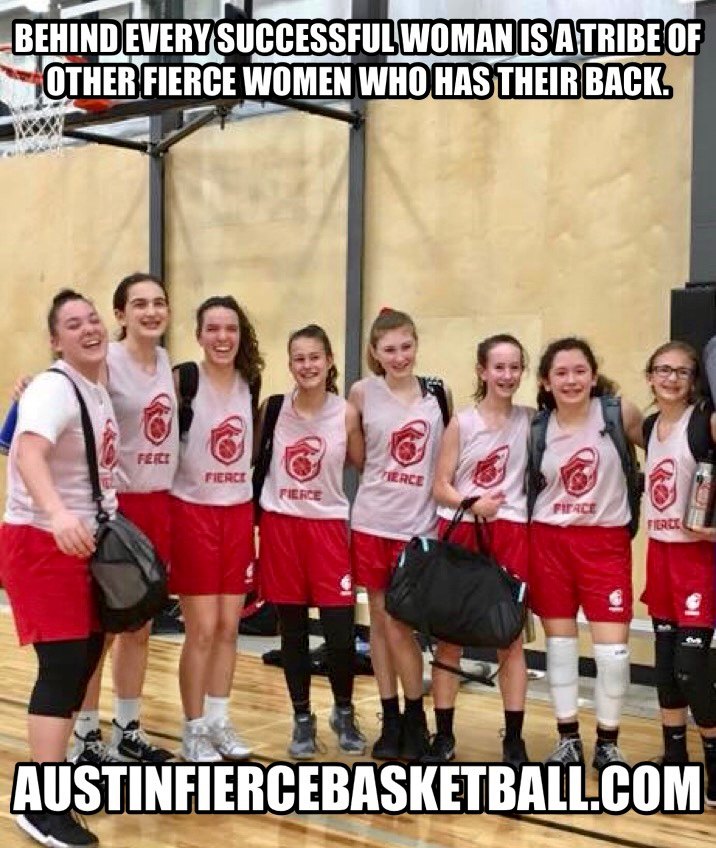
Watching the Grit and Growth of my Players

Fierce and Gritty Young Basketball Women

My girls, and most of the girls on their teams, are lovely and sweet kids that will ask me about my day when they see me or will compliment me on my outfit. But when they are playing, they play to win. Things can get physical on the court and there are times that the Mama Bear peeks out making me want to defend my child, and my kids never need it. They have learned grit as they have gained experience as players.

A couple weekends ago we were at a tournament and after one particularly physical game I asked my daughter how she was doing after the game. Her response was “they played physical, but they weren’t dirty. I like playing them!” I honestly don’t even remember which team won, I am just happy that her takeaway was that tough competition is fun.

When they have a bad game where you and they know they just didn’t play their best that Mama Bear wants to peek out again with some sort of ultra positive declaration of “You were great!” in order to make them feel better. But they don’t need that either. They are generally their own worst critics, but they are now learning to take their mistakes, evaluate what they need to change, and to move on. How wonderful is that? I need to take a lesson.

Time in the Car To And From The Game 

Austin Youth Basketball FamilyThere are days where the last thing I want to do is stop what I’m doing and hop in the car to drive one or more kids to practice, but the truth is that this time is priceless. I have had the most honest conversations with my kids when we are alone in the car.

I truly believe the fact that I’m driving so no eye contact is required has allowed them to open up to me more on those drives. When my car is full I get to appreciate how completely hilarious teen girls can be. I also get insight as to what is going on in their lives and how they react to the social situations in their world. There is something sad about losing that time when they get older and are able to drive themselves.

End of Season Speeches

This is the most bittersweet of all of my favorite things, when the coach gathers the team to have the last post game talk. Sometimes as parents we are lucky enough to be included and we get to hear how the coach feels the girls and the basketball team has grown. Sometimes we just hear the recap in the car afterward, but even if we can’t hear what’s being said the body language always warms my heart. The fact that we have spent HOURS, days, weekends together and it is all coming to an end can be a let down. We know that some of the girls will continue to play together, but this moment in time is ending. This exact team has finished their run and will not go to war again on the court. There always seems to be a team hug and a few hastily wiped tears from both parents and players. 

I am lucky in that I have one daughter that will be continuing her basketball career at Macalester College. I plan on being the Basketball Mom that shows up to games in school colors with homemade cookies for the team.

My youngest daughter began her high school basketball career in the fall. I will have at least one more year of her captive in my car on the way to practice. They both will forever know that I am their biggest fan.

And now, thanks to my people, I can watch an NBA game and actually have an idea as to what is going on.

Macalester College Women's Basketball Ellie CorbettSt. Michael's Guard Charlee Corbett and Dad

Filed Under: Basketball Parenting, blog, Uncategorized Tagged With: basketball daughters, basketball family, basketball mom, basketball parenting, best things about being a basketball mom

Basketball Cutting Drills: Master These To Score More

February 27, 2023 By basketballtrainer

Basketball Cutting Drills

Cutting is a basketball skill that is absolutely critical to individual and team success. The best players are good with and without the basketball. The best passing teams are made up of players who are tremendous cutters.

In this article, we have gathered the 10 most effective basketball cutting drills. These are pro cutting tips and drills for basketball trainers and coaches to use with their players. Players can do many of these drills by themselves or with a teammate or a parent to help.

We will cover:

  • Why is cutting important in basketball?
  • What makes a good cut in basketball?
  • Cutting drills for players and parents
  • Best cutting drills for basketball trainers and coaches

Why is cutting important in basketball?

Since there are 5 players on a basketball team, each player will have the ball about 1/5 of the time when they are on offense. That means it is important for players to know how to play during the 80% of the time that they don’t have the ball. Cuttting helps a team in the following ways:

A good cut can get create separation from . You can’t be a good passing team if no one is open to pass to.

The movement that cutters create helps your team maintain spacing (distancing offensive players 15 to 18 feet away from each other). Cutting is how players move away from each other to open up a driving or passing lane for a teammate.

how to cut without the basketball

When you are cutting, the player who is guarding you has to focus on staying with you and is less focused to help or trap on the player who has the basketball. If you cut well enough to force a seconder defender to help on you, that creates an opportunity for the player the helping defender is guarding to become open.

No matter what position you play, you will need to be an excellent cutter. It is not only wing players that need to be good cutters. Every player needs to be a good cutter. For example, even if you are a point guard, you need to be a good cutter to get the basketball back once you start the offense. Post players need to have great cutting footwork to establish post position to receive the ball.

What makes a good cut in basketball?

Cutting is not the same as moving. A good cut ends with you “getting open” and away from the defender who is guarding you with room enough to receive a pass. You won’t receive a pass every time you cut and get open. Even when you don’t get the ball when you cut, you are occupying your defender so that they can’t be a help defender and clog driving and passing lanes for your teammates.

moving without the basketball A good basketball cut has the following characteristics:

  1. Every great cut starts with an explosive movement.
  2. Changing pace either from a stationary position to full speed or from a jogging or walking pace to “full go'”
  3. Changing pace and changing direction getting away from the defensive player
  4. Always see the basketball when you cut. If your teammate sees that you are open, they are going to pass the ball, so be ready. Nothing is worse than a player who is wide open, but is looking the opposite direction away from the basketball

Here are ten basketball training drills that are a great way to improve your cutting.

Cutting Drills for basketball players and parents

If you want to practice your cutting by yourself, or with a parent, here are some of the most common (but still effective) basketball cuts. The best way to execute these cutting drills is to practice the different types of cuts, one at a time, then use our Curry Drill (described below) to put them all together and practice cutting in a way that is more like a game.

These are not all of the cuts in basketball, but are some that are commonly used. If you are playing for a coach, that coach will have an offensive system that more than likely will require you to learn other types of cuts. We

1 on 1 cuts

Our first series of drills practice the types of cuts to use when you are not receiving a screen from a teammate.

basketball cutting drills basket cut

Basket Cut Diagram

Basket cuts (sometimes referred to as a face cut or front cut). This is the most common cut in basketball. It is also the foundation for one of the most common and effective plays in basketball–the give and go. To run a give and go, pass the ball to teammate and then make an immediate cut to the basket looking for a return pass.

Here is how to execute this cut (see Basket Cut Diagram): Player 1 has the basketball on the left wing (free throw line extended). If you are doing this drill by yourself, set the basketball in the spot where player 1 is on the diagram.

Player 2 will execute a basket cut by taking one slow step in the direction away from the ball and then exploding in front of the defense (x2) and cutting to the basket. As you cut to the basket have your eyes on the ball and your hands ready to catch a pass with both hands and both eyes. If you do have a passer, they will pass you the ball to catch and score without having to dribble.

Repeat this cut 10 times on the left side of the basket and 10 times on the right side of the basket. Make sure to apply our principles for a great cut listed earlier. In case you forgot them, here is a review. If you really want to be a great cutter, you must learn and apply them to all of your cuts.

  1. Starts with an explosive movement.
  2. Change pace and change direction when you cut.
  3. The goal for your cut is to get away from the defense.
  4. Look at the ball when you cut

When you make a basket cut, you want to cut in front of your defender to block them from stealing a pass thrown to you.

Backdoor cut: (aka back cut)

You will use this cut when the player guarding you is overplaying you and playing denial defense so that you can’t catch a pass. They will either have their arm or their entire body in the passing lane between you and your teammate who has the ball.

To execute a backdoor cut, take one step toward the player with the basketball to get the defense moving away from the direction that you want to cut. Then make a quick and explosive step toward the basket. A bounce pass is often the best pass to throw to a backdoor cutter, so make sure that you are looking for a bounce pass.

The backdoor cut has to be timed correctly to work. When you cut, the player with the ball will throw the pass in front of you so that you can catch it in stride and shoot a layup. If you fake like you are going to cut backdoor and then stop, you will not only fake out the defense, but you will also fake out the passer which will result in a turnover. If you start to cut back door, keep going. If your aren’t open, your teammate can see that and won’t throw the pass.

Most backdoor cuts come from the deep corner, or the wing (that is the free throw line extended), or from the top of the key area. That is where you will practice cutting from.

Here are 4 backdoor cuts to practice at a game pace.

If you do have a teammate or parent who can pass to you, that is even better because you can practice catching and scoring. If you don’t have someone to pass to you, you can still practice the cut.

As in the previous diagram, the dashed line is the basketball being passed if you are practicing with a passer.

basketball cutting drills backdoor cut

Backdoor Cut from Slot Diagram

Backdoor Cut from Slot

  1. Put a basketball at the right slot.  That is the spot on the court just past the three point arc and even with the free throw lane. In the Backdoor cut from slot diagram, player #1 is holding the basketball at the right slot (indicated by the circle around player 1).Start at the right wing (noted by the location of player 2 in the diagram.  Step toward the ball.  That will force your defender to move toward the basketball as well.  Then, plant and push off that foot and sprint to the basket–all the time looking at the basketball. Repeat 10 times.Each time use your imagination to see yourself catching the backdoor pass and laying the ball in the basket.
  2. Move the basketball to the left slot (3 on Backdoor Cut from Slot Diagram)  and make 10 backdoor cuts from the left wing (4 on Backdoor Cut from Slot Diagram). Always look for the ball when you cut.
    Basketball Cutting Drills from the Deep Corner

    Backdoor Cut from Deep Corner


    Backdoor Cut from Deep Corner


  3. Put the basketball on the right wing (player #1 in the Backdoor Cut from the Deep Corner Diagram) and make 10 backdoor cuts from the right deep corner.  Again, step to the basketball first to drive your defender away from the direction that you will be cutting.
  4. Move the ball to the left wing (spot #3 Backdoor Cut from the Deep Corner Digram) and make 10 back cuts from the left deep corner (Spot #4 on the same diagram).

Fill Cut

Basketball cutting drills fill cut

Fill Cut Diagram

The purpose of a fill cut is to get open at the top of the key, or in the left or righ slot to reverse the side of the basketball court that the ball is on. That means pass the ball from one side of the floor to the top, and then from the top to the opposite side.

To make a fill cut, (see fill cut diagram) #4 will walk her defender into the lane at a walking pace and then explode until she get the slot.
If #4 doesn’t fill cut, then #5 can fill the slot by making a straight cut up to the slot.

To practice fill cuts, make 10 fill cuts from one side of the floor and then 10 on the other side of the floor. Each time you finish your cut in the slot, pretend that you are catching an imaginary pass from one side of the floor, look at the basket to look for an imaginary cutting or open teammate, and then make an imaginary pass to the opposite side of the floor.


Now we will focus on some cuts you make will need to be able to make when a teammate sets a screen for you.

Teaching point:  If you are using a teammate’s screen, you need to be close enough to them that you can rub your shoulder against their shoulder. That makes it very difficult for the player guarding you to get through the screen.

Here are 4 types of cuts that you can make when a teammate sets a downscreen for you.

Just as you have before, you will do each of these cuts 10 times on both sides of the floor.

When you receive a downscreen from a teammate, the type of cut you use depends on how the defender plays you. It takes practice to recognize what the defense is doing.

When a teammate sets a down screen for you, you can make one of the following cuts:

Basketball cutting drills down screen curl cut

Curl Cut Diagram


Curl cut:
This is the most effective cut when your teammate sets a downscreen for you and the defense is behind you or trailing you. See the Curl Cut Diagram.

The cutting player explodes into the cut and circles around the teammate who is setting the screen. As the cutter, it is important to physically touch your teammate who is setting the screen for you.

Basketball Cutting Drills Straight Cut

Straight Cut Diagram


Straight cut:
If the defense stays close to the basket and keeps you from making a curl cut.  Cut straight to the basketball, but stop 15 feet away from the player with the ball.  That allows you to maintain good offensive spacing.  Offensive spacing is the distance between two offensive players.

Fade cut: If the defensive player positions themseleves that you can’t make a curl cut or a straight cut, cut to the corner.  This is known as a fade cut.

Basketball Cutting Drills Fade Cut

Fade Cut Diagram

It is the least effective cut to score on because the player with the basketball will have to make a long pass to get the basketball to you.  But, it does help your team by you spacing to the corner to open up the middle of the floor.

Backdoor Cut: If the defense jumps into the passing lane to look to steal the basketball, make a backdoor cut to the basket.

Curry Cutting Drill

In a game, you will usually make a series of different cuts each time your team has the ball. This drill is designed to put many types of cuts together.

Steph Curry is great when he has the ball, and he is equally as skilled at cutting to get open.

To execute this drill, place a basketball somewhere on the court approximately 3 feet behind the three point arc. You will start underneath the net. Imagine that you have the best defensive player you know guarding you. If you can’t think of anyone, pretend that Marcus Smart or A’ja Wilson are guarding you. They were the 2022 NBA and WNBA Defensive Player of the Year Award Winners.

You are going to execute the cuts diagrammed and discussed above for 30 seconds. It is very important to think about which cut your are doing so that you are making basketball cuts and not just running around like someone whose pants are on fire! 🙂 That means that the first few times that you do this drill, you will need to go at a slow pace to think about your cuts. The more times you do the drill, the quicker pace you can go at.

Start under the rim and pretend there is a defensive player guarding you. Pretend that you are receiving a downscreen from a teammate. Walk your defender in the opposite direction from where you plan to cut, and make one of the four cuts (curl, straight, fade, back) off the downscreen. From there, mix up the cuts that you have practice one at a time. Make some

Best cutting drills for basketball trainers and coaches

These drills are designed to improve cutting, but they also have the added benefits of helping passers get better at passing to a cutting player.

Some of our drills involve the offense not being allowed to dribble. That is to place the emphasis on cutting to get open to catch a pass. For younger or beginning players, you can allow a single dribble each time a player catches the ball to get away from their defender and make the pass shorter.

4 on 4–no dribble game.

The best cutting drill in basketball is to play 4 on 4 and not allow the offense to dribble. I know you are probably thinking, “How can you play basketball and not dribble?” Well the answer is, you can, but it is VERY HARD and practing this way is going to make players much better cutters!

If the player with the ball has only 2 options–shoot or pass, her teammates have to execute excellent cuts to get open to receive the ball. Playing this game for 5 minutes gives every player a lot of practice cutting. If all players follow the cutting techniques we just described, they will become excellent cutters in just a few times of playing this game.

To play the drill, simply play normal basketball rules plus one special rule. If the offensive team dribbles, it is a turnover and the other team receives possession of the basketball. Start a player at the top of they key with the ball. The other offensive players can start anywhere in the half court. Each of the other three offensive players makes the cuts described above to get open to receive a pass and play until one team scores 10 points. Just like a game, score by 1 for free throws made, 2 for layups or a jump shot made inside the arc, and 3 for a three point shot made.

The first few times you run this cut drill, you might want to play until a team scores 5 points until you get the hang of it.

You need a team to run this drill. If you don’t have 8 players, you can play 3 on 3 No Dribble, or 2 on 2 No Dribble. If there are only 2 players available, you can play…

Off the ball one one one

This is a one one one drill. You do need two players and three basketballs, Put a chair on the right wing, another chair on the left wing, and a chair at the top of the key. Put a basketball on the seat of each chair. Players start in the three second lane. Designate who the player is on offense and who the player is on defense.

The first player should walk the defense away from where they want to cut and make an explosive change of directions to get to one of the chairs to pick up the basketball. From there, it is one on one–player with the ball works to get to the basket, or get a shot off the dribble.

You don’t put the ball back on the chair until the offensive player scores, or the defensive player gets a steal or a rebound. In summary, instead of “checking it up” after each change of possession, you start with the offensive player cutting from the lane to one of the basketballs.

A few teaching points to run this drill.

  1. The better cut the offensive player makes to create separation between them and the defense, the better shot they can get after picking up the ball.
  2. Think of it as a race to one of the basketballs. Did you ever hold races with your friends? What was the advantage in those races? The advantage was being the one who shouted “GO!” You knew when you were going to say go, but your friend you were racing against didn’t. It’s the same principle with cutting if you can slowly walk the defense towards one chair with a basketball and then change directions quickly to go to a different one, they don’t know when you are telling yourself “GO!” That gives the cutter an advantage.
  3. Fake a cut to make a cut. Walk the defensive player away from the direction you want to cut. If they don’t react with you, then just make a straight cut to that basketball.
  4. In basketball, you are the most open when you first catch the basketball. After that, the defense will recover to you. Work on that in this drill and if you can create separation from the defense, look for a quick shot, or a drive if the defense is off balance when they catch up to you.
  5. If you don’t have access to folding chairs, just put the basketballs on the ground at the spots mentioned. The offensive player will bend over to pick one up which isn’t ideal, but it will work.

Odd Man (or Woman) Out

If you have 3, 5, 7, or 9 players to run a cutting drill designate one player as the permanent passer.

Here is how the drill is run with five players. You will play 2 on 2 no dribble as described earlier. The permanent passer will play with the each team when they are on offense. One team starts on offense. The other on defense.

The permanent passer starts with the basketball. The two players on the offensive team cut to get open. The permanent passer passes to either one who gets open, then goes and screens for the other player who did not receive the pass. This gives the players a chance to practice cuts coming off a screen.

Since the permanent passer is not guarded, they can always cut to be in a position to catch a pass. When an offensive player does pass to the permanent passer, she should either make a basket cut, or go screen for her teammate. The permanent passer should practice good fundamentals like using pass fakes and maintaining triple-threat position.

If the permanent passes makes a turnover pass, the same team keeps the ball. That way the permanent passer does not cost them to lose the ball to the other team. Play to 8 by normal basketball scoring rules and then get a new permanent passer and start a new game to 8.

20 Point Game

This game can be played is best played 3 on 3 or 4 on 4, but will also work 5 on 5 or 2 on 2. Because we want to emphasize cutting in this dril, there is no dribbling. The offense scores one point for each pass they complete in addition to any baskets they score. In addition to forcing the offense to make good cuts, the defense is able to work on their pressure defense.

The first team with the ball has an advantage in this game. To see which team gets the ball first, alternate free throws. First team that misses a free throw starts on defense.

There you have 4 very good drills to improving your cutting. These drills force you to cut at game speed and against real defensive players. If you are working on cutting by yourself, you have to use a little more imagination. And, you have to be willing to push yourself.

Filed Under: Basketball Player Development, blog

Basketball Player Evaluation Form: Download and Accelerate

February 27, 2023 By basketballtrainer

Bodybuilding program starting 3 times a week – Fitnessmith what muscles do hang cleans work bodybuilding doping product, anabolic steroid buy us waterloo catholic teachers.
Basketball Evaluation Forms Template

Introduction:

Basketball is a team sport that requires a unique combination of physical and mental skills. To excel in the game, players need to work on their individual skills as well as their team dynamics. Player Evaluation Forms (P.E.Fs) are an essential tool for players, coaches, and trainers to assess player skills and progress. In this comprehensive guide, we will discuss the benefits of using P.E.Fs and how they can be used for player self-evaluation, coach feedback, and player skill development. We will also provide examples of best practices for using P.E.Fs and offer tips for effective use.

Part 1: Player Self-Evaluation

As a basketball player, it’s essential to take responsibility for your own development. Self-evaluation is a crucial process that allows you to assess your strengths and weaknesses and identify areas for improvement.

Understanding the Self-Evaluation Process

Basketball self evaluationSelf-evaluation is the process of assessing your own performance and skills. In basketball, this process involves reflecting on your individual abilities, team dynamics, and overall game strategy. Self-evaluation allows players to take ownership of their development and to identify areas for improvement that may have gone unnoticed by coaches or trainers.

Benefits of Self-Evaluation

Self-evaluation has several benefits for players, including:

  1. Increased self-awareness: Self-evaluation helps players develop a better understanding of their strengths and weaknesses.
  2. Personalized development: By identifying areas for improvement, players can create customized training plans that target their specific needs.
  3. Improved performance: Self-evaluation allows players to make incremental improvements to their skills and performance over time.

I strongly recommend any coach or trainer filling these forms out first ask the player to fill out those form first so players take the time to invest in this process and also look in the mirror before becoming defensive.  

Common Mistakes to Avoid

When completing a self-evaluation, it’s important to avoid common mistakes that can negatively impact the process. Some common mistakes to avoid include:

  1. Lack of objectivity: It’s essential to be objective when evaluating your skills and performance. Avoid letting your emotions or personal biases cloud your judgment.  Be aware of low scoring areas as huge opportunities to improve and high scoring areas as weapons you can sharpen and magnify as strengths.
  2. Focusing on only one aspect: Don’t focus on only one aspect of your game. Evaluate all areas of your skills and performance to get a comprehensive understanding of your abilities.
  3. Inconsistency: Make sure to complete self-evaluations regularly to track your progress over time. Consistency is key to using self-evaluation effectively.

Skip being defensive or butt hurt, focus on seeing how you can obtain valuable feedback and expertise.   

Using Self-Evaluation to Improve Performance

The ultimate goal of self-evaluation is to improve performance. Here are some tips for using self-evaluation to improve your performance:

  1. Identify areas for improvement: Use your self-evaluation to identify specific areas of your game that need improvement. This could be anything from shooting to ball-handling to teamwork.
  2. Create an action plan: Develop an action plan to address the weaknesses you identified. Your plan should include specific goals and strategies for improving your skills.
  3. Consistency: Make sure to evaluate your progress regularly and adjust your action plan as needed. Consistency is key to making incremental improvements to your performance over time.

In the case of coaches, they are likely handing you the values they reward… specifically to your game and the gap between you and their trust.   Hear them without judgement or using the word fair in your internal conversation.  

Part 2: Coach Feedback and Player Improvement

Coaches play a critical role in assessing player performance and providing feedback. Effective feedback is essential to player development and can help players take their game to the next level.

Understanding the Coach Feedback Process

Basketball coach feedbackThe role of coaches in evaluating player performance is to provide feedback that can help players improve their skills and performance. Feedback is essential because it allows players to understand their strengths and weaknesses and identify areas for improvement.

Benefits of Feedback

Feedback has several benefits for players, including:

  1. Increased awareness: Feedback helps players understand their skills and performance in a way they may not have been able to see on their own.
  2. Supportive environment: Good feedback is delivered in a supportive and constructive manner. This environment helps players feel safe to make mistakes and try new approaches to improve their skills.
  3. Motivation: Feedback can be a powerful motivator for players. When players receive positive feedback, it can boost their confidence and inspire them to work harder. When they receive constructive feedback, it can motivate them to make the necessary changes to improve their skills.

Common Mistakes to Avoid When Giving Feedback

When providing feedback to players, it’s important to avoid common mistakes that can negatively impact their development. Some common mistakes to avoid include:

  1. Focusing only on weaknesses: While it’s important to address areas for improvement, it’s also essential to acknowledge players’ strengths and accomplishments.  And magnifying one’s strengths can be a much greater investment than addressing all weaknesses. 
  2. Generalizations: Be specific when giving feedback. Provide concrete examples of where players can improve and how they can do so.  You are a good three point shooter.  You are great off the dribble, but your percentage drops when shooting off the catch.  Imagine what an offseason of focused catch and shoot training could do for your numbers, and our wins? 
  3. Negativity: Avoid being overly critical or negative when providing feedback. Instead, focus on providing constructive feedback in a supportive and positive manner.  The next steps for you this season are to 1.  increase your ppg by running the floor harder.   2.   Earn more playing time by increasing your assist to turnover ratio to 2:1.  3. Become a team captain by demonstrating excellence, leadership and accountability during the offseason training.  

Best Practices for Providing Effective Feedback

Providing effective feedback requires a structured and well-thought-out approach. Here are some best practices for providing effective feedback:

  1. Use specific examples: Use specific examples to illustrate your points. This can help players understand your feedback and make the necessary changes to improve their skills.
  2. Focus on both strengths and weaknesses: While it’s important to address areas for improvement, it’s also essential to acknowledge players’ strengths and accomplishments.
  3. Provide actionable recommendations: Provide specific recommendations for how players can improve their skills. This can include training techniques or other strategies to improve performance.
  4. Ensure feedback is delivered in a constructive and supportive manner: Feedback should be delivered in a supportive and constructive manner. This can help players feel comfortable making mistakes and trying new approaches to improve their skills.

Using Feedback to Build Player Skills and Mindset

Using feedback to build player skills and mindset is essential for long-term player development. Here are some tips for using feedback to build player skills and mindset:

  1. Creating an action plan based on feedback: Use the feedback you receive to develop an action plan to address areas for improvement. This plan should include specific goals and strategies for improving your skills.
  2. Encouraging players to take ownership of their development: Players should be encouraged to take ownership of their development. This includes setting goals, developing training plans, and tracking their progress over time.
  3. The importance of follow-up and ongoing evaluation: Follow-up and ongoing evaluation are critical to long-term player development. By regularly evaluating progress and adjusting strategies, players can continue to make incremental improvements to their skills over time.

Part 3: Trainer Tips for Building Player Skills and Mindset thru Evaluation

Trainers play a critical role in building player skills and mindset. Trainers have the knowledge and expertise to create customized training plans that target specific areas of a player’s game.

Understanding the Role of Trainers in Player Development

The role of trainers in player development is to provide customized training plans that target specific areas of a player’s game. Trainers use their expertise to design training programs that address individual player needs and preferences.

Benefits of Working with a Trainer

Working with a trainer has several benefits for players, including:

  1. Personalized development: Trainers can create customized training plans that target specific areas of a player’s game.  In order to help people we need a benchmark and a evaluation before building a path. Use the feedback process and evaluation forms to insure development has forward progress.
  2. Expertise: Trainers have the knowledge and expertise to develop training programs that are effective and efficient.  A coach may write on an evaluation form “player does not finish at rim at a desired percentage.  The trainer can know, two dribbles from the three point line to the rim is allowing too much help defense and not drawing enough fouls which would increase percentages.”
  3. Accountability: Trainers can provide the necessary motivation and accountability to help players stay on track and achieve their goals.   Trainers can often make time to catch players doing something right and stop practice to reinforce that while a coach may not.  Conversely, many trainers have goals aligned with clients in a way a coach can’t because the coach needs to win to keep a job.    Take advantage of that gap and make sure you hold players accountable both in truth and candor and encouragement.

Common Mistakes to Avoid When Working with a Trainer

When working with a trainer, it’s important to avoid common mistakes that can negatively impact player development. Some common mistakes to avoid include:

  1. Lack of communication: It’s essential to communicate effectively with your trainer to ensure that your training plan is tailored to your individual needs.
  2. Lack of commitment: It’s important to commit to your training plan and make the necessary effort to improve your skills.  Why spend time and money with a trainer if you aren’t committed.  At AustinYouthBasketball.com we work with Passion| Purpose | Power.  Your bring the passion, we bring the purpose thru our expertise, and the results are Power.   But you need to bring the Passion and commitment. 
  1. Not tracking progress: It’s important to track your progress over time to ensure that you’re making incremental improvements to your skills. Plateaus happen in training, but you need to recognize them and also know how to overcome them by tracking them.  

Best Practices for Building Player Skills and Mindset

Building player skills and mindset requires a structured and well-thought-out approach that should be documented in an evaluation form. Here are some best practices for building player skills and mindset:

  1. Identifying areas for improvement: Identify specific areas of your game that need improvement. This could be anything from shooting to ball-handling to teamwork.
  2. Developing a customized training plan: Work with your trainer to develop a customized training plan that targets your specific needs and preferences.  That training plan can start with an evaluation form.
  3. Incorporating mental and physical training techniques: Effective training should address both the physical and mental aspects of the game. Incorporate training techniques that target both of these areas to achieve optimal results.
  4. Using evaluation forms to track progress: Use evaluation forms to track your progress over time. This can help you identify areas where you’re making progress and areas where you need to focus more effort.

The Importance of Consistency and Ongoing Evaluation

Consistency and ongoing evaluation are critical to long-term player development. By consistently working on specific areas of your game and regularly evaluating your progress, you can continue to make incremental improvements over time.

Conclusion

Player Evaluation Forms are an essential tool for basketball players, coaches, and trainers to assess player skills and progress. Self-evaluation, coach feedback, and player skill development are all important components of using P.E.Fs effectively. By following best practices and avoiding common mistakes, players can take ownership of their development, receive effective feedback, and work with trainers to improve their skills and mindset. With consistent effort and ongoing evaluation, players can continue to make incremental improvements and take their game to the next level.

Here is a free download you can have of our version (collated from several other great forms):

Basketball Player Evaluation Form

Enjoy our free download here:

Basketball Player Evaluation Form

Filed Under: Basketball Parenting, Basketball Trainer Business, blog, Uncategorized

Basketball Training:The Hidden Problems and Unmet Needs of Players Today

February 26, 2023 By basketballtrainer

basketball training problems

Basketball is one of the most popular and widely played sports in the world, with millions of people participating in the sport at various levels of competition. From recreational players to professional athletes, basketball requires a combination of physical strength, mental agility, and technical skills to be successful. However, the process of developing these skills and abilities through basketball training is often fraught with challenges and obstacles that can hinder a player’s progress and limit their potential.

In this article, we will explore the hidden problems and unmet needs of players in basketball training today, and offer innovative solutions for effective basketball training.

Introduction

Basketball is a game that requires a combination of skills, including hand-eye coordination, agility, speed, strength, and endurance. Effective basketball training involves the development of these skills through various techniques and methods, such as drills, scrimmages, weight training, and mental preparation. However, the process of developing these skills can be challenging for many players, and there are several problems and unmet needs that can limit a player’s potential.

The purpose of this article is to highlight the challenges faced by players in basketball training and offer innovative solutions for effective training. We will discuss the problems faced by players during basketball training, the unmet needs of players, and innovative questions and posible solutions for effective basketball training we can look at.

Problems in Basketball Training

Basketball training requires access to adequate training facilities, qualified coaches, sufficient time and resources, and effective training methods. Unfortunately, not all players have access to these resources, and the lack of these resources can limit their potential. In this section, we will explore the various problems that players face during basketball training.

Lack of Access to Adequate Basketball Training Facilities and Equipment

One of the most significant problems faced by players in basketball training is the lack of access to adequate training facilities and equipment. Many players do not have access to a gym or court, making it challenging to practice their skills. Furthermore, even if players have access to a court, the condition of the court may be inadequate, making it difficult to practice effectively.

In addition to inadequate training facilities, many players also lack access to proper equipment. For example, basketballs, shoes, and clothing can be expensive, and many players may not have the means to purchase them.  A trip to the sporting goods store or Amazon can quickly empty a bank account these days and on my last trip I noticed basketball shoes and a basketball could easily be $300-$400 for a pair of Nikes and a Wilson Evo indoor ball.

Limited Availability of Experienced and Qualified Coaches

Another problem faced by players in basketball training is the limited availability of experienced and qualified coaches. A good coach can help a player develop their skills and provide valuable feedback to improve their game. However, not all players have access to such coaches, and some coaches may not have the necessary experience or qualifications to provide effective training.

Many coaches don’t know the science of player development, still others don’t have the passion, and yet others argue that player development should happen outside of practice because they don’t have the time.

Overall, we also have a sport that tends to be obsessed with specific tactics over skills.  Coaches making decisions from the sidelines on every play, but not teaching how to actually set and use a screen.  Trainers teaching James Harden 18 dribble and step, step, step back isolation moves but not how to perform a V cut to get open.

Skill Development Not Focused on Where Player Projects As A Varsity or College Player

We believe all player should learn all skills to be complete and position-less players.  But there are two scenarios currently happening all across America that should change ASAP.

  1. Scenario 1 has Recreational and Middle School Coaches playing our most genetically gifted players at big positions where they rarely get touches, athletic development (like defensive sliding), or skill development for position they would need to play in High School or beyond.   How many 5’8 players play center in Middle School only to end up 6’0 in a High School conference where the average Centers and Power Forwards are 6’7 plus?
  2. Scenario 2 has trainers teaching everyone isolation moves or deep threes when their mentee only receives the ball in the high post at school.   And because he doesn’t train on those skills, he doesn’t make shots and spends more time on the bench than if the trainer had personalized to him.

What if we collectively pivoted to think about what was in the players best interests first?

Scenario 1:  Coaches at all levels ask the height of the parents and if there are any height projections for the player.   They make an educated guess at where the kid ends up height an position wise and make sure they do skill development and play some at that position.  If you don’t have sufficient projected bigs, consider an offense like 5 out that allows everyone to focus on multiple skills while still reinforcing that rebounding and help defense is everyone’s job.  

Scenario 2:  What if trainers asked trainees what offense they are running at school?  Where are your opportunities and how do you move into those in flow during games?   Let me show you some high post moves that also will work when catching weak (facing away from your goal) on the wing.  Let’s divide up our training session between what you can use at school this week and what you need to become the player you want to be in the future.  

Inadequate Time and Resources for Training

Basketball training requires time and resources, and many players may not have access to these resources. For example, many young players may have to balance their training with their schoolwork, making it difficult to find the time to train effectively. Furthermore, some players may not have the financial resources to pay for training, which can limit their access to training facilities and equipment.

Each basketball community faces different struggles. I will never forget when a coach in rural Maine told me he was more worried about getting his kids food, sleep, some sense of security, hope  and basic necessities of life to think about extra training.  

Other communities face first world problems where a life of affluence can have a gym full of kids who really haven’t discovered the power that adversity can bring us to become more resilient warriors on and off the court. 

What does our community and kids in our gym need help with?

Inefficient and Outdated Training Methods

Finally, many players face the problem of inefficient and outdated training methods. Some coaches may rely on traditional training methods that may not be effective for all players. For example, some coaches may focus on repetitive drills without providing feedback or assessing the progress of the player. This can limit the player’s potential and result in a lack of progress.

Let’s use the example we can all relate to that was the norm for many years of basketball players always running cross country in the Fall to “get in shape for basketball season.”

I currently see a ton of Olympic movement and Crossfit type weight training in basketball strength programs across America.   I don’t see them actually benefiting most of the athletes in my gym from a functional basketball strength or explosiveness perspective and have seen a rise in back injuries among the athletes in our gym.    Is it possible that this trend is not serving our young athletes most efficiently?

Here is a link for an alternative:  Basketball Bodyweight Strength Program

What are we doing now in our basketball training that in the future might be the equivalent of “run cross country.?”

Unmet Needs of Players in Basketball Training

In addition to the problems faced by players in basketball training, there are also several unmet needs that can limit a player’s potential. In this section, we will explore the various unmet needs of players during basketball training.

Customizable and Individualized Training Programs

One of the most critical unmet needs of players in basketball training is customizable and individualized training programs. Every player has unique strengths and weaknesses, and a one-size-fits-all training program may not be effective for everyone. Players need personalized training programs that are tailored to their specific needs and abilities. Customizable and individualized training programs can help players improve their skills, identify their weaknesses, and work on areas that need improvement.

We run personalized training programs with customization to each player.  But could we do better by having a leader board on one of our whiteboards with every player’s benchmark times and scores and another section celebrating breakthrough personal bests?  Look at how martial arts guides, tests and celebrates with their belt system.  How could we bring that to basketball?

If you’re looking to help a young woman become a dominant shot-blocker and rim protector, one of the best ways to do so is by studying the techniques of the top shot-blockers in the WNBA. Luckily, there are plenty of resources available that can help you do just that. https://bucketlist.fans allows users to easily find and watch their favorite WNBA players, including those who excel at blocking shots.

For example, if you want to learn about the shot-blocking prowess of A’ja Wilson, you can easily search for her on the Bucket List website and find videos of her in action. Last season, Wilson averaged 1.9 blocks per game in the regular season and 2.4 blocks per game in the post season, so there are plenty of highlights available for you to review and study. By watching her approach and execution, you can gain a better understanding of what it takes to become a top shot-blocker in the WNBA. https://bucketlist.fans/#/videos/season/blk/1628932/42022

Similarly, if you’re interested in becoming a better passer and playmaker on the court, you can review film of the top assist-makers in the NBA. By watching how these players move the ball and create opportunities for their teammates, you can learn valuable lessons about court vision and decision-making. https://bucketlist.fans allows you to easily find and watch the top assist-makers in the NBA, including the likes of Tyrese Haliburton. Haliburton is currently averaging 10.2 assists per game this season, making him one of the top playmakers in the league. By reviewing film of his assists, you can gain insight into his passing technique and learn how he creates opportunities for his teammates.https://bucketlist.fans/#/videos/season/ast/1630169/22022

In short, https://bucketlist.fans is a valuable resource for basketball players who want to improve their skills by studying the techniques of top players in the WNBA and NBA. Whether you’re looking to become a better shot-blocker or playmaker, we have the resources you need to take your game to the next level.

Access to Sports Nutritionists and Sports Psychologists

Basketball is a physically and mentally demanding sport, and players require proper nutrition and mental preparation to perform at their best. Unfortunately, many players do not have access to sports nutritionists and sports psychologists who can provide guidance on proper nutrition and mental preparation. Access to these professionals can help players optimize their performance, reduce the risk of injuries, and overcome mental barriers.

Most trainers and coaches are not expert in either field, but do we have a resources list of best basketball nutrition options for players?  Do we have a mental health checklist for players?  Do we have a pre game checklist for mental preparation?  Could we teach kids how to make a smoothie that is healthy?  Discuss replacing horrible food choices with healthier ones? 

Regular Player Assessments and Data-Driven Feedback

Another unmet need of players in basketball training is regular player assessments and data-driven feedback. Many players do not receive regular feedback on their performance, making it difficult to identify areas that need improvement. Regular player assessments and data-driven feedback can help players identify their weaknesses, track their progress, and make adjustments to their training programs accordingly.

Sure we have technology options available, but a simple basketball player evaluation form filled out by the player and then by the coach can really help increase self awareness and also note progress.  This could be done in training once a month or quarterly.  

Integration of Technology and Data Analytics in Training Programs

The use of technology and data analytics in basketball training is becoming increasingly popular. However, not all players have access to these tools, which can limit their potential. The integration of technology and data analytics in training programs can help players improve their skills, track their progress, and make data-driven decisions about their training.

We are looking closely at this in our own basketball training business.  Some ideas that we are looking at include:

  • Mounting a Smart TV so we can film from our phone and stream to the TV and show in slow motion what shooting form is and how we can improve it.  Of course we can use it in other areas like discussing approach angles in shot blocking.  
  • There are now AI type camera solutions like the VEO that can track players and the ball in full court training or scrimmages.  
  • Training Apps so players can work out on their own (Caution: I don’t recommend spending huge amounts of time developing this unless you are confident your training group is dedicated to working on their own.)  There are many great training apps already complete you can share or partner with.  

Innovative Solutions for Effective Basketball Training

Innovative solutions for effective basketball training are emerging that can help players overcome the problems and unmet needs discussed above. In this section, we will explore some of the most promising innovative solutions for effective basketball training.

Virtual Reality Training Programs

Virtual reality training programs use virtual reality technology to simulate game situations and provide players with a realistic training experience. These programs can help players develop their skills in a safe and controlled environment and provide immediate feedback on their performance.

While these are financially out of the reach for almost all players how could we focus on taking the advantages of this and bringing it down to a level where we could use similar principles for the masses?   What if we wanted to train to become better at moving without the ball? We instruct players to watch a Golden State game, but not have their eyes follow the ball on screen.  Their job is to watch only Klay Thompson and watch his cuts, reads, use of screens, effort level, physicality, and change of speed.   This would essentially help us mimic some of the virtual reality programs being developed at a high $$$$ price tag.  

Artificial Intelligence and Machine Learning in Training

Artificial intelligence and machine learning are being used in basketball training to analyze player performance and provide personalized training programs. These technologies can identify areas that need improvement, track player progress, and provide feedback on performance.

What apps can we use to support players?  What can we learn about the future of AI in general terms?   How can it support our teaching and sharing?   Our sustainability as training business owners?  How can it support basketball parents?   

Sports Science and Nutrition Advancements

Advancements in sports science and nutrition can help players optimize their performance and reduce the risk of injuries. For example, players can use wearable technology to track their physical activity, monitor their heart rate, and track their sleep patterns. They can also use nutritional supplements to provide their bodies with the nutrients they need to perform at their best.

I was at a University of Texas closed basketball practice years ago.   They had a big screen television on rollers.  The display indicated the heart rate of each player who was wearing a chest strap for monitoring.  Graduate assistant coaches and trainers would monitor effort and also warmup and cool down processes.    A simple Apple watch can help in our training.  Think of shooting drills being performed at 120 bpm and then at 160 bpm.  We can move forward in sports science in our own gyms with out the University of Texas budget. 

Personalized Coaching and Mentoring

Personalized coaching and mentoring can help players overcome the problems and unmet needs discussed above. Coaches and mentors can provide players with personalized training programs, feedback on their performance, and guidance on proper nutrition and mental preparation. This can help players improve their skills, optimize their performance, and reach their full potential.

The fundamentals and skill development necessary to climb the competitive ladder are often the same for most players.  But the most effective path you journey can be personalized to each player.

  • What are realistic goals for this player and how can I support them?  
  • What is their Why?  
  • How do they learn? 
  • What is positive feedback for this player look like?  
  • How can I hold this player accountable to their goals and our agreed upon focus?  
  • When a player has a bad day, do you ask: “You don’t seem yourself today, tell me… how was your day… what’s going on?  Or do you throw them out of the gym?
  • Do you ask the parents how are we doing off the court?  And what else can I help with?  
  • Do you know the learning challenges and opportunities facing each player as an individual? 

Support, Accountability and Community

While sustained development is certainly driven by intrinsic motivation, how can we fuel that as leaders in basketball training?   How can we fuel it as players?  As parents?  As coaches?

What platforms can we adopt or build to make us grow together?  How can we go faster as a group rather than individuals?

Try this at a training session during cool down or free throw work:

Brag, Ask, Share.   Each player (and coach) has to brag about an accomplishment that week.  Could be basketball or otherwise.   Ask.. I sure could use some help or ideas with ________.  Share- a resource, quote, belief, hack, tool, website, Tik Tok Channel.  Keep it short and brief.  

Ask players at the beginning of a training session:

“What do you need accountability from me on today?  How can I best provide that to you? “

Their ideas imply permission and often we can skip the defensive reaction or butt hurt look that coaching criticism can bring.   

What can I outsource in these areas via technology or other products? 

Conclusion

Effective basketball training is essential for players to reach their full potential. Unfortunately, the problems and unmet needs discussed in this article can limit a player’s potential and hinder their progress. However, innovative solutions for effective basketball training are emerging that can help players overcome these challenges and reach their full potential. By prioritizing effective basketball training and utilizing these innovative solutions, players can develop their skills, optimize their performance, and achieve their goals.  We can meet the unmet needs and move from being problem spotters to problem solvers!

Filed Under: Basketball Parenting, Basketball Trainer Blog, Basketball Trainer Business, blog

How to Keep a Basketball Scorebook (Complete Guide)

February 7, 2023 By basketballtrainer

Every official basketball game needs an official scorebook. No matter what the level of basketball being played, both teams are required to have someone who knows how to keep a basketball scorebook.
Weight training on an empty or full stomach? – Fitnessmith best place to buy anavar online buy testosterone test propionate, anabolic bodybuilding usa – yabanci bahis siteleri.
The official scorer for the game is the individual who keeps the scorebook for the home team. He or she is seated at the the scorer’s table. The visiting team is allowed to have a person seated at the scorer’s table to keep their scorebook. The official score keepers have a big responsibility, but not one to be afraid of.

The officials signal each time a field goal is made and whether it was a two point or three point basket. They also signal fouls and free throws. So you must watch the officials more than watching the game. That is why a lot of parents and fans have a time keeping score! 🙂

Keeping

Official signaling 2 point field goal

The official scorebook of the home team is the official record of the running score of the game, the individual point totals, personal fouls, technical fouls, and team fouls. The scoreboard that is displayed in the gymnasium is NOT official.

If there is a discrepancy between the scoreboard and the home team’s official scorebook, the scorebook prevails. The game clock and scoreboard operator should communicate closely with the official scorekeeper to make sure that the scoreboard reflects what is recorded on the scorebook.

Here is a step-by-step guide on how to keep a basketball scorebook. We will emphasize the official scorebook, but any fan can keep their own at the game or when watching at home to add to the enjoyment. The official scorer must use their teams’ season’s scorebook. Anyone else doesn’t need an official book. You can make your own basketball score sheet.

Prepare your materials and pregame information:

To keep a scorebook, you will need a pen or pencil, a notebook, a scorebook specifically designed for basketball, and a basic knowledge of the rules of the game.

Before the game starts, make sure to:

    1. Write the date, location, and the team name for the two teams playing. This information is recorded at the top of the scorebook.


    1. Write down the names of the players and uniform numbers for your team, along with indicating the starting five. Copy the names and numbers from the opposing team from their scorebook. Allow their scorekeeper to do the same with yours. The coaches are required to report the starting five players for each team to the official scorer. Often, the visiting team’s coach will report to his or her scorekeeper who will then relay the information to the official scorer.


  1. There are areas on the score page to have the officials sign their names, to write the names of the coaches, and to fill in your name as the scorer.

Now, you are prepared for the game to tip off!

In Game Scoring Responsibilities

Remember, that even if you have ties to one of the teams or to some of the players in the game, you must be neutral. You cannot cheer, question officials, leave while the game is in progress, or check you phone. You must be focus only on the game!

Keeping track of the team score and the individual points scored is the main reason for keeping a scorebook. There are other responsibilities as well. Here is what you need to know:

    1. Write down the running score after each basket is made. There is a section on the scoresheet for easily recording the running score.


    1. When a player makes a field goal, the game officials will signal two or three-point shot. However, they do not indicate the number of the player who scored. That is up to the official scorer to determine. That is another reason why the visiting team have a person at the scorers table. The official scorer can ask for help on who scored, but the final decision on what player to credit the points to rests with the official scorer. Mark a “2” or a “3” in the row for the player who scored and in the correct quarter of the game.
Guide to keeping a basketball scorebook

Player shooting a free throw


    1. Before a player makes a free throw attempt, draw an open circle in the row for that player and in the quarter of play. If it is a one and one free throw situation, write a plus next to the circle. If the player makes the free throw, color in the circle.


  1. When the quarter ends (or the half end for college men’s games), record the total team points for both teams.

To clarify, you do not record every field goal that is attempted. You only record the field goals that are made. But, you do record free throws attempted and free throws made.

The end of each quarter is also a good time to compare with the scoreboard operator and the other team’s scorebook keeper to make sure everyone’s records match.

Other In Game Recording Responsibilities

If you are keeping an unofficial scorebook, you might want to also record assists, rebounds, total field goals attempted, or steals. Those are the responsibilities of the team’s statisticians and not the responsibility of the person keeping the official game scorebook.

    1. The scorebook has a place to record the quarters in the game that each player played. It is important to have this correct as most levels of play have a limit on how many quarters a player can play in one day and in one season. When a player enters the game, or starts a quarter, be sure to record that in the scorebook.


    1. If a player is going to substitute into the game, they will report to you and give you their number. Write down the player’s number, the quarter, and the game time remaining in the quarter in your notebook. This is important because a player is not allowed to leave the game and then come back in without any time having gone off the game clock. At times, the officials will refer to the person keeping the official scorebook to verify if a player is eligible to return or not.
How to keep a basketball scorebook (complete guide)

Official signaling one free throw


    1. When an official calls a foul, they will blow their whistle to stop play. They will then will signal the number of the player who was assessed the foul. Put a slash mark for the number of each foul committed by an individual player. You should also note if the foul is a personal foul or a technical foul. A technical foul also counts as a personal foul and a team foul. There is a space for a technical foul that is assessed to either coaching staff.


    1. At the bottom of the page there will be a row to keep track of team fouls. Each time a foul is assessed to an individual, you must also record it toward the team fouls total.


    1. When a team calls a time-out, make sure to write down the quarter and the time remaining in the quarter. The official book is the official record of time-outs called. Normally during a timeout, the officials will ask the official scorekeeper how many timeouts each team has remaining to use. They will then report the timeouts remaining to the coaches of both teams.


You should say out loud every time you record something. That allows the other team’s scorer as well as the scoreboard operator to know what the official counts are.

Post Game Scorebook Responsibilities

    1. The scorebook needs to be totaled at the end of the game so that the coaches have a record of the game.


    1. Total the number of two point baskets, three point baskets, free throws attempted, free throws and individual points for players on both teams. There is a column for each of these in the scorebook.


    1. The home team and visiting team scorebooks should be compared to make sure that all points, fouls, quarters played, and free throws match. If there is a media representative covering the game, they might want to compare their scorebook with yours to have an accurate report.


    1. .Make sure that the scorebook is given to one of the coaches from your team.


Learn to Keep a basketball scorebook

Keeping the official scorebook at basketball games is an important, but thankless job. The only time most people notice the person keeping the scorebook is if there is a mistake or a problem. But keep in mind, an official game cannot be played unless there is an official scorebook.

You are doing a great service to the players and coaches by keeping a basketball scorebook. They might not thank you, but you get a big thank you from us! Both for your service and for reading our article!

Filed Under: Basketball Parenting, blog

Basketball Mouthguards: Protect Yourself While Getting Buckets

February 7, 2023 By basketballtrainer

Basketball Mouthguards

Basketball Mouthguards are an essential piece of equipment for any basketball player. They help to protect your teeth and mouth from injury, and can also help to reduce the risk of concussions. There are a few things to consider when choosing a mouthguard, such as size, fit, comfort, and price. In this article, we will discuss the best mouthguards for basketball and help you find the perfect one for your needs.

Why is a mouthguard  important for basketball players

Mouth-guards are an important piece of safety gear for basketball players. They help protect the teeth and mouth from injury during play. Mouthguards are dental devices that cover your teeth. A mouthguard protects your teeth, tongue, gums and cheeks from trauma caused by teeth grinding or sports injuries.Oct 1, 2020

There are a variety of mouthguards available, so it is important to choose one that is comfortable and fits well. A good mouthguard should be easy to breathe through and not impede your breathing or speech. It is also important to clean your mouthguard regularly to prevent bacteria build-up.

Why are mouthguards only for top teeth?

Mouthguards are often only worn by athletes on their top teeth for a few reasons. First, when an athlete takes a fall, their bottom teeth are less likely to hit the ground and suffer injury than their top teeth. Second, mouthguards can make it difficult to breathe through the nose while playing sports, so wearing one on the top teeth only allows the athlete to still breathe easily.

Let’s face it, dental insurance is not what it used to be in managing dental care and a custom mouth guard or even a cheaper model can offer a little bit of level of protection and be a good option in managing the nightmares of the loose ball, elbows and driving the lane in the competitive sports arena of basketball. In fact, I am not sure how they even call dental insurance, insurance… it’s more like a discount plan .

The use of mouthguards for younger players can be the protective equipment and adequate protection they grow accustomed to before they they become used to avoiding the only real downside for many… the mouthguard feel, lack of clear communication and discomfort of playing with something in your mouth.

For the chronic complainers… please remind them that the ice hockey player and football players wear youth mouthguards and continue all the way to the pros.

Types of basketball mouthguards:

Mouthguards are an important part of protecting your teeth while playing sports. There are three main types of mouthguards:

  1. Stock mouthguards are the least expensive and can be bought at most sporting goods stores. They come in pre-formed sizes and can be difficult to get a comfortable fit.
  1. Boil-and-bite mouthguards are made of a thermoplastic material that becomes pliable when heated in water. These guards can be fitted to your teeth for a more comfortable fit.
  1. Custom-made mouthguards are made by your dentist or orthodontist and provide the best fit and protection for your teeth.

Stock basketball mouthguards

Stock basketball mouthguards are the most common type of mouthguard used by athletes. They are made from a mold of the athlete’s teeth and provide good protection for the teeth and gums. However, they can be uncomfortable to wear and can make it difficult to breathe through the nose.Mouthguards are dental devices that cover your teeth. A mouthguard protects your teeth, tongue, gums and cheeks from trauma caused by teeth grinding or sports injuries.Oct 1, 2020

Mouthguards should be worn during all practices and games to protect the teeth and gums from injury.

Boil and bite mouthguards for basketball

There are two main types of mouthguards for basketball: the “boil and bite” variety, and the custom-made kind. Both have their pros and cons, so it’s important to choose the right one for you Boil and bite are the cheapest option but don’t offer as snug a fit as other options.

The “boil and bite” mouthguards are the most popular type. They’re relatively inexpensive and easy to find in stores. The downside is that they don’t always fit well, and they can be uncomfortable to wear.

Custom-fit mouthguards for hoops

Most basketball players would never dream of hitting the hardwood without a mouthguard, but not all mouthguards are created equal. Custom-fit mouthguards offer superior protection to the over-the-counter variety and are well worth the investment for serious players.

Custom-fit mouthguards are made from impressions of your teeth, so they fit snugly and comfortably in your mouth. They also offer better protection than over-the-counter mouthguards, which can be loose and ineffective.

If you play basketball regularly, a custom-fit mouthguard is a wise investment. Your teeth are valuable, and you don’t want to risk damage from an errant elbow or wayward ball.

Trust me, my front teeth were destroyed in a basketball accident, the pain was massive, the cost high, and the upkeep costs also high.   And… I was not wearing a mouthguard.

How to choose the best mouthguard for you:

Know your budget, consider your dental history and also position and normal levels of physicality. A mouthguard can save big money over time so consider it an investment in your future savings. Check for positive reviews on Mouthguards are dental devices that cover your teeth. A mouthguard protects your teeth, tongue, gums and cheeks from trauma caused by teeth grinding or sports injuries.Oct 1, 2020

Find a comfortable mouthguard fit for basketball

A good basketball mouthguard should fit snugly and be comfortable to wear. It should also provide ample protection for your teeth and gums.

There are many different types of mouthguards on the market, so finding the right one for you may take some trial and error. Start by visiting your local sporting goods store and trying on a few different types.

Once you’ve found a few that you like, narrow down your choices by reading online reviews. You can also ask your friends or teammates for their recommendations. Ultimately, the best mouthguard is the one that provides the best fit and comfort for you.


lebron basketball mouthguard

Lebron has his kid’s initials on some of his mouthguards!

Look for durability

The best mouthguards for basketball:

Mouthguards are an important part of playing basketball. They help protect your teeth and gums from injury. Making the right choice can be difficult. There are many different types of mouthguards available. Some are made specifically for basketball players. Here are some of the best mouthguards for basketball players:

The Shock Doctor Ultra STC Mouthguard is one of the best mouthguards for basketball players. It is made from a comfortable material that conforms to your teeth. It also has a shock-absorbing layer that helps protect your teeth from impact.

The Sisu NextGen Max Mouthguard is another great option for basketball players. It is made from a medical-grade silicone that is designed to reduce impact on your teeth. It also has a lip protector that helps keep your lips safe from injury.

The Battle Oxygen Lip Protector Mouthguard is another great choice for basketball players.

SISU Max 2.0 Mouthguard for Basketball

The SISU Max 2.0 mouthguard is one of the best mouthguards on the market for basketball players. It is made of a soft material that conforms to your teeth and gums, making it comfortable to wear. It also has a gel-like layer that helps to absorb impact and protect your teeth from being damaged.

The SISU Max 2.0 mouthguard is also very affordable, making it a great option for basketball players on a budget. It is available in many different colors, so you can find one that matches your team’s colors.

Venum Challenger Mouthguard

Venum is a company that produces high quality MMA gear and apparel. The Venum Challenger Mouthguard is one of the best mouthguards on the market for basketball players. It is made from a comfortable material that does not irritate the gums or teeth, and it provides great protection from impact.

The Venum Challenger Mouthguard is available in several different colors, so you can find one that matches your team’s colors. It is also available in two different sizes, so you can find one that fits your mouth perfectly. The mouthguard comes with a case so you can keep it clean and protected when you’re not using it.

If you are looking for a high quality mouthguard for basketball, the Venum Challenger Mouthguard is a great option.


Shock Doctor Ultra STC Mouthguard

A mouthguard is a necessity for any basketball player. It protects your teeth and gums from injury while you’re playing. There are many different types of mouthguards on the market, but the Shock Doctor Ultra STC Mouthguard is one of the best.

This mouthguard is made from a special material that is designed to absorb impact. It also has a comfortable fit that will keep it in place while you’re playing. The shock-absorbing properties of this mouthguard make it ideal for protecting your teeth and gums from injury.

If you’re looking for a mouthguard that will give you the best protection possible, the Shock Doctor Ultra STC Mouthguard is the one for you. It’s made from high-quality materials and provides excellent shock absorption to keep your teeth and gums safe.

Best Basketball Mouthguards for Braces

https://www.amazon.com/basketball-mouth-guards-braces/s?k=basketball+mouth+guards+for+braces

Fun and Fashionable Basketball Mouthguards

Check out some of these impact custom mouthguard options: https://www.impactmouthguards.com/

Famous Basketball Players Who Wear MouthGuards

Some of the most famous basketball players who wear mouthguards include LeBron James, Stephen Curry, and Kevin Durant. all three of these players have suffered from injuries in the past, so they know the importance of wearing a mouthguard.

How To Store and Clean Your Mouthguard After Basketball Games

If you play basketball, you know how important it is to have a good mouthguard. Not only does it protect your teeth, but it also helps you breathe better while you’re playing. But what do you do with your mouthguard after the game is over? Here’s how to store and clean your mouthguard so it will be ready for the next game.

First, make sure to rinse your mouthguard off with warm water as soon as you take it out of your mouth. This will help remove any bacteria that could cause it to stink or get moldy. Then, store your mouthguard in a clean, dry place. A zip-top bag or container works well for this.

Once a week, give your mouthguard a more thorough cleaning by soaking it in denture cleaner or antibacterial soap.

American Dental Association on Mouthguards for Basketball

Mouthguards are an important piece of safety equipment for basketball players of all ages. The American Dental Association (ADA) recommends that mouthguards be worn to help protect the teeth and jaws from mouth injuries.

There are many different types of mouthguards available, so it is important to choose one that is comfortable and fits well. The ADA recommends mouthguards that are made of soft materials including on the inner layer and that cover all of the teeth.

Mouthguards should be replaced every few months or as needed. Be sure to follow the manufacturer’s instructions on how to care for your mouthguard.

Do Mouthguards Reduce Basketball Concussions?

A concussion is a type of brain injury that can occur when the head is hit or jolted. Concussions can occur in any sport, but they are most common in contact sports such as football, hockey, and basketball. While mouthguards cannot prevent all concussions, they can help reduce the risk of concussion by absorbing some of the impact to the head.

Mouthguards are required in some youth and high school leagues, but not at the collegiate or professional level. However, many athletes choose to wear them anyway. Studies that indicate mouthguards reduce concussions include:

  • The CDC, in a 2009 publication titled “Mouthguards: Being Hit in the Mouth”, stated that mouthguards can reduce concussion risk by 31 percent.
  • A U.S. Army study of high school football players found that wearing a mouthguard reduced concussions by 60%.

Conclusion

In conclusion,wearing a mouthguard while playing basketball is important for several reasons. First, it can help protect your teeth from being knocked out or cracked. Second, it can help prevent concussions by absorbing some of the impact from a fall or collision. Third, it can help you avoid getting your lips or tongue cut by your teeth if you take a hard fall. Finally, mouthguards are relatively inexpensive and easy to find, so there’s no excuse not to wear one!


Filed Under: Basketball Product Reviews, Basketball Trainer Blog, blog, Uncategorized

The Basketball Home Gym for Strength – All Budget Levels

April 14, 2020 By basketballtrainer

The Basketball Home Gym For The QuarantinedThe Basketball Home Gym for both basketball strength and basketball conditioning gains is becoming an important option as we navigate the tough realities of Coronavirus quarantine, Shelter in Place orders and the challenges in our world.  Challenges and suffering not withstanding, we do have a rare gift of time to make our bodies the athletic temples they can become with focus and hard work.

Home fitness equipment has been a booming business for years, but has exploded with the need to workout at home due to the current coronavirus quarantine status that we all face. According to a survey published by the National Endowment of the Arts, Americans spend $130 a year on home sports and fitness equipment, pre-quarantine, that is.

Creating a home gym that will meet the needs of improving your basketball game requires careful consideration. Home fitness equipment is less expensive and therefore, not as durable as commercial grade. Commercial use is designed to withstand a lot of use by gym and fitness center members. However, there are some commercial pieces of equipment that should be used for home use due to safety reasons.

If you and others will be using your equipment frequently, I recommend a higher grade of equipment so that wear and tear does not prematurely force you to make additional purchases before you have gotten your money’s worth. Certain home equipment is designed according to its low price point. These pieces are often “loose,” wobbly, and frail leading to lifter uncertainty and injury potential.

This can be infuriating even though your purchase was inexpensive. Additional money spent, lost training time, and the hassle of shopping for and ordering more equipment to replace the “cheap” equipment is sure to frustrate. This is an example of when spending more money on the front end may be more beneficial on the back end.

Building the more expensive home gym will create the opportunity for more variety in your workouts but only if you take advantage of it. Whatever you end up buying do so in multiple purchases, not all at once. Buying expensive equipment all at the same time that goes unused can be a massive waste of money. Make sure you are deeply committed to your workout program before you spend a lot of money on fitness equipment that ends up serving as really pricey clothes hangers.

Planning a workout program to best meet your basketball needs will help you determine how extensive your home gym should be. Answering questions like, “How committed am I to this program, right now?” “Will home be my primary place of training or will it be to supplement my training at school or the gym?” and “Who do I ask to design a program for me?” For a more limited budget, consider bodyweight exercises and those with limited equipment. This approach can provide great workouts if you are performing the right ones for your end goal – to become a better basketball player.

As a personal trainer for the past 30 years, I realize that choosing the right home equipment can be a daunting task. I use the following criteria to sift through all of the products on the market and make the process more manageable.

How To Select Home Gym Equipment for Quarantine Times And Beyond

Safety – Safety ALWAYS first! If the piece of equipment is not safe, don’t buy it or send it back and demand a refund.

Price – The cost of a piece of equipment may make or break a deal for you. Like most other purchases you make, find a happy medium between cost and quality.

Durability – Never sacrifice durability for expense. In the long run it will cost you more and may even cause an accident or injury if your purchase cheaply-made equipment to save a buck.

Flexibility – Multi-purpose pieces of equipment allow for greater use but are usually more expensive. This may permit you to cut back on other additional smaller pieces that are limited in the number of functions they provide therefore, cutting your cost.

Purposeful – Certain pieces of equipment are strongly recommended for basketball training. Unfortunately, many pieces are limited to certain kinds of training drills and exercises whereas, other pieces are specific to other much needed basketball training exercises. For example, you may want to purchase a sports agility ladder for your agility training because a power rack is designed for other usage. When this is realized, additional equipment is often needed. The more purposeful a piece is, the more variety that is available, i.e. medicine balls and exercise bands.

Portability – If you have a room or large space designated for your workout space, then portability is probably not an issue for you. However, if you have to set the equipment up before using it, then ease of movement needs to be addressed. If this is the case, look for lighter equipment and pieces with wheels.

Space Consumption – For most people, space is an issue that eliminates the purchase of certain large pieces right off the bat. Finding additional space around the house like hallways or staircases or in the front or backyard can create the opportunity for more equipment.

Aesthetic Appeal – The only reason I threw this in is that some people care what color their equipment is … I personally don’t, but if you do make sure you do not sacrifice quality for visual appeal.

Overall Practicality – Taking the big picture into account requires evaluating the previous eight factors. Weighing the pros and cons of each will help you come upon the home gym that is right for you.

At the end of this article, you will find a list of the exercise equipment and a description of each piece that make up each home gym set. With each item, consider how the above criteria affects your individual needs and situation.

OPTIONAL: Body-Weight Training for Basketball Players

I recommend the following – Body-Weight Exercise Course for Basketball Players – Current price – $49.00

Basketball Bodyweight Strength Training Program


This course is a prerequisite for any resistance training program used to improve strength on the basketball court. Although athletes of all ages will benefit from the following exercises, the focus of this 30-day challenge is on the development of the middle school and high school basketball player in a safe and functional manner.

The $100 Home Gym for Basketball and Beyond

The prices listed with each item are estimates due to Amazon’s frequent change in prices. These multi-purpose pieces of equipment will help you create a basketball training program that will meet your needs. To stay around $100 budget, dumbbells have been left off of this list.

Resistance Bands – Current price on Amazon – $9.49

Sports Agility Ladder – Current price on Amazon – $19.95

6-7 lb. Medicine Ball – Current price on Amazon – $22.91

Resistance Bands – “Door Gym” – Current price on Amazon – $62.97

Estimated amount: $115.00

The $200 Basketball Player Home Gym

The $200 home gym allows for a little bit more freedom with exercise choice given the addition of dumbbells. Typically, the more money spent, the more options that will be open to you.

Jump Rope – Current price on Amazon – $23.53

Resistance Bands – Current price on Amazon – $9.49

4-5 lb. Medicine Ball – Current price on Amazon – $24.65

Dumbbells – Current price on Amazon – Price for dumbbells and shipping varies based on the amount of dumbbell weight purchased.

Estimated amount: $210.00 – This estimate includes one pair of 15, 20, and 25-pound dumbbells priced at $1.25/pound. Typically, dumbbells are priced at .50 – $2.00 / pound.

The $500 Home for Basketball Training

A big jump in exercise choice can be made when moving from the $200 to $500 home gym. The $500 home gym is more “gym-like” in that it provides significantly more variety. A strong consideration should be made for this and the $1,000 home gym with the range of different exercises that can now be performed.

Jump Rope – Current price on Amazon – $23.53

Stability Ball – Current price on Amazon – $18.97 – $27.97

Plyo-Box – Current price on Amazon – $46.83

4-5 lb. Medicine Ball – Current price on Amazon – $24.65

Resistance Bands – Current price on Amazon – $9.49

Sports Agility Ladder – Current price on Amazon – $19.95

Flat Exercise Bench – Current price on Amazon – $54.11

Dumbbells – Current price on Amazon – See below.

Estimated amount: $480.00 – This estimate includes one pair of 8, 10, 15, 20, 25 and 30-pound dumbbells priced at $1.25/pound.

The $1,000 Home Gym for Basketball Families

Your exercise restrictions are greatly reduced with the $1,000 home gym. From barbells to bands and floor work to exercises on an adjustable exercise bench, you will be able to perform enough exercises to maximize your training and prevent boredom.

Jump Rope – Current price on Amazon – $23.53

Plyo-Box – Current price on Amazon – $46.83

Adjustable Exercise Bench (flat/incline) – Current price on Amazon – $119.00

Dumbbells – Current price on Amazon – Price for dumbbells and shipping varies based on number and amount purchased. For the $1,000 budget, this includes one pair of 8, 10, 15, 20, 25 and 30-pound dumbbells priced at $1.25/pound = $270.00

Stability Ball – Current price on Amazon – $18.97 – $27.97

Sports Agility Ladder – Current price on Amazon – $19.95

Resistance Bands – Current price on Amazon – $9.49

Resistance Bands – “Door Gym” – Current price on Amazon – $62.97

Exercise Mat – Current price on Amazon – $26.94

Power Rack – Current price on Amazon – $204.78

Barbell – Current price on Amazon – $67.99

Weight Plates – Current price on Amazon – Price for weight plates and shipping varies based on number and amount purchased. Pair of 5, 10, and 25-pound weight plates priced at $1.25/pound = $100.00

4-5 lb. Medicine Ball – Current price on Amazon – $24.65

6-7 lb. Medicine Ball – Current price on Amazon – $22.91

Estimated amount: $1,025 – This slightly exceeds the $1,000 budget, but this estimate includes one pair of 8, 10, 15, 20, 25 and 30-pound dumbbells priced at $1.25/pound and a pair of 5, 10, and 25-pound weight plates also priced at $1.25/pound.

Exercise Equipment and Description

jump rope for basketball home gymJump Rope – Current price on Amazon – $23.53

Jumping rope helps to develop footwork, quickness and explosiveness, lower leg strength and endurance, and hand-foot coordination. Also, five to ten minutes of jumping rump before workouts or practice serve as a great warm-up by helping you prepare for the ballistic actions that occur in the game of basketball.

plyo box for home gymPlyo-Box – Current price on Amazon – $46.83

A 12” plyo-box (18” if you are 6’0” or taller) will allow you to perform step-ups, one-leg squats, elevated reverse lunges, box jumps, depth jumps and other plyometric exercises designed specifically for basketball. These types of exercises will provide you with the strength and explosiveness needed to improve your game. The plyo-box is built to be durable, flexible, portable, purposeful, and conserve space.

Weight bench for basketball home gymAdjustable Exercise Bench (flat/incline) – Current price on Amazon – $119.00

An adjustable exercise bench provides the ability to perform exercises at different angles. The difference in bench positions allows for different angles of muscles to be exercised. Before purchasing any adjustable exercise bench, confirm that it is built for safety and is durable (read reviews). The sturdy, well-built adjustable bench is flexible, portable, and purposeful.

flat weight bench for basketball home gymFlat Exercise Bench – Current price on Amazon – $54.11

Although not a necessity, a flat exercise bench does provide you with a greater depth and range of motion when performing dumbbell flyes and presses and a seat-high bench to do various seated exercises. The flat exercise bench is safe, durable, flexible, and portable and may even provide a place to store other household items when not in use.

dumbbells for basketball home gymDumbbells – Current price on Amazon – Price for dumbbells and shipping varies based on number and amount purchased. Typically, dumbbells are priced at .50 – $2.00/pound + shipping.

Dumbbells are great for building strength and flexibility. They can be used for a variety of exercises and movement patterns, either bilaterally or unilaterally. This allows for weaker sides of the body to “catch up” to the stronger ones. Dumbbells are portable, durable, flexible, and purposeful making them great additions to your home gym. Note: Buying the lighter weights and adding heavier over time is strongly recommended.

;

stability ball for basketball trainingStability Ball – Current price on Amazon – $18.97 – $27.97

The stability ball is great for strengthening the core, building balance and stability, and improving and maintaining low back health. Its portability, flexibility, space consumption, and purpose make the stability ball an excellent purchase.

Sports Agility Ladder – Current price on Amazon – $19.95

Sports Agility Ladder for Basketball GymThe sports agility ladder helps you to clearly define your agility training program which is essential to basketball players. It assists in improving and maintaining balance, coordination, speed, reaction time, and strength. Agility ladders offer easy portability due to their light weight are purposeful, and are space savers.


Resistance Bands for Basketball Home GymResistance Bands – Current price on Amazon – $9.49

Resistance bands are absolutely fantastic! They provide you with prehab (injury prevention) and post-rehab (post-physical therapy) training that will elevate your game to a new level. Resistance bands are the only piece of equipment on this list that satisfies all nine criteria listed above.

Resistance Bands – “Door Gym” – Current price on Amazon – $62.97

resistance bands for door systemResistance bands have their limitations such as, acting contrary to the human strength curve, but when safety, portability, and space considerations are mentioned they are a huge hit. Bands also allow for a countless number of movements accompanied by resistance. Resistance bands also serve as rehab equipment following an injury.

Exercise Mat – Current price on Amazon – $26.94

Although not a necessity, an exercise mat will provide you with cushion while performing floor exercises. Mats are safe, cost-effective, durable, flexible, portable, purposeful, and space efficient. To make do without a mat requires several towels and/or a blanket to soften a hard floor’s pressure on your body’s joints.

barbell rack for basketball strengthPower Rack – Current price on Amazon – $204.78

Because this power rack is 85-inches tall, the height of your ceiling is important. The rack offers a pull-up bar at the top so ceiling height should be at least 9-feet. Its 61-inch width and 47-inch depth further illustrates its need for space. The power rack provides the opportunity to perform barbell flat and incline bench press exercises. A barbell may also be placed appropriately for certain exercises such as barbell bicep curls and barbell upright rows. Since back machines are expensive and space consuming, its best attribute may be its pull-up bar. The power rack is durable, flexible, and purposeful for your basketball training.

barbell for basketball strength7-Foot Olympic Bar – $79.99 on Amazon

This 45-pound, seven-foot barbell allows you to perform bilateral exercises for all of your major muscle groups. It fits nicely onto the power rack for storage. Although not a necessity, it provides additional exercise opportunities to your home gym. Because of its 45-pound weight, a certain strength level must be attained with the exercises for which it is intended to be used. The 7-foot Olympic bar is durable, flexible, purposeful, and portable.

weight plates for basketballWeight Plates – Current price on Amazon – Price for weight plates and shipping varies based on number and amount purchased. Pair of 5’s, 10’s, and 25’s = $100 + shipping.

Weight plates should only be bought if a 7-foot Olympic bar is purchased. A pair of 5’s, 10’s, and 25-pound plates will allow you to load the bar from 45-lbs. (bar weight) – 125-lbs. Weight plates are a great addition once your strength has reached that level for the exercises for which they will be used. Weight plates are durable, flexible, purposeful, portable, and space efficient. If a power rack is purchased, they may be stored on the rack itself.

weighted ball for basketball training4-5 lb. Medicine Ball – Current price on Amazon – $24.65 and 6-7 lb. Medicine Ball – Current price on Amazon – $22.91

Medicine balls help strengthen the core, build explosive strength, enhance hand-eye coordination, and are great when training with a partner. Different weighted balls are available for various exercises and strength levels of athletes. Medicine balls are portable, durable, flexible in their use, and consume little space.

My recommendation is that if your budget is set in stone, seriously consider the above options. A better option, if your budget allows, is to start slowly adding pieces of equipment over time to your existing gym. This permits you to continuously evaluate your commitment to your home-training program. It will prevent buying too much equipment that will ultimately go under-used.

Disclaimer: The purpose of this article is to assist male and female basketball players in enhancing his or her strength, balance, stability, and power for the game of basketball with home equipment. With any physical training program injury is a risk. The recommended equipment is my opinion only, which is based on my experience as a personal fitness trainer and knowledge of fitness equipment. ALWAYS train with a partner or someone who can help you should you need assistance during your workout. This will help prevent injury. Use all equipment as directed.

Consult with your licensed physician or healthcare provider before beginning any training program for his or her professional advice regarding your program of choice and your involvement in it. Train smart and hard and most of all, HAVE FUN!

Rusty Gregory - Austin Personal TrainerRusty Gregory, MS, CSCS is the coauthor of Living Wheat-Free for Dummies (Wiley Publishing). He received his B.S. (Commercial and Industrial Fitness) in 1989 from Texas Tech University and his M.S. (Kinesiology) in 1991 from the University of Michigan. In 1991, he began his personal training business in Austin, Texas, and became a Certified Strength and Conditioning Specialist (CSCS) with the National Strength and Conditioning Association (NSCA). In 1995, he opened Forte Personal Fitness, a private personal fitness studio where he trains athletes from a multitude of sports and people of all ages, health backgrounds, and physical limitations.

Filed Under: blog, Uncategorized

Basketball Nutrition – 25 Winning Foods For Performance Gains

February 4, 2020 By basketballtrainer

Basketball Nutrition: 25 Best Foods For Performance

Basketball Nutrition Overview

Nutrition is one of the most important, yet overlooked issues related to success on the basketball court. Many people regularly choose momentary cost and convenience over health and basketball performance. These decisions make an immediate difference and have a long term effect, whether positively or negatively. Making the right decisions today will have a positively profound effect tomorrow.

In order to reach your peak performance on the court, you must meet your nutritional needs with nutrient-dense, real food. Foods that do not fall into this category can be harmful and work against you and your efforts to become your best, especially heavily processed foods.

The purpose of all five parts of this article is to provide you with a higher level of nutritional thinking. It may challenge your taste buds, but in the end, the rewards are substantial; improved performance on the basketball court, clearer thinking, and less inflammation throughout your body.

Basketball Food Criteria To Win Nutritional Gains

In order to qualify for this list, each food had to fall under all five of the following categories. It is important to note that many of the most nutritious foods on the planet (organ meats, oysters, etc.) were excluded from this list because most people do not find them tasty. They must:

  • Provide good nutrition
  • Be industrial seed oil-free and grain-free
  • Contain no added sugar
  • Be kid-friendly (note: preparing food with sea salt, organic coconut oil, and/or grass-fed butter can make all the difference in the taste of foods, i.e. vegetables)
  • Provide the energy (individually or collectively) necessary to sustain the rigorous demands of high-level basketball.

The goal is simple: eliminate or greatly reduce processed food from your diet. Even though some foods (simple sugars such as, candy, sodas, etc.) may offer you immediate energy needs, they can destroy your health over time due to their effects on your gut bacteria, blood sugar / insulin levels, and inflammation levels. Over time, eating naturally sweet and savory foods will train your taste buds so that you will no longer desire lab-created, chemically-laden, sugary junk food.

The term “organic” is used for most of the foods on this list. Organic means that crops must be grown without synthetic pesticides, GMO’s, and sewage sludge-based and petroleum-based fertilizers. Livestock is raised outdoors and fed organic feed. They are also not given hormones, antibiotics, or fed any animal by–products.

Although it can be more expensive to eat organic, grass-fed (cows that eat grass only), and wild-caught (fish living in the wild, not farmed) food, it is far less expensive than correcting the health and disease issues created by eating more heavily processed, sugary foods. You can pay now or you can pay later. So, as often as possible, stick to the designated organic, grass-fed, wild-caught, and pasture-raised (birds that are kept outdoors throughout the year and that eat grass, bugs, worms and whatever they can forage) designation.

The foods listed will help provide you with the health-promoting benefits, energy, and muscle repair, and recovery that is essential for optimal performance on the basketball court. Although not listed as one of “The 25 Best Foods for Basketball Players,” filtered water is as important as any of the foods discussed. Filtering water removes harmful arsenic and DBPs (carcinogens), fluoride (associated with weakening the immune system), and aluminum (linked to hyperactivity and learning disabilities).

Keep in mind, limiting your selection to just a few of the foods on this list will not have the same healthy effect as diversifying your choices. Also, by eliminating the unhealthy food in your diet while regularly eating a large percentage of the foods on this list, as well as other known healthy foods, you will be more likely to sleep better, be in a better mood, and improve your memory. In other words, your body will be functioning at a much higher level.

Without further ado, add these twenty-five foods to your dietary routine and start eating like a champion today!

Eat To Win In Basketball:

Eggs for Basketball NutritionPasture-Raised Eggs – Fried, pouched, scrambled, or hard-boiled, pasture-raised eggs provide you with twice the omega-3 fatty acids, 3 times more vitamin E, 3-6 times more vitamin D, and 7 times more beta carotene than eggs produced by caged hens. Pasture-raised eggs, from hens raised on bugs, grass and sunshine, also contain more vitamin A, vitamin B12, folic acid and is a great source of quality protein. This nutrient powerhouse with help meet your nutritional needs and provide the energy and muscle repair necessary for success on the basketball court.

Basketball Diet - CherriesOrganic Apples, Bananas, Oranges, Cherries–Nature’s “candy” helps replenish depleted energy stores (glycogen) on a moment’s notice without the gut disruption of heavily processed sugary foods. These nutritional juggernauts contain the carbohydrates needed to meet the demands for high energy of basketball. Their phytochemical (plant chemicals) content helps regulate hormones, stimulates immune function, and protects against cell damage that can lead to cancer.

spinach for basketball nutritionOrganic Spinach / Organic Broccoli – If you can manage to eat both of these on a regular basis it will pay huge dividends. Spinach is a big-time player in producing good health. Its health benefits are too numerous to list here, but it’s chalk-full of iron, calcium, and magnesium (helps prevent muscle cramps) along with vitamin’s A,

B6, and C. Spinach’s CoQ10 (antioxidant) content helps promote strength building and heart health. Broccoli also does a body good with its healthy dose of vitamins K and C, fiber, and minerals. Certain compounds act synergistically and in isolation to provide an anti-inflammatory effect helping your body to heal faster. In combination with other complex carbohydrates, broccoli is a great contributor to the energy needed for you to be playing at a higher level than your competition.

sweet potatoes for basketballOrganic Sweet Potatoes–This root vegetable is loaded with fiber, iron, calcium, B vitamins, vitamin C, and beta-carotene (vitamin A) which assists in fighting oxidation and the damage caused by free radicals. Sweet potatoes also build a healthy digestive system. Its complex carbohydrate-rich content provides the energy needed for high level basketball performance without the gut damaging effects of easily digestible carbohydrates.

Chicken and Beef Bone Broth–This “superfood” contains collagen, minerals (calcium, magnesium, and potassium), and amino acids. It supports a healthy immune system, helps reduce joint pain, and boosts energy levels, among other things. Bone broth’s anti-inflammatory affect allows your body to feel its best, especially when aches and pains are accumulating from your play on the court.

The 25 Best Foods for Basketball Players, Part II

Regularly including the foods that challenge your taste buds in your diet will help you form a “taste” for them. At first, try adding them to other foods or dishes so that the taste, texture, smell, etc., is less offensive to you. Over time, you may find that eating them whole or without other foods acting as “distractions” is palatable.

One thing to keep in mind are food sensitivities. Unfortunately, not all food sensitivities have immediate health consequences. Therefore, health problems may exist for an extended period of time making it more difficult to identify the cause of the health problem.

Not all foods are healthy to all people. “Healthy” foods may be intolerable for some but not others. The following symptoms are obvious warning signs that your body wants nothing to do with certain foods. It stands to reason that performance on the court will be affected by any of these conditions as well.

  • Diarrhea, bloating, cramping, nausea, vomiting, and/or excessive flatulence
  • Skin rashes or flushed skin
  • Dizzy or lightheaded feeling
  • Swollen airways
  • Coughing, runny nose, sneezing, and constant clearing of the throat
  • Feelings of confusion or weakness
  • Headaches and migraines

Food intolerance and food allergy symptoms are varied and not limited to those listed above. Whether you experience food intolerances (no immune system response) or food allergies, identifying these foods through an allergy food test (food allergies only) or knowledge of how you respond to certain foods can help prevent these reactions from ever occurring.

Inflammatory foods are known to wreak havoc on your health. For basketball players, sore or injured joints will remain as such as long as inflammatory foods are eaten. Eliminating as many of them as possible from your diet is essential to optimal performance on the court and great health. Here is a short list of commonly eaten, highly-inflammatory foods to avoid:

  • Margarine
  • Sugar (cakes, cookies, sodas/juices/drinks, ice cream, candy bars, etc.)
  • Cured meats
  • Vegetable oil and soybean oil
  • Foods containing additives aspartame and monosodium glutamate (MSG)
  • Pasta
  • Foods containing gluten
  • White bread
  • Foods containing trans fats
  • Chips

One of the primary objectives of this article is to draw awareness to your current dietary intake. Eating nutrient-dense, real food that you know that you can tolerate is critical to optimal performance and great health.

The following five foods are must additions to any basketball player’s diet.

basketball foods salmonWild-Caught Salmon / Smoked Salmon (soy-free) – This GMO, antibiotic, growth hormone, pesticide, and chemical-free wild-caught fish offers a ton of healthy benefits. Salmon is nutrient-dense containing anti-inflammatory omega-3 fatty acids, high-quality protein that helps build muscle, vitamins B6 and B12 and phosphorus which are important for energy metabolism and transfer. B vitamins also help reduce inflammation that can cause aches, pains, and injuries to linger. Its vitamin D content is essential to bone health which is always important when competing in any athletic endeavor. You can purchase salmon at your local grocery store to bake or grill or order it online. Smoked salmon makes a great snack especially when you’re on the go.

butter for basketball playersGrass-Fed Butter– When cows are allowed to eat their natural diet of grass, they produce healthier products (meat, milk, cream, butter). Grass-fed butter contains healthy doses of unsaturated fat (omega-3 fatty acids) which has anti-inflammatory properties, vitamin K2 (escorts calcium to hard tissue like bones and teeth and away from soft tissue which can lead to arterial blockage), vitamin A and beta carotene, and conjugated linoleic acid (CLA) which helps prevent against several chronic diseases (type 2 diabetes, certain cancers, etc.).

avacadosAvocados – A true “mega-superfood” (my term), avocados are known as an anti-inflammatory, heart healthy fruit, that are high in oleic acid and low in carbohydrates. This allows for a longer, more sustainable energy level which is essential for performing your best on the court. Avocados are loaded with vitamins C, E, K, and B6, potassium, fiber, magnesium, and omega-3 fatty acids. Eating them as guacamole, in a breakfast taco, or adding them to a smoothie (thickener) are all great ways to ensure you are reaping the benefits of this top-notch nutritional food.

Organic Berries (Strawberries, Blueberries, Blackberries, Raspberries)–These pesticide-free, anti-inflammatory, nutrient-dense, antioxidant powerhouses are just what the doctor ordered. Berries are best known for their vitamin C and K, manganese and fiber content,flexibility (can be eaten alone, with nuts, or in a variety of dishes), and convenience. Organic berries are a great idea for a pre or post-game/practice snack, especially if multiple games are being played.

basketball nutrition bread sourcSourdough Bread–White and whole grain breads contain gluten which is known to be inflammatory and cause conditions like leaky gut and other gut disruptions. Although sourdough bread is not gluten-free, it is easier on the digestive system for those with gluten issues.Its long fermentation process diminishes the effect of gluten-forming proteins and breaks down fructans (carbohydrates in wheat that are mistaken as gluten issues). Sourdough bread’s nutritional value is similar to that of regular bread, but the lactic acid bacteria presence lowers the bread’s pH which reduces its antinutrient content. This allows for greater mineral absorption. Additionally, some studies have shown that antioxidants are released during the fermentation process allowing for protection against oxidation.

The 25 Best Foods for Basketball Players, Part III

The third installment of “The 25 Best Foods for Basketball Players” will include the next segment of foods that are essential to health and optimal basketball performance. Whether you have been playing the game of basketball for years or stepping out on the court for the very first time, congratulations! You are making a commitment not only for right now, but for your future as well …a commitment to your health!

You cannot play the game of basketball at your optimal level without reaching your peak health. This includes physical and mental toughness, being pain-free, and possessing great energy. Your diet can have a tremendous effect on all three of these areas. Seek out a professional (life coach, basketball or personal trainer, nutritionist – if your coach is unavailable) to direct you in a way that has you functioning at the highest level possible.

The phrase, “work up an appetite,” is particularly important in regard to healthy nutrition. The more basketball you play (energy you expend), the hungrier you will most likely be. Eating foods that will serve you rather than foods that will harm you, will determine whether or not you are benefitting from your diet or it is detrimental to your health and basketball performance.

As you know by now, this article deals primarily with what foods you should be eating on a regular basis.Food matters a lot! Some believe it is as important as the time spent practicing on the court. Therefore, eating must be intentional! Good dietary habits don’t just happen. You must plan it out and be deliberate; after all, changing dietary routines/habits and quitting dietary addictions can be a daunting task.

These next five foods will go a long way towards providing you with the nutrition you will need when peak basketball performance and great health are at the top of your want list. Like the other foods on this list, choose organic, grass-fed, wild-caught, and pasture-raised whenever possible.

beef for basketballGrass-Fed/Finished Beef–Grass-fed beef has become more than “(Beef. It’s) What’s for Dinner.” Grass-fed beef provides a healthy dose of omega-3 fatty acids, vitamins B3, B6, and B12, high-quality complete protein, creatine, and substantially more antioxidants, and bioavailable vitamins and minerals than grain-fed beef. Also, it is a much “cleaner” meat because of its lack of hormones, antibiotics and the corn and soy that are fed to grain-fed cows. It is important to note that grass-fed cows are often fed corn for the few months leading up to slaughter in order to fatten them up. So, purchase grass-fed and finished beef when shopping for your meat. You may want to try this beef snack when you are on the go.

Cheese for Basketball Nutrition SuccessFull-Fat Cheese from Grass-Fed Cows–This great source of calcium,(dairy) fat, and protein, is also loaded with omega-3 fatty acids and vitamin K2 (helps move calcium away from your arteries to your hard tissues like bones, teeth, etc.) where it belongs. High-fat cheese from grass-fed cows contains the anti-inflammatory conjugated linoleic acid. This helps reduce inflammation associated with injuries and illnesses. If you know that you have an allergy to casein, one of the proteins found in dairy, or that you are lactose intolerant, you may need to eliminate dairy or find a healthier alternative.

Cauliflower for basketball playersOrganic Cauliflower–Imagine that there is a food that can masquerade as noodles, mashed potatoes, pizza crust, fried or just plain rice, is a nutritional powerhouse and is delicious to boot: it sounds almost too good to be true.Eating cauliflower in these alternate forms can completely change the perception of what you are eating. Nutritionally, cauliflower is stacked with nutrients such that it helps prevent certain diseases, such as cancer (prevents oxidative stress), stomach disorders, hypertension, and macular degeneration as well as others. Its large B-complex vitamin (energy metabolism) content (along with numerous other vitamins and minerals) contributes to its high energy production.

almonds for basketball dietOrganic Raw Almonds / Dark Chocolate Covered Almonds–This healthy snack is perfect when you are on the go or needing something between tournament games. Almonds are loaded with fiber, healthy fats, and antioxidants (cell protection from damage). Additionally, its nutrient content packs a powerful punch with magnesium(important in the prevention of muscle cramps, helps you sleep better, and assists in making you regular) and vitamin E(important in the prevention of inflammation). It is important to note that these two nutrients have many other health benefits that they contribute to as well and this can all be accomplished with just one handful.

Adding a dark chocolate covering to your almonds makes a healthy, delicious, and portable treat. A cacao of 70%+ provides healthy doses of (additional) antioxidants (polyphenols, flavanols, etc.), copper, fiber, iron, (additional) magnesium, and manganese.

beans for basketball dietOrganic Beans–“Beans, Beans, the Magical Fruit” is a saying that refers to beans tendency to create flatulence. However, beans are “magical” in other ways as well. First, beans are loaded with fiber, folate, iron, magnesium, and zinc. Second, they help prevent fatty liver disease (fat accumulation in the liver). Third, beans can positively affect the microbiome (the bacteria universe inside your gut which heavily effects your immune system). Fourth, their polyphenol (antioxidant) content helps fight inflammation and cancer.

Note: Beans contain the anti-nutrients, lectins and phytates. These substances are plants natural defense mechanisms to help ward off would-be predators. They can wreak havoc on your gut and cause vitamins and minerals to not be absorbed ultimately leading to malnutrition. Soaking your beans in water prior to cooking them can help reduce these negative effects.

The 25 Best Foods for Basketball Players, Part IV

The fourth installment of “The 25 Best Foods for Basketball Players” includes three foods that are common to most households (chicken, milk, and yogurt) and a food and supplement (beets and MCT Oil) that are not.Hopefully, learning about the nutritional importance of all five will lead to regular consumption, better health, and a higher level of performance on the basketball court.

Nutrient-dense, real food promotes good health in ways that are known and unknown. One way is that nutrients act synergistically with other nutrients to providea more powerful healthful punch. This is why it is better to consume nutrients in food more often than in pills, capsules, and powders.

The heart of the message of this series is: when you’re feeling your best, you’ll perform your best! In other words, if you only eat foods that meet your nutritional needs making sure that they do not cause you harm, you will look, feel, perform, and be at your best!

As stated in an earlier installment, this requires that you eliminate or greatly reduce processed food from your diet. Even though some foods (simple sugars such as, candy, sodas, bread, etc.) may offer you immediate energy, they can destroy your health, performance on the court,and overall sense of wellbeing.Let’s face it, YOUR BODY CRAVES TO HAVE ITS NUTRITIONAL NEEDS MET!

Additionally, when you eat “junk” food, there becomes less space for the good stuff. If you are a parent and your kid is eating added sugar they need to stop as soon as possible. For better or worse, the dietary habits, routines, and addictions that they are forming now can last a lifetime.

chicken foOrganic Chicken – These birds are fed only certified organic feed and are not given hormones, antibiotics, nonapproved synthetic chemicals, or GMOs. Sewage sludge as fertilizer is also prohibited in their living environment. Additionally, they are to have access to movement and exercise. On the flip side, organic chickens contain almost 40% more heart-healthy omega-3 fatty acids and is a great source of protein. In combination with other foods on this list, organic chickens will assist in the recovery process between practices and games. There is also a significantly smaller chance of contracting salmonella from an organic bird.

Basketball Foods BeetsOrganic Beets–This highly nutritious vegetable is loaded with antioxidants, B vitamins, potassium, sodium, iron, folate, magnesium, calcium, vitamin C, and has powerful anti-inflammatory properties. Because of its nutrient density, beets help boost immune function and reduce the risk of colds and flu from developing. The potassium in beets help promote bone health by reducing the amount of calcium lost during urination. This can be beneficial when dealing with bone-related basketball injuries. One of the benefits of basketball players eating beets is their ability to enhance tolerance to high-intensity exercise in humans.Beet juice is also known to have positive effects on endurance activity performance. Its high carbohydrate content helps provide the energy necessary for prolonged basketball activity.

Cheese for Basketball Nutrition SuccessFull-Fat, Organic Grass-Fed Milk–Raising healthy cows begins with an organic, grass-fed only approach. These cows graze in pastures throughout the year in lieu of eating a diet full of processed food for most of their lives. The organic, grass-fed production of milk ensures that no growth hormones or antibiotics are used in the process. As a result, antibiotic resistance and “superbugs” are non-existent. Organic, grass-fed milk also produces twice the amount of omega-3 fatty acids than its organic-only and conventional counterparts. This creates a greater anti-inflammatory effect leading to the prevention of several diseases.Conversely, conventionally produced milk contains about seventeen times the omega-6 fatty acid content that we need as humans. This, of course, is pro-inflammatory.

Yogurt for Basketball PlayersFull-Fat, Organic, Grass-Fed Yogurt– Cows raised in the same manner listed above provide healthier yogurt as well. The bacteria used to ferment the milk into yogurt from these cows has shown to convert some of its fatty acids into conjugated linoleic acid (CLA) which is associated with a decrease in several health problems such as high levels of inflammation, poor immune function, the loss of bone mass, blood sugar imbalances, etc. The diversity of bacteria in your gut created by the consumption of yogurt increases the bioavailability of calcium, iron, magnesium, and manganese.  Basketball infections, viruses, and disease are threats to wellness and yogurt can help boost defenses.  

If you struggle with the bland taste of full-fat, organic, grass-fed yogurt, try adding it to the PurePaleo Protein Powderlisted in part V of this series or add organic berries to help sweeten it up a bit.If you have an intolerance or allergy to dairy, try goat’s milk. Many people who have problems digesting cow’s dairy find goat dairy easier to digest. It’s a delicious alternative!

MCT OIL For Basketball PlayersMCT (Medium-chain Triglycerides) Oil– Lactic acid is a bi-product of intense exercise that causes muscles to fatigue. This will often negatively affect performance. Research indicates that consuming small amounts of MCT oil can help reduce lactic acid accumulation and improve performance. The same study also indicates that supplementing with MCT oil increases fat burning while reducing the use of carbohydrates for fuel. In other words, you begin to use fat as your primary fuel source and save carbohydrate burning for later in the game. Another benefit of MCT oil is it has been called “rocket fuel for your brain” because it fuels energy for your brain.

The 25 Best Foods for Basketball Players, Part V

With this final installment, you have now seen all twenty-five foods of “The 25 Best Foods for Basketball Players.” Intentionally left off of this list due to their unpopular taste reputations are nutrient-dense heavyweights such as sauerkraut, fish eggs, oysters, kefir (fermented milk) and grass-fed organ meats. These foods are some of the most nutritional foods on the planet and therefore, great additions to your diet.

No one food on this list, or any other list for that matter, is healthy enough to propel you to great health and performance. It takes consuming most of these foods, and other known healthy foods, regularly to be at your best. The synergistic effects of the nutrients in foods that interact with one another create health benefits that can not be duplicated when the nutrients are separated, i.e. isolated nutrients put in pill or powder form that claim to have extraordinary health and athletic performance benefits.

Always remember that food is fuel. A clean, healthy diet that matches the physical demands of playing basketball at your highest level will provide you with the needed calories and nutrients for optimal performance. Consuming high-quality carbohydrates helps prevent muscle fatigue, speeds recovery, and stabilizes glycogen (stored sugar) in your muscles. As stated earlier, the protein in your diet will help to repair and build new muscle tissue. Healthy fats will also contribute to your energy needs and sustainability.

Focusing on eating a variety of foods on this list(and other healthy foods) is your best plan of action. Having a friend, teammate, parent, or coach hold you accountable to your dietary goals and planning out your meals in advance are great ways to help you stick with your new eating routine until it becomes your new lifestyle.

An article from Harvard University – School of Public Health offers several benefits and strategies to meal planning that can ease the process with an already hectic schedule. Here are a few:

Benefits of Basketball Nutrition Meal Planning

  • Helps to reduce the stress of last-minute decisions about what to eat;
  • Acts as a time-saver when time is limited; and
  • More nutritious meals because more thought was put into it.
  • Strategies
  • Identify what you are going to eat in advance;
  • Choose a specific day(s) to hit the grocery store and prepare your meals in advance

Collect recipes that include this article’s list of foods and other healthy foods that you can use over time.

By clicking on the Harvard link above you can get a more comprehensive idea of what would work best for you as you begin planning your new diet. The following five foods/supplements conclude this list of the 25 Best Foods for Basketball Players.

Tuna for Basketball Players NutritionWild-Caught Tuna–Tuna is known to be loaded with omega-3 fatty acids, magnesium, potassium, vitamin A, iron, and vitamin B6 and B12 making it an important food not to ignore.These nutrients help boost the immune system, strengthen bones, provide energy, reduce inflammation, and aid in growth and development with its high protein content. It is also reported that wild-caught tuna helps reduce depression, lessen ADD and ADHD symptoms, treat asthma, promote sleep, and even relieve pain. Evidently, there is little that wild-caught tuna cannot do. You can purchase it at your local grocery store or online.

Protein Powder for Basketball PlayersProtein Powder (With Collagen)–Once you step outside of the real food category and look to supplement your diet, buyer beware! Many supplements on the market today are left unchecked and therefore, contain questionable, if not dangerous, ingredients. When shopping for a protein powder, make sure it is hormone-free, antibiotic-free, non-GMO, gluten-free and contains complete and collagen proteins. In general, plant proteins are less bioavailable than animal proteins. Therefore, look to purchase a protein powder with animal (complete) proteins. There may be others on the market, but one such protein powder is PurePaleo Protein Powder.

Supplement for Basketball Cod LiverCod Liver Oil (Supplement)–This big-time fish oil supplement comes in capsule and liquid form. One of its primary benefits is its ability to ease joint pain which is a bonus for athletes experiencing sore joints. Other benefits include lowering inflammation and improving eyesight, heart function, and glucose tolerance. Its high content of vitamin A and vitamin D helps provide healthy brain function and bones, respectively. Research has shown that high levels of vitamin A can be dangerous, but this threat is offset when balanced with vitamin D. Both vitamins also give a boost to the immune system. Cod liver oil is also rich in vitamin K2. This vitamin directs calcium to the bones and teeth, where it belongs, and away from the heart and arteries where it can potentially become a threat to your cardiovascular health.

Plaintain chips for basketball snackPlantain Chips/ Fresh Plantains–Plantains are a close relative to the banana and therefore, share much of the same nutritional qualities. One of the differences, however, is that plantains are starchier and contain less sugar. Similar to bananas, plantains are packed with potassium, magnesium, and antioxidants to protect against free radicals. Their ability to boost the immune system, improve brain function, lower inflammatory markers such as homocysteine levels, and “regulate” you with their fiber content is a strong testament to their healthfulness. Since fresh plantains are typically cooked before eating, frying them in coconut oil makes them a tasty treat.

healthy alternative to tortilla chipsSiete Almond Flour Tortillas/ Chips–Although not considered a nutritional powerhouse per se, these grain-free products are a healthy way to satisfy any tortilla or chip “craving” and make it easier to enjoy fajitas, nachos and other foods that may not be so healthy.Another great idea is to use them as wraps withham, turkey breast, chicken breast, or roast beef with grass-fed cheese and mayo. Their Paleo, non-GMO, gluten-free, dairy-free, soy-free, and vegan ingredients make it possible for almost everyone to enjoy.


This concludes the “The 25 Best Foods for Basketball Players.”It is important to note that you can’t out-train an unhealthy, pro-inflammatory, highly processed diet; basketball training and diet must work in tandem. The only sure way to become your best on the court is training hard, getting the rest your body needs, and eating right. The twenty-five foods on this list are a crucial part of that quest.

Note: The links throughout this article are to recommended products only and in some cases we are paid an affiliate commission at no extra cost to you or motivation for us to choose that product.  . Feel free to use whatever foods fit your situation best.

Disclaimer: The purpose of this articleis to assist basketball players in choosing foods that will help provide the energy, recovery, and muscle repair needed for optimal performance on the basketball court. It is not intended to prescribe a diet or treat a disease. Consult with your nutritionist, licensed physician or healthcare professional before beginning any diet program for his or her professional advice and your involvement in it.

Rusty Gregory - Austin Personal TrainerRusty Gregory, MS, CSCS is the coauthor of Living Wheat-Free for Dummies (Wiley Publishing). He received his B.S. (Commercial and Industrial Fitness, Minor in Health Education) in 1989 from Texas Tech University and his M.S. (Kinesiology) in 1991 from the University of Michigan. In 1991, he began his personal training business in Austin, Texas, and became a Certified Strength and Conditioning Specialist (CSCS) with the National Strength and Conditioning Association (NSCA). In 1995, he opened Forte Personal Fitness, a private personal fitness studio where he trains athletes from a multitude of sports and people of all ages, health backgrounds, and physical limitations.

Filed Under: Basketball Parenting, Basketball Player Development, Basketball Trainer Blog, blog

Basketball Strength with Bodyweight Exercises for Middle Schoolers and Novices

October 27, 2019 By basketballtrainer


Are you a one sport middle schooler, basketball? If so, you are at a higher risk of injury due to physiological disparities created by playing basketball and/or burnout. A resistance training program will help counter muscular imbalances created by playing only one sport, break up the monotony of playing basketball “all of the time,” and develop a broader range of skills than those aided by basketball. As a middle schooler, you are at a physically developmental stage where playing only one sport can be detrimental to your skill development. The good news is that you don’t have to play multiple sports to get the needed skill development, prevent injury or prevent burnout.

It has been documented through research that middle school aged children can benefit in many ways from a safe, well-designed resistance training program. In fact, the American Academy of Pediatrics, the American College of Sports Medicine (ACSM) and the National Strength and Conditioning Association (NSCA) all support strength training for kids (as early as 6-years-old) if proper exercise technique, safety, and constant supervision are employed at all times.

Benefits of Resistance Training for Basketball Players

From general fitness to enhancing skill development to improving one’s play on the basketball court, much can be accomplished when things are done correctly in the weight room. The following list includes some of the benefits of resistance training that can be realized by middle school basketball players.

  1. Injury prevention – A stronger more flexible muscle or joint is more difficult to injure than a weaker one.
  2. Rehab – An increase in strength, range of motion, and blood flow are key elements in rehabilitating an injury.
  3. Prepares you for the season-long grind – A strong well-conditioned body is better suited for the physical challenges that accompany a basketball season.
  4. Produces power needed to explode off the floor – The ability to move forward, backward and laterally and to jump is enhanced by an explosive strength that can be developed in the weight room.
  5. Generates a functional strength needed to execute certain basketball and childhood development skills/moves – Any time strength is applied to a certain movement (functionally), the movement becomes more effective.
  6. Prevents burnout – A resistance training program acts as a supplemental and alternative workout program to basketball training. This provides a “diversion” from the occasional tediousness that can occur with playing basketball every day.
  7. Improved self-esteem, confidence, and self-image – Nothing strengthens self-worth and confidence more than an increase in strength, fitness, and an improvement in self-image that occurs from a resistance training program.
  8. Improves body composition – The muscle mass generated by a resistance training program is calorically more expensive than body fat which requires very few calories for its maintenance.
  9. You feel better – An increase in energy and well-being are common benefits to having spent quality time in the weight room.
  10. Improves flexibility – Training a muscle throughout its full range of motion will increase the range of motion of the joint(s) that that muscle affects.
  11. Enhances overall athleticism – Any time you can run faster, jump higher, or move quicker on the court, an improvement in athleticism has occurred. So much of this begins with a resistance training program in the weight room.
  12. Keeps morale high – Watching your game improve because of time spent in the weight room can add to your confidence and have you pushing for more out of your workouts.

Dangers of School Weight Room Training In Middle and High School

Unfortunately, throughout American middle school weight training rooms, boys and girls are performing resistance training programs that are directed by well-intended middle school coaches with the hope of elevating their player’s game to a higher level. Most coaches have been educated in a particular academic discipline such as history, math, or science. They have also had college course-work in coaching a variety of sports at the middle school level, but very few college education/teaching degrees provide the future coach with the resistance training education and experience needed to provide a safe and effective program, especially right out of school. As a result, these weight rooms have become a very dangerous place and often non-productive for young, underdeveloped, adolescent bodies.

The middle school years should be a time when students can develop a sound strength foundation for future resistance training programs and not feel intimidated once they reach the high school weight room. It is also a time to develop a working knowledge of how his/her body functions while performing resistance training exercises. It is not a time to get hurt or discouraged because of a poorly run program. Few, if any, middle school weight rooms employ “strength” coaches that meet the qualifications needed to demonstrate a working knowledge of resistance training’s effects on adolescent physiology. Every weight training room should have a professionally certified strength coach (i.e. Certified Strength and Conditioning Specialist – CSCS) with several years of experience employed to train each basketball player to his or her specific needs with an individualized program, and to provide supervision, correct exercise technique, and sufficient rest and recovery periods to optimize the training experience. An undergraduate or graduate degree in the field of exercise science, kinesiology, or the like, would also be helpful. This may be a problem, however, with school district budgets, but in the long run it would be much less expensive than a lawsuit.

Specific Movements To Avoid

Here are a few exercises that your middle school resistance training program may be utilizing that you would best be wary of:

  1. Front/Back Barbell Squats – The compressive forces placed on the lower back of a novice adolescent lifter can lead to serious injuries. Also, barbell squats can lead to other injuries if the individual performing them has a longer or shorter torso length in relationship to his/her femur (upper leg) bones. Inefficient torso to femur ratios can places various forces on the knee and back due to excessive hip flexion (bending over too much at the waist with very little bend at the knee).
  2. Olympic Lifts (Snatch, Clean and Jerk, or any version of these lifts) – These lifts are sports, not exercises. These lifts have over thirty coaching points each and are extremely advanced movements; not just something a coach demonstrates once or twice, and the athlete emulates it. My takeaway from attending a USA Weightlifting Club Coach 1 certification program is that each lift requires a significant amount of time and training to master proper technique for maximal performance. For example, the Chinese government travels the country in search of the next great Olympic lifters at the age of 9-years of age. This is identified by bodily lever lengths that are optimal for lifting, i.e. short arms and legs which provide for a greater amount of mechanical advantage, muscle biopsies, blood tests, etc. Once identified, they are taken to one of the country’s training facilities where the kids train for 10 years on technique alone with nothing more than a broomstick.
  3. Plyometric Exercises without a Prerequisite Strength Training Program
  4. Medicine Ball Chest Pass – This is a fantastic basketball exercise in that it is explosive and focus’ on acceleration, not deceleration. Without a certain amount of strength developed prior to performing this exercise, injury is likely to occur.
  5. Broad Jumps – Another great exercise if quadricep strength and knee stability are sufficient to handle the stress of landing with repeated jumps necessary to form a set.  Build the quad and knee strength first and then green light the broad jump.
  6. Barbell Squat Jumps – NEVER, EVER do these! These are a sure way to ruin your back for years to come, regardless of how long you have been training.

Functional Strength for Basketball

We all know that performing resistance training exercises will improve the strength needed to become a better basketball player. The question is, “Are you able to transfer that ‘weight room’ strength to a more functional form of movement on the basketball court?” The functionality and specificity of body-weight exercises help act as a segue to bridge that gap. This is done by increasing your strength and flexibility throughout the full range of motion that is created by the exercise.

Body-weight exercises were what was around long before gyms, weight machines, and dumbbells. These types of workouts help set a foundation for future resistance training programs by initiating neuromuscular activation and adaptation and a metabolic response necessary for sufficient resistance training affect. This is brought about by utilizing low-intensity, modifiable, compound body movements, i.e. bodyweight exercises. (Intensity is defined by the amount of resistance applied to an exercise). These exercises are more functional than resistance training machines and, therefore, more applicable to your basketball game. I have created the 30-Day Workout Challenge (bodyweight exercises for middle schoolers) to help “prime the pump” for my program, Middle School Basketball Training Program (10-12-month resistance training program for middle schoolers). Both programs provide a safe and effective strength building program for the middle schooler and will prepare you for future resistance training programs that you will encounter during your basketball playing days.

Although the 30-Day Workout Challenge adequately serves as a pre-requisite to a weight room resistance training program and plyometric exercises/program, it can also be used throughout your training “life” by changing your routine up so that your program doesn’t grow stale. Because a bodyweight program is capable of generating tremendous results that can be translated on to the basketball court, it is perfectly fine as a stand-alone program as well. Bodyweight workouts provide a “pre-entry” to the weight room, when a team resistance training program will be used, by helping set a foundation of strength and fitness prior to a potentially more intense weight room experience. Exercises that utilize only your bodyweight are safer, can be basketball-specific (depending on the exercise), convenient and easy to modify, do not necessitate a spotter, work the entire body, can be performed almost anywhere and at any time, require less information to get started, and are free. They can also be much less intimidating than a full-on resistance training program when you are just starting out. There are a multitude of jumping exercises from which to choose and bodyweight movements that actively engage the core that make this type of equipment-free training great for your basketball game.

Although the following exercises do NOT comprise a complete workout, each one of them should be included in all basketball related workout programs. Make sure that sufficient leg strength is present to handle the repeated stresses for all of the following jumping exercises. So, without further ado, here are my

Top 10 Bodyweight Exercises For Basketball Players:

  1. 1-Leg Deadlift – This lower back, glute, and hamstring exercise is terrific for developing strength, balance, and stabilization.
  2. Plank Up-Downs – A close relative to the push-up, plank up-downs help develop core and triceps strength.
  3. Bear Crawls – A great full-body exercise that engages multiple muscle groups at once.
  4. Broad Jumps – A basketball-specific exercise that can help increase the explosive power needed to “get off the floor.”
  5. 1-Leg Hops – Builds unilateral leg strength and stability that assists in improving balance leaping off one leg.
  6. Straight Leg Calf Jumps – Strengthens ankle and lower leg strength needed to help prevent ankle injuries and assists in increasing your vertical jump.
  7. Leg Sequence (bodyweight squats, jump squats, alternating lunges, jump lunges) – An excellent group of exercises that trains explosive effort when fatigued; a common occurrence in the game of basketball.
  8. Burpee with Vertical Jump – A fantastic full-body exercise that requires a maximal effort vertical jump.
  9. Jump Squats – One of the most basketball-specific exercises known to man.
  10. Push-ups – The gold standard for basketball training in that it strengthens the core and the entire upper body.

Ready to get to work?  Check out our program now and get the results you want and deserve in as little as 30 days.

Basketball Bodyweight Strength Training Program


Disclaimer: The purpose of this article is to assist male and female youth basketball players in enhancing his or her strength, balance, stability, and power for the game of basketball. With any physical training program injury is a risk. It is imperative that the information within this article be adhered to as stated for maximum results and a reduction in that risk of injury. Consult with your licensed physician or healthcare provider before beginning any training program for his or her professional advice regarding your program of choice and your involvement in it. Train smart and hard and most of all, HAVE FUN!


Rusty Gregory - Austin Personal TrainerRusty Gregory, MS, CSCS is the coauthor of Living Wheat-Free for Dummies (Wiley Publishing). He received his B.S. (Commercial and Industrial Fitness) in 1989 from Texas Tech University and his M.S. (Kinesiology) in 1991 from the University of Michigan. In 1991, he began his personal training business in Austin, Texas, and became a Certified Strength and Conditioning Specialist (CSCS) with the National Strength and Conditioning Association (NSCA). In 1995, he opened Forte Personal Fitness, a private personal fitness studio where he trains athletes from a multitude of sports and people of all ages, health backgrounds, and physical limitations.

Filed Under: blog

Basketball Vertical Training for Youth

October 27, 2019 By basketballtrainer

Have you ever dreamed of increasing your vertical jump but didn’t know where to start? Like the rest of your game, carefully executing a well-designed jumping program will help you reach your potential and improve your game. Players like LeBron James, Michael Jordan, and Zhaire Smith have a tremendous innate ability, but their attention to detail in the area of jump training further adds to their success on the court.


Why Everyone’s Fascinated with Vertical Jump Training

For those who refuse to vertical jump train, good luck! A good to great vertical jump improves your ability to finish at the rim, contest shots on defense, rebound, and oh yeah, throw it down when you play for your local high school; all very important and exciting to the game of basketball. Developing your “vertical” will help off-set other areas of your game that need work. Once you improve your weak areas, your game will elevate to another level. Without the ability to get off the floor, you better be very skilled in every facet of the game in order to make up for it. Hopefully, your skill will override your inability to jump and you will be able to have some success. Obviously, this is not the preferred route. For the purpose of this article, jump training will be used synonymously with plyometric training.

By nature, jumping is a plyometric activity; meaning, your muscles are placed in a stretched position then immediately contract. Imagine lowering your body to go up for a rebound. Once you reach the lowest point of your decent, you pause momentarily, then immediately explode into your vertical jump. The level of explosion that occurs will depend largely upon the attention you have placed on training.

Your ability to jump, good, bad, or otherwise, is a function of your strength, speed of movement, and your body weight. This is power related to your body weight. Power = Work/Time. If you improve your leg, hip, and core strength, the speed in which you perform the jump, and your weight decreases or stays the same, your vertical jump will increase. The faster, quicker, and stronger you are, the more effective you will be in any physical endeavor. As you know, this is especially true in basketball.


Basketball and Plyometrics – History and Basics

Plyometric training, jump training as it was called at the time, dates back to the 1920s. It began gaining significant recognition with Olympic track and field athletes from eastern countries when they demonstrated success in the 1960s with their training methods. It wasn’t until 1975 that track and field coach, Fred Wilt, coined the term plyometrics to define this form of training. This became more mainstream over the following decades leading up to today where it is expected that athletes employ such a program. Almost all sports benefit from plyometric training, especially basketball.


Common Questions for Basketball Jump Training

When looking for a vertical jump program that is best suited for you, it’s important to stick to the basics. There is no need to get fancy and elaborate with a particular program or with high-dollar equipment. At the end of the day, the fundamental element in training is system overload. Does the workout program you will be utilizing properly overload the muscles, energy systems / intensities to meet your training goals AND is the program safe? It is not uncommon to encounter questions and challenges along the way in your training. Here are a few with a brief answer that follows:

  1. Should I have a strength base in order to start a plyometric training program? Plyometric training is ballistic in nature and can stress the body to the point of injury if proper precautions aren’t taken. Therefore, the primary benefit to having a strength training base prior to plyometric training is that the stronger you are, the less likely you are to be injured. However, if you have been playing the game of basketball for any period of time, I am sure you have realized that basketball is a “plyometric” sport. It requires constant running, changing of direction, jumping, etc. A jump training program will augment your jumping ability and a strength training program will serve as an enhancement to your jumping ability, strengthen your skill to finish at the rim with contact, box-out, win possessions with 50/50 loose balls, improve confidence which leads to a much more aggressive, faster style of play, and help prevent injuries from occurring. In other words, strength training and jump training play off of each other and the key here is to do both!


  1. What do I do if I don’t have access to a gym to train in? Although it’s nice to have access to a weight room or fitness facility for the use of its equipment or a basketball goal to target touching the net, backboard, or rim, they are not a necessity. A great jump training program (INSERT LINK) requires little to no equipment and can often times be performed at home.


  1. How do I measure my improvement? Feel free to use a Vertec or Probotics Just Jump System if you have access to either one, but if you don’t, try the following. If done correctly, it can be just as accurate.
  2. Stand sideways next to a wall.
  3. Reach as high as you can with your arm closest to the wall while standing flat-footed.
  4. Have a friend place a marking on the wall with a pencil or piece of tape to determine the highest point where your finger tips reach.
  5. Then, perform a standing vertical jump with your friend marking the highest point on the wall that you touch with the same method that you used to mark your reach on the wall.
  6. Repeat several times and select the highest jump you perform.
  7. Measure the difference between your standing reach and your jump reach to determine your vertical jump height.


  1. How often should I jump train? This all depends on how often you are playing basketball and what you do during the off-season. Are you playing year-round basketball on a school and select team, or do you take time off during the off-season? Do you play other sports during basketball’s off-season? Today’s approach to year-round basketball / other sports renders it very difficult to participate in a plyometric training program and still get the rest and recovery you need to see improvements and not be injured. If you engage in a true off-season and are not playing any organized sports, jump training should be performed 2-3 times a week with at least 48-hours of recovery time between workouts. Plyometric workouts can be more intensive than playing basketball, so it is imperative that you get the recovery time that your body needs. Also, make sure that your program is progressive in resistance and / or volume (sets and repetitions).


  1. Should I train with Olympic lifts and what are the risks? The very nature of an Olympic lift is to create explosive power that can be useful for enhancing your basketball game, however, with that comes an injury risk that should not be taken lightly. More often than not, these lifts are treated as exercises not like the sports that they are. Both the Snatch and the Clean and Jerk have over 30 coaching points, more than the quarterback position in football. Progression exercises of these lifts can be performed ONLY if proper technique is used and qualified personnel (USA Weightlifting Advanced Sport Performance Coach) is available to assist and instruct you; Clean Pulls, Push Press, and Plyometrics (example of plyometric exercises only).


  1. How do I know what jump exercises are best for me to perform? Specificity, specificity, specificity! Your body adapts to the type of training in which you engage. A training program that includes jumps (off two legs, one leg, etc.) and muscle strengthening exercises that train similar movement patterns and energy systems (strength and power, not endurance) is your friend and should be utilized frequently.


Benefits of Basketball Jump Training Other than the Dunk

Nothing can change the momentum of a game or excite a crowd like a thundering dunk. It has become such a measurement of athleticism that many think that their rite of passage occurs with their first dunk. The thought that at some point you could be providing this exciting game-changing event is great motivation to train specifically for that time. However, once you realize that jump training can benefit other areas of your game, it becomes more than just a dunk, it can transform you as a player. The following are additional benefits to improving your vertical jump through plyometric training. Imagine:

  1. that you improved the quickness of your first step to the point you were beating defenders off the dribble routinely;
  2. that you were better at second chance rebounds because you were jumping higher and quicker;
  3. that your defensive quickness improved such that your coach had you defend your opposition’s best player;
  4. that your change of direction become so quick that you regularly beat your opponent to the point of attach; and
  5. that your new found general explosiveness were to breed a confidence and an aggressive mindset such that it had a profound impact on your game.


Goal Setting: A Recipe for Success in Basketball 

Setting S.M.A.R.T. goals is essential for success. It stands for Specific, Measurable, Action-based, Realistic, and Timely. Goals that do not measure-up to this standard and are set without an accountability buddy or group often fall apart and go unrealized long before goals would otherwise be reached. Almost always, this leads to loss of motivation to train and virtually no improvement at all. Living Wheat-Free for Dummies (Ch. 5, pp. 70-74) can help you with setting S.M.A.R.T. goals.

Setting S.M.A.R.T. goals for increasing your vertical jump is no different and can be just as effective as setting S.M.A.R.T. goals for weight loss, earning an “A” in math class, or implementing stress management practices into your life to alleviate stress. It is a matter of staying committed to the process. Keep in mind that with individual differences such as a different amount of fast twitch muscle fibers, recovery times from workouts, body weight, training experience, etc., different results will be realized. Therefore, be wary of any claims on products that “guarantee” results. There are just too many variables to substantiate a “guaranteed” claim.


Vertical Jump Improvements in Basketball: Factors Affecting Performance

As a middle or high schooler, there are three different areas that will affect your jumping ability and how it progresses over time. First, there is a natural improvement as you age and physically mature. This development may account for several inches (3”-5”) in progress even without training. During this time, you will become stronger and more powerful. This can be attributed to the hormone explosion during the phase of life we call puberty. I have a client who stopped lifting for nine months due to an injury and when he returned to the gym he was 10% stronger in several of his lifts for having done nothing. But keep in mind, your opponent is developing just like you and this will not be enough to “put you in the lead.”

Second, the saying, “practice makes perfect,” is only in your best interest if you are practicing perfect form. Otherwise, whatever you practice becomes better, even if your form is terrible. So, similarly to your basketball shooting form, learning to swing a golf club or baseball bat, perfecting your vertical jump technique over time with good quality repetitions will lead to improvement. It some estimations, this technique upgrade can lead to an additional 2”-5” on your vertical jump.

Third, as mentioned earlier, strength and power complete the vertical jump maximum improvement formula. Once this is added to the hormonal explosion during puberty and technique perfection, serious improvement will be realized. Imagine you start off with a 20” vertical jump and gain 4” in each area; a 32” vertical, or 60% improvement. By anyone’s definition, that’s impressive!

Jump training, like all other types of training, requires an all-in mentality. When you don’t come to your workouts with an intense desire to jump higher, chances are, you won’t. Here are three sticking points that can prevent you from reaching your vertical potential:

  1. Lack of Training Consistency – Performing your workouts when you can as to making it a priority will only get you discouraged because of your lack of improvement;
  2. Lack of Maximum Effort During Workouts – It is easy to “slack off” when fatigue sets in but pushing through during these times of your workouts will lead to the best results. No one ever increased their vertical jump by training with 50% effort; and
  3. Not Connecting Training to Your Game – Do you extend at your top height on every rebound, every block attempt, and every layup? Basketball itself provides for an excellent jump training workout, but it is not enough. Transferring your jump training to game-like situations is what it is all about.


Conclusion

Vertical jump training has inspired many to become the next great dunk champion. Although this has its appeal, there are many other areas of the game that stand to benefit from a great vertical jump. Understanding basic principles, setting S.M.A.R.T. goals, and having a program in place are essential elements in developing an explosive vertical jump that will improve your overall game. A commitment to excellence and maximal effort while training is required for optimizing training effect. So, train hard, have fun and watch your game elevate to a whole new level.

“People ask me if I could fly, I said, ‘yeah … for a little while.’” – Michael Jordan


Rusty Gregory, MS, CSCS is the coauthor of Living Wheat-Free for Dummies (Wiley Publishing). He received his B.S. (Commercial and Industrial Fitness) in 1989 from Texas Tech University and his M.S. (Kinesiology) in 1991 from the University of Michigan. In 1991, he began his personal training business in Austin, Texas, and became a Certified Strength and Conditioning Specialist (CSCS) with the National Strength and Conditioning Association (NSCA). In 1995, he opened Forte Personal Fitness, a private personal fitness studio where he trains athletes from a multitude of sports and people of all ages, health backgrounds, and physical limitations.


Disclaimer: The purpose of this article is to assist male and female youth basketball players in enhancing his or her jumping ability. With any physical training program injury is a risk. Consult with your licensed physician or healthcare provider before beginning a training program for his or her professional advice regarding the program in which you will be participating. Always be smart with your training, learn to jump higher, and most of all, HAVE FUN!


Filed Under: Basketball Parenting, Basketball Player Development, Basketball Trainer Blog, blog, Uncategorized

Playing Time

May 27, 2015 By basketballtrainer

your_project (5)

Looking to get more playing time?   Try EARNING more playing time!  A college coach tells you how to earn more playing time by helping your team.  Learn ten ways you can begin to inspire others to be more confident in your ability to contribute.  You deserve more playing time if you truly love this game.   Now learn how to get what you want by helping others and delivering value.

Like the Winston Churchill quote?  For more motivational quotes like the one above that will help you with the mindset to be a better teammate and a happier person, visit quotestoolbox.com

Filed Under: blog

Do Basketball Players Need Dairy Products?

May 14, 2015 By basketballtrainer

Do basketball players need dairy

What Role Should Dairy Play In Your Basketball Nutrition Plan?

Much has been said about the controversy over whether or not dairy is good for you. Actually, you could form your own opinion by perusing the internet but, buyers beware… you may not get the entire story with your research. It is common for writers, bloggers and researchers to encounter negative personal biases of certain foods based on their own bio-individuality. If ignored, this predisposition leads to the disservice to those who can benefit from what dairy has to offer. Instead, each one of us stands to benefit greatly when our individual make-up is taken into consideration. Dairy is much more than just the gallon of milk on a shelf. You have to consider where it came from, is it commercial/conventional or organic?

One important fact to consider is that dairy’s negative health issues deal with those products that have been produced from animals in commercial feedlots. Put another way, food that doesn’t come from the healthiest of animals. Cows that have been fed grains, injected with hormones and antibiotics and reside in poor living conditions, don’t provide the nutrition and health benefits compared to cows who have been grass-fed, are hormone and antibiotic-free and are free to roam about. Therefore, when I refer to the positive attributes of dairy, I will be talking about these happy, healthy animals.

The question of whether dairy is healthy or not is a more complex issue than just having a tummy ache after you ingest a dairy product. What, if anything, is the underlining cause to this problem? As you look deeper into the root cause of the problem, there appears to be a more insidious work at play.

Like many foods, there are pros and cons to eating them. Unfortunately, when the negative effects of foods are presented, they are typically given from a conventionally grown and produced perspective. Grain-fed, hormone and antibiotic injected animals produce less than healthy food. But, before we compare the benefits and consequences of dairy products, let’s take a look at what may be driving the ill-health effects of dairy.

So, What’s Causing All of the Dairy Ruckus?

Intestinal permeability, or leaky gut, occurs when a protein called zonulin is up-regulated in the small intestine and the intestine wall “opens” up allowing pathogens, toxins and food particles into the bloodstream. This triggers the auto-immune system to respond but it becomes overwhelmed with the task at hand. These intruders circulate throughout the body and settle in certain areas which lead to inflammation in that area. Isn’t that great?

So, what causes this process to occur? Cutting or eliminating each one of these will go a long way in healing your gut.

  1. Non-Steroidal Anti-inflammatory Drugs (NSAID)
  2. Antibiotics
  3. Standard American Diet (SAD) – Gluten, refined carbohydrates, processed foods and sugar.
  4. Stress
  5. Environmental Factors
  6. Hormone Use
  7. Chronic Infections

Diseases and disorders linked to leaky gut include, but are not limited to:

  1. Depression and anxiety
  2. Autoimmune diseases such as Type 1 diabetes, celiac, rheumatoid arthritis and             multiple sclerosis.
  3. Obesity
  4. Nutrient deficiencies
  5. Inflammatory Bowel Disease (IBS)
  6. Brain fog
  7. Chronic diarrhea and constipation

Do I have your attention, yet? Typically, people who eat/drink conventionally produced dairy, tend to eat conventionally produced other foods as well. They are also more inclined to eat the standard American diet (SAD), a low-fat, high-wheat/grain, high-refined carbohydrate, high-processed food diet. This is a perfect scenario for leaky gut. It provides the environment for a system not ready to accept a commercially grown dairy product or anything else for that matter.

The following list will help you sift through some of the confusion that is brought about with the dairy controversy.

PROS VS CONS OF DAIRY

PROS

  1. A Good Energy Source for Basketball.

Like with all foods, we should consider the sugar content of each dairy product we eat in order to assess its healthiness. Although it is true that added refined sugar in processed   foods is a major contributor to the chronic illness, obesity epidemic and other maladies   that we see throughout our country today, we can still benefit from its energy producing qualities in from real food sources in  time of high energy demand, like playing   basketball. It is best used when consumed as a pre- or post-workout meal so it can be used as immediate energy or to replenish glycogen stores (stored glucose in the blood,liver and muscles). On days where energy is not in as much demand, meaning less energy is expended, a lower carbohydrate intake is recommended because of its insulin-  raising effects. Insulin, the fat storage hormone, is secreted by the pancreas to carry blood sugar (glucose) to muscle and fat cells to be used later for energy. As more sugar is consumed, more is stored in our fat cells (in the form of triglycerides), leading to weight gain and increased triglyceride levels. By consuming dairy products that contain sugar      only on basketball playing days, you reduce the amount of sugar that increases weight and leads to health problems.

  1. Contains Whey Protein (High Quality Animal Protein) for Rebuilding and Repairing Muscle.

Not only does whey protein protect against cancer, but its complete protein (animal) makeup enhances muscular strength and size, a necessity for developing basketball players.

  1. Protects Against Heart Disease.

Research indicates that people who eat the most full-fat dairy have a significantly lower risk of cardiovascular   death than those who eat less of it. (1) In another study, researchers found a fifty percent reduced risk of having a heart attack in people who consumed full- fat, grass-fed dairy. Grass-fed dairy contains five times more conjugated linoleic acid (CLA) than its commercially produced counterpart. CLA is a healthy fat that is thought to be one of the driving forces behind the health benefits of grass-fed dairy products. (2)

  1. Nutrient-Dense.

In a study performed on grass-fed dairy cows greater amounts of vitamins A, E and beta- carotene in butter than from commercial feedlot cows. (3) Vitamin K2, a lesser known orm of vitamin K, is found in abundance in full-fat, grass-fed dairy products. Vitamin K is needed for blood clotting and therefore, helps prevent heart attacks. Vitamin K2 directs calcium to the hard tissues where it belongs and away from arteries and soft tissue. Put another way, it helps prevent heart disease and osteoporosis.


CONS (The issue with the CONS is that the reason for the intolerance and allergies, in most cases, is a result of having leaky gut).

  1. Lactose Intolerance.

Depending upon who you listen to, 50-75% of adults are sensitive to dairy products. People who lack the enzyme, lactase, needed to breakdown the milk sugar, lactose, will  have gastric distress if they are consuming pasteurized milk. The process of pasteurization kills the naturally occurring lactase in raw milk. (4) Lactose intolerance   increases with age therefore drinking raw milk (milk that hasn’t been pasteurized and still contains its natural lactase) becomes a better option.

  1. Milk Protein Allergies.

People’s immune systems that have leaky gut are more likely to react to elements in milk, although it may still be possible to be free of leaky gut and have milk protein allergies. (4) Only 2.5% of the 3-year-old and younger crowd suffers from milk allergies, with most children outgrowing it.

  1. Gluten Intolerance.

An exception to having leaky gut as a precursor for dairy sensitivities would be that of gluten intolerance.  These people are more likely to react adversely to milk because of the cross-reactivity of milk proteins and gluten. (4)

In nutrition, we tend to isolate certain compounds, nutrients and even food groups without considering the synergistic effects that they have with other elements in food. This leads to eliminating essential nutrients from our diet and can have dire consequences on our health or we can be cheating ourselves out of essential nutrients that our body needs for optimal health. If “leaky gut” is the guilty party (which I think it is in most cases) to many of the diseases and gastrointestinal disorders that we see today, wouldn’t we be better off healing our gut first before we eliminate dairy which has much to offer us?

So, if you are having problems with dairy address potential gut issues first. Try eliminating all grains, sugar and vegetable oils, i.e. processed foods, and focus on a real food, nutrient-dense diet. Once you have done this, remove all dairy products for 3 or 4 weeks and then slowly add each dairy full-fat, grass-fed item back in one by one. In his book, Your Personal Paleo Code, Chris Kresser lists dairy items in the proper re-entry order, from the least amount of lactose to the most. The order is as follows: 1. Ghee (clarified butter); 2. Butter; 3. Kefir (fermented milk); 4. Yogurt; 5. Hard Cheese Before Soft Cheese; 6. Full-Fat Heavy Whipping Cream; 7. Sour Cream; 8. Ice Cream (for lactose content ONLY); 9. Buttermilk; 10. Milk (whole, 2 percent, 1 percent, nonfat). (5) This will not only go a long way in removing your discomfort and other health issues, but it will also help identify the dairy offender.

Now, if you will excuse me, I’m going to go pour myself a glass of grass-fed, organic, hormone and antibiotic-free whole (full-fat) milk before my workout this afternoon. Cheers!


Sources:

  1. Guyenet, Stephan. “Full-fat Dairy for Cardiovascular Health??” www.wholehealthsource.blogspot.com. 9 April, 2010. 18 April, 2015.
  2. Smt, Liesbeth A., Ana Baylin, and Hannia Campos. 2010. Conjugated linoleic acid in adipose tissue and risk of myocardial infarction. The American Journal of Clinical Nutrition. Published, May 12, 2010.
  3. Searles, SK et al, “Vitamin E, Vitamin A, and Carotene Contents of Alberta Butter.” Journal of Dairy Science, 53(2) 150-154.
  4. Kresser, Chris. “Dairy: food of the Gods or neolithic agent of disease?” www.chriskresser.com. 8 February, 2011. 18 April, 2015.
  5. Kresser, Chris. Your Personal Paleo Code: the 3-step plan to lose weight, reverse disease, and stay fit and healthy for life. New York, NY: Hachette Book Group, Inc. 2013. Print.


Rusty GregoryRusty Gregory, MS, CSCS, CWC CES, is the author of Self-Care Reform: How to Discover Your Own Path to Good Health  and Living Wheat-Free for Dummies a). He is a personal fitness trainer, a Certified Strength and Conditioning Specialist, a Cancer Exercise Specialist, a Certified Health and Wellness Coach and a dailyRx Contributing Expert. He received his master’s degree in kinesiology from the University of Michigan.

Rusty is also a Certified Health and Wellness Coach. He helps people make lasting behavioral changes that lead them to become their best selves. Coaching has allowed him to become more empathetic with people and their wellness “issues.” Rusty has seen many realize a higher level of wellness and begin to live life with more depth, meaning and purpose. He uses this approach in Self-Care Reform: How to Discover Your Own Path to Good Health to motivate people to action.

Rusty’s desire to teach others about eating healthy culminated in the writing of Living Wheat-Free for Dummies. The title can be a bit misleading. It extends beyond the removal of wheat from the diet and into the grain-free, low-carb and vegetable oil-free lifestyle that would benefit us all. He has seen many people dramatically improve their health by eliminating the inflammatory foods that create the most damage to the human body. To learn more, visit www.RustyGregory.com.

Note from the publisher: We had a chance to meet Rusty Gregory while training his son David and daughter Lauren in our player development programs.  Like so many of the parents in our gym, Rusty is humble but extremely accomplished and expert in his field.  When I found about Rusty’s expertise, I asked him to help me address this hot debate which we had already explored the con sides of.  Rusty went above and beyond my request and gave us some great insight into the topic.  We look forward to sharing his insight again and highly encourage anyone committed to exploring wellness, physical training and physical recovery from cancer to check out how David can help you.


Filed Under: blog

  • « Previous Page
  • 1
  • …
  • 9
  • 10
  • 11
  • 12
  • 13
  • Next Page »

WELCOME TO BASKETBALL TRAINER…

your connection to expert & passionate basketball trainers, basketball teams, basketball camps and all basketball products and apps designed to improve your game.  We are committed to your basketball success.

Meet our team and learn more about our mission.  Click here…

Featured Course

basketball course of the week

There are many basketball courses for all skills, ages, budgets and goals.   We help you sift thru all the garbage to find the goals for each of … Learn more...

Featured Drill

 We Hope You Enjoyed The Basketball Trainer Drill of The Month Special Thanks To Friend USC Coach Chris Capko for his excellent teaching and my … Learn more...

Featured Product / App

basketball training apps and products

  Looking for the best basketball training apps? We have all the most popular basketball training apps here. Improve your basketball skills … Learn more...

Have A Basketball Biz?

Our team gathers basketball training resources from basketball trainers and in some cases for basketball trainers and their students.  Stay tuned for … Learn More

  • How It Works
  • Editorial Standards
  • Privacy Policy
  • Terms of Service
  • Contact

© Copyright 2026 Basketball Trainer

Design by BuzzworthyBasketballMarketing.com

Privacy Policy